
What are tokenized shares? What is the difference from real stocks?
Tokenized stocks are not equivalent to “moving a real stock onto the chain.” A more accurate statement is: it is a type of product related to stocks or stock prices, but the rights structure may be different. What readers really have to answer first is not "whether it can be traded", but "what rights I get, what arrangements support it, and how to deal with dividends and other matters." Only after these three points are clear, the comparison of trading time, spread, handling fee or funding rate will be meaningful.
This is not legal, tax or investment advice for any product. Product names, page displays and price trends cannot substitute for formal terms; especially in different regions, different issuers and different transaction structures, access, custody, redemption and rights arrangements may be different.
When judging tokenized stocks, remember these four points first
- Tokenization describes a record or representation and does not automatically mean that the holder has full shareholder rights.
- Price changes with a particular stock may represent a shareholding arrangement or may simply be price exposure.
- Dividends, voting, stock splits and other corporate actions must be reviewed in product terms and announcements.
- After confirming the product level, compare the liquidity, spreads, fees and funding rates of the platforms.
What is tokenized stock: first distinguish between record form and product rights
The recorded form of a tokenized security does not amount to a uniform set of holder rights.Investor.gov definition of tokenized securities, describing it as a financial instrument recorded or represented in the form of a cryptographic asset and written to a blockchain or similar distributed ledger.FINRA’s Investor Education MaterialsTwo types of arrangements are also listed: the issuer or transfer agent maintains an on-chain holder register, or an intermediary holds the asset as the registered holder before tokenizing it. Both types of structures illustrate that recording methods cannot alone substitute for checking the rights of the holder.
Therefore, tokenized stocks can first be understood as a general term: some products may be designed around issued securities, some may provide economic rights in custody or contractual arrangements, and some may be closer to tracking the price changes of a certain stock. They may all display the same company name and similar price curves on the interface, but the rights, counterparties and settlement rules written in the product documents may not be the same.
When the term "tokenized securities" first appeared, it could be understood in vernacular: it is a product form that puts securities-related equity or price relationships into an encrypted asset recording system. This definition addresses "in what form does it appear"; it does not answer "whether you directly own the underlying stock." The latter question must continue to look at the terms.
Also following the stock price, the underlying arrangements may also be different.
one servingOfficial product descriptionTokenized equity products are described as tracking underlying stock price exposure, and specific rights and risks are described in the product terms and provider documentation.
This illustrates that product names are not a substitute for checking price exposure against rights in terms. The so-called "price exposure" refers to the relationship between profit and loss as the price of an asset changes; it means that you may participate in price changes, but it does not mean that you already own the asset. Translating "price synchronization" directly into "already holding shares" is the most common leap in understanding of tokenized stocks.
When reading about a specific product, you can break down the underlying arrangements into three questions: First, does the product document clarify the source of the underlying stocks or related interests? Second, if there is a custody or reserve arrangement, who is responsible for it and what proof the reader can see; third, whether the conditions for exchange, redemption, transfer or settlement are stated. As long as one of them is not clear, the safest statement is "further verification required" rather than completing it to a 1:1 holding.
This is why official product documentation is more important than promotional phrases. The above example does not mean that all products have the same design; it just illustrates that "price relationships" and "specific rights" should be read separately. For RootData's market fields, this sequence is equally important: confirm the product level first, then you know which field to compare later.
If a product actually offers a stock perpetual contract, readers have to ask one more step: is it delivering stock equity, or is it providing ongoing price exposure? The former is related to issuance, custody, and corporate actions; the latter also involves contract specifications, margins, funding rates, and liquidation rules. The two types of information cannot be mixed together under one "stock product" label and directly compared.
The core difference from real stocks: rights cannot be presumed by default
Similar prices do not constitute proof of identical rights. Shareholdings in traditional securities accounts are usually processed through brokers, registration and settlement systems; in tokenized stock products, the rights obtained by the holder are jointly defined by issuance, custody, account and contract terms. The fact that it is technically "on chain" cannot alone substitute for reading these arrangements.
This is not an abstract play on words. Public with xStocksGlobal TermsFor example, even if xStocks is backed 1:1 by the underlying stock, the holder still does not own the legal voting, information, dividend or redemption rights of the underlying stock. This example only illustrates the term boundaries for this specific product and cannot be extrapolated to all tokenized stocks.
of the same productFAQIt is also stated that holding xStocks is not equivalent to buying the underlying company stock. To look at it together with other products, the correct way is not to pick one example to represent the entire industry, but to confirm the terms, applicable regions and rights arrangements of the products you are looking at one by one.
The most overlooked are corporate actions. Matters such as dividends, voting, stock splits, mergers and acquisitions, and stock exchanges are not naturally ancillary functions of price tracking. Even if there are underlying assets for a certain product, it still depends on whether it stipulates how the benefits are transmitted, at what time and under what conditions, whether voting is feasible, and how to adjust when a stock split occurs. When there is no corresponding clause, "may be" cannot be said to be "must be".
Trading experience should not prove rights the other way around. Longer trading periods, smaller trading units, or on-chain transferability answer “how to use this product”; they do not answer “what does the holder own at the company level”. In the same way, lower handling fees cannot prove that the product is closer to the real holdings, nor can higher liquidity prove that the underlying arrangement is more complete. Breaking down these layers of issues can avoid using one advantage to cover up another unchecked condition.
There is one thing to remember when making a judgment: first look at what is written in the product document, then look at how the price follows, and finally compare where to trade. Doing so does not negate the new settlement or circulation methods that tokenization brings, but rather puts the technical form back where it belongs - as part of the product structure rather than as automatic proof of rights.
How to read platform data: Market fields cannot replace product terms
If your next step is to compare equity-related derivatives platforms, market data is still useful, but it answers a different set of questions.Open the RootData Equity Derivatives Ranking Check Platform field. The data in this snapshot is as of 17:30 on July 23, 2026, and covers 29 platforms. The page displays comparable fields such as trading volume, open interest, liquidity, spreads, funding rates, Maker/Taker fees and contract coverage; please refer to the detailed field caliberRootData Equity Derivatives Instructions.
These fields are suitable for judging the market status of the target contract at the same point in time, such as transaction activity, quotation cost or position-related fees. They are not used to prove whether a certain token represents direct shares, whether a certain escrow arrangement exists, or whether a certain right is available in your location. RootData is a data platform and is not an exchange, broker, custodian or guarantor of rights to any product.
Therefore, the comparison sequence should be two steps: first confirm the product level with the issuer or product file; then return to the data page and compare the contract fields you actually want to use at the same point in time. This avoids wasting cross-platform data and burdening one ranking list with questions it can’t answer.
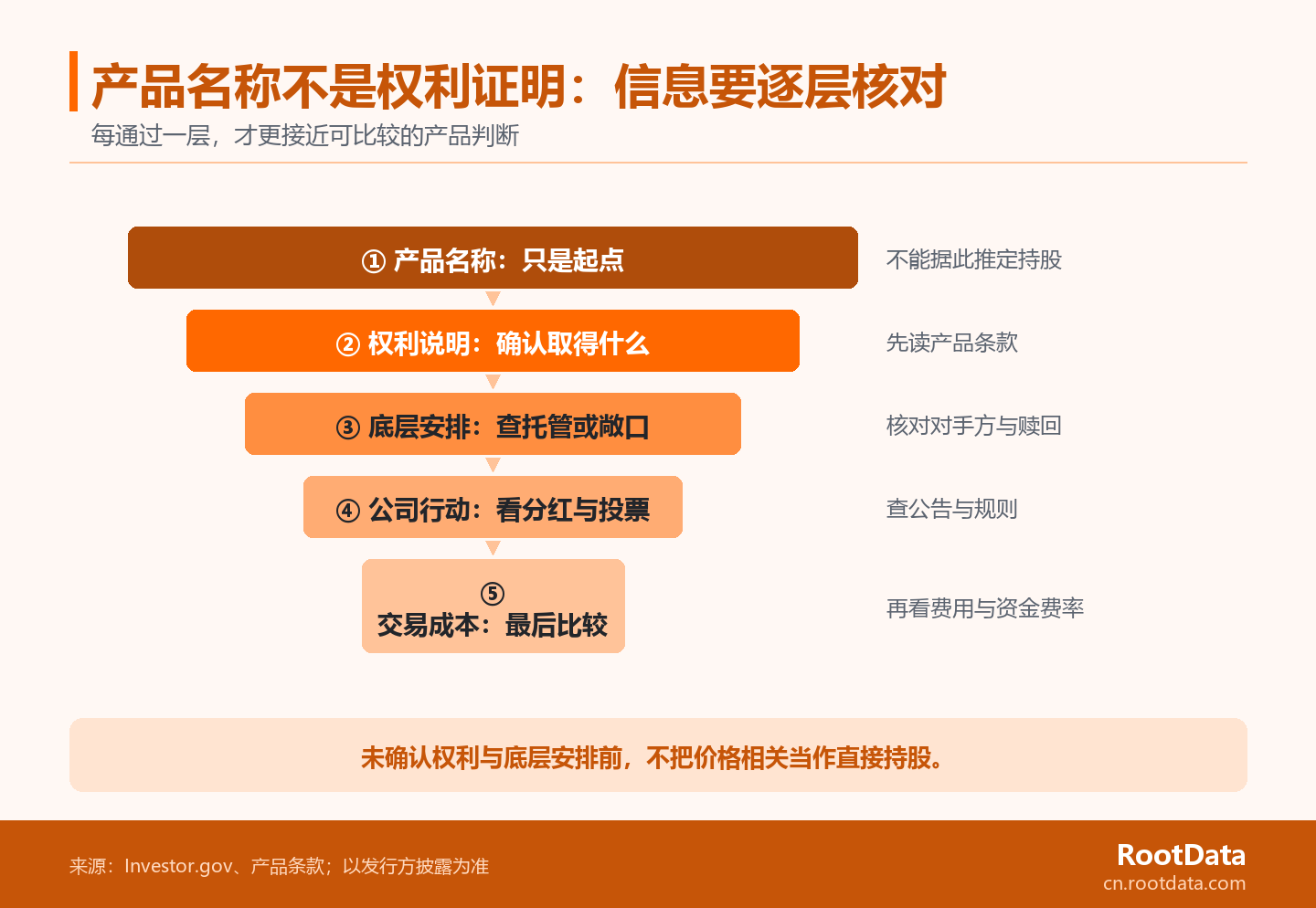
When encountering any stock token product, follow these four steps to check
The checking sequence is the original reading frame of this article and does not constitute trading advice. Its value does not lie in rating products, but in first eliminating the misunderstanding that "similar prices can be regarded as similar assets".
- Ask about rights first.Do the product documents clearly indicate what rights you obtain? Don't just look at the product name, the underlying symbol, or the "Stocks" tab in the interface.
- Let’s ask about the underlying arrangements.Who explains the underlying shares, custody, reserves, counterparties, exchange or redemption conditions? The undisclosed portion should be left as unknown, rather than being made up 1:1 by default.
- Check company actions.How are product rules handled when dividends, voting, stock splits, mergers or suspensions occur? Save announcements and formal terms for future review.
- Finally compare transaction costs.After confirming the product level, fix the target contract, order role and holding period, and compare market fields such as spreads, fees, funding rates and liquidity.
As long as there are no answers in the first two steps of the four steps, the subsequent trading experience should not be regarded as evidence that it is "equal to real stocks"; conversely, only after the rights structure is confirmed can a more targeted comparison of execution costs and market depth be made.
If you are ready to compare the market status of stock-related derivatives, RootData's role is to provide cross-platform field entry at the same point in time; actual product rights and regional access still need to go back to the specific terms for verification.
FAQ
Do tokenized stocks necessarily have 1:1 custody of real stocks?
uncertain. Whether there is real stock custody, who holds the custody, how the custody assets are segregated, whether the holders are redeemable, and what restrictions apply when redeeming, all need to be based on the issuance, custody and redemption documents of the product. Even if there are statements such as "anchor" or "support" on the page, you should continue to check the definition, applicable areas, fees, suspension conditions, and instructions on bankruptcy or liquidation situations; matters that are not explicitly disclosed should remain unknown.
Do tokenized shares automatically come with dividends and voting rights?
Not automatically available. Corporate actions such as dividends, voting, stock splits, allotments, mergers and acquisitions, and stock exchanges depend on product terms, account structure, and issuer announcements. Some products may arrange for financial benefits to be passed through, but this does not automatically equate to full shareholder rights; there may also be time differences, eligibility conditions, fees, record dates or regional restrictions. When making comparisons, list each item separately and do not use "follow the stock price" instead.
Are stock perpetual contracts and tokenized stocks the same thing?
uncertain. Stock perpetual contracts are usually used to provide continuous price exposure to a certain target, and their usage experience is also affected by margins, funding rates, index prices and liquidation rules; tokenized stocks are a broader term and may include different issuance or mapping structures. Both can be related to the same stock price, but rights, settlements and costs should be checked separately, and records of applicable regions and product versions should be kept. They cannot be regarded as the same product because of similar names.