
How to handle dividends and voting rights of tokenized stocks: differences in different product structures
The dividends and voting rights of tokenized stocks will not be automatically attached just because the word "stock" appears in the product name. First, it depends on whether the token represents a direct security, an interest recorded through an intermediary, or an exposure related only to a certain stock price; then, it depends on who is responsible for recording qualifications, transmitting event information and completing delivery. Read rights documents separately from market data to avoid replacing the entire rights chain with one price, one wallet balance, or one asset-backed representation.
Let’s look at the rights delivery chain first: dividends and voting will not happen automatically based on the name of the token.
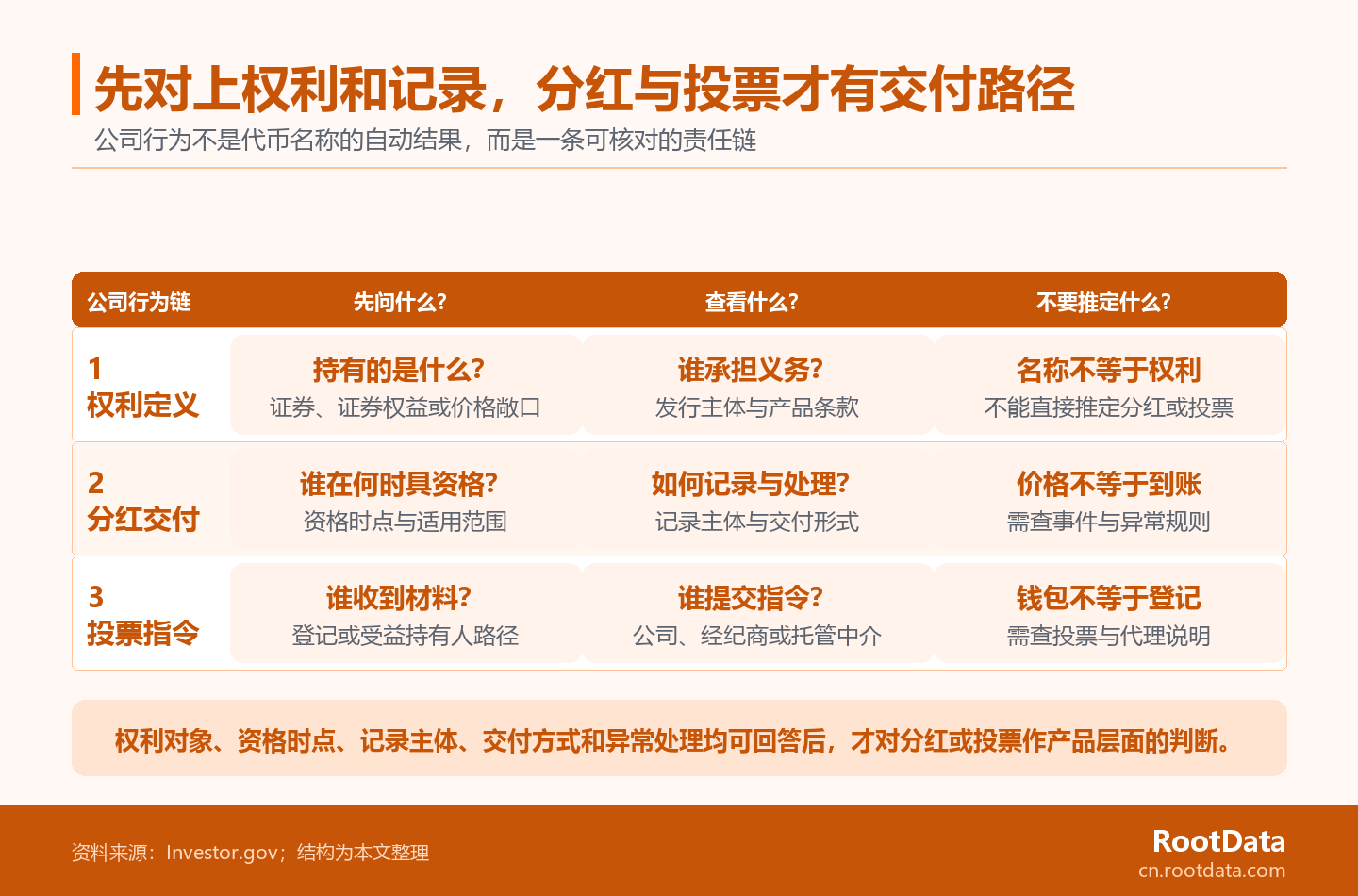
Dividends and voting rights are not automatic additions to tokenized shares: they must be separately accounted for in the product’s rights, registration, event handling and delivery arrangements. The focus here is not to label the product first, but to break down "whether there is a right" into documentary issues that can be verified item by item: what the holder obtains, at what point in time the qualification is obtained, which record is used as the basis, who is responsible for processing and how the results are delivered.
First ask about the rights object, qualification time point, record subject, delivery method and exception handling; when the five questions cannot be answered separately, the conclusion should be left as unknown. This will not judge the quality of the product for readers, but it will allow statements such as "with dividends" or "can vote" to return to clear responsibilities and paths: links that are not clearly written cannot be replaced by price tracking, on-chain transferability or platform pages. This is also a distinction that needs to be made before reading the RootData market fields later.
- Rights object:What kind of securities, rights or contractual arrangements the token holders receive.
- Records and Qualifications:Who is recognized by the system as the holder of receivables or orders that can be issued at what point in time.
- Delivery and Exceptions:How dividends, voting materials, or other events are delivered, and how suspensions, transitions, or exceptions are handled.
First distinguish three types of structures: they determine who bears the rights.
Investor.gov describes tokenized securities as issuer-led, custodial, and synthetic models, with the rights and benefits of different models varying depending on the structure.View Investor.gov’s explanation of tokenized security structures. This is a classification in educational materials for American investors. It is not a judgment on any region or specific product; it reminds us that we must first confirm who bears the rights before discussing dividends or voting before we have a common premise.
Investor.gov explains that the price of a synthetic tokenized security can change with the reference security, but the holder has no rights against the issuer of the reference security.View the model's rights boundaries. Therefore, similarity in price performance, underlying names, or charts does not alone infer that dividends, proxy votes, or other stockholder rights have been conveyed.
Investor.gov explains that holders of common stock are generally entitled to votes and dividends, and preferred stock may have a different combination of rights.View Investor.gov description of stock classes. Even if we return to traditional stocks, rights must be confirmed by share class and document; when it comes to tokenized products, the structure, record chain and processing entity need to be dismantled layer by layer.
Securities interestsIt can be understood as: the equity arrangement related to the underlying securities formed by the holder through intermediary records. It is not the same concept as "directly registered as a shareholder of the issuer". When reading product information, first find the issuer, rights description, holder record and event description, and then compare the name or slogan, the level of information will be clearer.
| structural clues | Issues to be prioritized | Content that cannot be directly inferred |
|---|---|---|
| Issuer-led | How are the rights between issuer and holder defined? | Any specific product necessarily provides full incident handling rights |
| Custody securities interests | Who registers, who handles the event, and who delivers to the holder | Wallet record must be equivalent to issuer registration |
| synthetic price exposure | How to explain price references, contractual obligations and risk assumptions | Price Correlation Equivalent to Shareholder Rights of Reference Security |
Dividends are not a credit action: qualification, recording and delivery are all integral
This article putscorporate actionsIt is understood that when dividends, voting, stock splits and other matters occur in listed companies, holders need to obtain rights or receive instructions in accordance with established rules. It precedes the result of "receipt": the qualification judgment occurs first, then the recording subject and processing responsibility are confirmed, and finally the delivery is in the form of cash, reinvestment, adjustment of the number of tokens, or other disclosed forms.
Dividend distribution is not a payment action, but a corporate behavior delivery chain from rights qualifications, holder records, processing entities to delivery forms. If the product description only says "supports dividends" but does not explain the qualification date, reference record, processor and delivery form, the reader still cannot check how this statement is implemented in a specific incident.
- qualifications:Which holder qualifies and at which record or ex-dividend-related time point.
- Record:Whether eligibility is identified by issuer, custodian, platform account, or other system of record.
- deliver:Who performs it, what is delivered, when it is visible, and how it is notified and handled when it cannot be delivered.
Investor.gov's description of a transfer agent lists the recording of ownership changes, maintenance of issuer-holder records, and distribution of dividends as its functions.Check out Investor.gov’s instructions for transfer agents. This is an educational background to the U.S. securities infrastructure, and it does not mean that any tokenized product necessarily uses the same arrangement; it explains why recording and delivery need to be written out separately.
Voting is not a wallet operation: first confirm who is recorded as the holder who can issue instructions
registered holderIt is a person or institution that is directly registered with the issuer or its record system and can receive relevant materials according to the record;beneficial holderA person who holds a financial interest through a broker, bank, custodian or other intermediary and may submit voting instructions through the intermediary. The difference between the two is not high or low, but different recording and execution paths.
Investor.gov explains that registered holders may receive proxy materials and vote directly, and beneficial holders will generally be required to submit voting instructions to a broker, bank or custodian.View the voting paths of registered holders and beneficial holders. This US company voting context provides a clear check sequence: first find the subject who receives the materials, then find the subject who submitted the instructions, and finally see if the product clearly states these two steps and the scope of application.
The wallet address only describes the record location on the chain and cannot independently prove that it is a voting holder record recognized by the product. Even if the tokens are stored in a personal wallet, you still need to go back to the product documentation to confirm the whitelist, snapshots, how to receive voting materials, command channels and final submitters; when these links are not explained, the answer to "whether you can vote directly" should remain unknown.
Check corporate conduct terms with five questions instead of guessing the answers
Only when the product documents can answer the rights objects, qualification time points, record subjects, delivery methods and exception handling, can the conclusion of dividends or voting have a verifiable basis. The following table is suitable for use when reading release notes, terms of service, corporate conduct policies, or FAQs; its purpose is to expose missing items, not to fill in undisclosed information to provide a yes or no answer.
| five questions | What to look for in the file | The state that should be retained when missing |
|---|---|---|
| What is the object of rights? | Definition of direct security, security interest or price exposure | Shareholder rights cannot be inferred from names |
| What is the eligibility point? | Record date, snapshot, applicable conditions or announcement mechanism | Unable to confirm eligibility for an event |
| Which record is accurate? | Priority of issuer, custodian, platform or on-chain records | Wallet balance cannot be used as the only basis |
| How to deliver or give orders? | Payment, Notification, Proxy Materials and Voting Channels | It cannot be presumed that the deposit or direct investment method is |
| How to handle exceptions? | Suspension, Territory Restrictions, Transitions, Disputes and Contact Paths | Cannot make up exceptions on your own |
After the rights boundary is confirmed, compare where and how the product is traded.
RootData's description of equity derivatives lists contracts, open interest, 24-hour volume, weighted liquidity, spreads, funding rates, Maker/Taker fees, and margin assets as readable fields.View field descriptions of RootData. These fields are suitable for comparing trading conditions between candidates whose structure, corporate conduct and eligibility for use have been confirmed and are not responsible for certifying dividend, voting or issuance arrangements for any product. After confirming these boundaries, you canView RootData Equity Derivatives Trading Platform Ranking, compare the trading conditions that have entered the candidate range at the same entry.
RootData exposes methods for structuring, collating, and maintaining data in data standards.View RootData data standards. When readers have fixed the comparison object and time point, they can read activity, liquidity, spreads and fees in the same caliber; this is a layer of market information and does not replace rights documents.
Market data is suitable for comparing trading conditions and is not a substitute for dividends, voting or corporate action documents. When comparing candidates who have passed the rights check into the same portal, neither the ranking nor the individual indicators should be interpreted as an endorsement of the company's behavioral arrangements.
FAQ
The following FAQs only clarify the boundaries of the company's behavioral documents and do not replace specific product terms or professional advice.
Will dividends from tokenized stocks always be received in cash?
Not necessarily; product terms should clarify how dividends are handled, who delivers under what qualifications and time conditions, and in what form it is reflected. Cash, reinvestment, volume adjustments or other arrangements answer delivery questions at different levels and cannot be inferred from a promotional word or a historical event to a long-term fixed rule.
Without voting rights, does that mean tokenized shares have no value?
It cannot be judged this way; it describes only part of the rights package, and readers still need to confirm what economic rights, restrictions and risk-bearing methods the product provides. The verification framework of the article does not make binary conclusions about value, but only requires that economic exposure, voting qualifications and corporate action delivery be read separately; if a certain right is not disclosed, it should be truthfully recorded as unconfirmed, rather than replacing it with another dimension.
Can I directly participate in voting if I keep the tokens in my personal wallet?
Not necessarily; whether the wallet holding record is equivalent to the product-approved holder record depends on the registration and voting instructions of the issuer or intermediary. You should continue to confirm the snapshot time point, the method of receiving materials, the instruction channel and the final submitter, rather than directly equating the self-hosted location with voting qualifications; if the product document states the geographical or identity conditions, they should also be checked together.
Seeing the 1:1 support, can you judge dividends and voting rights?
No; asset support, economic rights, voting qualifications and corporate action delivery are separate issues and must be checked against product documents and records arrangements respectively. Asset-level descriptions can be important information, but they cannot replace rights definitions, event qualifications, and exception handling provisions; after confirming support arrangements, you still need to continue to check who assumes the relevant rights and through what records they are delivered.