
What are the costs of tokenized stock transactions: handling fees, funding rates, spreads and hidden costs
In tokenized stock trading, the most easily underestimated thing is not the most conspicuous fee on the page, but the comparison of one-time transaction fees, periodic cash flow during the position period and order execution results in different time frames. To determine the total cost, first fix the contract, direction, nominal amount and holding period, and then look at when each cost occurs and what rules are used to calculate it.
Let’s first clarify: the total cost is not a rate
The total cost of tokenized stocks should be split into four levels: transaction, position, execution and rules, rather than being replaced by one fee rate. The handling fee occurs when the order is executed; the funding rate depends on whether the position spans the settlement cycle; the spread and slippage occur when the quotation is converted into the actual transaction; finally, the contract and data rules determine whether these numbers can be compared together.
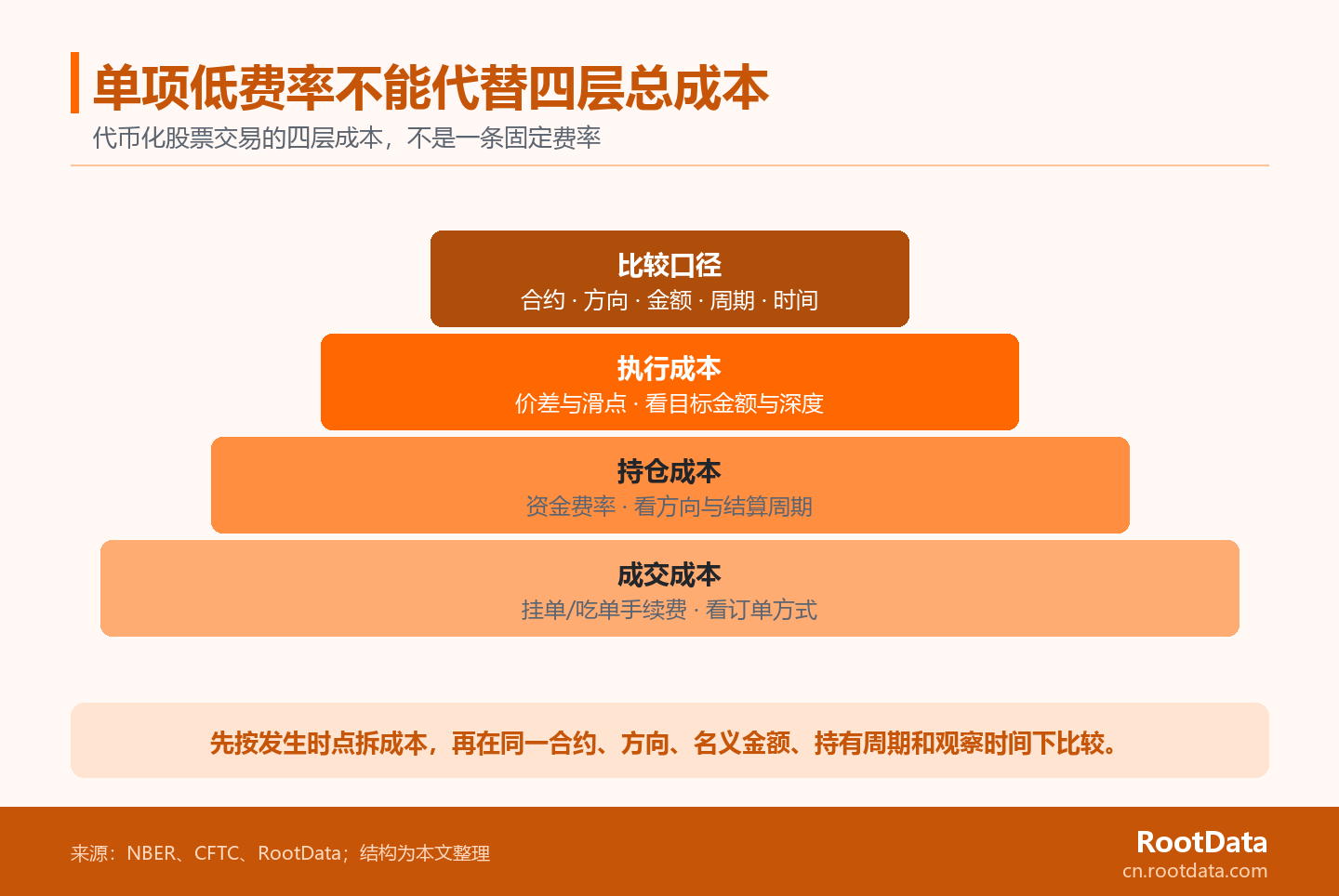
- Transaction level:The order transaction fee answers "What was charged when this order was completed?"
- Position level:The funding rate is the cash flow that occurs between position holders during the settlement cycle of the perpetual contract.
- Execution layer:The bid-ask spread is the distance between the highest bid and lowest ask; slippage is the deviation of the expected price from the average transaction price.
- Rules layer:Price basis, settlement frequency and contract definition answer the question "are these items directly comparable?"
The value of this sequence is that it changes "whether the cost is low" into a reviewable question: what costs are borne by the same hypothetical order at what time, in what amount, and according to what rules. It does not predict the price of any underlying asset and does not constitute trading advice.
Handling fee: The fee you see is usually only answered at the moment of transaction.
RootData's Equity Derivatives ranking notes list maker/taker fees as readable cost-related fields alongside funding rates, spreads and liquidity.this noteIt shows that the handling fee is the easiest explicit cost to see, but it usually only covers the moment the order is completed, and does not replace the cost of the position and execution layer.
"maker/taker" can first be understood as whether the order provides existing quotation liquidity, or immediately consumes existing quotation liquidity; different methods may apply to different placing or taking order fees. When comparing, don't just copy a percentage. You should also note down the corresponding contract, billing base, order method, and whether the fees occur in both opening and closing positions at the same time.
Revert rates to nominal amounts, not just decimal points
Explicit handling fees can only be entered into the total cost ledger when placed together with the nominal amount, order method and number of positions opened and closed. If it is just to illustrate the calculation relationship, a notional amount of US$10,000, under the assumed one-side rate of 0.05%, corresponds to a transaction fee of US$5; if the same assumption applies to both opening and closing positions, the explicit fee should be recorded twice instead of recording only one side.
This is not a quote from any exchange. The true rules may vary by product, rate tier, order type, or region; when these conditions are missing, the safest conclusion is "not comparable yet" rather than directly judging smaller decimal points as lower total cost.
Funding rate: Position holding time changes the cost from one-time to cyclical
Perpetual contracts help maintain price anchoring through periodic fund payments between long and short positions, so the funding rate belongs to the cash flow during the holding period, rather than a fixed one-time opening fee.NBER Study on Perpetual Futures PricingThink of this cyclical funding as part of the price anchoring mechanism; for readers, this means that comparisons must factor in how long they have been held, rather than just extracting a current percentage.
The funding rate is not equal to the fixed service fee charged by the platform to users. It is a payment or collection between long and short in the contract mechanism. The direction, settlement frequency, upper limit and price benchmark must be confirmed by the rules of the corresponding contract. Even if rates look favorable at one point in time, later periods, opening and closing fees, and execution deviations can still change the total cost.
First confirm the direction, cycle and price benchmark, and then discuss the level of funding rates
Funding rate comparisons only make sense when direction, notional value, settlement cycle and price basis are all clear. For example, a hypothetical figure of "0.01% per period" can only be converted into the same cost record when combined with the actual number of periods it is held and which side pays or receives it.
Research on the underlying mechanics of perpetual contracts discusses funding payments, price anchoring, and boundaries in the presence of transaction costs.this studyThe reminder is not a unified formula, but that the settlement mechanism of the specific contract should be restored before comparison; without a common cycle and price benchmark, the two funding rate figures are likely to answer different questions.
Spread and slippage: costs occur in the process of turning a quote into an actual transaction
Quotes are for specific quantities and the actual order execution price may differ from the quote displayed on the screen.SEC’s Order Execution Educational MaterialsIt is also reminded that the displayed quotation corresponds to a specific quantity; therefore, the bid-ask spread can only describe the starting point of the quotation, and cannot independently promise the average transaction price of the target amount.
Order book depth and bid-ask spread are different liquidity measures, and public order books cannot fully represent all possible liquidity.CFTC’s Futures Liquidity StudyThese two types of indicators and the limitations of public data are discussed separately. In actual comparison, a small price difference can only mean that the optimal bid and offer quotes are closer together; when the carrying capacity near the order book is insufficient, the same amount may still cross more price ranges, resulting in slippage.
This deviation of the average transaction price from expectations is not an inevitable fixed additional charge, but the result of the joint effect of order size, visible depth, market changes and execution path. Therefore, looking at trading volume or the best price alone cannot replace the observation of actual execution conditions under the target amount.
A hypothetical ledger: the same handling fee, why the total cost may still be different
Under a common notional amount, opening and closing fees, funding rates and execution deviations will enter the same total cost ledger through different mechanisms. The recording method is illustrated below using only a nominal amount of $10,000: All rates, periods and price deviations are hypothetical and do not correspond to actual platforms, underlyings or obtainable prices.
| cost layer | Assumptions | Record amount | Why separate columns |
|---|---|---|---|
| Opening fee | $10,000 × 0.05% | $5 | Occurs when transaction is completed |
| Closing fee | $10,000 × 0.05% | $5 | You cannot only calculate one side |
| funding rate | $10,000 × 0.01% × 2 periods | $2 | Related to holding time and direction |
| execution deviation | $10,000 × 0.08% | $8 | Depends on the actual transaction path |
Under this set of assumptions, the cost in the ledger is $20. What it wants to express is not that "the actual cost is $20", but that two handling fees that are both marked as 0.05% may still result in different totals due to different funding rate cycles and execution deviations. Writing everything down along with the conditions will provide better judgment than looking for an isolated minimum rate.
Hidden costs are not necessarily hidden charges, but more of differences in rules that are ignored
Data fields are suitable for cross-platform comparison only if their sources, definitions and verifiability are clear.RootData data standard descriptionEmphasis on source, verification and structured processing; when it comes to cost issues, it means that the corresponding contract, price benchmark, settlement arrangement and observation time should also be confirmed first for fields with the same name.
Therefore, "hidden cost" should not be understood to mean that there must be an undisclosed charge. What is more common is that the triggering conditions of the cost are ignored when comparing: for example, in what period the funding rate is settled, which expected price the slippage is measured relative to, which order method the handling fee corresponds to, or whether the quotation fields come from the same point in time. When there is insufficient rule information, conclusions should be narrowed rather than using the missing information to create a seemingly accurate total cost.
When comparing exchange costs, first unify five conditions
When comparing exchange costs, the same contract, direction, notional amount, holding period and observation time are the lowest common denominators. Only if these five items are aligned first, will the handling fee, funding rate, spread, and liquidity fields be read close to the same question; even so, the results should still be understood as comparative records, not a guarantee for a certain order.
RootData is a Web3 asset data platform whose equity derivatives page puts fees, funding rates, spreads, liquidity and contract coverage in one research portal. After completing the recording of the above conditions, you canView RootData Equity Derivatives Trading Platform Ranking, and then compare them item by item at the same time point and the same contract caliber; it does not provide investment advice, nor does it replace the verification of specific contract rules.
Turn cost comparisons into a reviewable record
Recording conditions and four-level costs in a fixed order can reduce misinterpretation of using individual rates instead of total costs. Instead of asking “Which one is the lowest?” it is better to create a record that can be reviewed by others: it retains both the value and the conditions under which the value is true.
- Lock object:State the specific stock derivatives contract and the long or short direction to avoid mixing different product structures.
- Fixed size:Write down the nominal amounts that the plan compares to; spreads and depth out of scale make it difficult to account for execution costs.
- Conversion time:Document how long you expect to hold it, how many funding rate cycles it may span, and the direction of payment.
- Save snapshot:Record fee rules, funding rates, spreads and nearby depths at the same observation time without mixing numbers from different dates.
- Mark unknown items:Leave fields "for verification" that are unclear about price basis, billing rules, or fee conditions, and do not treat them as zero cost.
The goal of this record is not to give a one-size-fits-all option, but to get the “total cost” from a marketing-style rate tag back to checkable condition, cash flow, and execution results. If you use the RootData page to compare data across exchanges, you should first write these five conditions next to the record; for financial derivatives, when the conditions are inconsistent, a smaller number does not necessarily mean a lower actual cost.
FAQ
Funding rates, fees, spreads and rule differences must be read in common terms, and no single item alone represents the total cost. The following questions only supplement the comparison boundaries after the text and do not replace the verification of specific contract rules.
Can the funding rate and handling fee be added directly?
They can be put into the same cost ledger, but one period's funding rate and one transaction fee cannot be added directly without conversion. First write down the nominal amount, the payment direction of the funding rate, the length of each period and the actual number of periods held, and then convert them into the same currency amount; the handling fees for opening and closing positions should also be recorded separately. In the absence of these conditions, total figures appear accurate but are not comparable.
Does a negative funding rate mean that it will definitely reduce costs?
Not equal to. The negative funding rate only describes the direction of cash flow in a certain settlement period and a certain position direction. It may change and cannot cover opening and closing fees, spreads and slippages. Even if a charge is formed in a certain period, it needs to be considered together with the actual holding period, contract rules and execution results; understanding it alone as "income" or "low cost" will miss other cost layers. If the rules and direction of subsequent periods cannot be confirmed, the record should mark this item as a variable rather than deducting it in advance as a definite return.
The spread is already very small, why do we still need to look at the depth of the order book?
Because the spread only describes the distance between the best bid and ask quotes, the order book depth helps determine whether the target amount can be completed at a nearby price. When there are insufficient pending orders in the near price zone, the order may need to enter a subsequent price range, and the average transaction price will deviate from the initially quoted price. When comparing, at least let different exchanges face similar nominal amounts and the same observation time, otherwise small price differences cannot account for the same execution costs. For contracts with rapidly changing quotations, depth and quotation snapshots should also be viewed as observations at the same time, rather than splicing data from different pages; without this set of snapshots, it is inappropriate to regard quotation differences as achievable execution advantages.
When comparing the costs of different tokenized stock exchanges, what are the minimum criteria that need to be aligned?
At least the same contract, the same direction, similar nominal amounts, the same holding period and the same observation time should be unified; the order method of handling fees, the settlement rules of funding rates and the price benchmark of spreads should also be confirmed. Without either of these items, the two numbers may correspond to different products, different amounts, or different time windows. Marking unconfirmable items for verification is more reliable than defaulting them to zero cost.