
How to Choose a Tokenized Stock Trading Platform: Data Metrics and Usage Conditions Evaluation Framework
When choosing a tokenized stock trading platform, don’t rush to compare who has higher trading volume, lower fees, or who ranks at the top of the list. A more reliable sequence is: first confirm whether the product structure and usage conditions are suitable for entry into the candidate, and then read market data at the same time, the same contract and similar order size. This way, rankings and data are comparison tools, not answers that make decisions for you.
Screen the usage conditions first, then compare the data: the selection order determines whether the data is meaningful
When choosing a tokenized stock trading platform, you should first screen the products and usage conditions, and then compare the data among the available candidates. Looking at products first is to avoid mixing different rights or contract mechanisms; looking at conditions of use first is to avoid including paths that are currently unavailable in performance comparisons; only after these two levels are clear can trading volume, order book depth, bid-ask spreads and fees have a common comparison object.
- The first level is qualifications:What the product is, who it is for, how it is held or settled, whether it requires a specific account, wallet or margin path.
- The second level is execution:Among candidates who have passed the qualification filter, look at the Volume, Open Interest, Depth, Spread, and Cost fields for the same contract.
- And finally the sorting:Ranking can help locate data worth continuing to look at, but it does not prove that a certain platform is more appropriate for all readers.
First make sure what you are comparing: tokenized spot and stock perpetual are not the same thing
IOSCO discusses relevant considerations such as market integrity and investor protection in its 2025 Tokenization of Financial Assets report.Open IOSCO report. Tokenized shares are a broad term: it can refer to products in digital form that relate to stocks or stock-related economic exposures, but the exact rights depend on the product documentation and structure. Stock perpetual contracts are contracts with no fixed expiry date and are based on stock-related prices as a reference. It is not the same path as directly holding some kind of tokenized spot; for readers, this means that the product layer needs to be checked separately and cannot be judged based on the name alone.
Therefore, first group candidate exchanges or platforms by product: tokenized spot and stock perpetuals are placed in different groups, and then compare their respective liquidity and costs. If the products themselves are different, juxtaposing the asset arrangement of a spot token and the positioning mechanism of a perpetual contract as "who is better" usually does not lead to meaningful conclusions.
The product name is not a list of rights. Please look for the settlement and rights documents first.
The words “tokenized shares” are not a substitute for document verification of equity, settlement, custody or redemption arrangements. First confirm whether you are reading spot tokens, derivatives contracts, or other stock-related products; then check how its public terms describe price references, asset arrangements, rights or restrictions during the position period, settlement methods, and handling of abnormal situations. In the absence of this information, there should be no assumption that it provides any of ownership, dividends, voting or redemption.
The conditions for use must be passed first: region, account, custody and mortgage path
Region, account, custody or wallet, margin and settlement path should be checked before market data. This is not to judge regional qualifications for any platform, but to remind readers: the same product page may correspond to different actual paths due to account type, identity verification, available settlement assets, wallet operations or contract margin requirements. If any of the conditions are not met, no matter how beautiful the subsequent trading volume or price difference is, it should not be regarded as its own available conditions.
This layer can be written as a minimum record of one line:Disclosed product name | Applicable region tips | Account or identity requirements | Escrow/wallet methods | Settlement or margin assets | Exit steps. If any of these six items cannot be confirmed, mark it as "to be verified" first. Do not use rankings to fill in missing information. The purpose here is not to complicate the rules, but to prevent readers from misinterpreting "the data can be seen" as "can now use it under the same conditions."
Read the data after passing the threshold: Each indicator answers a different question
After passing the first two levels of screening, the data enters the protagonist position. RootData's description of equity derivatives lists contracts, open interest (OI), 24-hour volume, ±2% weighted liquidity, spreads, funding rates, Maker/Taker fees, and margin assets as readable fields.View RootData description. They are not different ways of writing the same indicator: trading volume reflects more trading activity over a period of time, OI reflects the size of open positions, and depth and spread are closer to the quotation and carrying capacity at a certain moment.
When reading these fields, the most common misreading is to only look at a number. Order book depth is the number of visible buys and sells waiting to be executed at different price ranges. It helps determine how many price ranges an order of a certain size may cross; the bid-ask spread is the distance between the highest bid price and the lowest sell price at that time. Investor.gov reminds that quotes are only for specific quantities and prices may have changed before the order reaches the market.View Investor.gov instructions.CFTC Study of Futures Market LiquidityTransaction costs, market depth and price impact are also considered as complementary dimensions. In other words, high trading volume or small optimal spread cannot individually promise that a certain amount can be traded under the same conditions.
| Field | What does it mainly answer | Can't prove anything alone |
|---|---|---|
| 24 hour trading volume | Trading activity within a specified window | The target amount will definitely be successfully traded at this moment |
| Open interest (OI) | Open interest size clues | The offer must be tighter or it must be easier to exit |
| Order book depth | Visible buying and selling clues within the price band | All orders can be completed with the best quotation |
| bid-ask spread | The distance between the best bilateral quotes at that time | Average deal deviation for larger orders |
| Maker/Taker and funding rates | Fee conditions for transaction and position holding stages | Complete operating costs or product suitability |
Only data at the same time, same contract, and same scale can be compared horizontally.
When comparing data, fix at least four conditions:The same contract object, the same observation time, similar order size, and the same field definition. RootData exposes methods for structuring, collating, and maintaining data in its data standards.View data standards. This also reminds the reader to check the caliber before juxtaposing numbers. For example, the bid-ask spread only describes the difference between the buying price and the selling price, and does not automatically include the impact of subsequent price levels. A snapshot is good for looking at relative positions at that time, but it cannot be written as a real-time commitment that still holds later.
Don’t just look at the rate sheet: Execution, network and exit paths also change costs
Cost verification is divided into at least three categories: Maker/Taker fees at the time of closing, funding rates that may occur during the holding period, and network or transfer costs in the operation path. Taking the Ethereum path as an example, the Ethereum developer documentation explains gas as a measure of the computational effort required to perform an operation.View gas description. Therefore network fees should not be confused with transaction fees displayed on the platform. Different networks, wallets, cross-chain steps and product rules will change this part of the information, and the public description of the actual path should prevail.
Exit and operation paths should also be recorded along with liquidity and fees. Readers can ask four specific questions: Is the exit accomplished through the order book, a redemption arrangement, or some other step? What asset or wallet operations are required? What fees will appear during operation? What do the public rules say when an order or on-chain operation does not complete as expected? These questions are not meant to predict risk, but to avoid finding yourself comparing just a set of market fields on a page when you need to use or exit.
A six-item evaluation card: separate "can it be used" from "is it good or not?"
The six-item evaluation card can record products, conditions, contracts, data, costs and operation paths in a fixed order. It is not a scoring model, nor does it produce a "best exchange" conclusion; it only requires each candidate to answer the same questions, so that subsequent data comparisons can be predicated.
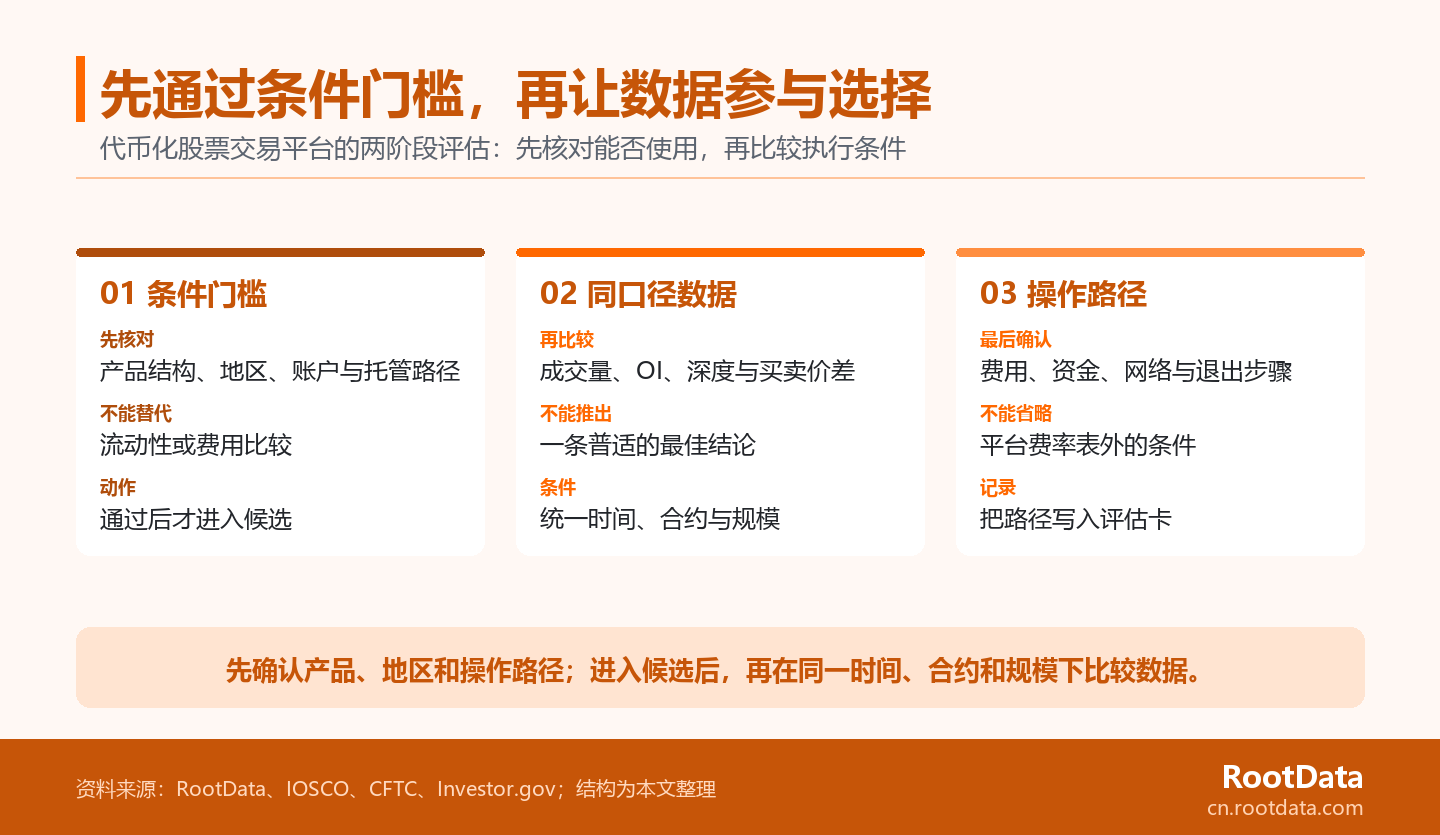
- product:Spot tokens, equity perpetuals or other equity-related products?
- Conditions of use:What region, account, identity, custody or wallet conditions are exposed?
- contract:Which underlying, which settlement and which margin path are being compared?
- data:Are the observation times for volume, OI, depth and spread consistent?
- cost:Under what conditions do Maker/Taker, funding rates and network fees occur?
- Operation path:What steps are required to enter, hold and exit, and are the public rules clear?
Hypothesis Assessment Card: Why two paths cannot be directly compared
In a hypothetical scenario, two paths with different products and usage conditions cannot be immediately compared side by side. The following is a hypothetical scenario that does not correspond to real platforms, users or orders: the reader finds two stock-related paths, A is tokenized spot and B is stock perpetual. Even if the transaction volume or fee fields are displayed on both pages, A and B should be divided into different product groups first, and then the region and account conditions, custody or wallet path, contract object and settlement instructions should be completed respectively; only the remaining candidates can be written to the same six cards before entering the data comparison at the same time point.
The value of this sequence is not to prolong the selection process, but to expose the incomparable parts in advance: A's focus may be product documents and holding arrangements, B's focus may be contracts, margins, and funding rates. Sorting them directly by a single ranking would skip the most important premise.
This example only contains 2 candidate paths and 6 check items. The actual order amount is not set, and the transaction price, fees or profits are not calculated.
They are still in the preliminary screening stage: product pages, public qualification prompts and data snapshots still need to be checked one by one, and individual fields seen on the page cannot be regarded as executable conditions.
The first observation is that the operation path of A still needs to check the wallet and settlement steps; this means that the product conditions are not complete yet.
The second observation is that B's region or account conditions have not yet been confirmed; this means that again one cannot go into the final comparison based on market data alone.
The two observations jointly illustrate that the product and usage conditions must be written into the evaluation card first to eliminate unsuitable paths; only the remaining candidates can be compared with data at the same time, the same contract and the same scale.
After the products, conditions and data caliber are complete, use the same contract, the same time and similar scale to observe the data. Doing so will not eliminate product differentiation, but it will make why a particular candidate was retained or excluded demonstrable and reviewable.
The next step is to record the product type, public qualifications, contract objects, snapshot time, depth and spread, fees and operation steps for each candidate path, and then decide whether to remain in the candidate group.
Only after the product, usage conditions and data caliber can be written into the same card can you start to view multiple market fields horizontally; this is the verification threshold in this example.
This is a hypothetical example that only covers the initial screening of 2 products and operation paths and does not represent the coverage, qualification status, or trading results of any real platform.
Complete second-stage comparison using common data entry
After completing the qualification layer and the six-item evaluation card, it is appropriate to open the unified data entrance to continue comparison. RootData is a Web3 asset data platform, and its stock derivatives page allows you to view contract, liquidity, spread, fee and other fields on the same page. Taking the snapshot at 17:30 on July 23, 2026 as an example, the page covers 29 platforms. Snapshots are used to compare relative data at the same point in time and do not replace readers' review of products, regions and operating conditions at that time.View RootData Equity Derivatives Trading Platform Ranking
FAQ
The following questions only supplement the boundaries of rankings, products, snapshots, and on-chain paths; the complete selection sequence should still return to the previous two-stage framework and six-item evaluation card.
Are top-ranked exchanges necessarily more suitable?
uncertain. Ranking can help you narrow the scope of your research within the time, coverage, and field caliber displayed on the page, but it cannot replace the verification of product structure, regional qualifications, account conditions, and order size. A more practical usage is to first exclude paths that do not meet the usage conditions, and then check whether the volume, depth, spread and fee of the remaining candidates are under the same comparison conditions. In this way, rankings provide data clues rather than selection conclusions that are valid for all readers.
Should spot tokenization and equity perpetuals be compared together?
They should not be compared directly together. Spot tokens, equity perpetuals and other equity-related products may have different rights descriptions, settlement methods, position mechanisms and fee conditions. You can put them in the same research list, but they should be grouped by product first, and then fill in the product documentation, usage conditions and cost path separately. Certain market fields are suitable for side-by-side reading only when the contract object, observation time and comparison purpose are clear; different product categories are themselves important comparison results.
What should you look at when data screenshots and real-time trading conditions are inconsistent?
First look at the update time, contract objects and field definitions in the screenshot, and then check the order book, fee rules, product tips and conditions of use you currently see. Historical snapshots can illustrate the relative position of data at that time, but do not guarantee that the same quotation, depth or qualification status will remain in the future. If the page does not display enough time and contract information, the safest approach is to mark the field as not directly comparable, rather than using numbers from other time points to spell out conclusions.
What additional costs need to be confirmed for the on-chain transaction path?
In addition to transaction or liquidity fees, you should also confirm network fees, wallet and asset cross-chain steps, quote validity times, and fee rules if a transaction does not complete as expected. These items may not necessarily appear on the same rate sheet, and the mechanisms vary between networks and products. Recording them separately from Maker/Taker fees, funding rates and exit steps can avoid misinterpreting "low platform fees" as "low cost of the entire operation path".