
How to view tokenized stock custody and reserves: supporting documents, audits and redemption mechanisms
Neither “1:1 support,” “proof of corresponding assets,” or “audited” on the Tokenized Stocks page are conclusions that can be read independently. What really determines the meaning of these materials is what rights the token corresponds to, how the relevant assets are isolated, which time point the certification covers, and whether qualified holders can enter the redemption mechanism along a clear path. Dismantle these questions in order so that one eye-catching label will not replace the entire chain of evidence.
Let’s start with the conclusion: Reserves are not an independent safety conclusion.
Reserve is not a stand-alone security conclusion: it needs to be read in conjunction with product entitlements, asset segregation, evidence dates, audit subjects and redemption eligibility. The reason is not that the public materials have no value, but that each material only answers part of the questions: a balance certificate cannot state the rights of the holder, product terms cannot replace the asset verification on the day, and the secondary trading portal cannot automatically prove redemption qualifications. This also defines the role of RootData market data: it is suitable for helping readers compare trading conditions after the aforementioned questions have been answered.
When actually checking, first record the public information according to six items: rights, issuer, custody, isolation, scope of certification and audit, and redemption path. Each item should leave the name of the document, version or publication date and unanswered questions; missing information is left as unknown rather than filled in with a description from another document.
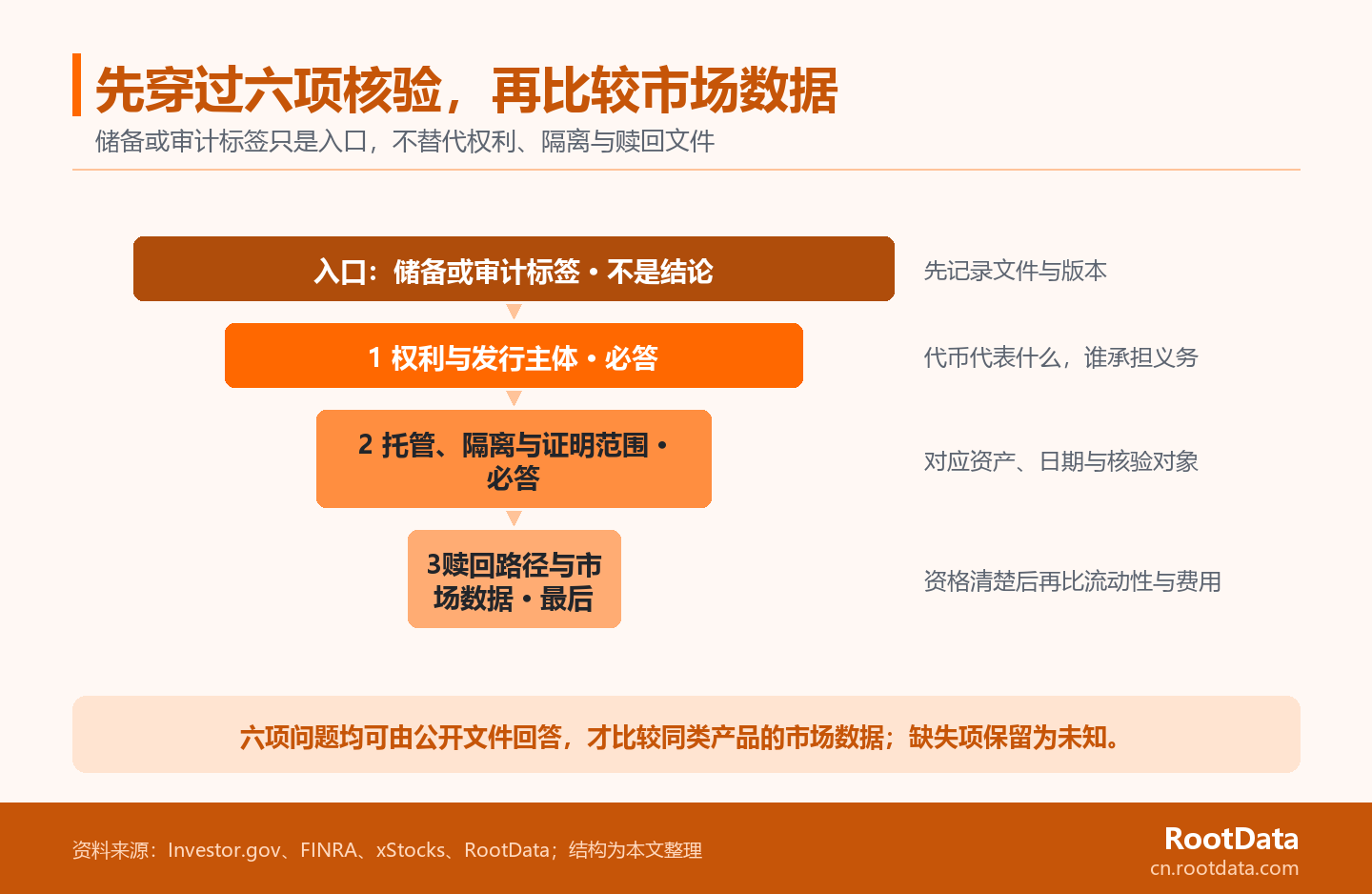
- Confirm your rights first:We must first know what the holder obtains before we can talk about how to understand the corresponding assets.
- Confirm the file object again:Escrow, public verification portal and auditing can refer to each other but are not substitutes for each other.
- Finally compare market conditions:Only after products and usage qualifications are selected, liquidity, spreads and fees will have a common comparison premise.
First ask the holder what he owns: the structure determines what the reserve should correspond to
Investor.gov classifies tokenized securities into different structures such as issuer-led, custodial, and synthetic. Under different structures, the rights and benefits obtained by holders may be different.Check out Investor.gov’s description of the structure. This is a classification in an educational material for American investors. It is not a judgment on any product or region, but it is enough to illustrate that the content of rights cannot be inferred based only on the name "stock token".
In its Capital Treatment FAQ, the Federal Reserve defines “eligible tokenized securities” as tokenized securities that have the same legal rights under applicable law as their non-tokenized forms.View the scope of the Federal Reserve FAQ. The document discusses US bank capital rules and cannot be extended to general product conclusions; the key point it reminds is that whether the rights are the same must go back to the applicable law and product documents, rather than being determined by the on-chain form itself.
What this article saysTokenized security structures, is the arrangement between tokens, underlying securities and holder rights: it may be issued directly by the issuer, it may form equity through an intermediary, or it may only provide price exposure. Different structures require different objects for reserves. When reading, first find the issuing entity, legal classification, rights description and exception handling clauses, and then look at the asset support description. It will be more secure.
Before comparing reserves, confirm whether the token represents a direct security, an interest held through an intermediary, or simply an exposure tied to the stock price. This question will not judge the quality of the product for readers, but it can avoid directly converting "having corresponding assets" into "having the same shareholder rights", and it can also make the subsequent custody and redemption documents clear to read.
What do the four types of documents answer? Don’t let “audits” replace product terms
The product terms, escrow instructions, reserve verifiable portals, and audit reports answer different questions, and no one should automatically replace the rest. When putting them into the same record sheet, the focus is not on the number of documents, but on whether the object, issuer, coverage and date of each document are clearly written.
| Material type | Priority issues to check | A conclusion that cannot be drawn alone |
|---|---|---|
| Product Terms and Legal Notes | Who is the issuing entity; what does the token represent? What rights and restrictions do holders have? | It cannot be independently proven that there are still sufficient corresponding assets on a certain day |
| Hosting and Isolation Instructions | Who keeps the assets; whether they are separated by product; how to deal with exceptions when they occur | It cannot be separately stated whether the holder is eligible for redemption. |
| Reserve Certificate Entry | Verification objects, methods, time points and whether they can be reviewed | Not a substitute for legal rights or full audit coverage |
| Audit or review report | Audit objects, test scope, reporting dates and limitations | Not automatically covering all assets, processes and rights issues |
When you see "Audited", first confirm whether the audit is smart contracts, asset balances, financial statements or a certain control process, as well as the date and range covered by the report. If a report only addresses code security or balances at a point in time, it should not be extended to an overall judgment on the issuance structure, custody segregation, or redeemability.
same,Reserve certificateIt can be understood as a public evidence entrance that allows external readers to check the corresponding asset or token supply information at a certain point in time. The most useful thing about it is that it allows readers to continue to ask "what was checked, when was checked, and how was checked?"; treating it as the end of all questions will obscure the parts that still need to be confirmed.
When looking at escrow vs. reserves, at least check isolation, verifiability, and timing
Here'sIsolated hosting, refers to the way in which the assets corresponding to a certain product are kept separately from other assets according to accounts or legal arrangements. When reading the relevant instructions, you should also record what the corresponding asset is, who the custodian is, where the isolation arrangement is written, whether the certificate is accessible, and the corresponding time point of the page or report; when one of these is missing, do not rush to fill in the conclusion for it.
The custody description should at least clearly state the corresponding assets, custodians and isolation arrangements; if one of them is missing, you should not make up the conclusion on your own. For readers, the most useful way to record is not to just take off the "regulated" or "isolated" label, but to indicate item by item: who keeps the assets, what accounts or legal arrangements they are separated into, and whether the relevant instructions still correspond to the current product version.
FINRA's Customer Asset Protection Materials list special reserve accounts and the location of custody or control of customer securities as regulatory matters for U.S. broker-dealers.View FINRA’s Customer Asset Protection Instructions. This U.S. broker-dealer context reminds us that "reserves", "custody" and "control" are inherently different objects; it is not a universal standard that can be directly applied to any region or any product.
The reserve page should continue to check the certification objects, methods and time points; "verifiable" does not automatically answer rights or redemption questions. When faced with similar entrances, the next step should be to look at the verification methods, update times and applicable products displayed on the page, rather than equating a certification label with all structural questions having been answered.
The redemption mechanism determines how “supportable” translates into actual paths
Primary issuance and redemptionIt refers to the channel through which qualified participants directly create or withdraw tokens from circulation with the issuer, rather than general secondary transactions. When checking this path, region and identity restrictions, account or wallet conditions, minimum size, processing windows, settlement methods, and unusual arrangements can all change what "theoretically supported" means in practice.
Access to first-level redemption depends on the issuer’s disclosed qualifications, account or wallet conditions and operating procedures. Even if the public materials mention the corresponding assets, you should continue to confirm the region and identity range, minimum scale, processing period, settlement method and exception handling arrangements; these conditions will determine whether the holder can enter the channel in actual operation.
The secondary transaction entrance and the issuer's redemption path should be checked separately; the former cannot replace the latter's qualification statement. Therefore, when comparing transactions, depth or spreads on the platform page, it is best to put them on the "secondary execution conditions" layer; the issuer's redemption qualifications and procedures need to go back to another set of documents for confirmation one by one.
After document verification is complete, market data is then used to compare available candidates.
RootData's description of equity derivatives lists contracts, open interest, 24-hour volume, weighted liquidity, spreads, funding rates, Maker/Taker fees, and margin assets as readable fields.View field descriptions of RootData. These fields help readers put identified comparable candidates into the same light, but they do not by themselves answer the question of the issuance, escrow, or redemption document.
When the product structure, redemption qualifications and comparison time points have been fixed, it is appropriate to put the candidates on the same market data page: first compare whether they cover the same contract, then look at the open interest and transaction activity, and then judge the trading conditions based on liquidity, spreads and fees. At this time you canView RootData Equity Derivatives Trading Platform Ranking, limiting data reading to the same time, the same product and similar order situations, rather than misreading the rankings as an endorsement of product structure or asset arrangement.
Market data is suitable for comparing trading conditions between products and qualified candidates and is not a substitute for offering, custody, reserve or redemption documents.
RootData exposes methods for structuring, collating, and maintaining data in data standards.View RootData data standards. This is better understood as a basis for comparison in common market fields rather than as a certification for a specific product.
Four Frequently Asked Questions about Reserves, Rights, Redemptions and Rankings
The following FAQs only clarify the boundaries of document verification and do not replace specific product terms or professional advice.
Are reserve certificates and audit reports the same thing?
no. The former usually focuses on the corresponding assets or supply information at a certain point in time, and the audit or review report needs to look at its clear objects, test scope and limitations; smart contract audits may also only discuss the code. Readers should map each material to specific issues in "rights, assets, processes, or code" and not rely on any one of them as a complete guarantee.
Does seeing 1:1 support mean that you directly own the stock?
Doesn't mean. The "1:1" description may point to the corresponding asset arrangement, but whether the holder enjoys direct shareholder rights and through which intermediary holds the interest still depends on the issuance structure and document definition. A more prudent approach is to simultaneously check the issuing entity, legal classification, rights clauses and disposal arrangements of related assets to avoid extending rights conclusions from a single promotional statement.
After buying tokens in the secondary market, can I redeem them directly from the issuer?
not necessarily. Direct redemptions are often subject to region, identity, account or wallet whitelisting, minimum size, operating windows, and process documentation; secondary market tradability is just another path. When encountering this kind of problem, you should first confirm whether you fall within the applicable scope disclosed by the issuer, and then check whether the current document is still valid, instead of inferring qualifications from secondary market prices.
Can platform rankings determine the reserve or custody of tokenized stocks?
It cannot be judged alone. The ranking page is suitable for comparing market conditions such as contract coverage, liquidity, spreads, fees, etc. under a common caliber; reserves, custody, and rights should still be returned to products and issuer materials. Using the two types of information in a sequential relationship will not waste market data, but also avoid letting transaction performance replace structural verification.