
How to identify risks when operational abnormalities occur on the platform: data changes, withdrawals and announcement signals
Operational abnormalities on the platform are not confirmed by a certain number returning to zero, a slowdown in withdrawals, or an "under maintenance" announcement. The "operational abnormality" here refers to a situation where a certain service, data or information disclosure is different from the usual state, but the reason still needs to be verified. What really deserves attention are: data, withdrawals and official announcements.independent source, whether it points to the same service issue in a similar period of time.A single exception does not constitute an operational conclusion.It can only trigger a record and cannot be directly equated to an outage, asset issue or fraud.IOSCO proposes that important operational and technical risks should be disclosed in a clear, concise and non-technical manner.
First split the exception into three types of signals, and then determine whether they are in the same direction.
Data changes answer "what happened in the open market fields"; withdrawal status answers "whether there are changes in the service path of a certain asset"; official announcements answer "how the platform defines events and scope". Their observation objects are different and cannot be substituted for each other. For readers, this means putting each type of signal back into its original context: data to detect changes, service alerts to confirm scope of impact, announcements to check timelines and the platform’s public claims.
- Record first, without drawing conclusions.Keep the observation time, page or announcement original address, specific fields or service names.
- Compare the range again.Confirm whether the change corresponds to a certain trading pair, a certain network, a certain region, or a broader functional layer.
- Finally, check if they are in the same direction.Only when clues from different sources, at similar times, and with the same function can correspond to each other, will the verification priority be increased.
This order may seem conservative, but it actually avoids the most common misunderstandings: taking the decrease in market transactions as withdrawal restrictions, taking a single network maintenance line as the entire platform is unavailable, or taking social media reports as the official status of the platform. The goal of risk identification is not to quickly name risks, but to enable any subsequent judgments to be reviewed.
What can data changes indicate and what cannot be replaced?
Data changes are verification clues, not operational conclusions.Absence, unusual inactivity, or sudden changes in market data can indicate a "worthy of review," but it describes observable trading activity and is not evidence of operational status. If the transaction, open position, liquidity or spread fields of a platform suddenly cannot be updated, you should first record the field name, page time, whether all contracts are affected at the same time, and whether there is an update delay in the field. This can distinguish between "single data source is temporarily unavailable", "liquidity of a certain product layer decreases" and "multiple market fields are abnormal at the same time".The FSB's senior recommendations cover governance, risk management, data collection recording and disclosure respectively.
RootData's market fields cannot replace proof of platform operational status.RootData's stock derivatives description page discloses the indicator range, source category and update logic; itsEquity Derivatives Explainedanddata standardsHelp readers understand how market fields are organized and verified. They are suitable for horizontal records under a unified standard, but cannot replace the original proof of platform withdrawals, announcements or asset processing status. In other words, the data platform can help discover changes that need to be questioned, but cannot endorse the operational status of any platform.
If you need to put the market changes back to the same observation time point for comparison, you canView RootData Equity Derivatives Trading Platform Ranking, and fix the contract, observation time and field range. A more reliable recording method is not to write "the value is zero" directly as an exception, but to state "the field was not displayed at a certain point in time, which fields changed at the same time, and whether there were subsequent updates from the same source." Different information layers have their own purposes, and one field cannot cover all questions.
The withdrawal signal depends on the range, time and processing information.
Withdrawal delays are not an overall operational conclusion.When a withdrawal shows "Processing", a certain network is suspended, or the payment time becomes longer, it first indicates that a specific service path needs to be continuously checked; it does not automatically indicate the operational conclusion of the entire platform. At least four dimensions need to be broken down when recording: what is the affected asset, what network or link is used, what is the applicable region or account condition, when does the prompt start and how long does it last. Only by writing the scope clearly can we later judge whether two seemingly similar withdrawal prompts really describe the same thing.The CFTC noted that some cash market platforms may lack critical system safeguards and customer protections.
For example, a certain asset's single network maintenance, on-chain congestion, risk control review, identity verification restrictions, or platform internal processing may all appear in a waiting state on the front end. When the public page does not give a reason, the most accurate label is "to be verified" instead of filling in the reasons for readers. The CFTC’s tips provide context for risk rather than qualitative rules for any one delay.
Therefore, the most valuable output of the withdrawal signal is a reviewable record: the specific asset and network, the time when the prompt occurred, the reason for the page display, whether there is an official announcement, and whether it was restored or updated later. It can change the verification from "I heard that it cannot be mentioned" to "whether the status and scope of a certain service in a certain time window have been publicly explained."
The value of an announcement lies in its verifiability, not in its reassuring tone.
Announcements need to be verifiable.For announcements that can enter the verification chain, the focus is not on "whether the platform expresses its importance", but on whether readers can confirm five things from the original content: what happened, when it started, which functions are affected, what assets or regions are applicable, and whether follow-up updates are given. Content that lacks these elements, even if it has a positive tone, only serves as a clue that the search for the original message needs to continue. Platform status pages, maintenance notices in the help center, and verified original posts from official accounts are usually easier to compare versions and times than intercepted social media reports.The FSB's senior recommendations cover governance, risk management, data collection recording and disclosure respectively.
Announcements must also be checked against other layers of information. If the announcement says that a certain network withdrawal is affected, you should check whether the corresponding network, asset, and service prompts are consistent; if the announcement says system maintenance, you should confirm whether it explains transactions, logins, asset transfers, or the specific scope of a certain product function. FSB's high-level recommendations cover governance, risk management, data collection records and disclosure respectively, while IOSCO emphasizes the need for clear disclosure of operational and technical risk information. What both of them suggest together is:The announcement is not the end point of the conclusion, but rather the raw material for checking scope and timing.
| What should appear in the announcement | what does it help to check | What state should be retained when missing? |
|---|---|---|
| Start time and update history | Whether it is in the same time window as data or withdrawal changes | The time relationship needs to be verified |
| Affected features, assets, networks, or regions | Is there any range extrapolation? | The scope of influence needs to be verified |
| Recovery instructions or next node update | Is there any traceable follow-up information about the incident? | Processing progress awaits verification |
Move leads into reviewable status using the same timeline
Public observation can be divided into three states:Record, pending verification, upgrade verification. When a type of independent signal appears, record its source, scope and time; when two types of signals point to the same service at a similar time, enter the verification process; when the three types of clues such as data, withdrawals and announcements all revolve around the same function, but the announcement still cannot explain the scope or subsequent progress, upgrade to upgrade verification. "Signals in the same direction" here refer to clues from different sources pointing to the same service problem at a similar time.The three types of signals determine the strength of the verification, but not the platform’s qualitative nature.They are not risk labels for the platform, nor are they a substitute for fact-finding.
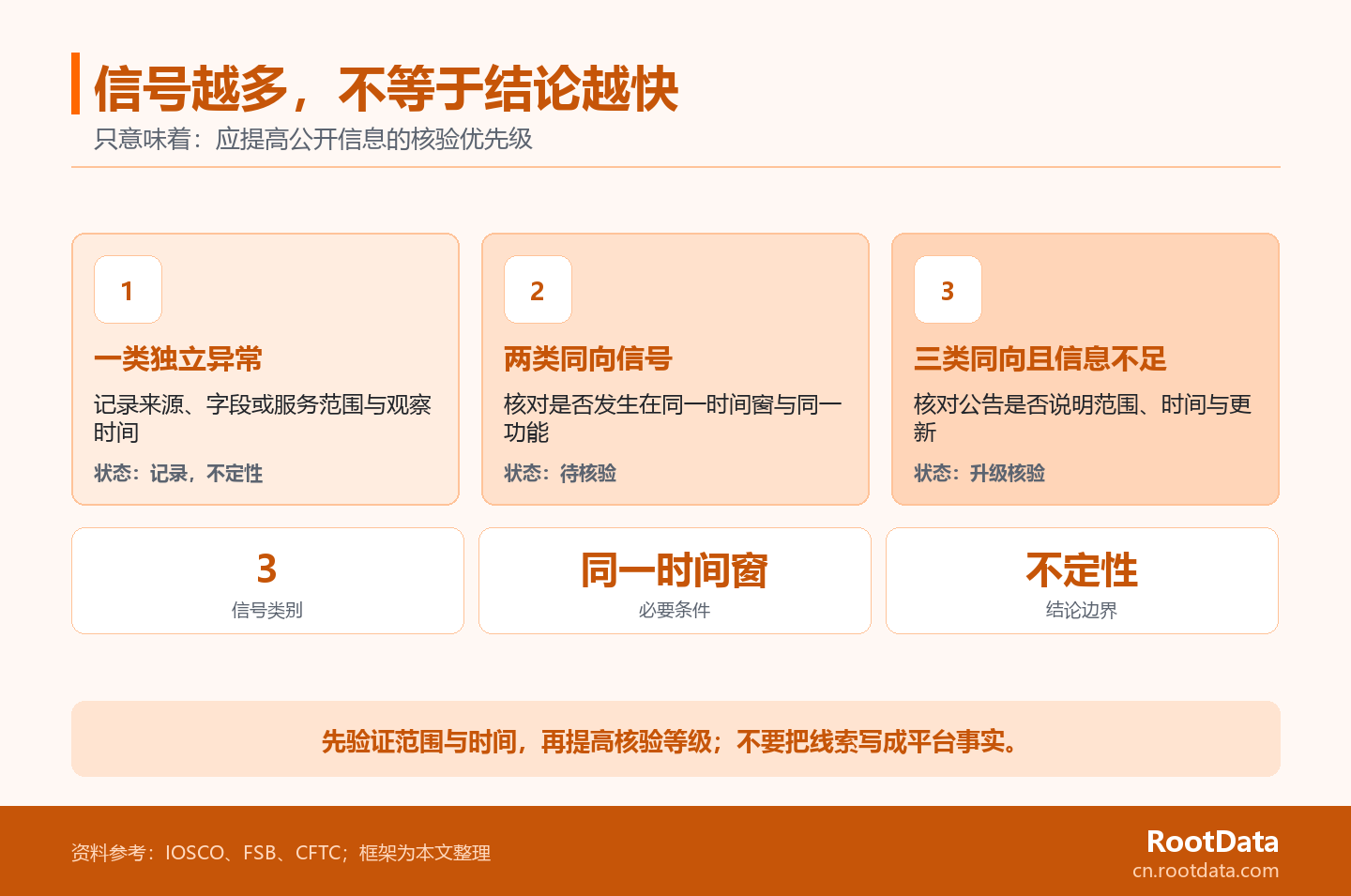
This framework has a deliberately reserved limitation: do not piece together anomalies from different time periods, different assets, and different networks into the same story. Data is temporarily missing in the morning, a certain network is undergoing maintenance at night, and a general announcement appears a few days later, which may not belong to the same event. On the contrary, when the time window, service scope and announcement version can all correspond, readers will have reason to check the original status page, service updates and verifiable follow-up records first.
The rights structure of platform operating information and tokenized products also need to be separated.Investor.gov explanation of tokenized securitiesA distinction is made between issuer-led, managed and synthetic models.The rights, obligations and benefits of different tokenized security models may differ.Even if the platform's service information is complete, it cannot replace the verification of product terms, holder records or rights arrangements; conversely, product structure descriptions cannot answer whether the platform services are normal at a certain point in time.
When filtering data changes within the same time window, the market field of RootData can be used as the starting point for unified records; in the end, it is still necessary to return to the corresponding service status, original announcements, and product documents to supplement the evidence respectively.
- Fixed time window:First put all records into the same hour or the same announcement period.
- Fixed function objects:The transaction field, asset withdrawal and announcement scope must point to the same functional layer.
- Specify unknown items:When there is no original announcement, the scope is unclear, or it has not been updated subsequently, the unknown should be retained in the record.
FAQ
If there is insufficient information, it will remain in the pending verification status.This is more useful than writing a single market, service, or announcement lead into a definitive conclusion. The following questions all return to the same principle: first distinguish what each piece of information can prove, and then determine whether it is mutually corroborated with other independent sources within the same time window.
If the transaction data suddenly returns to zero, can it be considered that the platform has been shut down?
cannot. Zeroing, missing, or static may reflect data source delays, page rendering issues, lack of activity on a contract, or service changes that truly require further verification; one field alone cannot distinguish these reasons. The field name, observation time, whether it affects a single or multiple contracts, whether other fields change simultaneously, and whether there is official status information for the same time period should be recorded. Only when data changes correspond to independent service prompts and formal announcements in scope and time should the verification priority be increased.
If withdrawals are slow or show that they are being processed, does that necessarily mean there is something wrong with the asset?
Not necessarily. The withdrawal status may involve specific assets, networks, regions, account verification or processing windows. "Processing" on the front end does not automatically explain the reason, let alone infer the status of the entire platform. A more valuable approach is to retain the original prompts, time, assets and network information, and then check whether there are corresponding maintenance notifications, service status updates or recovery records. If the public information cannot explain the scope of impact, keep the conclusion as "the service path needs to be verified" and do not generalize the status of individual services to asset processing or overall operations.
The announcement says system maintenance, what should I continue to check?
Continue to check the impact scope, start time, affected features and reverting updates. A reviewable maintenance description should let readers know whether the maintenance involves transactions, logins, asset transfers, or a certain network, which assets or regions are applicable, and whether there will be subsequent versions. This information is then compared with data and service prompts within the same time window: if the scope of the announcement cannot explain the observed changes, or there is no subsequent update, the most accurate status is still pending verification. Announcements are a link in the verification chain, rather than a final judgment that can replace other layers of information.
Can the market data on the ranking page be used to determine whether the platform is normal?
It can be used as a clue, but it cannot alone determine whether the platform is normal. Fields such as transactions, open positions, liquidity, spreads, fees, and contract coverage on the ranking page are suitable for comparison at the same caliber and at similar times, and can help discover which market performance deserves further inspection; they cannot prove whether withdrawals are available, whether the announcement is complete, nor can they explain the rights structure of a certain tokenized product. The correct way to use it is to fix the time point and field range, treat the exception as a record to be verified, and then go back to the relevant official service information and product documents to supplement the evidence.