
Current status of tokenized stock regulation in the United States: securities attributes, information disclosure and platform responsibilities
"On-chain" solves the problem of recording and delivery methods. It will not compress different products into the same security rights, nor will issuance, trading and custody be automatically attributed to the same entity. When researching U.S. tokenized stocks, the most reliable starting point is not to ask a general "is it compliant?" but to confirm in order: what the token represents, what is disclosed in public documents, what the platform actually does, and who continues to control access and transfer. Only when these four items are aligned does market data begin to be comparable.
What RootData undertakes here is the final step of market field comparison entry: it cannot replace the previous four document checks, nor does it make conclusions about specific products, platforms or user qualifications.
First use four types of document questions to replace a general judgment
The order of reading of U.S. public materials should begin with rights structure, disclosures, platform features, and hosting controls. This sequence is not a legal conclusion, but a minimal framework to prevent the research from being biased by the product name: first read the relationship between the token and the underlying security; then look for the issuance or product documents; then confirm the functional subject behind the transaction interface; and finally list the access, transfer and custody arrangements separately.
- right:Does the holder obtain a direct security right, an interest held through an intermediary, or price exposure to changes in the reference asset?
- Disclosure:Which product risks, transfer restrictions, fees, technology dependencies and rights arrangements have been spelled out in formal documents?
- Function:Who issues, who brokers or executes transactions, who clears, and who just provides the interface?
- control:Who can decide to access, transfer, resume or interrupt processing?
As long as one of the four items is blank, the conclusion should be left as "to be checked." The platform page that says "trading", the token name with "stock", or even a certain market quotation are not enough to fill this gap. This boundary also applies to products outside the United States: the reading of regulatory materials must go back to the rights and participants, rather than just inferring based on product slogans.
Security attributes: first confirm which right the token represents
Investor.gov explanation of tokenized securitiesDistinguish between issuer-led, custody and synthetic structures; under different structures, the rights, obligations and interests of holders and underlying securities may be significantly different. The "tokenized securities" here can first be understood as financial instruments represented in the form of on-chain or similar distributed ledger records; it describes the recording and arrangement method, and does not guarantee that each product will deliver traditional stock rights to token holders as they are.
Issuer-led structures may allow tokens to directly carry rights similar to traditional securities; custodial structures are commonly connected to underlying securities through intermediaries or custody arrangements; synthetic exposures are where the price changes with the reference asset, but do not necessarily give the holder rights to the issuer. The latter two differences are particularly important:Price behavior is similar and does not equal the treatment of ownership, dividends, voting or corporate actions.
Therefore, when encountering the label "tokenized stock," the first round is not to compare quotes, but to look for documents that answer three questions: to whom do token holders claim rights, how are rights transferred or redeemed, and corporate actions are delivered by whom and under what rules. When these contents cannot be found, it is safer to write "what is held" as unknown than to complete it based on the name.
Information disclosure: In addition to risk factors, we must also go back to the product documents to see the arrangements.
Regulation S-K Item 105Registrants are required to discuss the most important risk factors and organize risk disclosures with meaningful titles; the rights and technical arrangements for tokenized products should still be checked back to the specific issuance documents. For readers, this means not treating a line of “regulated” or a page of marketing copy as a substitute for disclosure, but rather locating where risk factors, security descriptions, terms of service and related technical arrangements each appear.
A usable reading record does not need to be filled with regulatory terms, but it should separate "disclosed" and "not yet answered." Disclosures may include: source of rights, transfer and redemption conditions, fees, suspensions or restrictions, conflicts of interest, and external systems on which the product relies. Unanswered questions may include: who triggers a certain restriction, who is responsible for handling technical failures, and when information is updated. Leaving these spaces free will avoid misinterpretation of a paragraph in the risk disclosure as a complete commitment.
This also explains why disclosure is not a pure “paperwork”. It transforms security attributes into enforceable boundaries: what situations can be transferred, what situations are restricted, who is responsible for explaining exceptions, and what risks are borne by the holder. The more the product relies on multi-party arrangements, the more important it is to put these answers back into the corresponding files, rather than just looking at the front-end transaction page.
Platform responsibility: transfer trading, matching, clearing and custody back to specific entities
United States CodeThey are respectively defined as brokers who facilitate securities transactions for other people's accounts and dealers who buy and sell securities for their own accounts;Regulation ATSIt defines an ATS that aggregates interests in securities buying and selling and promotes interaction in established, non-arbitrary methods; and the registration rules for brokers and dealers are also provided.15 U.S.C. § 78o. These definitions do not automatically answer the status of a certain platform, but they indicate that platform responsibilities must be read separately according to actual functions.
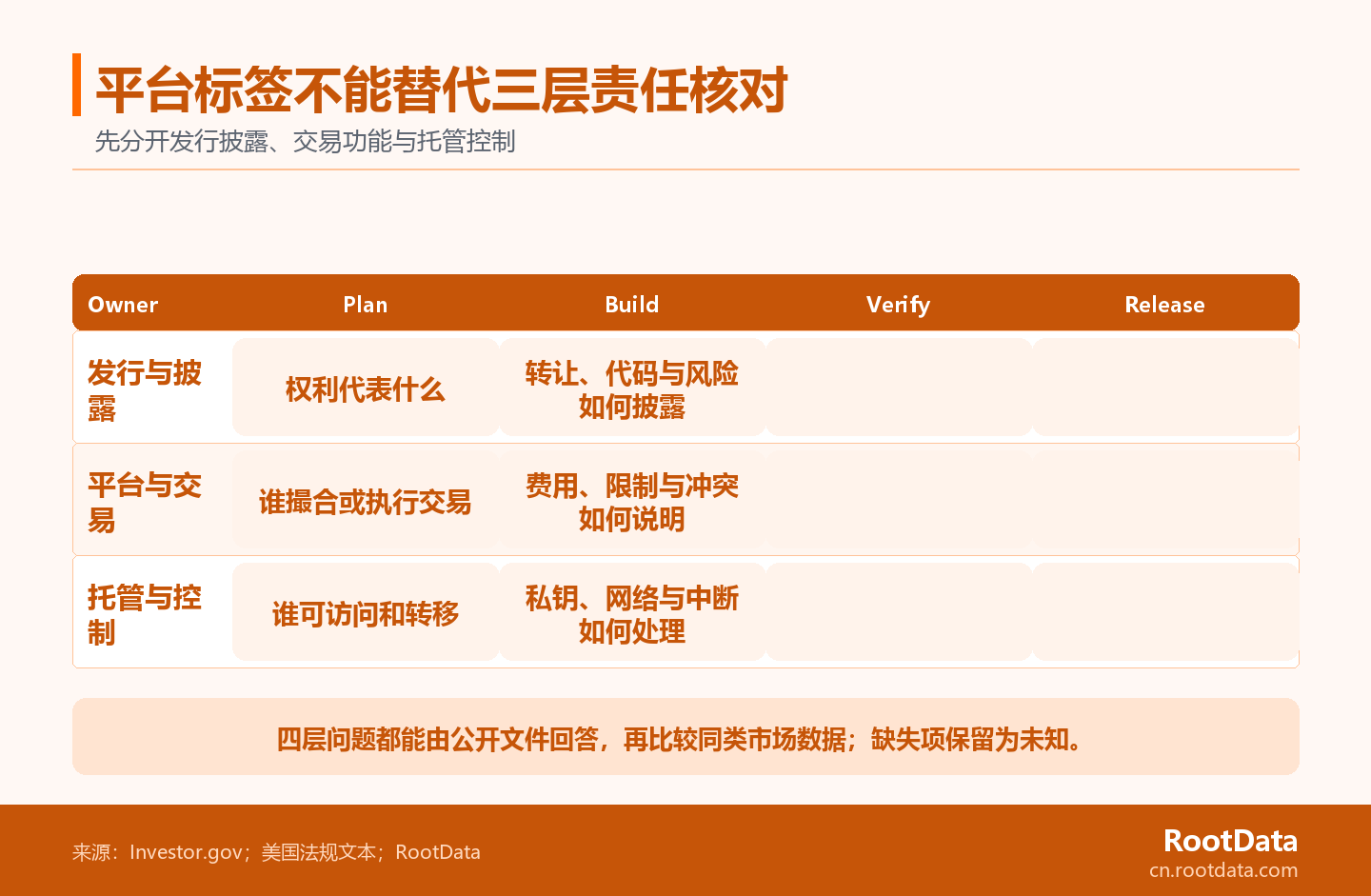
To the same user, the interface often looks like only one brand; at the arrangement level, there may be at least issuance or product entities, trading or matching entities, clearing or settlement arrangements, custodians, and service providers that provide technical interfaces. They can be related or independent of each other. What readers really need to correspond to is "who did what", rather than taking the platform name on the page as an abbreviation for all responsibilities.
For actual verification, you can use a simple menu: if an entity commits to executing orders, look for execution and trading rules; if it holds client assets or controls transfer rights, look for custody and access arrangements; if it only displays market prices or provides access, you still need to confirm whether it also collects orders, sets routing, or touches client assets. This action will not replace the judgment of specific facts and rules, but it can shift the research from "what platform it is" to "what it does in the transaction chain."
Custody and technical control: the problem of continuous custody of on-chain records without cancellation
17 CFR § 240.15c3-3There are rules for broker-dealers’ actual possession or control of client securities and client fund reserves; access and transfer arrangements for tokenized products will still need to be checked in specific custody documents. Putting securities records on the chain will not eliminate the ongoing custody problem of "who can control the assets and who is responsible for handling them in the event of an exception."
“Escrow controls” can be understood in the vernacular as the custody arrangements surrounding asset access, transfer permissions, private keys, and outage disposition. It does not ask readers to judge for themselves whether a technology is compliant, but rather asks observable questions: Who keeps or manages access credentials? Who can initiate or block a transfer? Who provides a recovery path when customers lose access, network congestion, or service outages? The answers to these questions are sometimes in the custody agreement, sometimes in the product terms or risk disclosures, and not necessarily in the trading interface.
This step can also help readers distinguish between "recording methods" and "accountability methods." A product can display balances on the chain, but still needs to rely on specific entities to complete customer identification, authority management, company action delivery or exception handling. If the public materials only show the technical characteristics but do not explain the control and recovery mechanisms, it is not appropriate to directly interpret "visible on the chain" as "the custody arrangements are clear."
"Current situation" requires reading the file hierarchy clearly, rather than just excerpting a sentence.
Rule text, official interpretations, product disclosures, and marketing materials are at different levels of documentation, and no one of them can be used in place of the rest. The “regulatory status quo” of U.S. tokenized stocks is therefore more like a document map that needs to be continuously updated: rules answer the institutional boundaries, explanatory materials help understand the disclosure caliber, product documents explain the actual arrangements, and marketing pages only show the parts that the operators choose to present.
When reading, you can first ask which level a piece of material belongs to, and then ask whether it is enough to answer the current question. For example, regulatory definitions can help identify transaction functions, but cannot prove what rights a certain product gives holders; product terms can describe a specific arrangement, but cannot alone replace applicable rules; the platform's regional prompts cannot summarize all users, all transactions, or all points in time. This approach avoids exaggerating explanatory text into general conclusions and avoids hastily drawing negative conclusions due to incomplete materials.
Once the structure and responsibilities are clear, use RootData to compare market conditions.
RootData’s Equity Derivatives Description PageComparison fields such as volume, open interest, depth, spread, fees, funding rate and contract coverage are displayed. RootData's equity derivatives platform fields can be used to compare market conditions for similar products at the same point in time and are not used to demonstrate security rights, regulatory applicability or custody arrangements.
This is exactly the right place for data in the research process: first confirm whether the comparison is for similar products, whether the service scope is similar, and whether the data update time is consistent; then look at market conditions such as liquidity, spreads and fees. Taking the frozen snapshot at 17:30 on July 23, 2026 as an example, the RootData page covers 29 platforms; this is a horizontal observation of the market field and is not an endorsement of any platform, product or user qualifications. When you are ready to compare, go toView RootData Equity Derivatives Trading Platform RankingStart and record the product structure and data time points together.
Organize public materials into a "Rights to Control" reading card
Questions of rights, responsibility, or control not answered by disclosure materials should remain unknown, rather than being filled in by product name or platform accessibility. Putting a certain product into the following four-line reading card can make subsequent research clearer: what type of documents are missing, which subject should be requested from, and to what extent it is worth entering the next step of comparison.
| What to ask first | Corresponding materials | What to do when there is no answer |
|---|---|---|
| What rights do tokens represent? | Security description, offering or product terms | Do not equate it with direct shareholding |
| What risks and limitations have been disclosed? | Risk Factors, Terms of Service, Fees and Transfer Instructions | Mark as risk or limitation for review |
| Who completes each function in the transaction chain? | Subject information, transaction rules, execution and settlement arrangements | Correspond to the subject item by item, do not replace it with the platform name |
| Who controls access and transfers? | Hosting Agreement, Permissions and Exception Handling Instructions | The visibility on the chain is not considered as the custody has been cleared for the time being. |
The value of this reading card is not to give a "can buy" or "can't buy" conclusion, but to make the research sequence reviewable. When the product structure, file hierarchy, and responsible entities are not aligned, the use of market data for horizontal comparison should be suspended; when corresponding materials are available for all four items, more detailed market condition judgments such as quotation, depth, cost, and contract coverage should be entered.
FAQ
In the United States, are tokenized shares automatically equivalent to owning shares directly?
Not naturally equivalent. Public information distinguishes between issuer-led, custody and synthetic structures, and the rights relationship between the holders and the underlying securities may be different. Priority should be given to checking the product terms for descriptions of ownership, corporate actions, transfers and redemptions; price following does not alone prove that the holder has acquired similar rights. If the terms do not explain how these rights are transferred, the token should not be understood directly as a traditional shareholding.
Does the SEC staff statement amount to a new regulatory rule?
Not equal to. When studying regulatory issues, rule texts, official interpretations, and specific product documents serve different functions; an explanatory material cannot replace applicable rules or issuance documents. A safer approach is to confirm the material level first, and then check its scope of application and release date. If the materials are not connected to applicable rules or product terms, a complete judgment on specific transaction arrangements cannot be derived from them.
Can the trading platform page alone prove what regulatory responsibilities the platform bears?
cannot. Issuance, trading, matching, custody, clearing and interface services need to be mapped to actual entities and their public documents respectively. A brand page may integrate multiple functions, or may be just the entrance to one of the links; it should be based on actual activities and responsibility arrangements, not just on the page name. If the page does not explain who executed the order, who held the client's assets, or who handled the exception, the chain of responsibility should still be marked as pending.
Can RootData’s platform data determine whether a product is appropriate for a particular user?
cannot. RootData's fields are used for comparison of similar market conditions and are not a substitute for product rights, geographic coverage, or personal qualification judgments. The product type, target contract and data time point should be fixed before comparison; any issues involving personal identity, region or specific trading arrangements need to go back to the current product documents and relevant professional opinions. Data can help compare market conditions, but they cannot fill in the gaps in rights, responsibilities and access documents for readers.