
What is the difference between tokenized stocks and real stocks: trading, custody, dividends and shareholder rights
Just because tokens can be transferred, it does not mean that shareholders’ rights will also be transferred. The most critical difference between tokenized stocks and real stocks is not whether the same company code is displayed on the page, nor whether it can be traded over a longer period of time, but: who holds the bottom layer, what rights the holders get, and what rules are followed for matters such as dividends, voting, and stock splits. Only by confirming this rights chain can the transaction experience and fees be comparable.
To judge two types of products, first separate the four questions
- Where do rights come from:The rights of real stocks come from company shares; token products must be defined in the issuance and product documents.
- Who is holding and registering:The tokens in the wallet, the registered holder, and the underlying custodial assets may not be the same layer.
- How company actions are communicated:Dividends, voting, stock splits and redemptions must be confirmed item by item and cannot be inferred from the product name.
- When is market data used:After confirming the structure, compare liquidity, spreads, fees and contract coverage to avoid considering trading conditions as proof of ownership.
Establish a baseline first: real stock rights come from company shares
Before comparing, use real stocks as a baseline.Investor.gov description of stocksIt is pointed out that stocks represent ownership shares of a company; common stocks usually include voting and dividend arrangements, while preferred stocks may have priority in the order of dividends but do not necessarily have voting rights. This reminds us that even within traditional stocks, we must first look at the specific share class, and we cannot understand the word "stock" as a set of identical rights packages.
Also following the stock price, it may correspond to three different relationships.
"Tokenized security" means a financial instrument recorded or represented in the form of a cryptoasset.Investor.gov structure classificationDivide these into issuer-led, custodial and synthetic: the first two can be arranged around actual securities or interests in securities held through an intermediary, while synthetic may simply be price exposure to a reference stock. That is, price following a stock does not automatically answer the question of whether to own the stock directly; the answer depends on the issuer, the underlying arrangements, and how the contract transfers equity to holders.
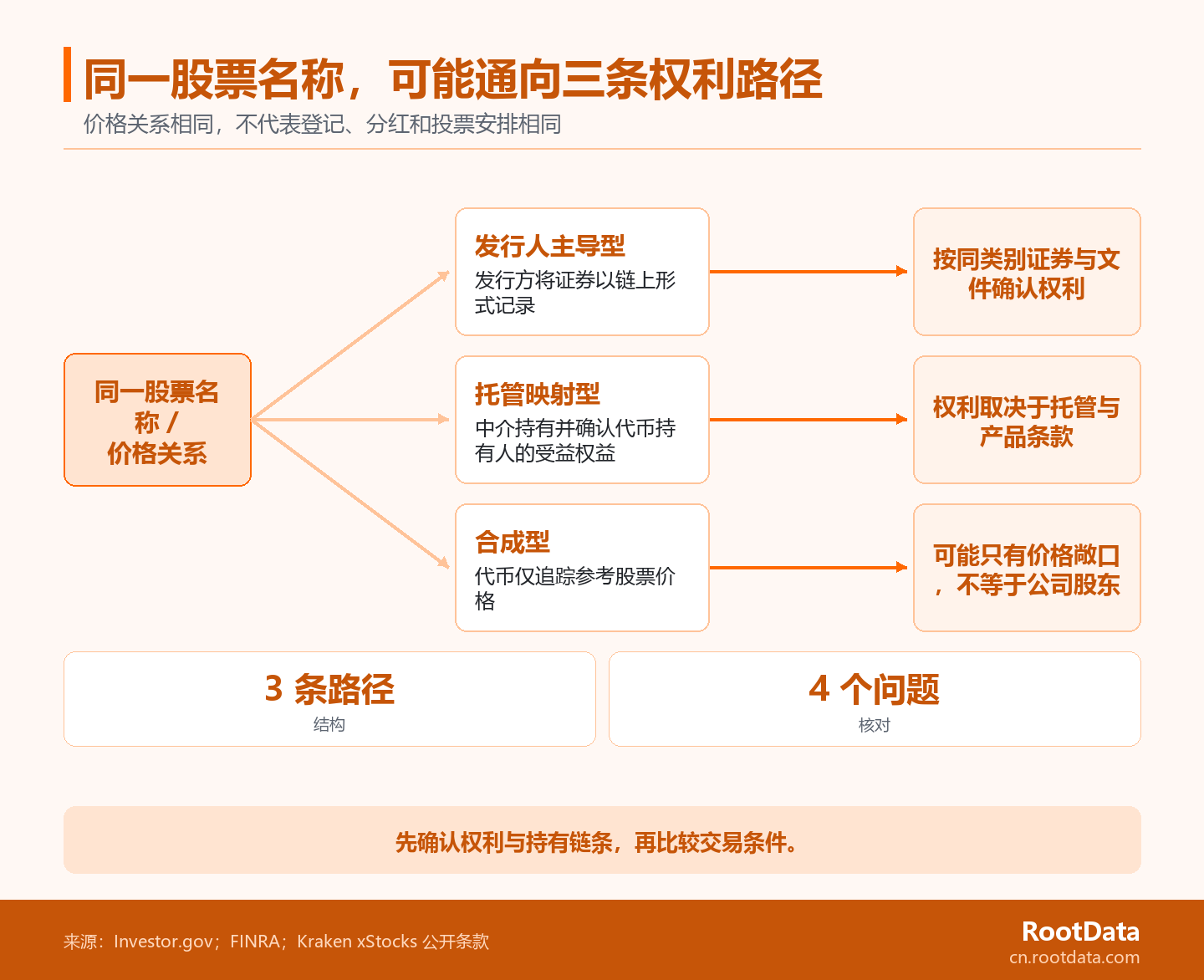
This is where readers are most likely to get confused. The trading interface often puts the name of the target, price curve and tradable quantity in the most conspicuous position, while the rights structure is hidden in the terms, issuance documents or risk disclosures. When comparing two products, first put them back under the same question: is it a security issued directly by the company, an equity held by an intermediary and then mapped, or is it just a stock used as a reference price? There is no answer to this step, and the following "transactions are more convenient" or "prices are closer" are not enough to show that it is closer to the real holdings.
Trading and Custody: Wallet Control Does Not Equal Stock Registration
The key to the custody issue is not “whether there is a wallet”, but how the securities interests—that is, through whom and under what arrangement the rights to the underlying securities are obtained—are recorded.FINRA’s Investor Education MaterialsTwo types of tokenized securities arrangements are listed: the issuer or transfer agent maintains an on-chain register of holders, or the intermediary first holds the asset in traditional form as a registered holder and then tokenizes it and recognizes the beneficial interest of the token holders. Both paths can use blockchain, but registration, custody and claimable rights are not determined by the same piece of information.
Ask about registration first, then ask about custody, and finally ask whether it can be transferred.
These three questions are not substitutes for each other. Registration answers who is recognized as the holder in the company or securities registration system; custody answers who keeps the underlying assets, whether they are isolated, and how the documents describe the risks; transfer answers whether tokens can be moved in accounts or on the chain. Self-custodial wallets may give holders direct control over the transfer of tokens, but do not automatically change how the underlying shares are registered. Conversely, even if the product enables the holder to acquire certain security interests through intermediary arrangements, conditions such as withdrawal, redemption, suspension and applicable regions should still be reviewed.
Therefore, when reading a specific product, you may wish to ask continuously: Who is the registered holder? Who hosts the bottom layer? Can token holders redeem or convert? The more complete the public answers to these questions are, the better readers can put "technically transferable" and "product rights" in their correct positions. Undisclosed aspects should be left unknown rather than completed in the most advantageous way.
Dividends and shareholder rights: corporate action rules must be looked at individually
Dividends, voting, disclosures and redemptions are the corporate actions that require the most itemization. Taking xStocks as an example, itsDisclosure of global termsState: Although this product is backed 1:1 by the same underlying stock or ETF, the holder does not have the legal voting, information, dividend or redemption rights of the underlying stock. This example only illustrates the terms boundaries of a specific product, but it is enough to illustrate that "having underlying support" and "having the same set of shareholder rights" are two different judgments.
The economic effect of dividends may not be in the form of cash
of the same productxStocks FAQNote that holding this product is not equivalent to purchasing shares of the underlying company; its dividend economic benefits will be reflected through reinvestment and multiplier adjustments, rather than being recorded as separate cash. The important thing for readers is not to memorize this mechanism as an industry standard, but to learn to ask: Will the proceeds be passed in cash, reinvested, balance adjustment, or other forms? How is the net amount calculated? Which document determines when record dates, taxes, stock splits, or mergers occur?
There is no default answer for voting, messaging and redemption
In traditional stocks, voting and company information are related to shareholder identities and record dates; in token products, whether there are voting instructions, company document forwarding, cash handling, token adjustment or redemption paths depends on the product's contractual and operational arrangements. Don’t further assume that a product has voting rights just because it provides a “dividend-like” economic effect; and don’t assume that just because a token can be transferred across wallets, it can be transferred into a traditional securities account. By listing each company action separately, you can see the boundaries of what your product truly offers.
After confirming the structure, use market data to compare trading conditions
Once the product hierarchy has been identified, market data begins to answer another valuable question: whether it is easy to trade.View RootData Equity Derivatives Trading Platform RankingPlatform fields at the same point in time can be checked. The frozen snapshot used in this article is as of 17:30 on July 23, 2026, covering 29 platforms, including trading volume, open interest, liquidity, spread, funding rate, Maker/Taker fees and contract coverage and other indicators; please refer to the field caliberRootData Equity Derivatives Instructions.
These indicators are suitable for comparing the trading activity, quotation costs, position fees and coverage breadth of the target contract at the same point in time. They are not used to prove whether a token represents company stock, whether the underlying layer is in custody, or whether voting and dividends are available in a certain region. RootData is a data platform and is not an exchange, broker, custodian or guarantor of product rights. Reading the product terms and market fields in two steps avoids burdening a ranking list with questions it cannot answer.
When comparing specific products, use these four columns to complete the initial screening
Ask about rights first, then look at holding chains and corporate actions, and finally compare trading conditions. This order is not to rate the products, but to prevent readers from mistaking a readily observable advantage, such as longer trading periods or smaller trading units, for evidence of outright holdings.
- right:What does the product documentation clearly say? Is it shares in a company, an interest acquired through an intermediary, or price exposure to a reference stock?
- Holding the chain:Who are the registered holders, who holds custody of the underlying, and are there conversion, withdrawal or redemption paths for token holders?
- Corporate Actions:What are the handling methods, timing and restrictions when dividends, voting, stock splits, mergers, trading suspensions or liquidations are made?
- Trading conditions:After the first three items are clear, then fix the target contract, order role and holding period, and compare the spread, fees, funding rate and liquidity.
The absence of answers to any of the preceding questions in the four columns should keep conclusions from subsequent market data limited. Conversely, when the chain of rights and holdings is confirmed, RootData's cross-platform fields can help readers compare actual trading conditions at the same point in time, without having to mistakenly write "better trading" as "more like real stocks."
FAQ
Do tokenized stocks necessarily have a 1:1 ratio of underlying stock?
uncertain. The existence of underlying shares, who holds them, whether the assets are segregated, whether they are redeemable by holders, and the conditions that trigger suspension or conversion restrictions will all be governed by the terms of the offering, custody and product. Even if "anchored", "supported" or similar expressions appear on the product page, confirm the definitions, applicable regions, fees and corporate action rules of these words; matters not explicitly disclosed should remain unknown.
Will dividends from tokenized stocks always be received in cash?
uncertain. Different products may stipulate cash distribution, reinvestment, balance or multiple adjustment, and may also have other provisions on taxes, recording dates, qualification conditions and suspension situations. Readers should record "whether economic benefits are delivered" and "whether they enjoy legal shareholder dividend rights" separately, and then confirm the actual payment form and calculation caliber, instead of using the method of one product to replace the answer for all products.
Are stock perpetual contracts and tokenized stocks the same thing?
Not the same concept. Stock perpetual contracts usually provide continuous price exposure to a certain underlying, and their use is also affected by margin, funding rates, index prices and liquidation rules; tokenized stocks may correspond to different issuance, custody or mapping structures. Both may be related to the same stock price, but rights, settlements and costs should be checked separately, and they should not be considered the same product because of similar names.