
Tokenized Stock Spot vs. Stock Perpetual Contracts: Ownership, Fees, and Risks Compared
Both tokenized stock spot and stock perpetual contracts allow one to gain access to price changes related to a certain stock, but they are not the same rights, nor do they follow the same cost and risk path. Classifying both as "on-chain stocks" or "tradable products" easily overlooks three things: what economic or legal rights the holder actually obtains, whether the fees are incurred in one execution or during the holding process, and whether the position will be passively interrupted due to margin rules. This article only summarizes the mechanisms that can be proven by public documents and does not constitute transaction, legal or qualification advice.
Let me give you the conclusion first: three things cannot be put into the same “spot vs. sustainable” answer.
Tokenized stock spot and stock perpetual contracts should be compared based on rights, costs and risks respectively, rather than being determined by the same stock underlying at once.Tokenized spot must first ask what rights the issuance document positions the holder; stock perpetuals must first ask how the contract generates price exposure, funding fees and margin requirements. Both may move with the price of the same stock, buteconomic exposureIt's just that the "economic effect of changes in value with the underlying asset" does not automatically equal direct shareholder status; similarly, the capital fee shown once cannot automatically become a long-term cost. The order of comparison should be to look at rights first, then fee windows, and finally at risk parameters.
| comparison line | Tokenized stock spot | Stock Perpetual Contract |
|---|---|---|
| What to check first | Issuers, legal classifications, corporate actions and holding paths | Contract specifications, funding fees, margin and liquidation rules |
| Cost highlights | Execution, transfer and holding arrangements for target channels | In addition to the execution fee, it also depends on the direction of the funding fee and the number of settlements. |
| main borders | Tradeable does not automatically equal direct common equity rights | Price exposure does not automatically equal sustainable holding, margin may trigger liquidation |
The purpose of this framework is not to select products for any reader, but to avoid using one label to replace three pieces of information of different nature: the issuance document proves the rights boundary, the contract specifications describe the cost and risk parameters, and the platform data page explains the market fields at a certain point in time.
Ownership: Distinguish between direct ownership, economic exposure and corporate actions
The xStocks legal overview describes it as a tracker certificate that provides economic exposure and states that it does not give shareholders voting rights.View xStocks Legal Overview. This is not to say that all tokenized stocks have the same structure, but it is a verifiable example: even if the product can track the value of the stock, it still depends on the issuer, legal classification and rights documents, and cannot be deduced from the word "spot" as direct common stock in a traditional brokerage account.
Economic exposure is not a list of holder rights
Issuance and redemption also cannot be confused with secondary market transactions. xStocks’ documents place issuance and redemption in the issuer’s primary market, and direct access requires KYC/AML and whitelist wallets.View the issuance and redemption mechanism. Its FAQ also distinguishes between the secondary market where tokens can be traded 24/7, versus the usual 24/5 window for issuance and redemption.View xStocks FAQ. Therefore, "can be traded", "can be transferred" and "can be issued or redeemed directly to the issuer" are three paths that need to be confirmed separately.
xStocks' Corporate Actions page explains that events such as dividends and stock splits adjust the economic exposure of a position through an onchain multiplier.View company action mechanisms. This prompts a more practical checkpoint: for tokenized stock spot, in addition to asking "is there underlying support", also ask how dividends, stock splits, redemptions, voting or other rights are handled in the current document; fields lacking disclosure should remain pending verification.
Fees: For spot prices, it depends on the execution path, and for sustainability, it also depends on the funding fee window.
Both types of products may incur order execution costs, quote spreads or channel fees, but the holding costs are structured differently. Spot tokens have to go back to the fee arrangements for actual transactions, custody, transfers and product documents; stock perpetuals have an additional item related to the position window on this basis.Funding fee: It is the receipt and payment that occurs between the two parties of the perpetual contract according to the rules during settlement. It is not a fixed "interest rate" for all platforms and all contracts.
The capital fee of the perpetual contract will be applied to the position value at the settlement time according to the rules of the target platform. The rate and period should not be extrapolated from one page to universal constants.Bybit’s funding fee descriptionDisplay, the rate will be updated over time, and will be applied to the position value at the time of the funding fee;Hyperliquid funding fee documentationThe payment is calculated based on the position size, oracle price and rate, and adopts its own hourly settlement rhythm. These two pieces of information are used to illustrate the differences in mechanisms, rather than to fill in the parameters for any stock perpetual contract.
Example: Put a single funding fee into the holding window
Under the illustrative assumptions of a fixed $10,000 notional position, a positive 0.01% funding fee, and three settlements, the funding fee is $3.
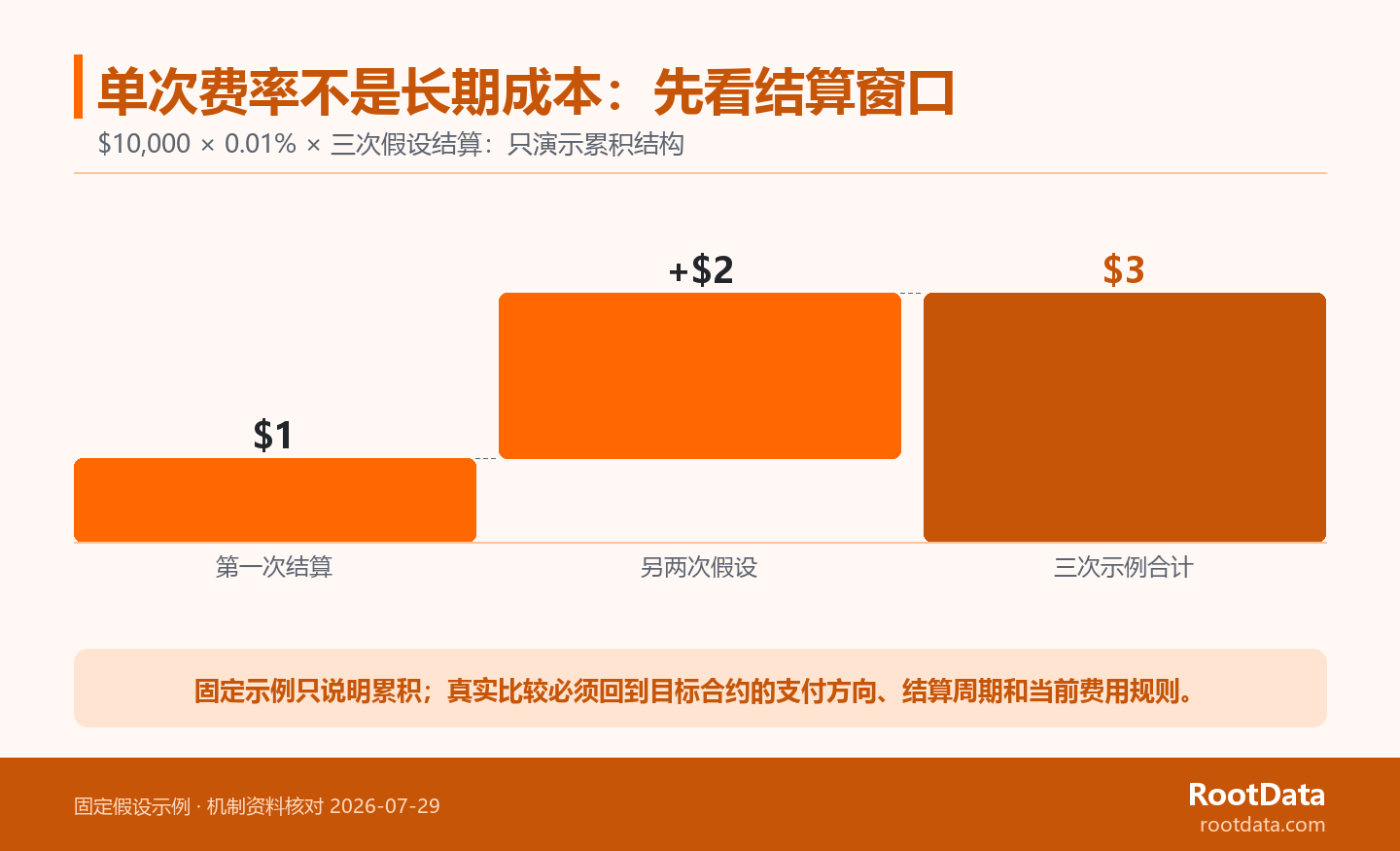
The calculation is just $10,000 × 0.01% × 3: $1 for the first settlement and $2 for the other two under the same assumptions. It intentionally excludes price movements, transaction fees, slippage and future rate changes, in order to illustrate one principle: a single rate reading must be read along with the payment direction, notional position and the actual number of settlements crossed. If one of them is different, the result will be different; directly annualizing the single-point rate will cover up the contract conditions that need to be confirmed most.
Risk: Perpetual contracts have an additional path for margin and liquidation
The risks of tokenized stock spot have not gone away: issuance structure, custody or on-chain path, corporate action processing and channel availability are all subject to product documentation. But in addition to price fluctuations, there is also a contract path of margin and liquidation for stock sustainability.maintenance marginIt is the minimum margin level required to maintain a position; when the account equity falls below the level set by the rules, the position may be forcibly disposed of. This is a different level of issue than "whether the underlying price has increased."
When the margin is insufficient, the perpetual contract may trigger liquidation because the account equity is lower than the maintenance margin. The threshold changes according to the asset and contract rules.Hyperliquid’s Margin InstructionsRelate opening margin to position size, mark price and leverage; itLiquidation instructionsThen connect the liquidation with the account equity being lower than the maintenance margin, and make it clear that the conditions for different assets will change. This is also a mechanism example. The actual stock perpetual should be based on the current specifications of the target contract.
Liquidation is not a fee, it is a holding continuity risk
Fees usually describe how much was paid over a period of time; liquidation describes whether the position can continue to exist. Therefore, comparing stock perpetuals cannot just list Maker/Taker rates or a certain funding fee snapshot, but also confirm leverage caps, margin modes, mark price sources, maintenance margins, and liquidation/deleveraging rules. For tokenized stock spot, risk should also not be ignored just because there is not the same set of margin paths, but should shift back to document verification at the issuance, holding, corporate action and channel levels.
Put comparison into documents: four-step verification, do not regard platform data as proof of rights
When comparing, first check the issuance and rights, then check the company actions or holding paths, then check the contract specifications, and finally compare the platform data at the same point in time.The first step is to confirm the issuing entity and legal classification; the second step is to confirm the holding path such as dividends, stock splits, redemption or transfer; the third step is to read the funding fee, margin, mark price and liquidation rules of the target perpetual; the fourth step is to compare the fees, funding fees, depth, spread or OI at the same point in time. This sequence prevents market indicators from substituting product rights, and it prevents issuance documents from substituting real-time execution data.
After product rights and contract mechanisms are confirmed, platform-level fees, funding fees, depth, spreads and OI should be returned to RootData's stock derivatives data portal for verification at the same time point and definition.RootData’s Equity Derivatives InstructionsThese fields are included in platform-level comparisons; it does not replace offering or contract documentation. If you want to continue comparing fields on different trading platforms, you canView RootData Equity Derivatives Trading Platform Ranking, and then return to the target product page to confirm the current rules.
FAQ
Rights, fees and risk parameters not confirmed in the designated offering documents or contract specifications should be retained for verification rather than completed by the product label.
Is tokenized stock spot equivalent to holding the stock directly?
It does not mean that whether you have direct shareholder rights must be based on the specific issuance documents. Tokens may provide underlying economic effects, but the specific treatment of issuing entities, legal classifications, voting rights, redemptions and corporate actions may still differ. If readers are concerned about a specific right, they should find the corresponding terms in the current product documentation rather than infer from labels such as "off-the-shelf" or "1:1".
Can the capital fees of stock perpetual contracts be directly regarded as long-term costs?
No, the single funding fee also needs to be combined with the payment direction, actual number of settlements and subsequent rate changes. The notional value of the position, transaction fees and possible slippage should also be put into the same holding window; only when these conditions are fixed can the costs over a certain period of time have comparable meaning. The single percentage displayed on the page does not by itself provide long-term results.
Why do the risks of the same stock underlying the two products differ?
Because the same price does not mean the same holding structure, perpetual contracts are also superimposed with margin, mark price and liquidation rules. For tokenized stock spot, it is necessary to focus on checking the issuance, holding, company actions and channel paths. Both require continuing to look at specific documents, but the files that need to be opened are different; leaving undisclosed fields to be checked is usually more accurate than giving a general conclusion about the pros and cons of a product.