
What is the difference between tokenized stock spot, stock perpetual contract and CFD?
Classifying the three types of products as "all able to track stock prices" often skips the most critical step: do you get a layer of equity, a contract with continuous settlement, or a contract calculated based on the price difference with the provider. The price curves can be similar, but the rights of the holder, who bears the cost, and when the position may be passively ended are three different sets of issues. Confirm the structure first, and then compare fees, liquidity and trading hours to avoid using the same set of standards to interpret different products.
First put the three types of products into four different questions
When comparing the three types of products, first separate equity, settlement, holding costs and risk triggers, so that the product name will not replace judgment. Equity answers "whether and how to obtain the rights related to the shares"; settlement answers "how the contract or token lasts and when it ends"; position cost answers "under what rules and who will charge the fees"; risk triggers answers "when will the price, margin or account conditions change the position path". These four questions come from different documents and cannot be replaced by a product label.
- First check whether the equity exists and who will take over it, and then discuss whether the price follows a certain stock.
- Having no expiry date does not mean holding spot. Perpetual settlement and margin still depend on the contract specifications.
- Fees and account protection for price difference contracts should go back to the provider, region and customer category terms.
- Trading periods and leverage are suitable for comparison at the end and cannot cover the first three structural issues.
| Compare dimensions | Tokenized stock spot | Stock Perpetual Contract | price difference contract |
|---|---|---|---|
| What to ask first | From which layer of the distribution, escrow, or other structure the rights pass | How to price, settle and maintain margin for contracts with no expiry date | How to settle the price difference between the provider and the account |
| Holding cost | See issuance, custody, exchange and related terms | See periodic fees, transaction fees and contract rules | See spreads, overnight financing and provider fee rules |
| risk trigger | See rights, escrow, redemption and product documentation | See mark prices, margin and liquidation conditions | See margin, liquidation mechanism, region and customer category terms |
| trading session | Relevant to specific product, provider and regional availability arrangements; cannot independently infer entitlements, costs or account protections. | ||
After comparison, the first thing to eliminate is not the price difference, but the misalignment of information: using "rights documents" for spot structures, "contract specifications" for perpetuals, and "account and regional terms" for price difference contracts are the starting points for comparison. For RootData's equity derivatives data, this order also avoids mistaking market fields for evidence of equity or regional access.
Tokenized stock spot: First ask which layer of rights you get
Stock represents a share of ownership in a company; voting and dividend arrangements may be different for common stock and preferred stock.Investor.gov explanation of stock rightsWhat is provided is a reference line for traditional stocks, not an automatic endorsement of any on-chain product rights. When you see a stock name, symbol or price tracking relationship, you should still continue to ask: who inherits the rights, who keeps the relevant asset records, how dividends or corporate actions are handled, and whether they can be redeemed or transferred.
“Tokenized securities” here refer to financial instruments recorded or represented on a blockchain. It describes the recording or representation method and does not independently tell the reader what legal, custodial or economic interest relationship the token holder is in. Therefore, the most important comparison object for spot products is not the quotation on the interface, but the issuance documents, custody arrangements, rights descriptions and applicable restrictions.
Price correlation does not equal the same shareholder rights
Tokenized securities can be structured as issuer-led, custodial or synthetic, and the rights and benefits may differ between models.Investor.gov’s structural classification of tokenized securitiesThis suggests an easily overlooked boundary: a synthetic arrangement may only provide exposure relative to the price of a reference asset, without giving the holder a claim on the assets of the reference company. If the product documents do not clearly spell out voting, dividends, corporate actions and redemption arrangements, the safest way to record them is as "unconfirmed" rather than filling in traditional shareholder rights.
Stock perpetual contracts: no expiry date, still a contract
The CFTC describes traditional futures as agreements to buy or sell a specific underlying at a future date, and some contracts can be cash-settled.CFTC Futures FundamentalsA comparison is given for understanding perpetuals: perpetuals cancel the fixed maturity date and do not therefore become spot stocks. It is still a contract that establishes exposure around price changes. Readers need to judge how the position will be continued based on the contract specifications and account rules, rather than the stock name.
The funding rate solves price anchoring and does not explain the total cost for you.
Taking Hyperliquid's public specifications as an example, the perpetual contract has no expiration date and relies on the funding rate to promote the contract price to move closer to the spot price over time.The public contract specificationsThis product-level mechanism is merely stated and cannot be extrapolated into uniform frequency, rate, or markup price rules for all platforms. The funding rate can be understood as the fee mechanism for settling long and short positions according to a regular cycle: it affects the cost of holding a position, but it cannot answer for you all the consequences of transaction fees, slippage, margin occupation and actual holding time.
Margin and liquidation rules determine whether a position can continue
Margin and liquidation triggers belong to specific contract and account rules and cannot be inferred uniformly from the name "stock perpetual". The aforementioned public specifications list both initial and maintenance margin; this means that "lower funding rates" are not a substitute for reading about risk triggers.Margin field in the same specificationAvailable as a production-level example only. When comparing specific perpetuities, the marked price source, initial margin, maintenance margin, position reduction or liquidation mechanism should be copied into the same table respectively to avoid mistaking the cost judgment for the judgment of whether the position can be continued.
CFD: A contract for rising and falling prices, not a default stock holding
The FCA describes CFDs as a way to bet on the rise or fall of the price of a share or asset without owning it.FCA’s risk warningMake the boundaries very clear: This type of contract settles around the difference in price of the underlying and the terms of the contract. It allows an account to gain directional exposure to price without inferring ownership of stock, eligibility to vote, or exposure to corporate action through the traditional shareholder route based solely on the underlying name.
Overnight financing, spreads and fees must be reconciled according to provider rules
The fee name, calculation basis and collection frequency of CFD must be independently checked according to the provider's documents, and the perpetual funding rate cannot be directly applied. Both may cause the cost of holding a position to change over time, but the funding rate is usually a rule-based settlement mechanism between long and short perpetual contracts; CFD spreads, overnight financing or other fees should be returned to the provider's quotation and account terms. When comparing, at least list side by side the fee name, billing basis, frequency of charge, currency, whether it changes with direction, and under what trading hours or account conditions it takes effect.
Margin closing and negative balance protection are region and account conditions
Among the UK FCA’s rules for retail CFDs are leverage limits, a 50% margin close-out rule at account level and customer loss protection.FCA policy statementQualified within the context of UK retail CFD rules and is not the default answer for all regions, customer categories or providers. "Margin closing" refers to the mechanism by which the provider closes a position when the margin reaches product or regulatory set conditions; therefore, any 50% figure must be marked with the region, retail customer conditions and specific account terms at the same time, and cannot be used independently of the original rules.
After the structure is confirmed, compare the market data of similar contracts.
RootData's frozen snapshot at 17:30 on July 23, 2026 covers 29 platforms and displays fields such as trading volume, OI, liquidity, spreads, funding rates, fees, and contract coverage.Field description of RootDataThe scope of this type of data that is suitable for answering is defined: after the target product has been confirmed to belong to the same type of contract, data at the same time point are used to compare market activity, enforceability and fee conditions; they are not used to prove the rights of token holders, custody arrangements or regional access. When you need to put these fields back into the same set of comparable conditions, you canView RootData Equity Derivatives Trading Platform Ranking.
When actually checking, first fix the product type and target contract, and then confirm the data time point; then look at the trading volume, OI, liquidity, spread, funding rate, fees and contract coverage. Empty fields on the page should be left as "not shown", don't treat it as zero, and don't replace product files with market data.
Turn product names into verifiable questions with a 3×4 checklist
Putting three categories of products into four questions gives you 12 boxes of information to check; no single category label is enough to fill them all. The purpose of this 3×4 method is not to rate the product, but to break down the intuition that “everyone seems to be able to trade a certain stock” into items that can be verified by documentation.
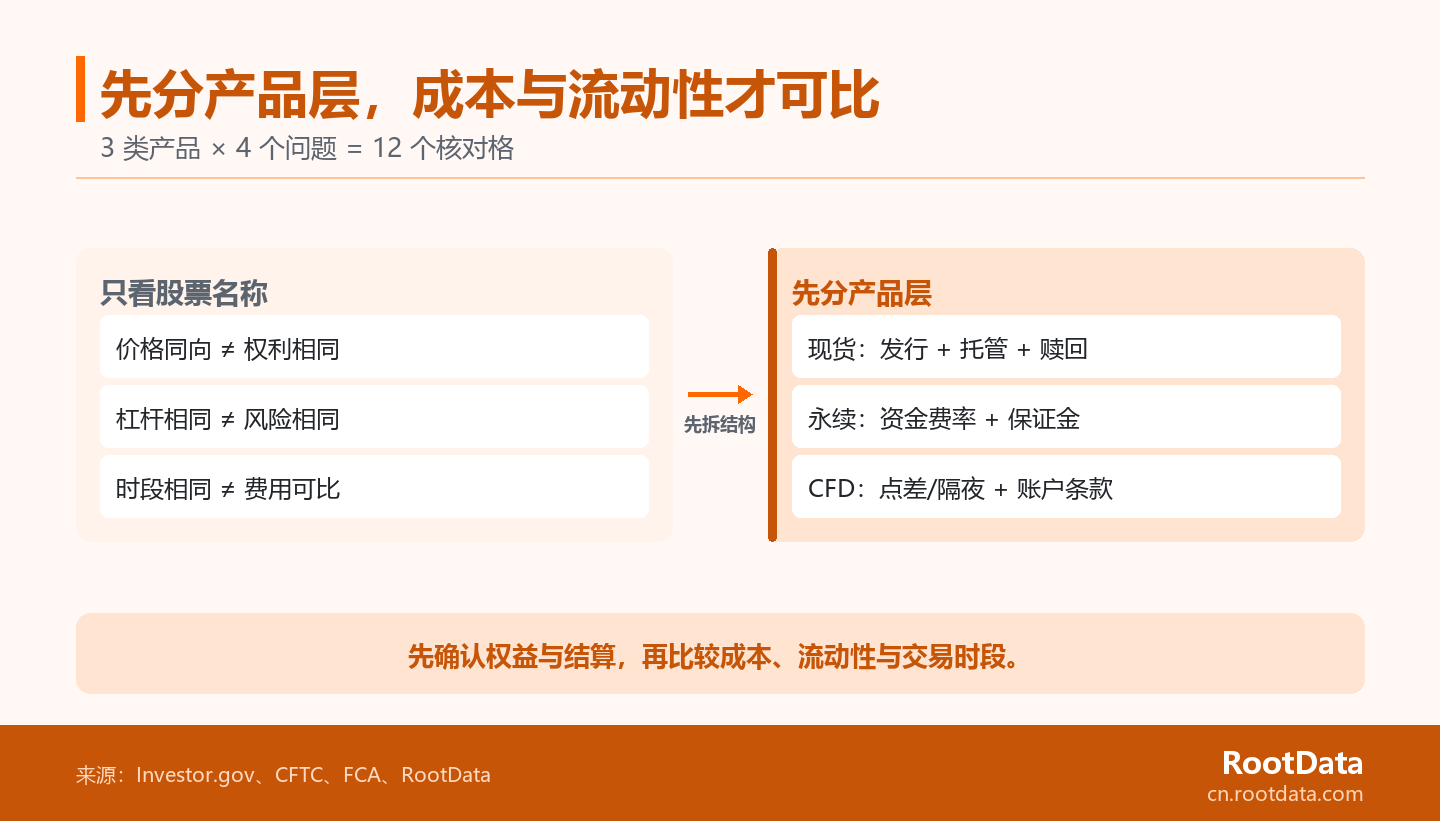
- rights and interests:Does the token or contract represent a direct interest, an indirect interest, or just price exposure? Without clear documentation, it is recorded as unknown.
- Settlement:Is there an expiration, redemption, funding rate, index or mark price mechanism? Write down the persistence method first, and then compare the trading experience.
- Holding cost:Splitting transaction fees, funding rates, spreads, overnight financing and other fees according to their respective names, frequencies and calculation bases cannot be combined into one "rate".
- Risk trigger:Record margin, position closing or liquidation rules, as well as region, customer category and trading period restrictions; missing items do not rely on experience to complete.
After being organized in this way, market data is the final layer of verification: it helps compare the trading conditions of similar contracts at a certain point in time, but does not change the previously confirmed or unconfirmed rights and account boundaries.
When equity, settlement, cost and risk triggers have been confirmed one by one, RootData's equity derivatives data can be used to review market conditions for similar contracts; before that, no single transaction or rate field should assume the task of product characterization.
FAQ
Do tokenized stock spots necessarily have shareholder rights?
Not necessarily, ownership of rights depends on the issuing, hosting or composition structure and its product documentation. If the product only explains price tracking but does not explain how voting, dividends, corporate actions, redemptions or transfers will be handled, traditional shareholder rights cannot be included by default. The most useful action is to match each right with the corresponding document one by one, and mark the applicable regions, eligibility restrictions and executable redemption paths, rather than just looking at the product name.
Are funding rates and CFD overnight fees the same thing?
No, funding rates and CFD overnight fees may both affect the cost of holding a position, but who is charged, the calculation formula and the frequency are determined by different rules. The former is part of the mechanism of the perpetual contract to maintain price anchoring; the latter must be understood according to the specific provider's quotation and account rules. Before comparison, the expense name, direction, frequency, calculation basis, pricing currency and applicable time period should be recorded respectively, and then judge whether they can be put into the same cost table.
Can I select products based only on leverage and trading hours?
No, leverage and trading sessions only describe part of the trading experience and are not a substitute for checking rights, settlement and risk triggers. The same tradable period does not mean that holders have the same rights; the same leverage ratio does not mean that the margin, liquidation mechanism or fees are the same. Also confirm how settlements, financings, corporate actions or account restrictions occur outside of trading hours. Compare them after equity, settlement, cost and risk triggers, so that the conclusion will not be biased by a single field.