
How tokenized stocks are regulated in major markets: an overview of U.S., European and Asia-Pacific frameworks
When discussing tokenized stock regulation, it is easiest to fall into two extremes: either only looking at the product name, or only looking at the regions where the platform says it is available. Neither is sufficient to answer the real question. What rights the tokens represent, who is responsible for issuance or distribution, who assumes custody and technical control responsibilities, and which jurisdictions and customer types the products are actually intended for are often scattered in different public documents. This article organizes these public frameworks based on specific Asia-Pacific examples of the United States, Europe, and Hong Kong to help readers establish a research sequence without making binary judgments about any product, region, or individual qualifications.
When comparing regional supervision, first break it down into four verifiable questions.
- right:Does the token directly represent rights in a class of securities, represent an indirect interest held through an intermediary, or simply provide price exposure?
- responsibility:Who is responsible for issuance, distribution, hosting and technical control respectively? Who is still responsible for the overall arrangement after outsourcing?
- scope:Which jurisdictions, customer types and verification conditions the product is actually intended for, rather than just where the platform is located.
- data:Platform fields such as liquidity, spreads and fees can only be compared if product type, service scope and data time points are aligned.
The regulatory reading of tokenized stocks should return to the four issues of rights structure, issuance or distribution, custody and technical control, and region and customer scope. This order is not to give a "universal conclusion", but to avoid misinterpreting a region name, a product page or a line of market data as a complete regulatory answer. For data platforms like RootData, it also draws a clear line: market information can help compare tradable conditions and is not a substitute for checking product rights and geographic availability.
United States: First confirm the rights and security structure represented by the tokens
Investor.govDistinguish between issuer-led, custodial and synthetic tokenized securities; the rights relationship between holders and the underlying securities under these structures may be different. The "tokenized securities" here can first be understood as a product structure that uses on-chain or similar distributed ledger records to present financial instruments such as stocks, bonds, or fund equity; it is not naturally equivalent to directly holding a certain company's stock.
The three structures do not answer the same question. Issuer-led arrangements may allow securities issued on the chain to carry the same rights as traditional securities of the same type; in custody arrangements, tokens may represent indirect rights and interests obtained by the holder through an intermediary; andsynthetic exposureIt means that the price changes can change with the reference asset, but the holder does not necessarily acquire the rights to the issuer of the asset. For researchers, this means that “the price that follows a stock” must be examined separately from “what shareholder or security holder rights are enjoyed.”
Therefore, a more appropriate first question for the U.S. sector is not “Can this token be simply classified?” but rather: the product documentation states what the holder owns, who inherits the rights, and who he or she will face in the event of a dispute. Public educational materials can provide classification coordinates; the actual product rights, sales targets and service scope must still be checked back to the current issuance documents, service terms and applicable rules.
Europe: First determine whether the product falls within the scope of MiCA
ESMA’s MiCA Article 2 excludes crypto-assets that qualify as financial instruments from MiCA’s scope, so product classification is a front-end issue for European regulatory reading. "Financial instruments" here is a concept used to identify product categories such as securities, which determines which set of applicable scope and related documents the reader should check next;View Article 2andESMA’s overview of MiCA.
This does not mean that once the classification is complete, you can jump to conclusions. It only tells readers that the next step cannot be to continue cramming all the issues into MiCA: it is also necessary to identify the rights that the token actually represents, where issuance and service activities occur, which subjects are involved, and how the relevant national-level documents are stipulated. ESMA’s overview also describes it as a framework for crypto-assets not covered by pre-existing financial services legislation, which further illustrates that “classify first” is more reliable than “label first”.
When reading relevant European materials, a safer way to record is to list "whether it is a financial instrument" as the first question to be answered; if the public document does not give enough information, leave it as pending verification, rather than infer that the product has been fully covered or excluded by a certain system.
Hong Kong: Intermediaries, custody and technical control are concerns in public documents
The Hong Kong Securities and Futures Commission describes tokenized securities as traditional securities plus tokenized packaging, while emphasizing that intermediaries still need to manage ownership records, technology and network-related risks. The circular is still listed in the relevant regulatory information directory of the Hong Kong Securities and Futures Commission; seeOriginal text of circularandCurrent regulatory information directory.
The circular specifically places questions on intermediaries and controls: how ownership interests are transferred and recorded, what happens if the underlying or related technology network fails, how network and cybersecurity risks are managed, and how institutions involved in the arrangement complete due diligence on both the product and technology sides. In other words, what technology packaging adds is not a “up chain” description, but a set of control issues that need to be assigned responsibilities, kept records, and managed on an ongoing basis.
This 2023 Circular remains listed as relevant regulatory information by the Hong Kong Securities and Futures Commission. This article only uses it to illustrate the key points of reading Hong Kong’s public materials, and does not extrapolate Hong Kong’s requirements to other Asia-Pacific markets or any specific products.
Asia-Pacific is not a single-rules region: put “region” into specific jurisdictions
Asia-Pacific is not a single regulatory regime; Hong Kong’s disclosure framework can only be used as a specific example and cannot be extrapolated to other markets or conclusions for all products. Even if the same distribution arrangement uses similar product names in different markets, the actual customers, available services, distribution paths and local documentation may be different.
Therefore, the research record should at least specify the region: where the product or service is actually targeted, who provides which services locally, and whether the disclosure terms specify customer types or verification conditions. If there is no clear information on any of these items, the conclusion should stop at "insufficient information" instead of being filled in by general statements such as "Asia Pacific Available" or "Asia Pacific Restricted."
When the platform restricts access to certain areas, it should return to the four types of public documents
Regional restrictions are the result of product structure, customer types, distribution arrangements and platform control, and cannot be interpreted as a complete regulatory conclusion alone.Regional accessRefers to the open scope of the product or service for which types of customers in a specific jurisdiction; the platform's regional prompt is only an entry signal and cannot replace the check of terms and liability arrangements.
- Product Rights and Risks Document:What the token represents, how rights and obligations are described, and whether there are additional intermediaries or counterparties.
- Terms of Service and Regional Availability Description:The platform or issuer indicates which countries or regions and which service links are restricted.
- Customer Qualification and Verification Instructions:Which types of customers apply, what identity or suitability verification is required, and whether these conditions vary by service type.
- Regulatory Disclosures and Statement of Responsibilities:How relevant entities describe their roles in public regulatory materials, risk disclosures and custody arrangements.
When conflicts arise between the four types of documents, the most valuable result is not to hastily choose one to believe, but to list the conflict itself as a matter for further verification. In particular, do not replace whether the wallet can be connected, whether the page can be opened, or whether a pop-up window appears in a certain region as a judgment on product rights or local applicability.
After the structure and access are clear, compare the market data of the platform
RootDataThe Equity Derivatives Platform field can be used to compare market conditions for similar products at the same point in time and is not used to prove token rights, custody arrangements or regional access. Fields such as volume, open interest, depth, spreads, fees, funding rates and contract coverage answer market execution conditions, not regulatory applicability.
Taking the frozen snapshot at 17:30 on July 23, 2026 as an example, RootData covers 29 platforms; this is only a comparison range of available and verifiable data at that time, and is not a regulatory endorsement of any platform or product. First fix the product type, target contract, actual accessible range and data time, and thenView RootData Equity Derivatives Trading Platform Ranking, so products with different structures will not be put into the same set of market indicators for comparison.
Record unknown items with a custody reading card
Leaving unknowns as unknown is more reliable than padding regulatory conclusions with product names, regional cues, or ranking data. For any specific product, the public information can be summarized into four lines: the first line contains the rights and underlying relationships represented by the token; the second line contains the responsible entities for issuance, distribution, custody and technical control; the third line contains the actual jurisdiction, customer type and access conditions; the fourth line contains market data and time points for similar platforms.
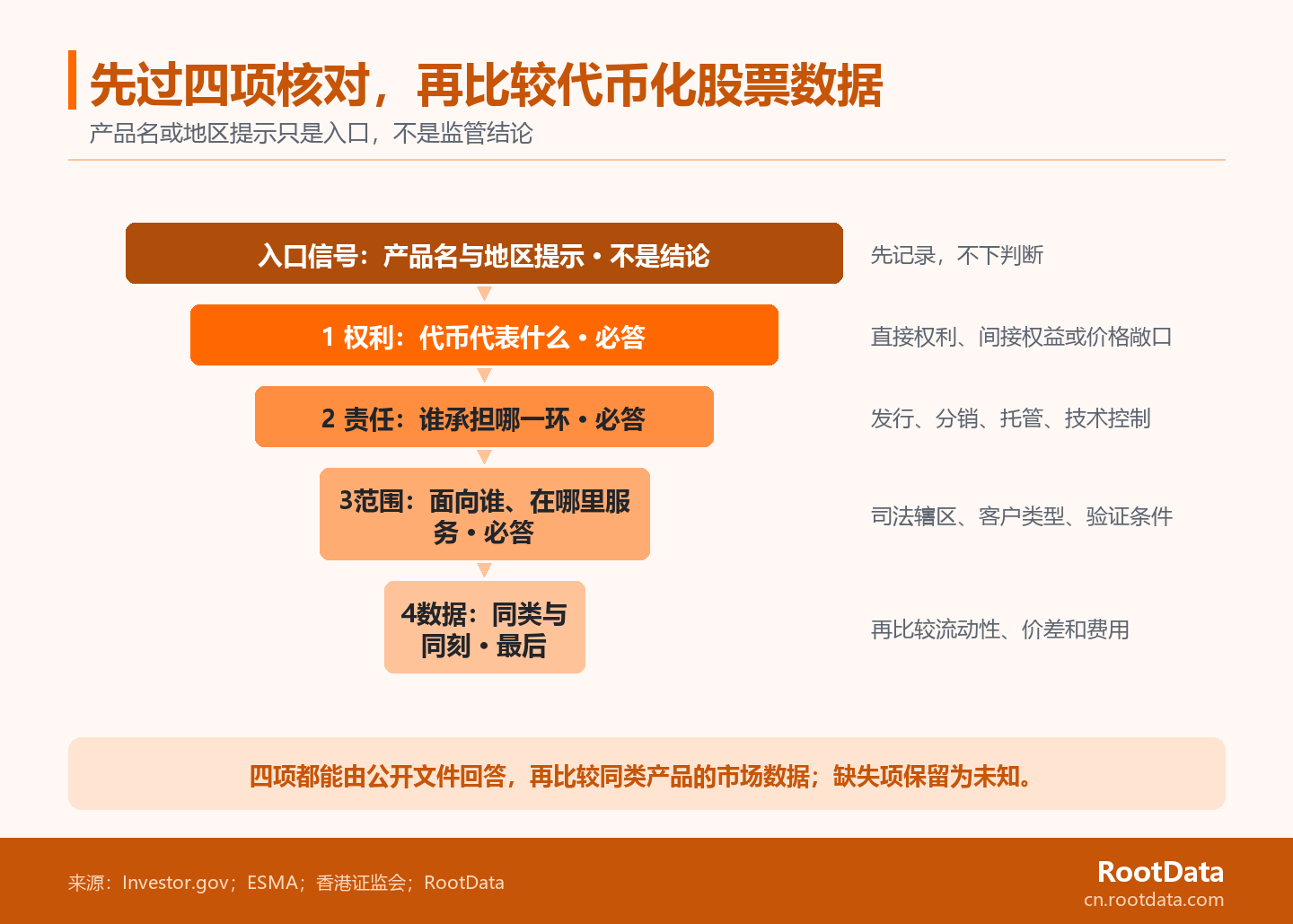
The purpose of this reading card is to decide which document to read next, not to make trading, account opening or legal decisions for the reader. It also applies to the United States, Europe or other specific markets: different regions may have different priorities for checking; keeping the order of questions unchanged will allow you to see where the information comes from.
FAQ
Can the United States, Europe and Asia-Pacific reach a unified conclusion on tokenized stocks?
cannot. Product rights, method of release and distribution, participant responsibilities, and jurisdictions of actual service may vary and require individual verification. Public materials in the United States, Europe and Hong Kong provide different reading entrances: the United States emphasizes differences in structure and rights, Europe looks at product classification first, and Hong Kong reminds intermediaries and technical control. They do not add up to a unified conclusion that supersedes specific product documentation.
Does MiCA automatically cover all tokenized stocks?
Not automatically overwritten. ESMA’s MiCA Article 2 explicitly excludes crypto-assets from qualifying as financial instruments, so it is more important to determine the product category first than to affix the regime name first. After classification, it is necessary to continue to check based on the actual issuance or service activities, participant roles and relevant national-level public materials; it cannot be directly launched from "covered by MiCA" or "not covered by MiCA" to determine whether the product can be provided to a certain type of user.
Does the fact that the platform restricts access to certain areas indicate its complete regulatory status?
cannot. Regional restrictions may reflect both product structure, customer types, distribution arrangements and platform controls; terms of service, qualification statements and risk disclosures still need to be checked. The access restriction itself is worth recording, but it does not answer what the token represents, who assumes custody and technical responsibility, and whether other service links have other conditions. When encountering inconsistent information, it is safer to leave it for verification than to force an explanation.
Can RootData's ranking data determine whether a product is appropriate for my area?
cannot. RootData's platform market field is used for comparison of similar products at the same point in time and does not replace product terms, rights arrangements or regional access judgments. It can help study market conditions such as trading activity, depth, spreads, fees, and contract coverage; before using these data, you should still confirm that you are comparing similar products, and check the service scope and regional conditions you are concerned about.