
Regional restrictions on tokenized stock platforms: why the same product cannot be traded in different regions
The region reminder on the tokenized stock platform is not a list of countries that can be directly determined as "tradable" or "untradeable". It is more like the intersection of three layers of document boundaries: product rights, service entities and market arrangements. As long as one layer is different, the service scope of the product with the same name may be different in different regions. When reading this kind of prompt, the most important thing is not to guess the conclusion first, but to find out which level the restriction falls on.
This is why the same tokenized stock name may show different prompts on different pages, different service entities or different account processes. This article does not make judgments about specific products, exchanges, platforms, or user qualifications; it provides a sequence for reading public documents to help researchers record product facts, service scope, and market conditions separately.
Regional restrictions must first be split into three layers, not one label
Regional cues usually come from the combined boundaries of product rights, service entities and market arrangements, rather than a separate list of countries. Take it apart and look at it. The first layer answers "what product is the holder facing?"; the second layer answers "who actually provides account opening, distribution, trading or custody services"; and the third layer answers "what rules are attached to transactions, settlements, access and account prompts". The area name only provides clues and is not a substitute for the three answers.
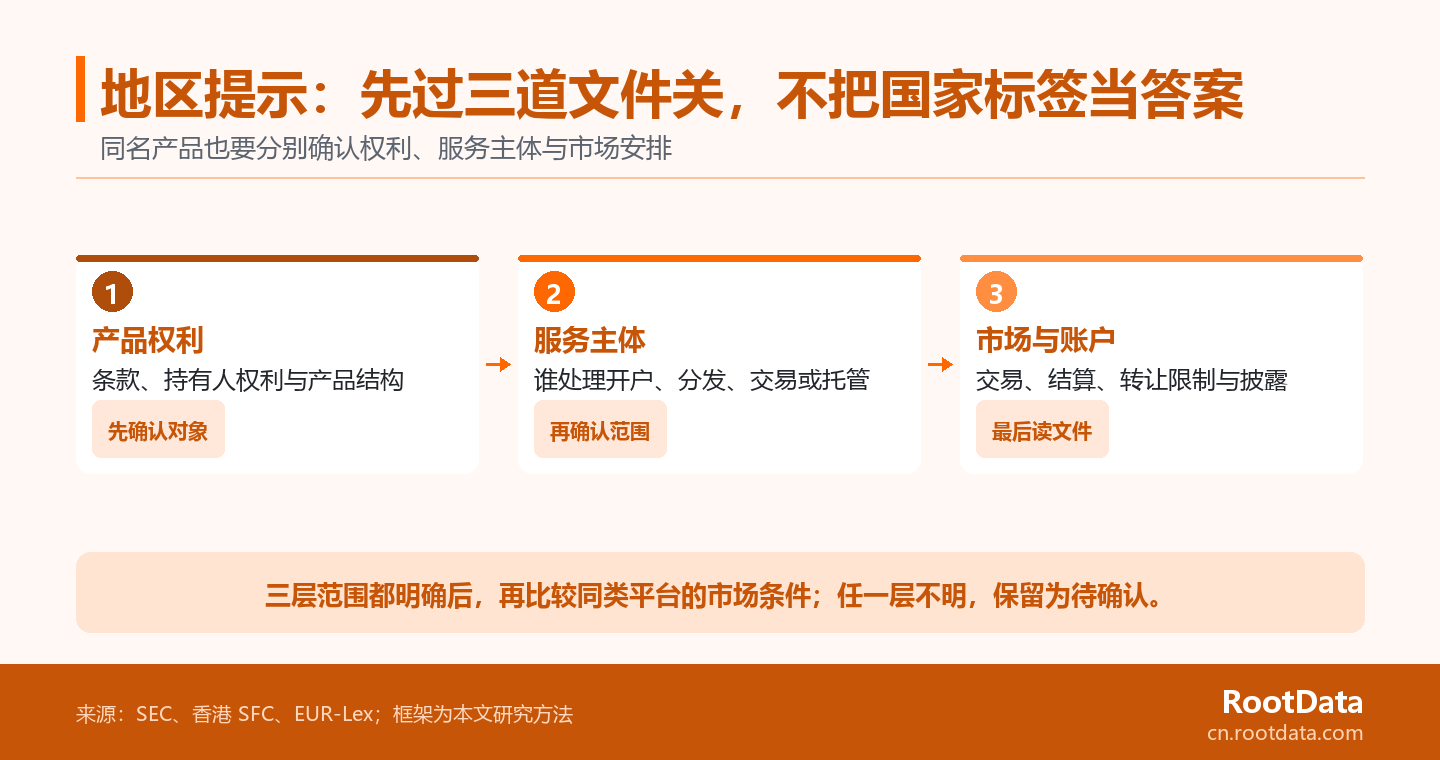
- Let’s look at the products first:Does the same stock name point to direct rights, some price exposure, or another tokenization arrangement?
- Let’s look at the subject again:Are the branding, distribution arrangements, customer service and hosting responsibilities on the page the same entity?
- Finally, look at the market:Are transaction portals, settlement paths, transfer restrictions and account files within the same service scope?
| Limit the landing point | What should readers ask first? | Materials to be checked with priority |
|---|---|---|
| product rights | What do tokens represent, and how do the rights correspond to the underlying underlying assets? | Product Terms, Release Notes, Rights Disclosure |
| Service subject | Who handles account opening, distribution, trading, settlement or custody? | Terms of Service, Entity Information, Customer Agreement |
| market arrangement | What rules govern transactions, settlement, transfers and access? | Trading Rules, Market Descriptions, Accounts and Risk Documents |
The value of this sequence is that it prevents a common misunderstanding: mistaking regional cues for product properties themselves. For research notes, the safest approach is to record "product-subject-market" as three fields respectively; only when the three fields can correspond to each other can regional information have enough context for comparison.
The first level: first look at the rights and product structure behind the tokens
ESMA’s MiCA Article 2 page explains that cryptoassets that meet the definition of financial instruments are not within the scope of MiCA.View ESMA’s explanation of the scope of MiCA. This is not to label a product, but to remind researchers: in the European context, first identify whether the product is a financial instrument before knowing which set of public materials to continue reading from.
“Tokenized securities” as used herein means product arrangements that record or represent security rights in the form of digital tokens. This definition does not automatically answer what economic rights the holder has, whether there are transfer restrictions, or what kind of arrangement the stock name on a certain page corresponds to. Product pages, release notes, and rights disclosures are the starting point for answering these questions; if these materials do not correspond to each other, the region should not be prompted to fill in the missing rights conclusions.
The Hong Kong SFC describes tokenized securities as traditional securities with a tokenized shell and explains that existing securities market rules still apply.Hong Kong SFC’s Tokenized Securities CircularDiscuss the “underlying financial instruments” together with the “technical and ownership risks of tokenization.” For the reader, this means that the product name is only a gateway and is not a substitute for a step-by-step check of rights, recording methods and applicable documentation.
If two pages mention the same stock, the research question should not stop at “does it have the same name?” but continue with asking: Do both refer to the same product terms? Are the same holder rights stated? Are the services provided by the same entity? As long as one of them cannot be confirmed, it should be recorded as unverified, rather than deriving "the same product" from "the same subject matter".
Second level: The main body providing services and the market arrangement can set their own boundaries.
After the product is confirmed, the second issue that is easily overlooked is: who is providing which service. The service entity is the entity that actually handles account opening, distribution, trading, settlement or custody; it is not necessarily the same as the brand name that readers see first. Therefore, even if a product name remains unchanged, the service entities, customer agreements and available functions for different regions may be different.
The Hong Kong SFC issued a separate circular on secondary trading of tokenized authorized investment products, explaining that trading arrangements may also become a layer that needs to be read separately.The secondary transaction circularThe significance is not to draw conclusions for any platform, but to remind readers that in addition to issuance or distribution documents, the transaction layer still has its own arrangements, participants and conditions.
Market arrangements are the rules and infrastructure on which products enter the transaction, settlement and access processes. It's related to product rights, but it's not the same issue. One tokenized stock exchange or platform may display a certain product, while another service portal may use different trading, settlement or account processes; comparisons should be made between "whether the product is available" and "under what arrangements the product is offered" into two columns, rather than treating the former as proof of the latter.
The EU DLT Pilot Regime targets DLT market infrastructure and their operators, and incorporates investor protection, market integrity and financial stability into authorization considerations.Regulatory text for EUR-LexExplains why market infrastructure should be read separately from the product itself. This framework does not explain who a certain product can provide services to, but it suffices to say that trading and settlement are not omitted footnotes behind the product name.
During actual research, you can first align the entities, functions, and files that appear on the page one by one: who is the product-related subject, who is responsible for customer relations, who describes the market rules, and who explains settlement or custody. If there are multiple roles mixed under the same name, the best way to record them is not to merge them into "this platform is responsible for all aspects", but to leave each role next to its corresponding file.
Level 3: Account prompts are clues to information disclosure, not the final conclusion.
Many readers see regional prompts on the registration, access or order pages. Of course it is important, but its value is to first tell you what materials you should check back: which service entity the prompt comes from, which product it corresponds to, what time the page is displayed, and whether there is a link to a more complete terms or risk description. A single sentence on a page usually cannot carry all this information on its own.
The Hong Kong SFC requires intermediaries to provide clients with material information relating to tokenization arrangements, which may include transfer restrictions, custody arrangements and technical controls.Key points of customer information set out in the circularNote that regional prompts should be understood together with materials such as restrictions, custody, logging, and exception handling. Just a "not available in this region" or "restricted" page language is not enough to restore all product and service boundaries.
Account or page prompts are better suited as clues back to product, entity, and market documents for continued verification, rather than final conclusions on individual qualifications. A reusable four-step recording method is: intercept the page and time when the prompt appears; write down the service entity associated with the page; correspond to product terms or risk documents; and finally check whether the transaction, settlement and account rules state the same scope. Any missing step should be left as "pending confirmation".
This approach is also suitable for studying regional restrictions on tokenized stock exchanges: it neither encourages bypassing page restrictions nor treats public information as an answer to individual accounts. It just helps researchers convert the ever-changing front-end prompts into file clues that can be reviewed and updated.
After checking the scope, use market data to compare platform conditions
RootData's rankings of equity derivatives can be used to compare market conditions integrated into the platform at a point in time, but do not demonstrate product entitlement, regional regulatory status or availability to a given user.RootData’s Equity Derivatives Ranking ExplainedData fields and comparison context are explained; it is suitable for answering market questions such as liquidity, spreads, fees, contract coverage, etc., and is not suitable for replacing product or account files.
Therefore, the research sequence should be to first confirm the scope of products, service entities and market arrangements, and then compare the market conditions of similar platforms at the same point in time. After completing the previous scope check, you canView RootData Equity Derivatives Trading Platform Ranking, put the included stock derivatives platforms under the same field for observation. Rankings can help narrow the scope of research; it should not be read as proof that a certain location has access to users, a certain product has certain rights, or a certain exchange is suitable for everyone.
FAQ
The following questions only supplement the short boundaries of this article and do not replace confirmation of specific product, account or region documents.
Does the regional hint mean that the product is not available in that location?
It does not mean that the regional prompt is first of all the scope information that needs to be read in conjunction with the product, service entity and account file. It may point to a certain service entity, a certain product version, a certain account process or a certain market arrangement, rather than a unified conclusion for all products with the same name. After seeing the prompt, you should record the page time and associated subjects, and then return to the corresponding terms and conditions to confirm.
Do tokenized shares with the same name represent the same rights?
Not necessarily, the same name or the same underlying subject matter does not replace checking the product terms and the rights of the holder. Names can help locate the subject of research, but they cannot alone describe economic rights, how they are recorded, transfer restrictions, or how corporate actions are handled. If the rights file and the service file cannot correspond to each other, the more accurate status is "Not Confirmed" instead of being the same by default.
Why do we need to look at both trading and settlement arrangements?
Because after product rights are determined, transaction entry, transfer restrictions, settlement and custody arrangements may still determine how services are provided. They may be carried by different subjects, different rules or different technical arrangements. Recording these links separately can avoid misinterpreting "the product is visible on the page" as "all transaction, settlement and account conditions are clear".
Can platform rankings determine whether a place is usable?
No, the ranking reflects the market fields that are included in the platform, not regional qualifications, product rights or account review results. For researchers, the right place to rank is after the scope document has been initially checked to compare liquidity, spreads, fees or contract coverage of similar platforms. If the region or product conditions are not clear, market data can only be used as observation and not as proof of qualification.