
List of low-fee platforms for tokenized stocks: Comparison of handling fees, funding rates and holding costs
If you just ask "Which one has the lowest fees?", the easiest thing to get is a list of fee numbers, rather than comparable holding costs. Maker and Taker rates describe the order role when placing an order; the bid-ask spread reflects the quote interval at that time; the funding rate is a variable during the position holding period. They are all worth looking at, but do not add up directly in the absence of a target contract, order direction and time conditions. The following table retains the fields of 29 platforms displayed by RootData at 17:30 on July 23, 2026. The purpose is to establish a candidate range, not to give account opening, trading or income recommendations.
The low cost is divided into three layers: order rate, quotation cost and holding period fee.
Maker/Taker rate, bid-ask spread and funding rate are different cost fields and cannot be combined into the total position cost when conditions are missing.RootData’s Exchange Comparison MethodIt also uses multi-dimensional reading, andInvestor Education Materials from Investor.govBreak down product fees, transaction commissions and bid-ask price differences. The most important thing about this list is not to add up the three columns, but to first determine which level you want to compare.
- Order rate:The Maker rate corresponds to the page rate when the order is placed on the market and provides tradable quotes to others; the Taker rate corresponds to the page rate when the order is immediately traded with the existing quote and consumes market liquidity. The two are not the same order role.
- Quotation cost:The bid-ask spread is the quotation interval other than the order rate; the same Taker rate does not guarantee the same transaction price or slippage.
- Holding period fees:The funding rate needs to be read together with the position direction, settlement cycle, position length and current contract rules. The plus/minus sign alone is not a substitute for total cost judgment.
What this “low fee” list answers is which platforms show lower Maker or Taker rates in the same snapshot. What it cannot answer is: how much cost a certain user will ultimately pay for a certain contract, a certain order size and a certain position holding period.
Display fees and funding rates for 29 platforms: complete field list
RootData recorded 29 platforms in the frozen snapshot at 17:30 on 2026-07-23.The source page of this frozen snapshotShow Maker, Taker and funding rates alongside other market fields; this article is organized by raw displayed values only, all--Leave as missing. The rank column is used to position the platform order in the snapshot, not the cost ranking.
The taker rate shown in the snapshot for MEXC and Lighter is 0%. This simply means that they show 0% in the Taker field at that point in time and do not include spreads, slippage, target contract rules, user rate tiers or holding period fees; therefore they are only candidates for further verification.RootData's platform page at the same timeis the starting point for checking these dynamic fields.
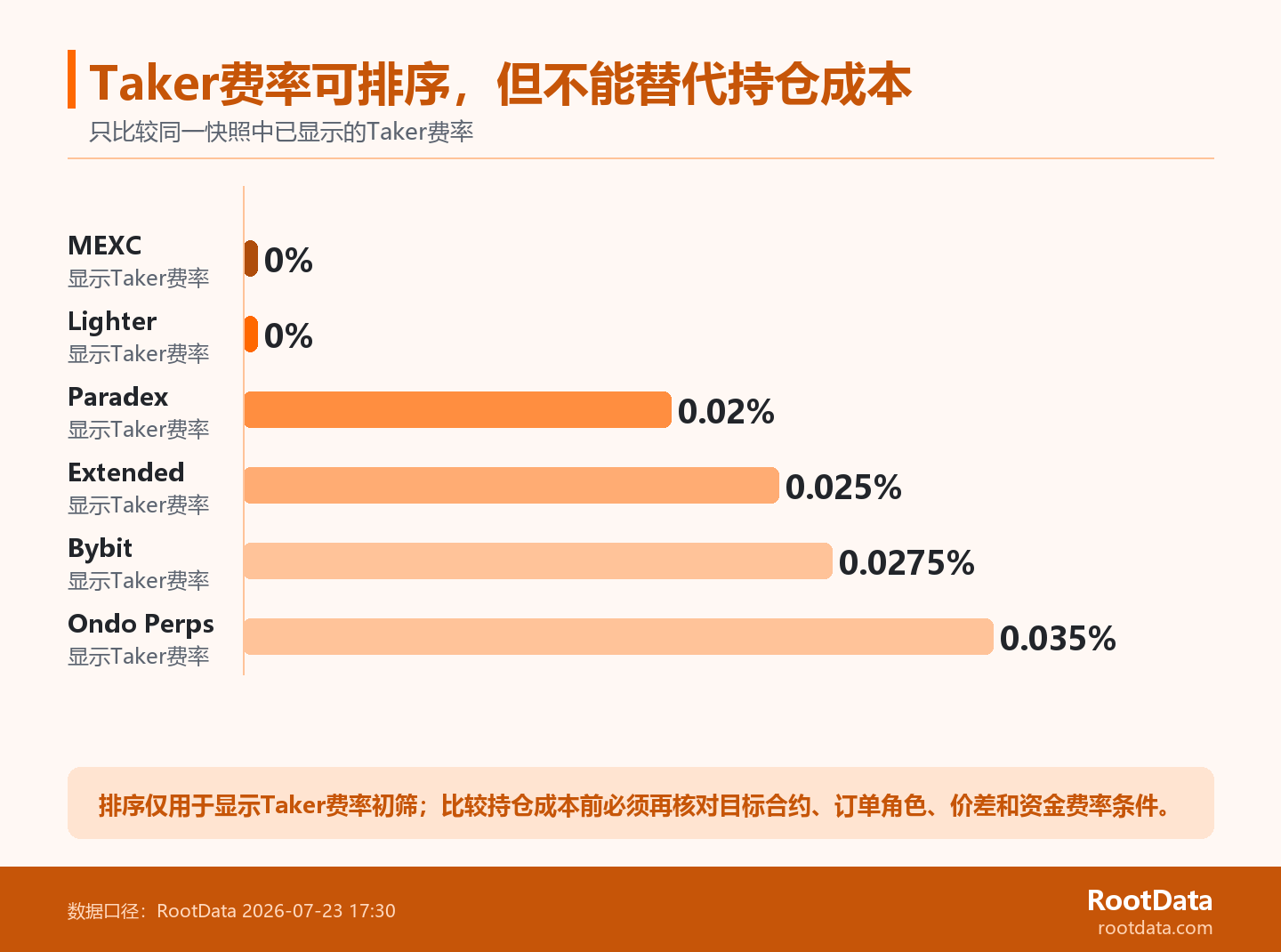
| Snapshot ranking | platform | Maker rate | Taker rate | funding rate |
|---|---|---|---|---|
| 1 | Binance | -- | -- | +0.0001% |
| 2 | Bybit | 0% | 0.0275% | -0.0002% |
| 3 | OKX | 0.02% | 0.05% | 0% |
| 4 | Bitget | 0.02% | 0.06% | -0.0002% |
| 5 | Ourbit | 0.02% | 0.04% | +0.0001% |
| 6 | Gate | -0.01% | 0.075% | +0.0003% |
| 7 | Hyperliquid | 0.015% | 0.045% | +0.0002% |
| 8 | Lighter | 0% | 0% | +0.0008% |
| 9 | BingX | 0.02% | 0.05% | +0.0001% |
| 10 | XT.COM | 0.02% - 0.04% | 0.06% | +0.0001% |
| 11 | Ondo Perps | 0.015% | 0.035% | 0% |
| 12 | Extended | 0% | 0.025% | -- |
| 13 | Phemex | 0.01% | 0.06% | 0% |
| 14 | Bitunix | 0.02% | 0.06% | +0.005% |
| 15 | GRVT | -0.0001% | 0.045% | +0.0015% |
| 16 | KuCoin | 0.02% | 0.06% | +0.0002% |
| 17 | edgeX | 0.018% | 0.038% | +0.0005% |
| 18 | MEXC | 0% | 0% | +0.0001% |
| 19 | MSX | 0.02% | 0.045% | -- |
| 20 | OrangeX | 0.02% | 0.06% | +0.0003% |
| twenty one | Coinbase | -- | -- | +0.0004% |
| twenty two | Aster | -- | -- | +0.0003% |
| twenty three | BitMart | 0.02% | 0.06% | -0.0003% |
| twenty four | HTX | 0.02% | 0.06% | +0.0002% |
| 25 | BitMEX | 0.05% | 0.05% | 0% |
| 26 | Kraken | 0.02% | 0.05% | +0.0193% |
| 27 | Crypto.com | -- | -- | +0.0001% |
| 28 | Paradex | 0% | 0.02% | +0.0002% |
| 29 | Ostium | 0.06% | 0.06% | -- |
How the above table reads is more important than "who's cheapest". If you plan to execute the transaction immediately, look at the Taker column first; if you plan to enter with a pending order, look at the Maker column; if you plan to hold the position across multiple periods, the funding rate becomes an input that requires continuous review. If the fee column displays a range, for example, the Maker field of XT.COM is 0.02% - 0.04%, you can only keep this range, and you cannot choose the lower end as a general conclusion. When you need to continue to confirm the dynamic fields, you canOpen RootData Equity Derivatives Ranking to continue checking fields.
Before comparing and displaying rates, fix the order role and quote cost.
When comparing and displaying order rates, you should first fix whether the order provides or consumes liquidity, and then read the corresponding Maker or Taker column. This rule does not require guessing the specific matching results of the platform, but avoids placing different order roles on the same "low fee" scale. For research scenarios that require immediate transaction, the Maker column is not a direct cost answer; for scenarios that are willing to wait for pending orders to be completed, the Taker column is not a field that should be compared first.
The bid-ask spread is the difference between quotes and should be read separately from the order rates shown on the page.Investor.gov definitions of bid and askThe difference between the two is called the price difference;Investor Education MaterialsProduct fees, commissions and bid-ask spreads are also explained using different items. This article uses this to distinguish cost levels and does not extrapolate examples from traditional securities markets to the actual execution quality of a certain platform.
A reusable reading sequence is: first write down the target contract and order direction, then decide whether to study the Maker or Taker column yourself, and then put the displayed spread at the same time aside to observe. Only when these three calibers are consistent can the rate table have comparative value. Order size, order book depth and market conditions may still change the actual path of a trade, so the percentages in the table are not guaranteed costs for a given trade.
The funding rate determines the holding period variable, but the snapshot cannot replace the total cost
Funding rate snapshots cannot stand alone as a substitute for holding costs, as direction, settlement period, holding duration and current contract rules will still change their meaning.RootData’s Equity Derivatives InstructionsCan be used to understand the comparison boundaries of ranking page fields;CFTC’s Investor TipsIt is reminded that leveraged digital asset transactions require conditional reading based on product, platform and market risks. Neither material is used to determine regional eligibility, compliance, or availability of any platform.
+0.0001%, -0.0002% or 0% in the table are snapshot display values and are not uniform results that can be directly multiplied by any holding period. To judge how it affects a specific position, you need to at least know: which contract you are holding, what direction the position is, what cycle the platform settles on, how long you plan to hold it, and whether the rules are still in effect at that point in time. Without these conditions, the plus/minus sign is just a market field to be checked.
When a Maker, Taker, or funding rate is displayed as --, it should not be replaced with zero, old data, or fields from other platforms. The absence does not mean that the platform is unavailable, let alone that the cost is higher or lower; it only means that this snapshot cannot continue to provide comparable input for the field. The safest approach at this time is to return to the current target contract page, confirm the rate structure and settlement rules, and then decide whether to compare.
Turn your low-cost list into a four-item checklist instead of a total cost ranking
Further cost comparison can only be entered when the target contract, order role, applicable rate and funding rate conditions can be verified at the same time. This is the research priority rule for this article: it does not predict which trade is a better deal, nor does it replace anyone's risk judgment.
- Fixed target contract.First confirm which stock-related derivatives you are studying, rather than just looking at the platform name.
- Fixed order roles.Read Taker when preparing for immediate transaction; read Maker when preparing to place an order, do not mix and compare.
- Confirm applicable rates.Check the current rate bracket, display range, region and product rules;--Only recorded as unknown.
- Let’s look at the holding period conditions.The direction, cycle and expected holding time of the funding rate should be judged separately and not added mechanically to the one-time order rate.
In that order, a 0% or lower display rate is still valuable: it tells you where to prioritize checking; but it doesn't need to be inflated into "lowest carrying costs." RootData’s ranking page is suitable for providing first-level data entry across platforms at the same point in time, and the final comparison should still go back to the target contract and current rules.
FAQ
If the Taker rate is displayed as 0%, does it mean that the transaction cost is zero?
No, 0% only means that the Taker fee rate shown in the snapshot is 0%; spreads, slippages, target contract rules, individual fee brackets and holding period funding rates still need to be checked separately. Especially when the order size increases, the quotation changes, or the product rules are different, the single rate on the page cannot represent the full cost in the final transaction and holding process. It is suitable for establishing candidates for priority checking, but not suitable for directly turning into a "zero cost" conclusion.
Why can’t Maker rates and Taker rates be compared directly?
Because the two correspond to different roles of whether an order provides or consumes liquidity, when comparing explicit fees, you should first fix the order type you are using, and then read the corresponding rates. If you plan to execute the order immediately, the Maker rate does not directly answer the cost of the order; if you plan to wait for the pending order to be executed, the Taker rate is not the priority comparison column that should be used. Only by determining the role first can the fields in the same column on different platforms be comparable; if the role itself has not yet been determined, the smaller value from the two columns should not be selected as the cost conclusion.
If the funding rate is negative or positive, can it be directly determined that holding a position is cheaper?
No, the cost meaning of the funding rate also depends on the position direction, settlement cycle, position length and the current rules of the contract; a single snapshot cannot replace the complete position cost. The same displayed value may be read differently in different directions or for different holding times. Before comparing, you should first confirm the current settlement rules and planned position holding time of the contract, and record it separately from the order rate and quotation cost; if the cycle or direction is not clear, the safest conclusion can only be to continue checking, rather than judging that the position is cheaper.