
How Funding Rates Affect Long-Term Holding Costs: A Periodic Comparison Across Platforms
Author: Flowie|ChainCatcher content author, focusing on RWA, interpreting the true narrative of Web3.

The funding rate affects the long-term holding cost, but a snapshot rate cannot directly give the total cost of a holding period. First of all, it is the periodic fund transfer that occurs between the two parties of the perpetual contract position according to specific rules; to read it into a long-term cost, it is also necessary to complete the position value, how many settlement time points have actually been passed, and whether the rate has changed in each subsequent period. When doing horizontal research on tokenized stock exchanges and related platforms, break the information apart first. The conclusion will be more reliable than directly annualizing a percentage.
The longer you hold it, the real accumulation of three variables
- Amount per time: The fee rate is applied to a clear nominal position value and cannot be treated as a margin ratio.
- Actual times: How many days you have held it does not automatically mean how many times fund settlement has occurred. It must be based on the time arrangement of the target contract.
- Follow-up path: The rates shown today can only describe the current observation point and cannot represent that the same level or direction will be maintained in every subsequent settlement.
Therefore, the cross-platform periodization comparison is not "whose percentage is smaller", but "under the same contract, the same observation window and the same amount, whether the conditions for comparing multiple fund transfers are met."
How does the funding rate enter the position cost: first distinguish between each time, several times and changes
Long-term costs include at least three time levels: how much occurs at one settlement, how many times it actually occurs during this holding window, and whether the rate will change before the next settlement. Research on perpetual contracts usually discusses fund payments in the context of price anchoring mechanisms; this reminds us that the funding rate is not a fixed service fee separated from time, but a position holding mechanism that needs to be read together with the specific contract arrangements. Please refer to Perpetual Contract Mechanism Research for an explanation of this type of design.
Compressing these three layers into one number will cover up two differences at the same time: the same rate may correspond to different settlement times; the same holding time may also face different subsequent rates. The "periodization" in this article is just a research sequence: first fix the visible input, and then list the rules and time information that have not yet been obtained, rather than calculating the real bill for any platform.
Look at each time first: the fee rate acts on the position value, not the margin ratio
In order to see the one-time amount clearly, the simplest research formula is: Fixed nominal position × absolute value of displayed fee rate. The nominal position here refers to the position value used to calculate one-time funding costs, and is not equal to the margin amount. Assuming a nominal position of $10,000 and a snapshot rate of 0.0003%, the amount of a demo is $0.03. This calculation is only used to present the range; how the actual contract defines the payment direction, reference price and fee caliber should still be subject to its public rules.
Do not substitute the leverage multiple into this position. Leverage will affect margin occupation and risk exposure, but it does not automatically turn the funding rate into a margin percentage. If the nominal position or contract specifications are not determined first, even if the rate figure is correct, a complete explanation of the single amount has not yet been formed.
Number of re-views: the holding time must be converted into the actual settlement time point
It is also "held for three days", which does not necessarily mean that the same number of fund settlements have occurred. The number of times depends on the settlement arrangement of the target contract, the specific time points of opening and exiting the position, and whether the position still exists at the corresponding time point. NBER's research on perpetual futures pricing discussed cyclical capital payments in the price anchoring mechanism, which shows that timing cannot be omitted from a static percentage. View a mechanistic overview of the study.
This is also why different platforms cannot perform unified amplification by "day, week, and year" first. If the settlement frequency or payment trigger of a certain target contract has not been checked, the most accurate record is "the current snapshot is visible, but the number of settlements needs to be confirmed" instead of filling in a number based on common cycles.
Final changes: Today’s snapshot cannot replace every future period
Even if the one-time amount and number of settlements are clear, the long-term window still needs to face the rate path: the rate displayed in each period may be different, and the position may be adjusted or closed midway. Simply multiplying today's rates by an entire year is equivalent to assuming that future rates, settlement arrangements, and position status will remain unchanged; these assumptions are not included in the platform-level snapshot. A more prudent approach is to mark the snapshot as the starting point and continue to add observations based on new time points.
Four meter reading anchor points under the same snapshot: first look at the amplitude, then leave it blank
RootData's stock derivatives page covers 29 platforms in a frozen snapshot of July 23, 2026 17:30, and displays fields such as funding rates, OI, 24-hour trading volume, liquidity, spreads, etc. This article only uses the displayed value of the funding rate as input at the same point in time: for example, Kraken is +0.0193%, Gate is +0.0003%, Bitget is -0.0002%, and Extended is displayed as "--". The original fields can be reviewed at the RootData Equity Derivatives Ranking Page.
These four meter reading anchor points deliberately cover large positive values, small positive values, negative values and missing values. They are not cost rankings: the plus and minus signs are not interpreted here as a certain party must pay, and 0% is only the display status at that time; "--" means that the available funding rate is not displayed in this snapshot and cannot be filled in as 0%. RootData's Stock Derivatives Ranking Description also presents the funding rate and liquidity, spread, fee and other fields separately, reminding readers not to let one field replace all trading conditions.
| Platform | Snapshot display rate | Single absolute amount in unified example | Meter reading status |
|---|---|---|---|
| Kraken | +0.0193% | $1.93 | The range is large, you need to check the target contract rules first |
| Gate | +0.0003% | $0.03 | Smaller positive value from the same snapshot |
| Bitget | -0.0002% | $0.02 | Only display the amplitude, do not infer the payment party from the symbol |
| Extended | -- | Not Calculable | Missing rate input for this snapshot |
The "single absolute amount" in the table is calculated based on a nominal position of US$10,000 and is only used to demonstrate the order of magnitude of the snapshot rate. It is not a fee quote, it is not the actual settlement result of a certain stock perpetual contract, and it does not include transaction fees, spreads or other costs.
Research example: Separate "every time" and "three times" using the same nominal position
Set up a pure research scenario: the notional position is fixed at $10,000 and assume that a certain displayed rate remains constant at three settlement points. Kraken's +0.0193% corresponds to $1.93 per time and $5.79 in total three times; Gate's +0.0003% corresponds to $0.03 per time and $0.09 in total three times; Bitget's -0.0002% corresponds to $0.02 per time and $0.06 in three times in absolute terms. This demonstration only shows that when other conditions are artificially fixed, the rate range will accumulate with the number of settlements.
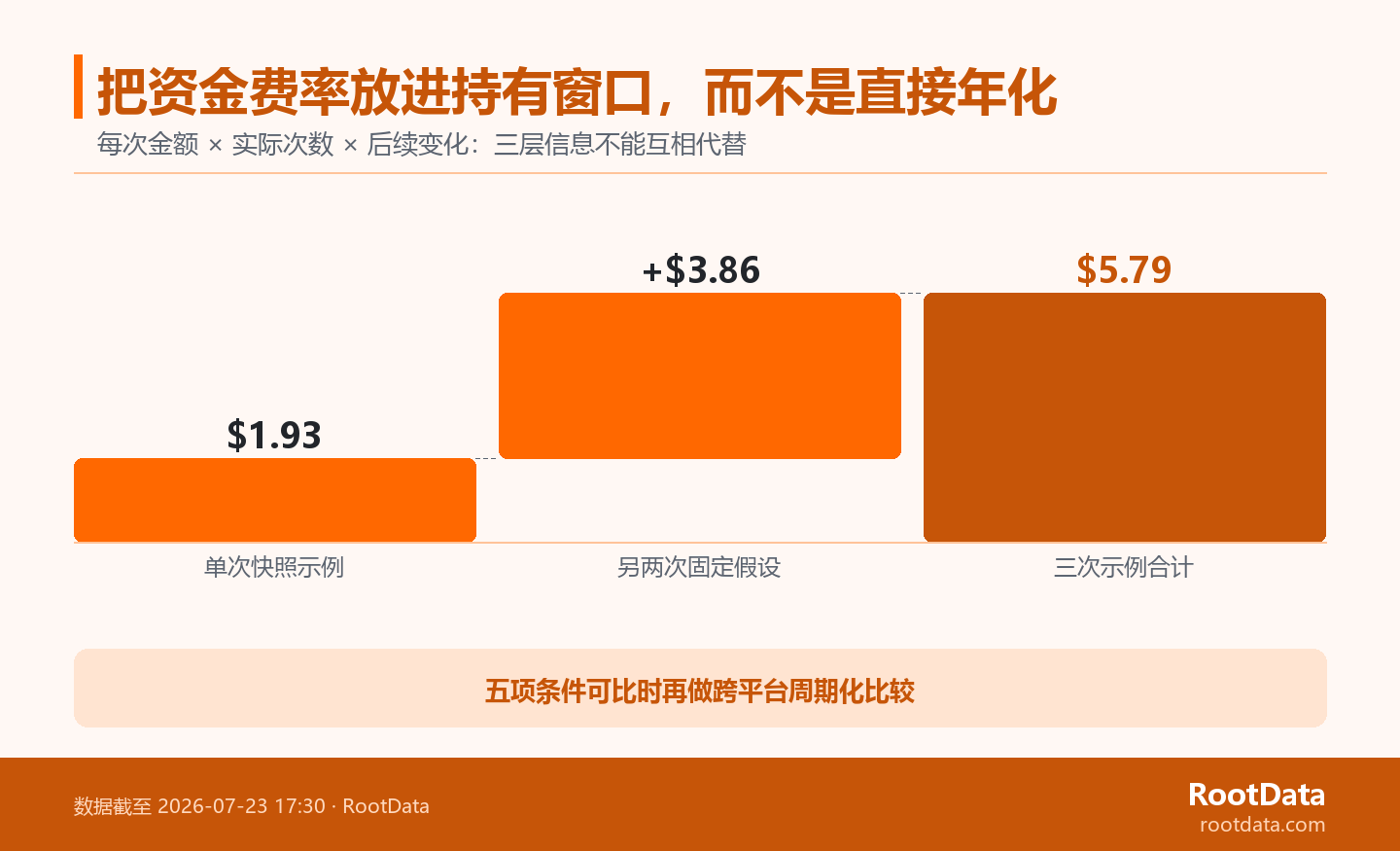
It does not explain that the three platforms will actually settle three times in the same window, nor does it determine who will pay the positive and negative rates, nor does it predict the next rate. If the rules, holding time or subsequent rates of the target contract are different, none of the items in the demonstration can be directly transferred to the real fee. This limitation is not a disclaimer but a prerequisite for periodized comparisons.
Periodic comparison of different platforms: first unify the windows, and then check whether the rules are comparable
Before cross-platform comparison, at least five conditions must be confirmed at the same time: Whether the target is a comparable stock perpetual contract, how the contract defines the payment direction, what the fund settlement arrangements are, what caliber is used for the nominal position, and how the comparative holding window is divided. Only when these conditions are aligned can the amounts at multiple settlement points be eligible to enter the same periodized cost table. Explanation of exchange ranking method emphasizes multi-dimensional comparison; here, it means that funding rates need to be read together with liquidity, spreads, fees and product structure, rather than bearing the conclusion of "which one is cheaper" alone.
When a rule or window has an item that doesn't align, the best conclusion is not to guess who has lower long-term costs, but to keep a "rate comparison under the same snapshot" and make it clear that the comparison has not yet been established.
This is especially important for tokenized stocks. The funding rate on the platform page is the entrance to research, and the target targets, regional access, contract specifications and account conditions may change the actual range of products available. The presence of the same displayed values across platforms does not automatically mean that readers are facing the same holding period cost structure.
Four-step review: Return to target stock perpetual contract from RootData snapshot
The first step is to record the page observation time and field names, and do not regard the old snapshot as the current condition; the second step is to locate the specific stock perpetual contract to be studied; the third step is to confirm the funding rules, payment direction and settlement time announced by the contract; the fourth step is to record the nominal position size, actual holding window and each new rate. RootData's Data Standard Description provides the basis for checking time and field caliber. When you need to check the latest page again, you can View the RootData stock trading platform ranking and repeat these four steps under the new observation time.
The value of this path is that it allows readers to first use the unified page of 29 platforms to narrow the scope of research, and then return to the contract-level information that truly affects the holding period. It does not require that all numbers be annualized to a uniform rate; rather, finding that a key condition is missing is itself a valid result.
This is not a long-term cost ranking: it must be read in conjunction with transaction costs and product conditions
The funding rate snapshot does not include future rate paths, transaction fees for opening and closing positions, quoted spreads, tradable depth, product qualifications, or any personal account conditions. Even if the rate range can be demonstrated uniformly, it is still not the entire holding cost, let alone earnings, direction judgment or platform recommendation. RootData's Disclaimer also clearly positions the information as research and information services, not investment advice.
A more practical goal is: use a timestamped snapshot to ask questions, use contract rules to complete key conditions, and use subsequent observations to update the holding window. In this way, the funding rate goes from a percentage that can be easily over-interpreted to a research variable that can be used in conjunction with other trading conditions.
FAQ
The following questions only clarify the reading boundaries of snapshots, cycles, examples and missing values, and do not add new platform functions or qualification judgments.
When the funding rate is positive, will the long-term costs have to be borne by the bulls?
One should not make direct judgments based on cross-platform snapshots alone. Some perpetual contract designs will correspond to positive fee rates as long to short payments, but the actual direction must be based on the rules published for the target stock's perpetual contract. The display methods, calculation details and triggering points of different products may be different; before locating a specific contract, the plus and minus signs should only be regarded as fields that need to be continuously checked.
Why can’t today’s funding rate be annualized directly?
Because annualization will write down multiple unverified premises: the settlement frequency is fixed, future rates will remain unchanged, positions will always exist, and the same amount will be used in each cycle. A single snapshot does not provide this information. If the study is a holding period, it is more suitable to record continuously according to the actual settlement time, rather than magnifying the percentage at one point in time into a seemingly precise long-term number.
Does the three settlement examples of a unified notional position represent actual fees?
No. It only shows a transparent calculation structure: how the fee range accumulates when the nominal position and the number of times are artificially fixed. Actual fees will also be affected by the target contract rules, payment direction, actual settlement time span, subsequent rates and position changes. Therefore, examples should be used to check what information you are missing, not as a substitute for platform or account expense records.
Can the funding rate be treated as 0% when it is displayed as "--"?
No. "--" means that the RootData snapshot does not show the available funding rate input, which is not equal to zero rate, nor does it mean that there is no fund transfer for long-term positions. Filling missing values with 0% disguises unknown states as comparable numbers and may change the results of cross-platform comparisons. If new data appears later, it should be observed again with a new timestamp.