
How to calculate the capital rate of stock perpetual contract: explanation of positive and negative rates and settlement cycle
The most easily misunderstood thing about stock perpetual contracts is that the single-period percentage displayed on the page is directly regarded as the complete position cost. Whether comparing on the market data page of RootData or checking the rules on the contract page of a specific exchange, the single-period percentage, number of settlements, and billing base should be read separately.
To read the funding rate, first divide a percentage into three variables
Single-period funding rates only constitute comparable cost information when read in conjunction with notional value, payment direction and settlement cycle. The funding rate here is a periodic rate paid or charged according to rules for long and short perpetual contract positions at a specified time; it is not a fixed interest that the platform charges uniformly to all position holders.
- Let’s look at the direction first:The plus and minus signs first indicate which side is paying in the current period and cannot alone predict price movements.
- Look at the base again:The amount base for fee calculation cannot be replaced by margin alone. The definition of position value must be confirmed first.
- Last seen time:For the same single-period rate, if the number of settlements is different, the cumulative amount will be different.
The role of the funding rate is to reduce price deviations, not to fix interest on the platform.
The CFTC describes cryptoasset perpetual contracts as derivatives that have no fixed expiration date and are designed to maintain parity with a reference spot price.this definitionExplained the background of the funding mechanism: Contracts without expiration dates lack nodes for natural expiration and convergence. The platform will provide a reverse incentive for price deviations through periodic fund transfers between long and short positions. It is not equal to the borrowing rate, nor does it promise that the contract price will closely follow any reference price.
Open platform rules can incorporate interest rate components, average premium index and fee upper and lower limits into the calculation of funding rates.Bybit’s public official pageHere's a concrete example: It's based on interest rates and an average premium index, and sets upper and lower limits. What readers really need to keep in mind is the method boundaries - the indices, smoothing methods and upper limits of different platforms and different stock perpetual contracts may be different, and the formula of one company cannot be directly applied to another.
The positive and negative rates first indicate the direction of payment, but do not indicate who will win.
In OKX’s public rules, positive funding rates are paid from longs to shorts, and negative funding rates are paid from shorts to longs.The rules pageThis transfer is also described as the exchange of funds between long and short positions matched by the platform. Therefore, the most direct meaning of a positive interest rate is that bulls bear the payment in the current period, not "the price must rise"; a negative interest rate only means a reversal of the direction of payment in the current period, not "the price must fall."
When calculating the amount, look for the nominal value first instead of just the margin
An open platform rule writes the funding fee as the position value multiplied by the funding rate, and states that the position value will vary depending on the contract type and mark price.Bybit’s funding fee descriptionThis basic relationship is listed. The nominal value is the value used to calculate the billing base for a position and is not equal to the margin invested; the mark price is the reference price used by the platform for valuation, risk control or fee calculation according to its own rules. So, after seeing "0.01%", the next step is not to multiply it by the margin, but to find out how the contract defines the position value.
The settlement cycle determines how many times the fee occurs and cannot be omitted.
Different products can adopt different settlement rhythms, and public rules can introduce corresponding formula factors for the actual settlement cycle, so the cycle must be confirmed on the contract page.OKX formula update instructionsAn 8/N factor corresponding to the settlement period was introduced. This type of setting shows that the period is not a background value that can be omitted by default, but a calculation condition that should be confirmed on the specific contract page.
This means remembering at least four things at the same time when comparing: which period the rates are currently displayed, when the next fee assessment is, what the regular period is for the contract, and whether the platform will adjust the period or cap during extreme fluctuations. The time field is not a side note because it determines how many billing opportunities will occur within the same observation window; adjusting positions near the settlement window cannot replace confirmation of the actual processing rules of the platform.
The same is 0.01%, the settlement frequency is different, and the accumulated fees are also different.
Under the example conditions of unchanged nominal value and single period rate, the number of settlements will linearly change the cumulative funding fee. Here's just a math demonstration: Assuming a notional value of $50,000, a positive 0.01% funding rate per period, and excluding fees, price changes, margin changes, and rule adjustments, the single-period funding fee is 50,000 × 0.01% = $5.
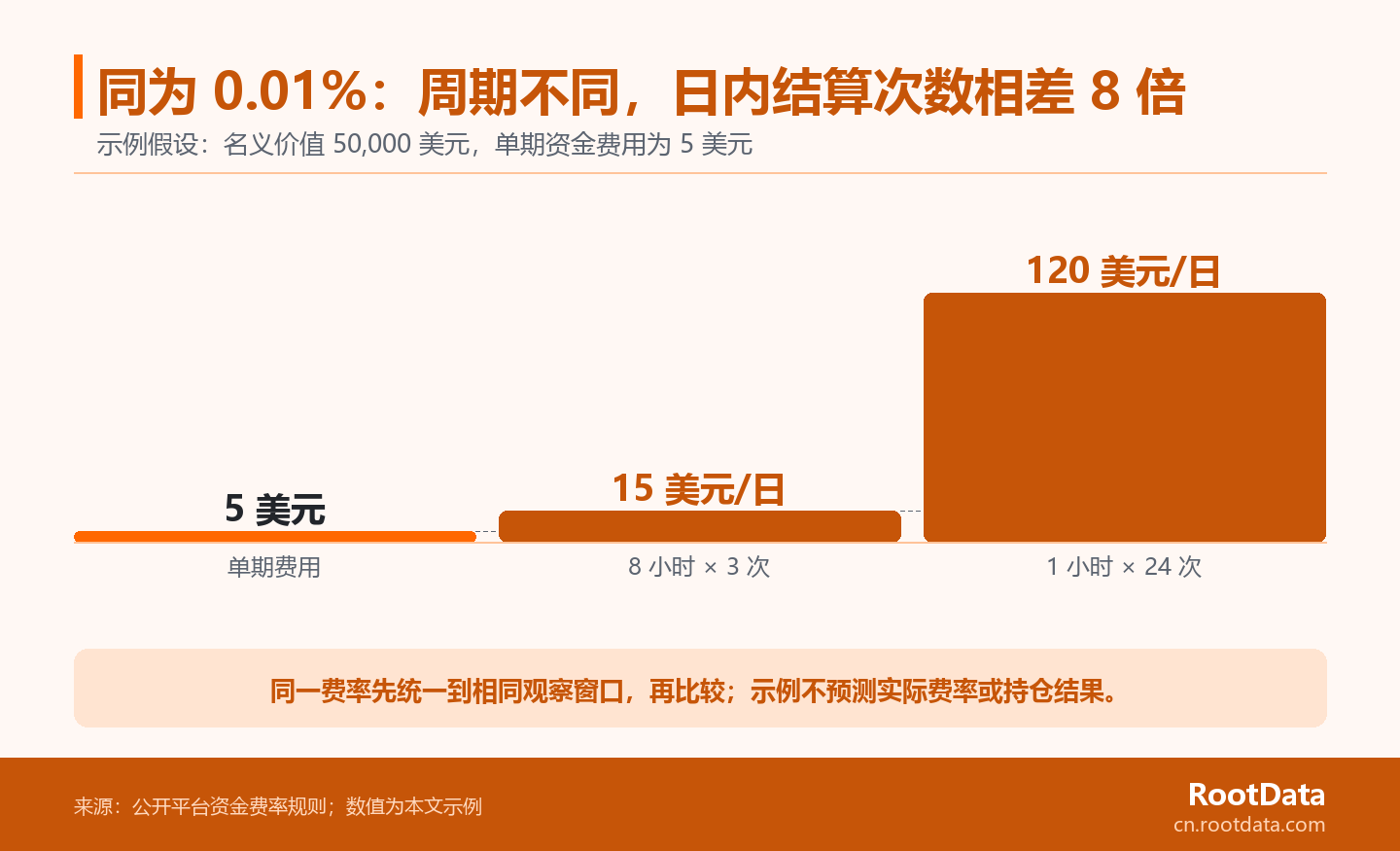
| Example conditions | Cost per period | Number of settlements in one day | Example of daily accumulation |
|---|---|---|---|
| 8 hours settlement, other assumptions remain unchanged | $5 | 3 times | $15 |
| 1 hour settlement, other assumptions remain unchanged | $5 | 24 times | $120 |
The table does not imply that contracts with one-hour settlement are necessarily more expensive, nor does it imply that in reality the rate will remain at 0.01%. It only reveals a comparison rule: if you want to discuss "daily costs" or "fees for a certain holding period," you must change the rates to the same time window and write down the period assumptions clearly.
Directly annualizing the variable single-period funding rate can only form a hypothetical scenario and cannot be used as a prediction of future holding costs. The rate will change with price deviation, liquidity, rule caps and settlement arrangements; even if the percentage at a certain point in time is the same, the premise of whether it remains the same in each subsequent period cannot be omitted.
The CFTC’s risk warning notes that leverage in margin accounts can magnify the risks of trading products.this tipAlso qualifying the example above: Funding charges are just one cash flow from a position and are not a substitute for a complete understanding of price fluctuations, margin requirements, liquidation rules, or liquidity.
When comparing stock perpetual contracts, use the rules page and market data separately.
RootData's equity derivatives rankings are suitable for comparing market fields such as funding rates, fees, liquidity and contract coverage at the same point in time, but they cannot replace the settlement rules of specific contracts.RootData ranking descriptionThe comparative context of these market fields is defined; whether the contract adopts a specific billing base, settlement time or rate cap still needs to be checked back to the corresponding product document.
When comparing the capital costs of stock perpetual contracts, the five items should be checked in order: contract, direction, billing base, settlement time and rate cap.
- contract:Confirm whether it is a stock perpetual contract or another product, and find the rules page for that contract.
- direction:Confirm which side pays the positive and negative rates under this rule.
- Billing base:Check the definitions of notional value, contract multiplier, denomination currency and mark price.
- Settlement time:Record the current period, the next settlement time, and whether the period can be adjusted.
- Rate cap:Confirm whether there are upper limits, lower limits, or temporary rules under abnormal market conditions.
After completing the check of these five rules, use the market fields at the same time point to judge the conditions of different platforms. When you need to view funding rates, fees, liquidity and contract coverage horizontally, you canView RootData Equity Derivatives Trading Platform Ranking; It provides an entry point for comparison, rather than a conclusion on a certain holding cost or user suitability.
FAQ
The following questions only supplement the short boundaries of this article that have not yet been expanded upon. The specific contract rules should still be based on the latest page of the platform.
If the funding rate is positive, does it mean that the price will definitely rise?
Doesn't mean. The positive funding rate first shows that the contract is paid from long to short under the current rules and cannot alone predict the price trend in the next period. It may reflect price deviations, position structure or platform calculation parameters at a certain point in time, but these factors will change. To judge the risk of a contract, you also need to look at the mark price, margin rules, liquidity, market fluctuations, and whether the next settlement will occur during the planned holding period.
Are funding fees and transaction fees the same thing?
no. Transaction fees are usually related to order placement or transaction, while funding fees depend on whether the position is held at the specified settlement time, as well as the funding rate and notional value of the period. Both may affect the actual cost, but the occurrence conditions, billing base and recording location are different; when comparing, they should be recorded separately, and check whether the platform will affect the available margin after the fee is incurred, so as to avoid using a low fee label to cover up another periodic fee.
Why may the settlement cycles of different contracts on the same platform be different?
Because settlement cycles, rate caps and observation methods are usually set by specific contract rules, the platform may also adjust relevant arrangements based on market conditions or risk parameters. Product lines on the same platform do not necessarily adopt the exact same settlement rhythm, so when comparing across contracts, you should confirm the rules page and next settlement time one by one, rather than treating the common cycles at the platform level as a fixed fact. If the page also displays historical rates, you must also identify whether the value corresponds to the settled period or the next period's estimate.
Can the single-period funding rate be directly annualized to compare?
It can be converted to a unified observation window for scenario comparison, but the static annualization cannot be used as a future cost prediction, because the rate, cycle, nominal value and position status will all change. A transparent scenario calculation should also state whether the rates are assumed to be unchanged, the number of daily settlements, which costs are ignored, and the results are only used to understand the comparative caliber rather than predicting revenue. If any of the assumptions are changed, the results should be recalculated rather than using the previous annualized figures.