
Stock Perpetual Funding Rate Comparison: Assessing Long/Short Costs and Holding Periods
Author: Flowie|ChainCatcher content author, focusing on RWA, interpreting the true narrative of Web3.
The funding rate snapshot cannot alone answer the actual cost of long or short positions in a position period. What it records is the rate field displayed by a platform at a specific point in time, rather than a fee bill that has completed the payment direction, number of settlements, and calculated amount. When comparing stock perpetual contract exchanges and related platforms, snapshots are suitable to establish the research scope first; writing it directly as "which one is cheaper" will skip key conditions.
First conclusion: the funding rate snapshot cannot alone determine the cost of long and short positions
- Let’s see what it answers first. Funding rate is a display field in the perpetual contract, which can be used to observe the rate status at a certain point in time.
- Look again it doesn’t answer anything. The plus and minus signs in the table do not automatically give the payment direction of the target contract, nor do they tell the reader how many times settlement will occur.
- Finally fix the review order. First retain the original value of the same snapshot, and then confirm the target contract rules, settlement cycle and position value caliber; without any of these, the snapshot should not be annualized or ranked in the long-term cost list.
What is recorded in the funding rate: periodic transfers, not unified platform service fees
The funding rate can be designed as a periodic payment mechanism between the two parties of the perpetual contract position. "A Primer on Perpetuals" discusses a type of perpetual contract that sets the funding rate as a payment arrangement between the two parties. The point here is not to extrapolate a certain design as a unified rule for all platforms, but to first distinguish it from the fixed service fee charged by the exchange: it is part of the specific contract mechanism.
The funding rate cost explanation must first be read in conjunction with its recurring payment schedule. NBER's research on perpetual futures pricing Discuss periodic fund payments within the mechanism of perpetual futures price anchoring. For meter reading, this means that it is also a percentage. If you do not know the specific contract, payment rules and settlement arrangements it corresponds to, you cannot equate it to the cost of the same length of holding period.
Therefore, this article will not write positive or negative rates as a directional view, nor will it output a list of "low-cost exchanges" based on single-point rates. A more reliable reading is: first use the page value as a research signal to be checked, and then return to the rules page of the target stock perpetual contract to confirm when and in what caliber it occurred.
Snapshot of funding rates of 29 exchanges: first retain the displayed values, then retain the missing values
The following table completely retains the funding rates displayed by RootData on 2026-07-23 17:30 for 29 platforms, as well as the original "--". RootData Equity Derivatives Ranking Page is the data source for this table. The table is presented according to the comprehensive ranking of the page, and is not reordered by funding rate; this can preserve platform coverage and avoid misreading a snapshot field as a cost ranking.
RootData compares funding rates to OI, volume, liquidity, spreads and fees as independent comparison fields. RootData's Stock Derivatives Ranking Note provides a framework for this field. Therefore, rates can help raise next-step questions but are not a substitute for checking other fees, market conditions, or product rules.
| Comprehensive page ranking | Exchanges and related platforms | Funding rates |
|---|---|---|
| 1 | Binance | +0.0001% |
| 2 | Bybit | -0.0002% |
| 3 | OKX | 0% |
| 4 | Bitget | -0.0002% |
| 5 | Ourbit | +0.0001% |
| 6 | Gate | +0.0003% |
| 7 | Hyperliquid | +0.0002% |
| 8 | Lighter | +0.0008% |
| 9 | BingX | +0.0001% |
| 10 | XT.COM | +0.0001% |
| 11 | Ondo Perps | 0% |
| 12 | Extended | -- |
| 13 | Phemex | 0% |
| 14 | Bitunix | +0.005% |
| 15 | GRVT | +0.0015% |
| 16 | KuCoin | +0.0002% |
| 17 | edgeX | +0.0005% |
| 18 | MEXC | +0.0001% |
| 19 | MSX | -- |
| 20 | OrangeX | +0.0003% |
| 21 | Coinbase | +0.0004% |
| 22 | Aster | +0.0003% |
| 23 | BitMart | -0.0003% |
| 24 | HTX | +0.0002% |
| 25 | BitMEX | 0% |
| 26 | Kraken | +0.0193% |
| 27 | Crypto.com | +0.0001% |
| 28 | Paradex | +0.0002% |
| 29 | Ostium | -- |
"--" means that this page snapshot does not show the available funding rate; it is not 0% and should not be padded to any value. The 0% in the table is also only the displayed value at that point in time, and does not automatically mean that there is no fund transfer during the entire position period, nor does it include transaction fees, spreads or other product costs. Keeping these three states intact is to allow the head, middle and tail platforms to obtain the same data context, rather than creating non-existent comparison conclusions.
Before reading the rate into position cost, there are still three pieces of information missing
Rate symbol, settlement period and position value are three layers of information that cannot be combined before comparing holding costs. They answer "who pays", "how many times does it happen" and "to what amount does the percentage apply" respectively. If only one of the layers is retained, the reader will still see a snapshot number rather than a comparable holding period result.
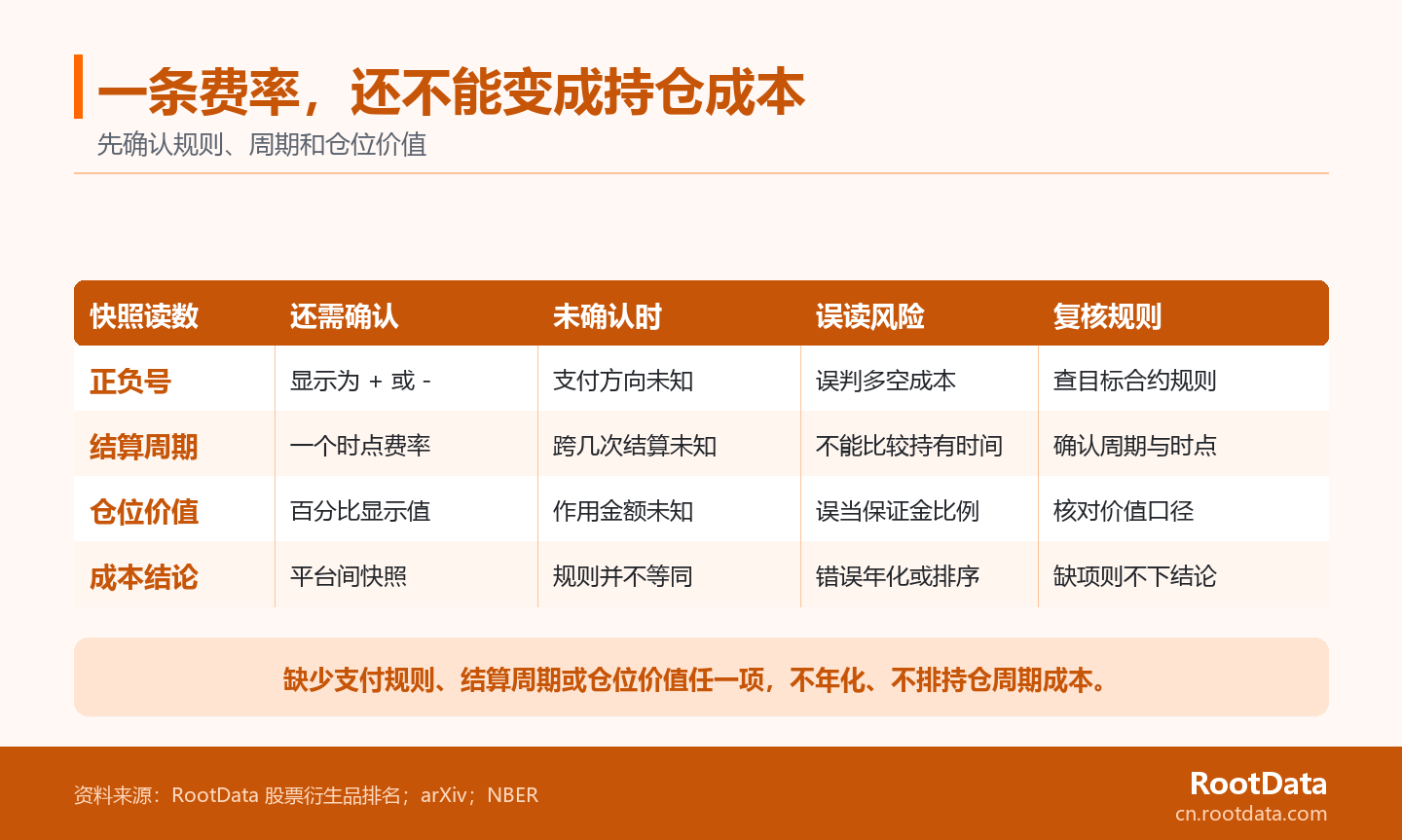
Look at the sign first: it must go back to the payment rules of the target contract
The actual payment direction of the sign must be based on the rules published by the target contract and cannot be inferred only from cross-platform snapshots. The page rules of different exchanges, different products or different contracts may differ in settlement frequency, payment triggering and display methods. Researchers should first confirm how the target stock perpetual contract defines the rate, and then discuss the fund transfers that long or short positions may face under this rule.
Look at the period again: the same percentage does not equal the same holding cost
The rate can only have comparative meaning in terms of the position period when viewed together with the settlement cycle and the actual settlement time points. The snapshot does not show the fact of "how long to hold" and does not guarantee that the rate will remain the same every period after that. Multiplying the current displayed value directly into a day, week or year number is equivalent to assuming the cycle, rate path and continuous position conditions at the same time. These assumptions are not included in this table.
Finally look at the position value: the rate is not automatically converted according to the margin ratio
When evaluating a fund transfer, you must confirm the position value or reference price used in the contract, rather than just looking at the leverage or initial margin. The fee rate is displayed as a percentage and is not equal to the margin ratio; the same margin figure does not necessarily correspond to the same position value under different contract specifications. There’s no need to pre-calculate anyone’s costs here, but it’s important to know that percentages don’t give a complete explanation of costs if dollar amounts haven’t been reconciled.
Research example: The same rate shows why long-term costs cannot be directly discharged
If the same displayed rate corresponds to different settlement frequencies, specific contracts or position values, it cannot be directly concluded which platform has a lower position cycle cost. Imagine two platforms displaying the same funding rate at the same point in time: Platform A’s target contract rules have not yet been confirmed, and Platform B’s settlement cycle has not yet been confirmed. Even if the two numbers are exactly the same, researchers still don’t know whether they will have the same number of fund transfers within the same holding window, let alone whether the two use a position value caliber that can be directly compared.
This example is not a cost estimate. It only describes a research sequence: the first step is to retain the two displayed values as the observation objects of the same snapshot; the second step is to locate the target stock perpetual contract respectively; the third step is to check the payment rules, settlement cycle and value caliber; and finally it is decided whether this information is sufficient to support further comparisons. If any of these are missing, the most informative conclusion is not to guess which one is lower, but to clearly mark "not directly comparable at this time".
From snapshot to contract: four-step review to compare funding rates
RootData public data standard states that when comparing frozen snapshots and dynamic pages, you should first confirm the observation time and field caliber. When viewing the RootData data standard, the time tag should be recorded together with the field name to avoid combining values seen at different times into the same conclusion without tags.
Fixed time, positioning contract, confirmation cycle and verification position caliber are a set of research procedures that make the comparison of funding rates reviewable. Specifically, you can follow the following four steps:
- Fixed observation point. Record the time and fields of the comparison page, and do not regard the old snapshot as the current condition.
- Locate target contracts. The platform-level rate only provides entrance, and you need to confirm which stock perpetual contract you are researching in the end.
- Confirm rules and cycles. Read the contract's description of the plus and minus signs, payment direction, and settlement arrangements, and do not regard the cross-platform displayed values as a unified formula.
- Check the amount. Reconfirm the calculation method of position value or reference price; if you need to update the research entrance, you can View RootData stock trading platform ranking and remark the observation time.
Four judgments that this funding rate table does not replace
RootData's disclaimer positions the content as an information service and not as investment advice. RootData Public Disclaimer defines the boundaries of the use of this article: the table serves data comparison and research and does not replace personalized judgment on trading, leverage, income or product selection.
- Not a direction judgment. The plus or minus sign cannot be written as a long or short view without departing from the target contract rules.
- Not a long-term cost forecast. The snapshot does not give a future rate path, nor does it confirm for readers the actual settlement point passed.
- Not a complete cost sheet. Funding rates and transaction fees, spreads and other product costs need to be checked separately.
- Not a product or region entry conclusion. The presence of a platform in the ranking page does not mean that any account or region can use a certain product.
FAQ
The FAQ only clarifies meter reading boundaries for rates, periods, zero values, and missing values. It does not overwrite platform functionality, regional qualifications or legal conclusions, nor does it extend frozen snapshots into trading recommendations.
Does a positive funding rate necessarily mean that long positions have to pay holding costs?
You should not draw direct conclusions based on cross-platform snapshots; you must refer to the funding rate rules and settlement time points published on the target contract page. Academic materials discuss a type of perpetual contract design in which longs pay to shorts, but this does not mean that every exchange and every stock perpetual contract can infer the direction of payment based on just a positive sign. Confirm the specific rules first, and then discuss the possible fund transfers of the position at the corresponding time point, so that the background of the mechanism will not be mistakenly written as platform facts.
Can the funding rate be directly annualized to compare long-term costs?
Direct annualization is not possible; first confirm the settlement cycle of the contract, whether the rate will change, and whether the position has passed the settlement time point. Annualizing a snapshot number implies the preconditions of fixed cycles, unchanged rates, and continuous positions, which are not provided by this table. If the purpose of the research is to compare a certain holding period, the first thing that needs to be completed is the rules and time information, rather than expanding a single point percentage into a seemingly precise long-term value.
Does the funding rate of 0% mean there are no holding costs?
Does not mean; 0% only describes the funding rate display in this snapshot. Transaction fees, spreads and other product costs still need to be checked separately. Even if we only discuss the funding rate itself, 0% is only the state at a certain point of observation, and different displayed values may appear in subsequent settlement cycles. It cannot be extrapolated to mean that the entire position does not have any fund transfers, nor can it be used as proof of the overall lower cost of an exchange.
Why do some platforms’ funding rates appear as “--”?
It means that this RootData snapshot does not show the available funding rate, is not equal to zero, and cannot be used to compare payment directions or long-term costs. Missing status does not automatically explain the reason, nor can it be filled in as a favorable or unfavorable value. Keeping "--" allows the table to remain traceable: readers know that the row lacks fields to enter the same caliber comparison at that time, and if it is updated later, it should be re-read with a new timestamp and a complete snapshot.