
How 1:1 reserve tokenized stocks work: issuance, custody, redemption and price anchoring
"1:1 reserve" is most easily understood as a conclusion: one token corresponds to one stock, so rights, redemptions and prices will naturally be established. The actual judgment is exactly the opposite. It is first and foremost a claim about the number of corresponding assets and tokens; what the tokens represent, who can change the supply, how the assets are segregated, who can redeem them under what conditions, and why the secondary market price deviates are all answered by different documents. Only by connecting these four layers can we verify the structure of a 1:1 reserve tokenized stock.
Before judging 1:1, put the four questions on the same checklist
- supply:Who can issue or destroy tokens, and when will the corresponding assets be allocated or exited?
- Hosting:Who holds the assets, and in which document are the segregation arrangements and holders' rights contained?
- redemption:Who can use the issuer channel, what can be exchanged, and how are the qualifications and time periods limited?
- price:Is the primary channel available, and how do the supply, demand and liquidity of the secondary market affect the quotation?
First answer: 1:1 Reserve is not a label, but a verifiable chain
Actual rights to tokenized securities cannot be inferred solely from the token name or 1:1 representation.Investor.gov explanation of tokenized security structuresDistinguish between issuer-led, third-party escrow and synthetic arrangements: they may all be related to a certain stock, but they may not allow holders to obtain the same rights or benefits. Traditional shares typically represent a share of company ownership, and voting and dividends may also vary by share class; this reference line can be found atStock Fundamentals Explained from Investor.gov, but cannot be automatically moved to any token product.
Therefore, when you see "fully backed", "1:1" or a stock symbol, first note whether the token holder is getting direct shares, security interests obtained through an intermediary, or contractual rights related to the price. Here'sSecurities interests, refers to the rights or interests related to the underlying securities obtained through intermediaries or custody arrangements; it is not the same expression as direct registration of shareholdings. Voting, dividends, corporate actions, transfers or redemption arrangements that are not clearly stated in the product should be marked as "unconfirmed" instead of being completed with 1:1 three characters.
Issuance and destruction: supply must know when to change
In the public xStocks example, tokens enter or exit circulation through issuance and redemption in the primary market with the issuer.its issuance and redemption documentsInclude account opening, eligibility verification, whitelisting wallets, and issuer access as part of the process; this is a product-level example and is not a uniform approach for all tokenized stocks.
primary marketIt is a product channel for holders or qualified participants to directly issue or redeem products with the issuer. When verifying, you should not just look at the total amount on the chain, but ask four things: who triggered the addition of new tokens; when the corresponding assets were allocated; whether the destruction of tokens is connected to withdrawal from circulation; and which terms or records govern these actions. Only when the number of tokens and the change path of the corresponding assets can be compared with each other, the "reserve" will not be a static balance screenshot.
Custody and isolation: reserves must be able to locate corresponding assets
Taking the public xStocks file as an example, corresponding assets, sub-account isolation and independent supervision are listed as part of the custody structure.Legal overview of this productAt the same time, it is explained that it is a tracking certificate rather than direct stock ownership; the customer asset protection context of the U.S. securities brokerage business also emphasizes the distinction between control locations and supervision requirements. You can refer toFINRA’s Note on Client Asset Protection. Both of them remind that "there are corresponding assets" and "what rights the holder enjoys" need to be checked separately.
so-calledIsolated hosting, is to keep the corresponding assets of a specific product separately from other assets according to accounts or legal arrangements. At a minimum, it needs to allow the reader to find who holds the assets, at which account or entity level they are recorded, whether there is an independent oversight role, and how the document describes the path to resolution if problems arise with the issuer or related servicer. The phrase "in custody of the custodian" does not replace these verification items, nor does it replace reading of the specific product or region documents.
Redemption: It is not the wallet transfer that determines withdrawal, but the product rules
The transfer of tokens in the secondary market and the direct redemption by the issuer are two different paths. The former solves whether anyone among the holders is willing to take over; the latter involves whether the issuer, qualified participant or designated channel accepts the token and delivers the agreed exit result. Even if tokens can be continuously transferred in the secondary market, it does not follow that every holder can redeem them at the reference price at any time.
Public product documents often include identity verification, region or wallet qualifications, minimum limit, business period and delivery form as redemption conditions. Taking xStocks' public Q&A as an example, secondary market tradability and direct redemption are explained separately, and the latter also depends on its product process.The public Q&AThe most valuable part is not to extrapolate the rules, but to form the same checklist: who can redeem, what can be exchanged, when it can be done, what the fees and minimum units are, and how to deal with market closures or abnormalities.
Price Anchoring: Secondary market transactions and primary and secondary channels are two different things
Issuing and redeeming channels can support price alignment, but secondary market prices are still affected by supply and demand, liquidity, and channel availability. Here'sprice anchor, is a process that allows product prices to have the opportunity to move closer to the price of a reference asset through an accessible buying and selling, issuance or redemption mechanism, rather than a fixed price or a commitment to no deviation.
The primary market allows qualified participants to enter or exit according to product rules; the secondary market determines real-time prices based on orders, liquidity, tradable periods and trader demand. The public description of xStocks also distinguishes primary issuance and redemption and secondary on-chain circulation into different market levels.Description of how this product worksCan help understand this stratification, but does not prove that spreads, liquidity, or channel periods are the same across all platforms. When there is a price deviation, you should continue to check whether the channel is available, whether the liquidity is sufficient, whether the reference market is open, and whether the product has corresponding pricing rules.
After the structure is confirmed, compare the market data of similar products.
RootData's equity derivatives fields are suitable for comparing market execution conditions for similar products and are not used to infer rights, custody or regional access.Field description of RootDataThe scope of data comparison is defined: first fix the product type, target contract and data time point, and then compare market fields such as transactions, liquidity, spreads, fees, funding rates or coverage.
For example, RootData's July 23, 2026 17:30 frozen snapshot covers 29 platforms; missing fields on the page should be left as "not shown" rather than treated as zero. Only when the structures and contract types of the two products are confirmed to be comparable, can market data help answer the question "which is easier to execute at the same point in time?" When you need to put these fields back into the same set of comparison conditions, you canView RootData Equity Derivatives Trading Platform Ranking.
Test a 1:1 claim with four document questions
Four layers of supply, custody, redemption and price questions turn 1:1 propositions into verifiable product information. It does not label products as "reliable" or "unreliable", but leaves the missing information clear: If any of the four layers cannot be answered from the document, continue to check, rather than replacing the answer with market popularity or product name.
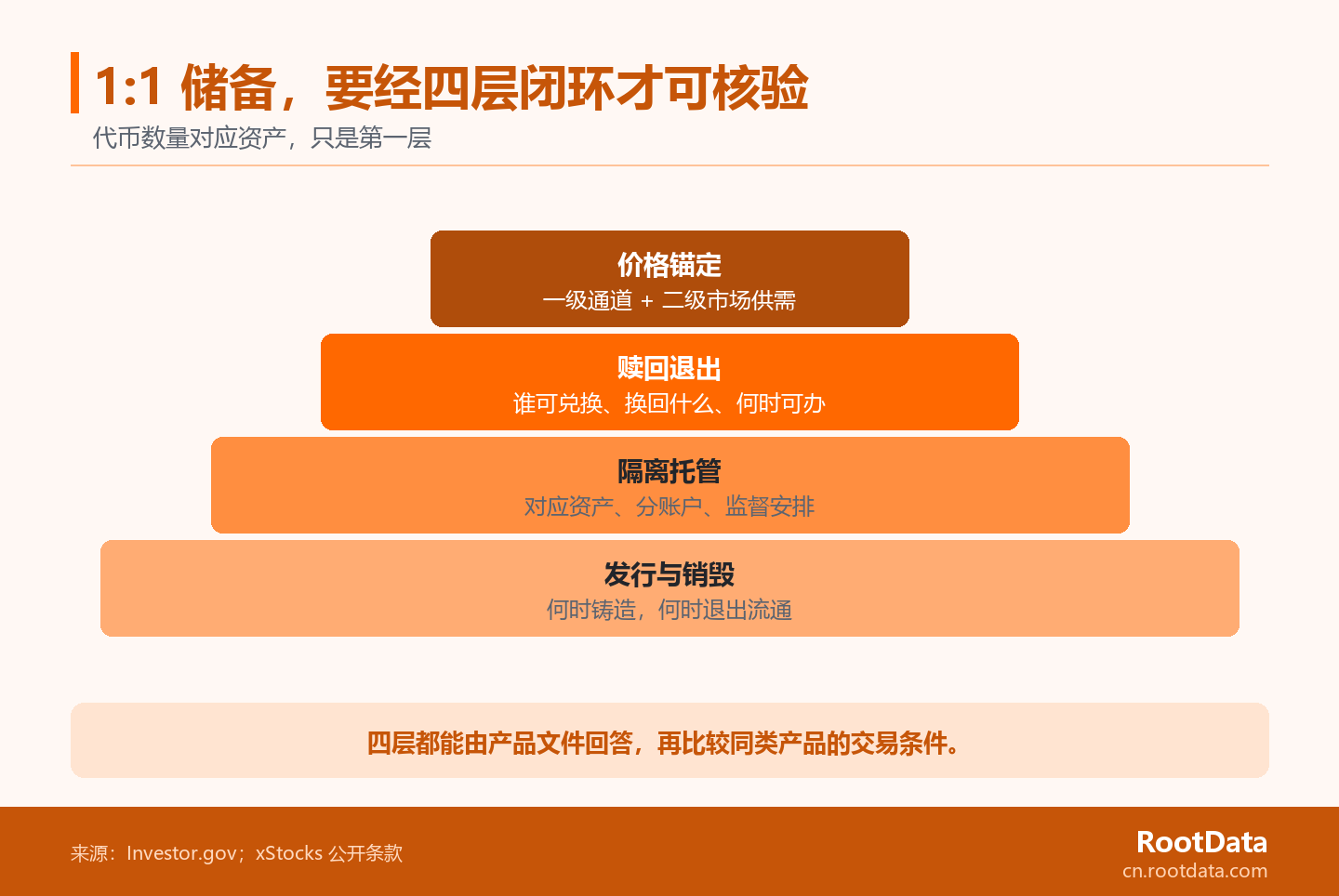
- supply:Who triggers issuance, minting and destruction? Can changes in the number of tokens be linked to the allocation or exit records of corresponding assets?
- Hosting:Who holds the corresponding assets, and which document describes the segregation arrangements, supervisory roles and rights of the holders?
- redemption:Who can redeem through the issuer channel, what can be exchanged, what are the qualifications, time period, fees and exception handling?
- price:How does the price form in the secondary market, when is the primary channel available, and what liquidity and time period conditions should be checked when deviations occur?
The order of the four questions also determines the order in which the data is used: read the structure file first, and then compare similar products with market data at the same time point. In this way, 1:1 is transformed from a marketing language into a set of product information that can be questioned, recorded and updated.
FAQ
Does the 1:1 reserve equal direct ownership of shares by token holders?
Not necessarily. The 1:1 reserve usually describes the relationship between corresponding assets. Whether the holder obtains direct stocks, securities interests or contractual rights still depends on the issuance and product documents. Votes, dividends, and corporate actions for traditional stocks cannot be automatically transferred due to token name or price tracking. A safer approach is to map each right to the terms one by one: who bears the obligation, which holders apply, when to settle, and leave "unconfirmed" where it cannot be confirmed.
The secondary market can trade 24 hours a day, does that mean it can be redeemed from the issuer at any time?
It does not mean that the transfer of tokens in the secondary market and the primary market redemption by the issuer are two different paths. The latter is usually also subject to qualifications, business periods and product processes. The fact that someone is willing to buy in the secondary market shows the current availability of transactions; it does not mean that the issuer's channel is open, nor does it mean that the holder is eligible for redemption. When checking, transfer rules and direct redemption rules should be recorded separately, paying special attention to the minimum amount, deliverables, and how to handle exceptions.
Why might prices still deviate from the underlying stock after proof of reserves?
The reserve certificate answers the correspondence between assets and will not automatically eliminate the differences in supply and demand, liquidity, trading hours and issuance and redemption availability in the secondary market. Whether the price can move closer to the reference asset also depends on whether qualified participants can actually use the relevant channel and whether the market has sufficient depth to undertake it. When you see a deviation, it is not advisable to directly infer that the reserve has failed or that there must be an opportunity; you must first check the product's pricing, trading hours, liquidity, and channel status before interpreting the signal.
What’s the first thing you should look for when comparing tokenized stock platforms?
First confirm the product structure and rights documents, and then check the redemption rules; only when the target products are the same and the data time points are consistent, platform data such as liquidity, spreads and fees can be directly compared. Ranking stocks with the same name, different types of tokens or different contracts together can easily misinterpret structural differences as execution differences. Fixing "what is being compared" first, and then comparing "where it is easier to trade" allows the data to play its due role and prevents market indicators from crossing their explanatory boundaries.