
How RootData Ranks Tokenized Stock Exchanges: Data Sources, Metrics, and Update Times
RootData's stock trading platform ranking will be based on platforms that meet the scope and verifiable conditions, organized into multi-category fields as comparative snapshots at the same observation point in time. It is suitable as a starting point for research and comparison, but it does not amount to a table of recommendations out of context: readers still need to know what products are compared, how the data enters the page, what questions each field answers, and which point in time this conclusion corresponds to. RootData Stock Derivatives Ranking Page and The ranking description page collectively discloses these verifiable boundaries; the complete weights and formulas are not disclosed and should not be inferred.
 Author: Flowie|ChainCatcher content author, following RWA, interpreting the true narrative of Web3. Follow X
The ranking is first a reviewable data snapshot, not an out-of-context recommendation
- Let’s look at the scope first: Stock perpetual or stock-related derivatives and real stock spot, CFD and other structures cannot automatically be regarded as the same product.
- Look at the sources and fields: Volume, Open Interest, Liquidity, Spread, Fees and Contract Quantity describe different issues.
- Last look at time: The update time of the snapshot belongs to the conclusion itself; old snapshots cannot be regarded as real-time market status.
When reading RootData rankings, first establish boundaries based on four questions
The scope, source, fields and time should be checked in order to put the platform ranking back into interpretable comparison conditions. First ask "Who are you comparing" to confirm that you are studying the same type of product; then ask "Where does the data come from" to know whether the field has a verifiable standard; then ask what comparison goal each indicator serves; and finally use the time displayed on the page to limit the conclusion window. This order is not a scoring formula, but a basic way to avoid reading a row of rankings as a conclusion of safety, compliance or fitness.
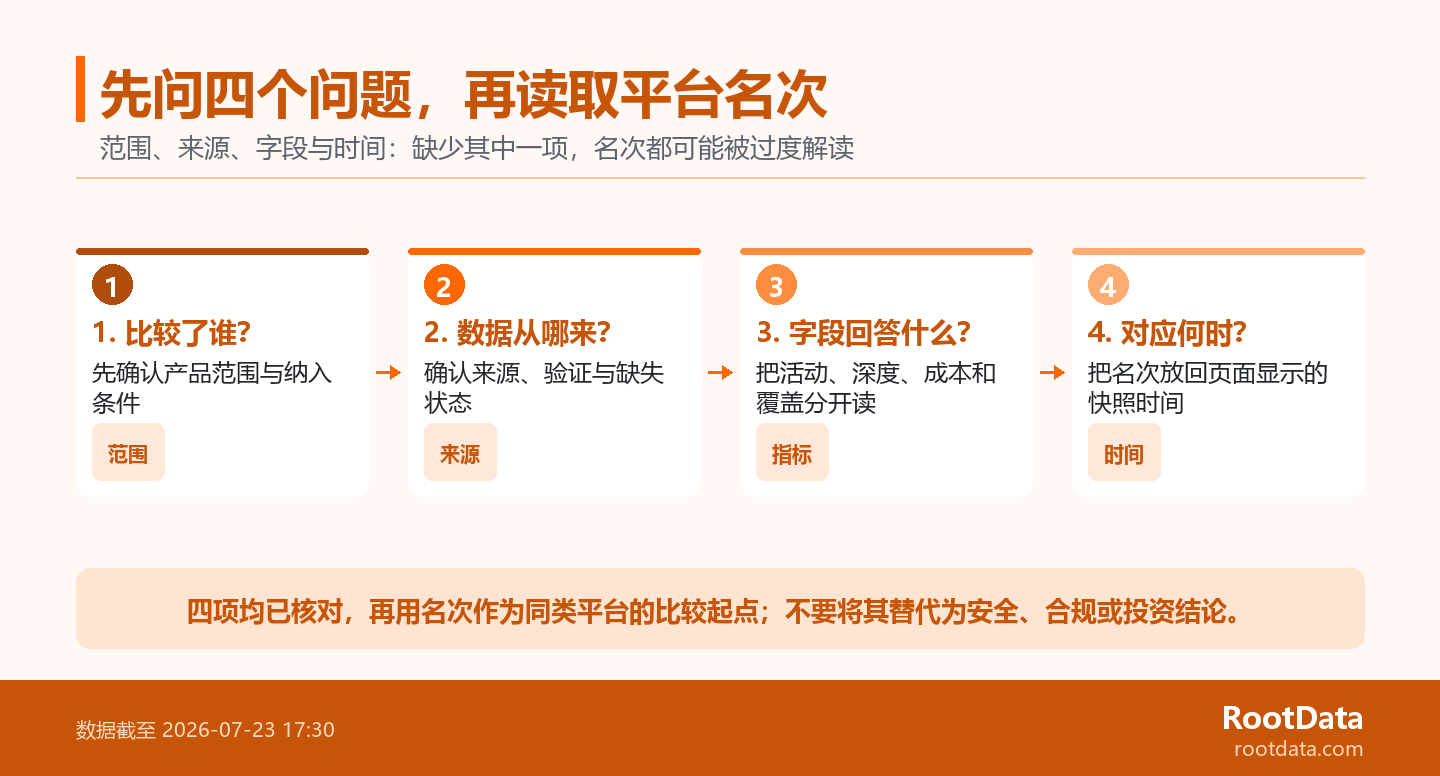
First question: Which stock product platforms are compared in this ranking
Ranking Coverage RootData is a centralized and decentralized stock perpetual or stock-related derivatives platform that can obtain and verify key market data. This condition is very important: it shows that the page does not list "stock concept platforms" according to brand awareness, but first limits the product range to which key market fields can be obtained and checked. Stock Derivatives Ranking Instructions Put the scope, fields and update logic in the same public information.
Indices, commodities, FX derivatives, real stock spot trading, and crypto contracts using only ticker symbols are excluded from this stock scope. Stock Ranking Description defines this product boundary. Similar product names do not automatically establish comparability. If readers are concerned about holder equity, redemption or dividend processing, they should first confirm whether the research object is a spot tokenized structure or a perpetual contract; such questions cannot be directly answered by the same derivatives ranking list.
Second question: Where do the fields come from, and what data can be entered into the comparison
RootData's stock data pipeline can use public trading pages, public APIs, official APIs provided by exchanges, and is cleaned, verified, and standardized. Stock Ranking Description, RootData Data Standard and Transparency Methodology Material collectively illustrates the context of verifiable information. The point here is not to describe all data as coming from the same interface, but to acknowledge that different fields have different availability and validation conditions.
Verifiability and field caliber are the prerequisites for data to be compared with the same caliber. Data Standard Description provides access to public information on this principle. Therefore, fields that also read "volume" or "liquidity" are suitable for horizontal interpretation only when the range, definition and observation time can be matched. This rule also explains why pages remain missing: when a field is missing, the boundaries of the conclusion should be narrowed rather than filled in by imagination.
When the page is displayed as -- or Pending, it means that the snapshot has no field value that can be used for same-caliber comparison. The RootData data standard supports retaining this type of state as missing, rather than rewriting it to a zero value. It is not a zero value, nor is it an inverse conclusion about the capabilities of the platform. The safest reading is to retain known range or coverage information while ceasing side-by-side comparisons requiring that field and wait for new verifiable data to emerge.
Third question: What do the indicators answer? Why can’t we just look at the comprehensive score
Volume, open interest, liquidity, spreads, fees, funding rates, number of contracts, and margin paths are used to describe different market and product issues. Stock Ranking Description and CFTC's Futures Market Liquidity Study can help differentiate the purpose of these fields. Open interest (OI) is the size of the position corresponding to the contract that has not yet been closed; both it and the trading volume can provide clues to the activity, but it does not equal the acceptance of orders at a certain moment. The stock ranking instructions present these fields side by side precisely to avoid relying on one number to explain all market conditions.
Transaction activity, quotation depth and spread are different dimensions, and a single field is not enough to fully describe the execution conditions. RootData Exchange Ranking Methodology and general market structure research place these fields under separate questions: Federal Reserve's Note on Market Liquidity Distinguish between quote cost and depth, CFTC The futures market liquidity study also suggests that order size changes the interpretive focus of the indicator. They are used to understand the fields and do not constitute a guarantee of a transaction on any platform.
Disassemble trading activity, order taking, cost and coverage
Dividing fields into trading activity, order acceptance, cost and coverage can reduce the risk of mixing different issues into a single judgment of merit. 24-hour trading volume and OI are closer to the activity and position background; ±2% weighted liquidity focuses on visible liquidity near the quote; the spread is the distance between the buyer's quote and the seller's quote, closer to the real-time quote cost; Maker/Taker rates and funding rates belong to cost information; the number of contracts answers directory coverage. RootData's general exchange ranking description also uses multi-dimensional information instead of directly treating one item as the entire judgment.
Question 4: Which time point does the ranking correspond to and why does the ranking change
The fixed snapshot used by the project is 2026-07-23 17:30, covering 29 platforms; any numerical conclusions should be read together with the observation time. RootData stock derivatives ranking page and ranking description provide entrance for subsequent review. This article uses this frozen snapshot explanation method and does not express it as current or real-time market conditions. When the page is dynamically updated, the new valid snapshot may show different trading volume, open interest, liquidity, spread or funding rate.
When market fields change in a new valid snapshot, the relative rankings based on these fields may also change. This does not mean that the old ranking was "wrong," but rather that it only answered the comparative question at the time. For readers who need to double-check, timestamps should be written into records like field units: mixing numbers from different times is often more likely to lead to erroneous conclusions than not knowing a number.
Turn the method description into an actual review
First check the time, then confirm the product range, then compare according to the target field, and finally record the missing status, which is a reviewable path for reading rankings. In actual operation, you can first note the update time displayed on the page; confirm that you are researching stock sustainability or other products within the scope; then check the coverage, activity, liquidity or cost fields according to your needs; if the key fields are missing, stop the comparison at the level of known information. When you need to re-view the same set of fields, you can View RootData stock trading platform rankings and re-record the new time and field status.
Three questions this ranking cannot answer for you
RootData's information services do not constitute investment advice. The Disclaimer makes this boundary clear. Rankings cannot answer three questions alone: whether users in a certain region are qualified for the product; whether a specific contract provides the rights, margins or settlement rules you need; and whether it meets your risk tolerance and position duration. Data snapshots can help identify areas that require further verification, but these issues still come back to product documentation, regional restrictions, and personal judgment.
FAQ
Questions about real-time performance, comprehensive scores, missing values and ranking changes should all come back to the understanding of the four boundaries of time, scope, field and source. The following short answers do not add new platform functions or qualification judgments, but only help readers return the ranking to the correct comparison position.
Is RootData’s stock trading platform ranking a real-time ranking?
No; the page data comes from market fields collected at regular intervals and presented in the most recent valid snapshot, so when reading, you should first look at the update time displayed on the page. A historical snapshot can be used to explain the field relationships at that time, but it cannot replace your review of the target platform or contract at this moment. If you want to make a new comparison, you should record the page time again, and then put the fields at the same time into the table.
Does the overall score mean that one platform is best for everyone?
Not equal; the composite score supports structured comparisons but cannot replace specific checks on product mix, regional access, liquidity and holding costs. Readers can use it as a research entry point, and then return to the corresponding fields and product conditions according to whether they are concerned about target coverage, instant quotation, order acceptance, or cost; no score can automatically replace these conditions.
How should we understand that -- or Pending appears on the page?
It means that this snapshot does not provide field values that can be used for comparison with the same caliber, and cannot be treated as a zero value or to infer platform capabilities in reverse. You can keep the coverage information at this time, but do not mix this row with platforms with complete fields in the same liquidity, spread or cost sort. Wait for new verifiable fields to appear before resuming the comparison at a new point in time.
Why may the rankings viewed at different times change?
Market fields such as trading volume, open interest, liquidity, spreads and funding rates will change with the observation window, and the ranking will also be updated with the latest valid data snapshot. The change does not mean that a certain fixed judgment has been overturned, but rather reminds readers that the ranking is only responsible for its display range, field caliber and time window, and new decisions should be reviewed using new snapshots.