
Which Exchange Supports the Most Stock Contracts? Contract Coverage Ranking and Category Distribution
Author: Flowie | ChainCatcher contributor covering RWA and the real-world narratives of Web3.
If the only question is which platform supports the most stock contracts, this snapshot points to BitMart with 313 contracts, followed by BingX (291), Gate (275), and Bitget (252). Contract count only describes the breadth of the research universe. It neither establishes that a given contract is easy to trade nor substitutes for an assessment of a platform.
This article sorts the displayed stock-contract counts for 29 tokenized-stock exchanges in RootData's fixed snapshot at 17:30 on July 23, 2026. Read it in order: use the count to create a candidate set, check the target instrument, then inspect the relevant market fields.
How to use contract counts: screen the universe, then check the target
- Start with scope: coverage is the number of stock contracts counted for a platform in the snapshot.
- Then check the instrument: even a high total requires confirmation that the asset you care about is included.
- Finally check execution conditions: market fields describe the trading environment and cannot be replaced by a contract count.
What stock-contract coverage does—and does not—show
Contract coverage is the number of stock contracts counted in a snapshot; it is not a substitute for an overall score or actual tradability. It records the contracts observed on one platform at one point in time and is useful for defining research scope. RootData's stock-derivatives ranking guide presents contract counts alongside market data, so this column should not be equated with the tradability of an individual contract.
Category distribution also needs a careful reading. Using this snapshot, platforms can be grouped by coverage tier, but unverified underlying categories or product rules should not be inferred. For research on a particular stock, index, or other contract, the count is an entry point—not the instrument list itself.
Coverage answers “how broad is the universe?”; the target instrument, liquidity, spread, and OI each answer a different question about whether research can continue.
Snapshot of 29 tokenized-stock exchanges: coverage ranking
The RootData snapshot at 2026-07-23 17:30 covers 29 platforms, with displayed contract counts ranging from 10 to 313. The following list is ordered by the snapshot's contracts field; the underlying fields can be checked on RootData's stock-derivatives exchange ranking. The page ranking is an overall ranking on that page, not the ranking recalculated here by contract count.
| Coverage rank | Exchange | Displayed stock contracts | RootData page rank | Use |
|---|---|---|---|---|
| 1 | BitMart | 313 | 23 | Initial coverage screen |
| 2 | BingX | 291 | 9 | Initial coverage screen |
| 3 | Gate | 275 | 6 | Initial coverage screen |
| 4 | Bitget | 252 | 4 | Initial coverage screen |
| 5 | Ourbit | 175 | 5 | Initial coverage screen |
| 6 | Binance | 144 | 1 | Initial coverage screen |
| 7 | Bybit | 131 | 2 | Initial coverage screen |
| 8 | OKX | 131 | 3 | Initial coverage screen |
| 9 | KuCoin | 125 | 16 | Initial coverage screen |
| 10 | MSX | 116 | 19 | Initial coverage screen |
| 11 | XT.COM | 107 | 10 | Initial coverage screen |
| 12 | HTX | 104 | 24 | Initial coverage screen |
| 13 | Hyperliquid | 103 | 7 | Initial coverage screen |
| 14 | Bitunix | 98 | 14 | Initial coverage screen |
| 15 | Aster | 96 | 22 | Initial coverage screen |
| 16 | Phemex | 94 | 13 | Initial coverage screen |
| 17 | OrangeX | 89 | 20 | Initial coverage screen |
| 18 | Crypto.com | 52 | 27 | Initial coverage screen |
| 19 | MEXC | 47 | 18 | Initial coverage screen |
| 20 | Lighter | 47 | 8 | Initial coverage screen |
| 21 | edgeX | 43 | 17 | Initial coverage screen |
| 22 | Ostium | 35 | 29 | Initial coverage screen |
| 23 | Coinbase | 30 | 21 | Initial coverage screen |
| 24 | GRVT | 29 | 15 | Initial coverage screen |
| 25 | Ondo Perps | 21 | 11 | Initial coverage screen |
| 26 | Extended | 19 | 12 | Initial coverage screen |
| 27 | BitMEX | 12 | 25 | Initial coverage screen |
| 28 | Kraken | 11 | 26 | Initial coverage screen |
| 29 | Paradex | 10 | 28 | Initial coverage screen |
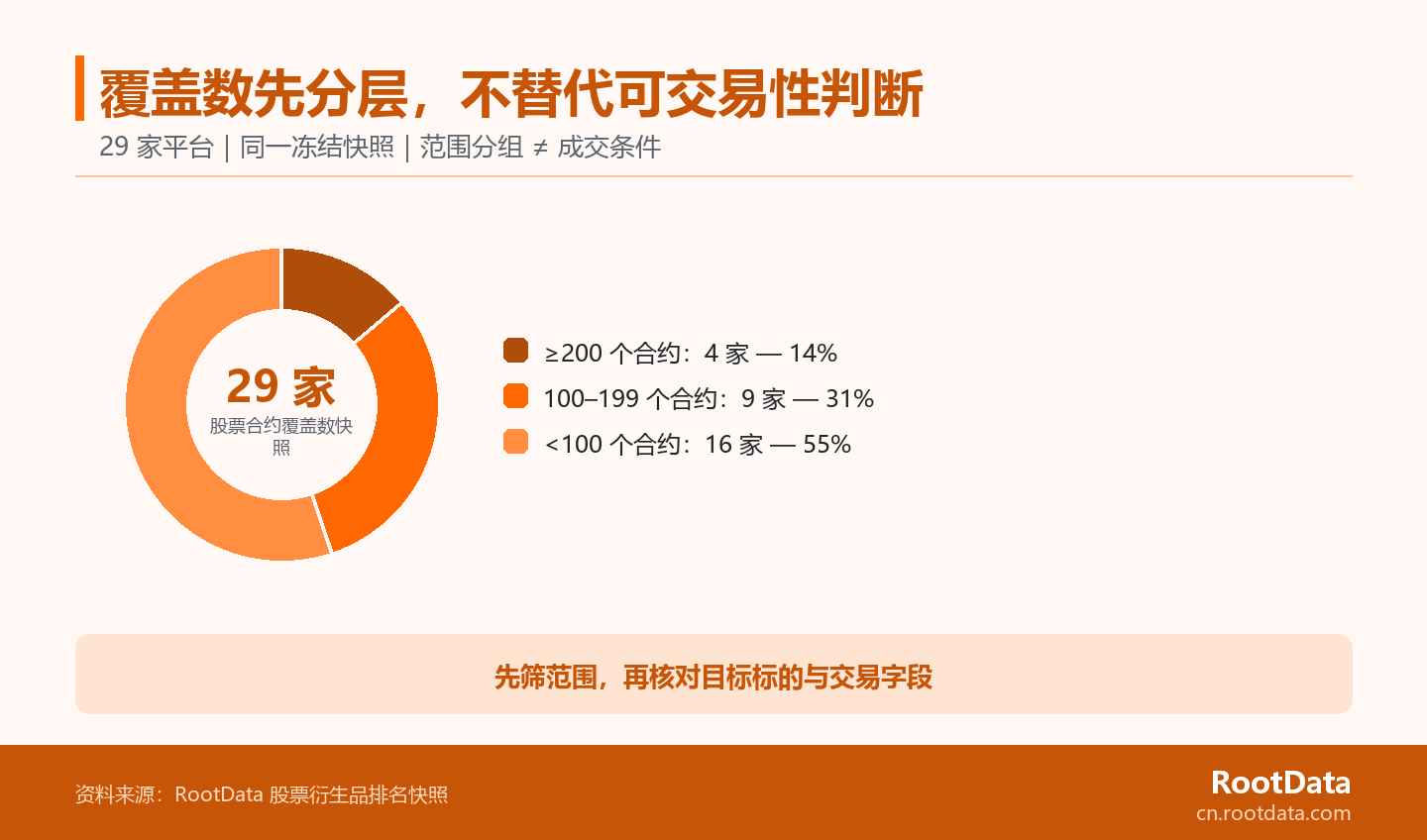
Four platforms display at least 200 contracts, nine display 100–199, and 16 display fewer than 100. This 4/9/16 split only groups the breadth of coverage; it does not tell us the trading conditions of a target contract or whether it suits a particular account.
Two more checks after finding broad coverage
Use coverage as an initial screen, then verify the target instrument and its trading fields. This separates two questions: coverage narrows the research universe; only after entering the candidate set should you determine whether the desired instrument exists and which observable execution conditions it has.
First: is the target instrument actually covered?
A high total does not replace checking whether the target is included. State the research target precisely—such as a particular stock or index contract—and confirm it within the candidate platform's product range. For readers focused on only a few instruments, a match matters more than the aggregate count.
Second: does the target contract have observable trading conditions?
Contract count, liquidity, spread, and OI are distinct fields and cannot substitute for one another. After confirming the target, inspect its market fields: liquidity indicates market activity; spread is the distance between bid and ask; and open interest (OI) is the size of outstanding contracts. RootData's ranking page and field guide list them separately.
Example: how to read the difference between 275 and 11
The difference between 275 and 11 is 264, indicating different displayed coverage in the snapshot. Gate displays 275 contracts and Kraken 11. Under the same time point and page field, the former has a broader displayed universe. It does not mean every Gate contract is easier to trade, nor that the same target is available on both platforms under comparable conditions.
Turn counts into reproducible research records
Record the observation time, platform, target instrument, and trading fields to keep coverage comparisons reproducible. This avoids mixing conclusions from different times, instruments, or fields. RootData's data-standard guide provides methodological context for checking field definitions. After screening, return to RootData's stock-platform ranking to check the update time, candidates, and related fields in one environment.
Four decisions coverage cannot replace
This article is not trading or investment advice. Coverage cannot replace verification of regional access and account availability, product rules for the target contract, execution conditions, or personal risk assessment. RootData's exchange-ranking methodology uses multiple fields, and its disclaimer states that the material is not investment advice.
FAQ
Does the highest count mean the most stock underlyings?
Not necessarily. It is the number RootData counted at that time; definitions, presentation, and update status may vary. Verify the specific target.
Does more coverage mean easier execution?
No. Review the target contract's liquidity, spread, order-book depth, and OI.
Why consider a platform with fewer contracts?
It may include the instrument you need and expose fields worth further research. Narrower coverage is not a verdict on that instrument.
Can this table choose a trading platform for me?
No. It creates a candidate set and a comparable record; it does not replace access, product, account, execution, or risk checks.