
What exchanges support U.S. stock contracts: List of platforms organized by asset quantity and category
This type of coverage volume is not the answer to “which exchange is better?” but is the first step in building a candidate pool.In RootDataIn the frozen snapshot, there are 29 platforms within the scope of stock-related derivatives comparison. This number can help readers discover the scope of the research, but it cannot directly prove that a certain U.S. stock is now tradable, that the product is equivalent to direct stock holdings, or that a certain platform is suitable for all regions.
Below, "Supporting U.S. stock contracts" is broken down into three questions: first organize the platform according to coverage items, then distinguish different contracts and token structures, and finally return to the target contract, market fields and account rules for confirmation. The numbers in the list all correspond to the above snapshot; real-time products, quotations and regional qualifications should be based on the information when the current page of the platform is opened.
First, confirm: this list answers coverage, not trading advice.
The contract coverage number is a screening entry, not the final selection.What this article saysNumber of contracts covered, is the number of entries recorded as stock-related contracts on a platform in this frozen snapshot; it is a field of the same caliber in the horizontal discovery range, and is not the "total number of U.S. stocks" available for trading on the platform in all regions and at all times.View RootData’s explanation of equity derivativesFinally, you should continue to read the coverage fields separately from the market fields of the target contract.
- Quantity used for preliminary screening:A higher number of contracts indicates greater coverage of records within the snapshot; it does not constitute a liquidity, fee or suitability ranking.
- Category decision information:The same stock name may appear as a perpetual, CFD or token product, and the rules documents and rights boundaries are not the same.
- The target contract determines the next step:After the candidate platform is determined, the target, liquidity, margin, settlement and regional qualifications still need to be checked.
Let’s first classify product categories: the three structures are not the same answer.
The same stock name can appear through different contracts or token structures, and the product documentation, not the platform label, determines which rights and risks should be checked.If the search term is "US stock contracts", don't rush to filter by platform name first. A more useful approach is to ask yourself: Do you need derivatives around stock price fluctuations, a token product that can be transferred on the chain, or another price difference settlement arrangement? This step determines whether the perpetual contract specifications, issuance documents, or the platform’s trading terms should be read later.
Category 1: Look at price exposure, funding fees and contract specifications
Stock Perpetual Contractyes nofixed expiration date, reflecting stock price changes through contract pricesderivatives, does not represent shareholding.Stock perpetuals are price exposures and are not the same as direct shareholdings.Binance’s official description also describes it as a product that tracks a company’s stock price but does not require ownership of the underlying stock.Check out Binance’s explanation of stock perpetual contracts. Therefore, readers should pay more attention to the settlement, funding fees, leverage and closing period price rules of the target contract, rather than treating it as a traditional stock account.
Category 2: Look at deal terms, not stock ownership
Contract for Difference (CFD)is aroundPrice changessettledderivatives,generallyNot holding shares.CFD checks focus on transaction terms, not stock ownership.Bybit’s official product description separates stock CFDs from spot holdings: the former trade in price changes and do not carry stock ownership or shareholder rights.View Bybit's Stock CFD instructions. If the candidate platform provides such products, you should first read the trading hours, margin, fees, overnight arrangements and regional restrictions.
Category 3: Read the issuance documents first, then look at the secondary trading conditions
Tokenized sharesIs the stock related expressed in a token or tracking certificate?economic exposurea category of products,specific rightsDepend onissuance documentsdefine.Specific rights to tokenized shares are subject to the offering documents.In the case of xStocks, its product legal description says the product provides economic exposure to the underlying equity but does not give shareholders voting rights and is not direct equity ownership.View xStocks’ Product Legal Overview. This is just one product example and cannot be extrapolated to all similar products.
Product issuance path and secondary transaction conditions are two layers of information.xStocks’ official description separates primary issuance and redemption, and secondary market trading, and reminds that whether secondary trading is available 24/7 depends on the platform.See how xStocks works. Therefore, even if readers confirm the form of tokenized products, they still need to confirm the current transaction time, supported network, distribution scope and target on the specific platform.
The 29 platforms are organized in layers based on contract coverage.
This table covers 29 platforms, all from the same frozen snapshot.The snapshot time is RootData 2026-07-23 17:30; the number in the table is the number of stock-related contract entries recorded at that time, which is suitable for establishing a candidate platform range.View the RootData Equity Derivatives page, the dynamic fields of the page should be read separately from the fixed time caliber of this article.
| Contract coverage range | Number of contracts in the platform and snapshot | What does this set of numbers suit to answer? |
|---|---|---|
| 200+ | BitMart (313), BingX (291), Gate (275), Bitget (252) | Can be used as the first candidate when wider coverage is needed; still need to confirm which product category the target belongs to. |
| 100–199 | Ourbit (175), Binance (144), Bybit (131), OKX (131), KuCoin (125), MSX (116), XT.COM (107), HTX (104), Hyperliquid (103) | The coverage number is at the middle level and is suitable for checking the target contract and account conditions one by one after the target product structure is known. |
| 30–99 | Bitunix (98), Aster (96), Phemex (94), OrangeX (89), Crypto.com (52), Lighter (47), MEXC (47), edgeX (43), Ostium (35), Coinbase (30) | Narrow coverage does not mean that a specific target is unavailable; it is more suitable for targeted verification around clear target contracts. |
| Below 30 | GRVT (29), Ondo Perps (21), Extended (19), BitMEX (12), Kraken (11), Paradex (10) | May remain within the scope of research on specific products or specific markets, but quality judgments should not be precluded or drawn solely on the basis of low numbers. |
Tiers are read by coverage numbers only, not platform ratings.200+, 100–199, 30–99, and 30 The following four groups are just within the same snapshot to help the reader narrow down the scope of the study. To continue comparing OI, 24h trading volume, depth, spreads, fees or funding rates, you canOpen RootData Equity Derivatives Ranking to check the same time field. Especially in stock-related products, wider coverage does not automatically equal better trading conditions for the target contract; if the product form, regional qualifications or current underlying are different, the numbers cannot be directly interchanged.
After the number of contracts, look at the market fields and rules of the target contract.
Coverage numbers are just one layer of discovery information; the target contract's liquidity, price, fees, margins, and market rules must continue to be reconciled at the same point in time.This puts the platform list in a “candidate discovery” role rather than a substitute for reading about specific products and market conditions.
The target contract is more important than the platform name
Coverage and execution conditions are not the same field.RootData's Equity Derivatives Notes place contract coverage in the same comparative context as volume, open interest, depth, spreads, fees, funding rates and margin routing.View RootData’s explanation of equity derivatives. When actually reading, first use the coverage number to discover candidates, and then use the target contract fields at the same point in time to determine whether it is worth continuing to study; do not extrapolate from a platform-level number to determine whether the order can be completed at a certain scale.
After entering the candidate pool, it is recommended to fix the same set of questions: whether the target is currently visible, whether it is a stock perpetual or a CFD or tokenized product, whether the quote and depth are read at the same time, which contract the fees and funding rates apply to, and whether there are additional restrictions on the account or region. This can avoid misapplying the rules of one platform for a certain type of product to another product entrance.
On-chain sustainability also requires reading specific market rules.
The target market for on-chain sustainability still needs to look at the rules one by one.Taking Hyperliquid's HIP-3 as an example, official documents show that market deployers need to be responsible for market definition, oracle definition and contract specifications, and undertake related market operations.Check out Hyperliquid’s HIP-3 instructions. This is just an example of the protocol mechanics, but it illustrates that "on-chain" alone is not a substitute for reading about target market definitions, price inputs, margins, and settlement conditions.
The coverage number is only a preliminary screening, because the product category will change the source of the rules; the fields of the target contract must be checked at the same time. Only when there are no conflicts in terms of coverage, product categories, target contracts, and regional qualifications, should a platform proceed to the next step of research from the candidate pool. Any unconfirmed items should remain as information gaps rather than filled with platform names or rankings.
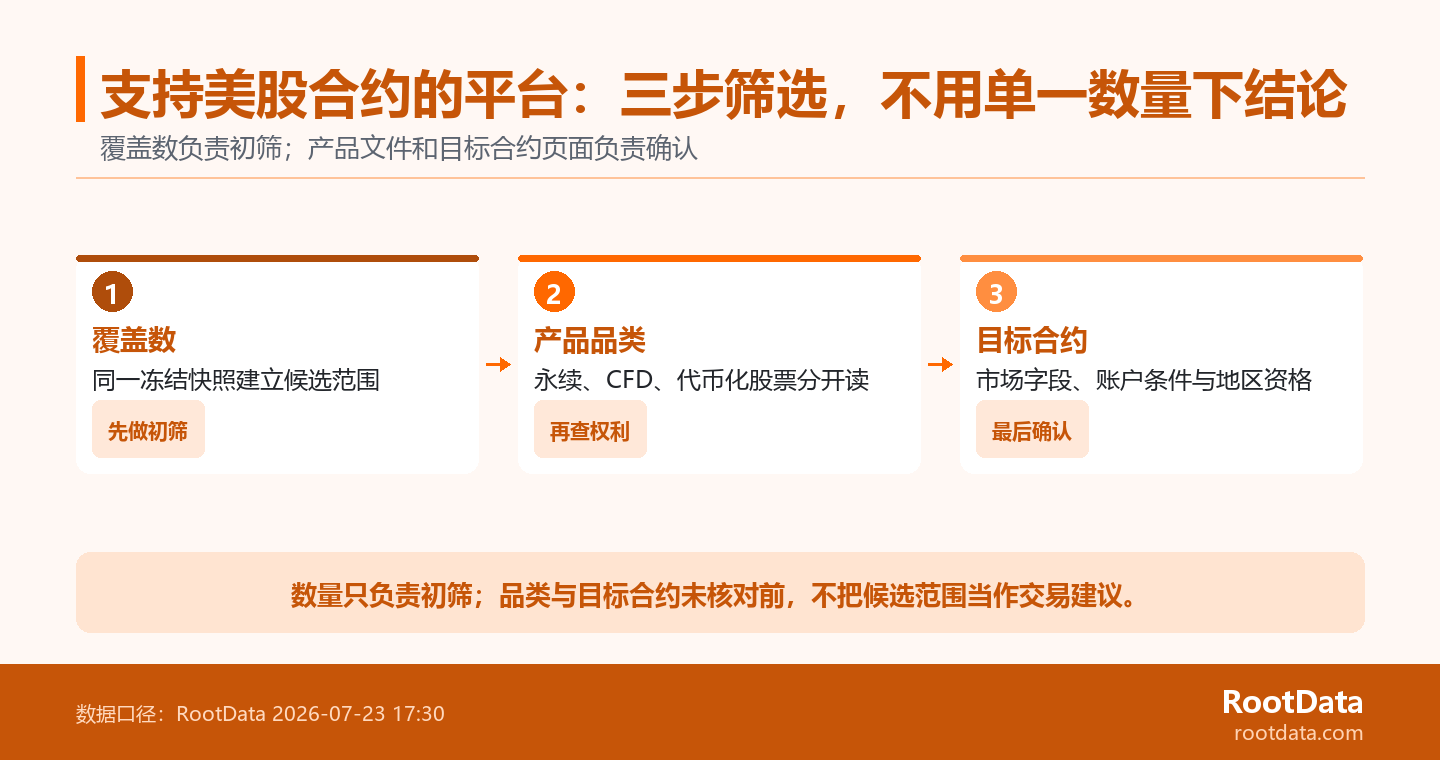
Turn your platform list into a three-step filter
Quantities are used to discover scope and rules are used to confirm availability.The value of this list is not to rank the 29 platforms in a "best to worst" order, but to lead readers to the correct verification path: each step can filter out unmatched candidates and keep information that has not been publicly confirmed from the candidate pool.
- First build the pool according to the coverage number:Select candidate groups of 200+, 100–199, 30–99, or below 30 depending on the research scope; no trading conclusions are drawn at this time.
- Then eliminate mismatches by product category:Confirm whether the target is a stock perpetual, CFD or tokenized stock, and open the corresponding product or offering document.
- Finally confirm according to the target contract:Check the underlying, liquidity, fees, margin, settlement and regional qualifications on the current page; stop extrapolating if the conditions are not clear.
When the research has moved from "what platforms are there" to "whether a certain target contract is worth continuing to look at", RootData's role is to provide a unified time caliber data entry, rather than to confirm product rights or regional availability for readers. Read the listing, product documentation, and current contract page side by side to avoid turning a snapshot into an overly conclusion.
FAQ
It cannot be used in any region from the list of 29 companies.Product distribution, account qualifications and tradable objects may change with regional and platform rules; frozen snapshots only provide a comparison entry and do not replace the platform's current terms, product documents or professional opinions.
Does more contracts mean more U.S. stocks are available for trading?
Doesn't mean. The number of contracts reflects the coverage records included in the comparison at a specific point in time and cannot be automatically converted into the number of tradable targets in your region. It also does not indicate whether the target contract is still online, is of the type of product you want, or has sufficient real-time depth. First use the quantity to narrow the scope, and then confirm it with the target page; if the platform does not disclose key conditions, it should be left as an unconfirmed item, so that the snapshot will not be misinterpreted as an availability commitment.
Are stock perpetual contracts and tokenized stocks the same thing?
no. Equity perpetuals usually provide derivative exposure around stock price changes and are not equivalent to holding shares; another type of token product requires an issuance document describing economic exposure, rights, mortgage or redemption arrangements and regional restrictions. The same stock name may appear in both, but the rules that should be read and the conditions that need to be confirmed are different; if the product documents do not explain the rights or settlement mechanism, they should not be combined and judged based on their names.
Are all 29 platforms suitable for users in any region?
not applicable. Product distribution, account qualifications, KYC requirements and tradable objects will vary depending on region and platform rules, and some products will also list clear restrictions in the issuance documents. When reading this list, regional qualifications should be regarded as the last necessary check: only when the account page, target contract page, and product documents all support it, can the candidate platform be meaningful for continued comparison; any restriction is enough to return the candidate to the pending confirmation state.