
Why Exchange Rankings Change: Understanding Data Snapshots and Metric Volatility
A change in the exchange ranking first indicates that another comparative snapshot is being read, rather than a separate conclusion on the merits of the platform. A data snapshot is a field status that is collected and displayed at a specific point in time; it puts the transactions, positions, quotes and availability at that time in the same comparison table. Therefore, when seeing the difference between the old and new rankings, the first thing to do is not to ask "which one is suddenly better", but to first put the update times of the two pages side by side. The RootData Equity Derivatives Ranking Page and Ranking Description together provide this layer of time and method boundaries.
 Author: Flowie|ChainCatcher content author, paying attention to RWA, interpreting the true narrative of Web3. Follow X
The change in ranking first indicates that the comparison conditions have changed, which does not mean that the platform conclusion is reversed
- Align the time first: two rankings are only worth putting together when their respective observation times are clear.
- Separate the fields again: volume, open interest, liquidity, spread and cost do not answer the same question.
- Last check availability: -- or Pending should be left as missing rather than overwritten with a zero value or negative judgment.
First distinguish three levels of changes: time, relative fields and data availability
Time, relative fields and data availability should be checked separately to explain ranking changes. The first layer is which time window the page is answering; the second layer is the relative status of various market fields and other platforms in the same time window; the third layer is which fields are verifiable and comparable in this snapshot. This order deliberately does not discuss undisclosed weights: public information can explain the fields and update logic, but it is not enough to accurately attribute each ranking move to a certain formula item.
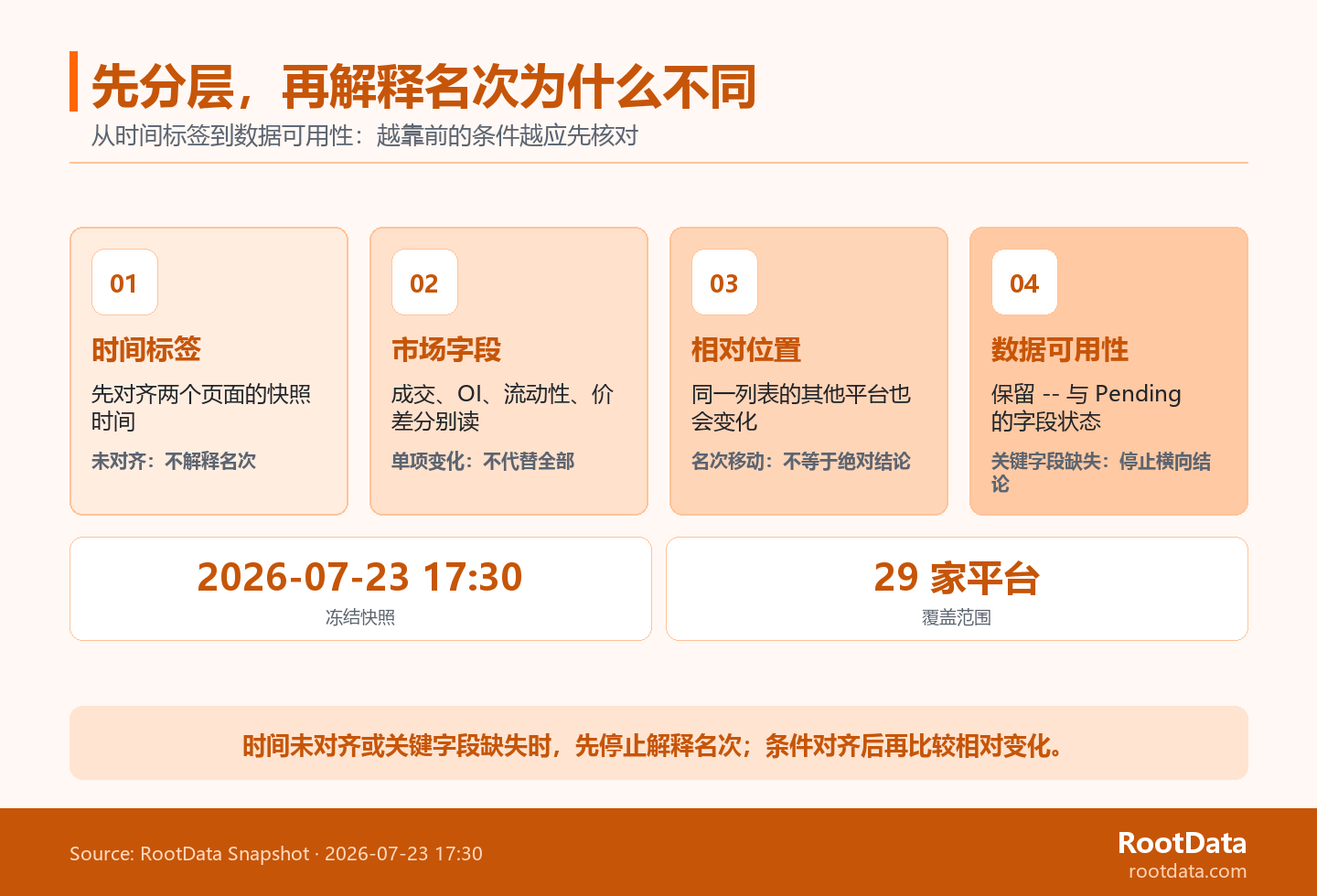
When the three layers are mixed together, the most common misunderstanding is to regard a page refresh as a major event for a single platform. A more prudent approach is to first ask "Is this another data snapshot", then "Which fields or comparison objects have changed", and finally "Are key fields still complete". Only if all three questions can be answered can the rise and fall of rankings have an interpretable context.
The first level: the update time determines which market window this ranking responds to
The fixed snapshot used by the project is 2026-07-23 17:30, covering 29 platforms; dynamic market data is presented in the latest valid snapshot. Ranking Page is used to review page data, Stock Derivatives Ranking Description explains the update logic of dynamic market data. This article only uses this frozen snapshot to illustrate the reading method, and does not write it as current or real-time market conditions.
"The update time has changed" itself is not up or down news. It only confirms that the reader is looking at another set of the most recent valid data; the interval, market status and field completeness between the two snapshots may differ. If you put the rankings saved on Monday directly side by side with those on Friday's page without marking the respective times, then what you are comparing is actually two different observation windows, not the horizontal performance at the same time.
This is why the timestamp should be recorded as part of the number. Saving only the "number" will lose the premise of the conclusion; saving "the number, which field, which time point, and whether it is missing" makes subsequent review possible. For fields that fluctuate quickly, the new page does not overturn the old page, it just answers the comparison question in another time window.
Second level: fields will fluctuate, but each field does not answer the same question
Volume, open interest, liquidity, spreads, fees and funding rates describe different market or cost issues. Stock Ranking Instructions, RootData Exchange Ranking Methodology and The Federal Reserve’s Market Liquidity Notes all remind readers not to compress these dimensions into the same market conclusion.
The 24-hour trading volume records the trading activities that have been completed within the specified window; the open interest (OI) is the position size corresponding to the unfilled contract, which provides the background of the position rather than the acceptance of orders at the same time. Both may change, but not necessarily in the same direction. A market can be actively traded in a short window without concurrently experiencing larger open interest; and vice versa. Therefore, when you see one of these changes, you should not immediately translate it as "an overall improvement in trading conditions" or "an overall weakening."
Liquidity and spreads should also be read separately. Liquidity focuses on the scale that can be accepted near the quotation; the spread is the distance between the buyer's quotation and the seller's quotation, which is closer to the interval of the optimal quotation. Fees and funding rates are holding or transaction cost information. CFTC’s Futures Market Liquidity Study also discusses market indicators under different order conditions separately. For readers of the rankings, the right question isn't "Which number counts for everything?" it's "On which condition do I really care about this change?"
Ranking is a relative position: changes by others may also move your ranking
The ranking is the relative position in the same comparison list. Changes in other platforms over the same period may also move the ranking of a platform. Even if a field on a platform does not appear to have changed significantly, the rankings may still differ if other platforms change within the same time window or if the comparison fields have different availability. This is the normal nature of relative comparisons, rather than a positive or negative event necessarily occurring on an individual platform.
Think of it as a table that moves at the same time, rather than a line that moves alone. The most common thing to miss when interpreting rankings is the fact that the comparison objects are also changing: other platforms in the same category, inclusion fields and valid data status can all change the relative positions you see. Therefore, the arrows between screenshots can only indicate the need for review and cannot replace the review results on their own.
Third level: Missing fields will narrow the comparable range instead of automatically giving negative scores
-- or Pending means that this snapshot has no field value that can be used for same-caliber comparison and should be left in a missing state. RootData Data Standard emphasizes verifiable sources and standardized boundaries; for readers, the fact that a field is not displayed does not equal zero value, and it cannot reversely prove the platform's capabilities.
This layer is especially easy to overlook when comparing across time points. If a field in an old snapshot is complete, but the new snapshot shows Pending, the safest conclusion is not "the new value is worse", but "this dimension cannot be compared with the old value for the time being." Likewise, if a field later becomes verifiable, think of it as an increase in comparative information, rather than reinterpreting the white space of the old page as some implicit score.
Leaving the missing state narrows the conclusion, but is also more honest: you can still discuss the product coverage or other complete fields shown, but you should suspend horizontal sorting that relies on the missing field. Data boundaries are not indications of flaws in the list, but rather stop lines where readers know when to stop inferring.
When putting two ranking pages together, review them in this order
First align the time, then confirm the range, then separate the fields and missing status, and finally record the ranking difference. This is a repeatable sequence for cross-snapshot review. This sequence does not generate new ratings, nor does it tell readers which platform to choose; it simply converts an observation of "ranking change" into a record that can be reviewed.
- Write down two times. Keep the update time displayed on the page and indicate which one is the old snapshot and which one is the new one.
- Confirm the comparison range. Check whether you are still looking at the same equity perpetual or equity-related derivatives category twice, rather than mixing different product structures together.
- Split fields by target. If you are concerned about activities, look at trading volume and OI first; if you are concerned about quotation conditions, look at liquidity and spreads separately; if you are concerned about costs, look at fees and funding rates.
- Keep the missing points and write the conclusion. When the key field is -- or Pending, the comparison of this dimension is suspended and the narrative is not filled with null values.
When you need to re-view the same set of fields, you can View RootData stock trading platform rankings and replace the old records with the new page times instead of mixing numbers from different snapshots into one line. What you get is not a slogan of "who is better", but a comparison note that can be returned to the original field to check.
Three questions that ranking changes still cannot judge for you
RootData's information services do not constitute investment advice. The Disclaimer makes this boundary clear. Even if time, fields, and availability are reviewed, ranking changes alone cannot answer three questions: whether users in a certain region qualify for the product; whether a certain contract has the settlement, margin, or entitlement arrangements you need; and whether it meets your risk tolerance and holding period.
In other words, snapshots are suitable for helping researchers discover "which conditions are worth continuing to ask", but are not suitable for replacing product documentation, regional restrictions or personal risk judgments. Limiting the interpretation of rankings to data comparisons makes them more useful when needed.
FAQ
Questions about refresh, single fields, cross-time point comparisons and missing status should all go back to the understanding of time, field and availability boundaries. The following answers do not add new platform functions or qualification judgments, but only help readers put screenshots, records, and page data back into the same set of comparison conditions.
The ranking update time has changed. Does it necessarily mean that there have been major changes in the platform?
Not necessarily; the update time first indicates that the page is presenting another valid snapshot, and specific changes still need to be checked back to similar fields and the same product range. A page refresh may just mean that the market field enters a new observation window, or multiple data changes may occur at the same time; the reason cannot be determined based on the time tag alone, nor can it be automatically described as some major positive or negative event on the platform.
As the trading volume of a platform increases, will its ranking definitely rise?
Not necessarily; trading volume is just one of several market and product fields, and contemporaneous changes in other fields and other platforms will affect relative positions. Readers should first confirm whether they are comparing activities, positions, quotation conditions or costs, and then check whether the corresponding fields change in the same direction. Public information does not disclose the complete weight, so the precise reason for a certain ranking move should not be inferred based on individual trading volume.
Is it possible to compare last week's rankings directly side-by-side with today's pages?
Can be used as a clue to changes, but you should first indicate the observation time of the two pages and confirm that the product scope, field definitions and missing status remain comparable. The most practical way to record is to write down the ranking, page update time, target field and missing mark at each time point together; if one of the key conditions cannot be aligned, narrow the comparison conclusion to "observed differences" without judging the cause.
-- Or Pending will cause the ranking to appear to change?
It is possible to change the range of comparable fields, but the missing status should not be rewritten to a zero value, nor can reverse conclusions about the platform's capabilities be drawn based on this. When a dimension changes from complete to missing, the correct action is to pause this horizontal comparison; when the field becomes available again, it should also be rechecked with a new snapshot and the same caliber. What is missing suggests a boundary of evidence, not a number that can be directly plugged into a ranking narrative.