
Gate stock product data files: stocks, gStocks, CFD and perpetual contracts
When researching the Gate stock product exchange, the most common misunderstanding is not misreading a certain number, but mistaking different products under the same platform name as the same "stock transaction." RootData's stock derivatives snapshot can help locate Gate's similar market fields; Gate stocks, gStocks, CFD and traditional asset perpetual contracts respectively correspond to different position shapes, equity boundaries and rules pages. The ranking is the starting point for research and is not a real-time evaluation of any single product.
 Flowie, ChainCatcher content author, focuses on RWA and interprets the true narrative of Web3.Follow Flowie
The numbers below are all from the frozen page at 17:30 on July 23, 2026. Product information comes from Gate's currently accessible official pages and announcements; the two types of information answer different questions, so the frozen fields are not extended to real-time fees, personal regional qualifications or order transaction results.
Stratify first, then read the rankings: Gate’s ranking cannot answer four product questions
In the frozen snapshot of 2026-07-23 17:30, Gate ranked 6th out of 29 platforms, showing 275 contracts and $1.02B in 24-hour trading volume.RootData Equity Derivatives Exchange RankingThis set of fields in is suitable for horizontal positioning of the platform under the same category at the same time.
Gate's public information lists stock-related products under different product entrances and rules, so it cannot be summarized with the same set of equity or cost conclusions. Gate’s announcement on the TradFi sector separately describes CFD contracts, perpetual contracts and spot tokens, and reminds that there are naming adjustments in the original product copy; this is a direct reason to identify the product first and then read the rules.Check out Gate’s product-level announcements.
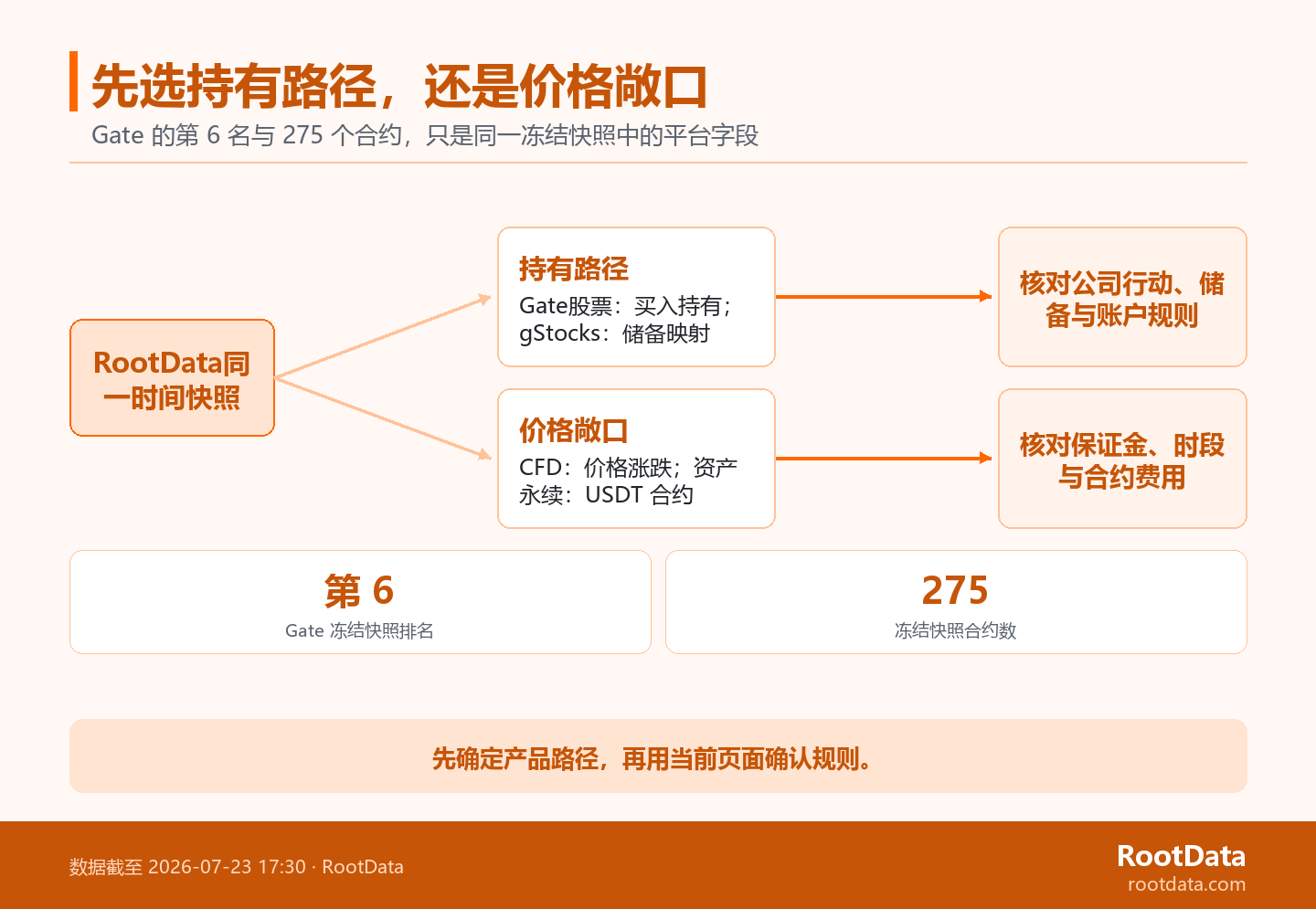
- Number 6 answered the platform field.It cannot individually describe the respective rights, periods and costs of Gate stock accounts, gStocks, CFDs or traditional asset perpetual contracts.
- First, it is divided into "holding path" and "price exposure".Gate stocks and gStocks should focus on checking positions, corporate actions or reserve mapping; CFD and traditional asset perpetual contracts should focus on checking margins, time periods and contract mechanisms.
- Product conditions are dynamic information.The target listing, trading hours, fees, account rules and regional access should all be confirmed by returning to the current page of the target product.
Gate in frozen snapshot: it records the stock derivatives field
Gate's rankings and fields can only be interpreted within the display scope of fixed time and stock derivatives pages.RootData Equity Derivatives Ranking Descriptionis a gateway to understanding the scope of these fields: it helps compare similar platforms, rather than rewriting a platform snapshot into a complete description of a stock product.
| Freeze fields | Gate display value | What does this set of fields help answer? |
|---|---|---|
| Ranking | No. 6 | Relative position within the same snapshot |
| Number of contracts | 275 | Contract coverage fields included in statistics at that time |
| open interest | $247.73M | Stock market fields at a fixed point in time |
| 24 hour trading volume | $1.02B | Activity field within fixed window |
| ±2% weighted liquidity | $3.90M | Liquidity fields within a fixed range, which should be viewed together with spreads and other fields at the same point in time |
| Show spread | 0.061% | The quotation field in the snapshot is not equivalent to the actual transaction result of any order. |
The value of this table is to fix the comparison object, rather than to create a conclusion of "Who is No. 6 more suitable?" Especially ±2% weighted liquidity: it is a liquidity field within a fixed price range at the same time point. It can help understand the relative depth, but it cannot promise at what price a single order can be filled. The corresponding target, direction, order book and current price difference still need to be checked separately.
Gate’s four stock paths cannot be answered with the same table
If readers want to deal with buying, holding and corporate actions in stock accounts, focus on Gate stocks; if they are concerned about reserve mapping and order book rules for tokenized securities, focus on gStocks; if they are studying the price rise and fall of reference assets, they should read CFDs and traditional asset perpetual contracts separately. Although all four may be related to stocks, they have different answers on "what to hold", "whether you have the rights to the underlying" and "how the cost is formed".
| product path | What to understand first | What should not be inferred directly? | Next step to check |
|---|---|---|---|
| Gate stock | Buying, holding, selling stocks and ETFs, and handling corporate actions | The individual is registered as a shareholder in the traditional registration system | Stock accounts, listed stocks, trading hours and corporate action rules |
| gStocks | Tokenized securities, real stock reserve mapping and intra-platform trading rules | Reserve mapping automatically equates to full traditional shareholder rights | Product announcements, reserve instructions, dividends and current scope of application |
| CFD | Contract exposure that references the rise and fall of an asset’s price | Buy and hold the underlying stock yourself | Margin display, market hours, overnight fees and contract rules |
| Traditional asset perpetual contract | A USDT contract with no expiration date that tracks the price of a reference asset | Contract positions provide ownership or rights attached to a reference asset | Target contracts, funding mechanisms, margins and current market conditions |
Gate's stock explanation path is to buy, hold, and sell stocks and ETFs, and handle cash dividends, stock splits, and stock partnerships according to rules; users do not hold shares in the traditional registration system in their personal names.Gate Stock ProfileandStocks FAQCompany actions, accounts and access conditions are all described in product rules. Therefore, after seeing the word "stock", you should continue to confirm the position record, time period and specific target, rather than judging the right set based on the name alone.
The Gate 2026-07-22 announcement describes gStocks as tokenized securities backed by 1:1 full native stocks, and says it supports 7×24-hour trading and stock dividend functions for eligible assets.Gate gStocks AnnouncementPublic representations of reserve mapping, odd lot and dividend functions are given. The key here is not to reduce "1:1" to a synonym for any traditional shareholding rights, but to check how the product defines reserves, conversions, dividends and scope in the current page.
Gate’s CFD description defines it as a CFD that trades the rise or fall of the price of a reference asset, rather than buying or selling the underlying asset itself.Gate CFD Contract IntroductionThe time period, margin, position mode and fee mechanism of CFD and USDT perpetual contracts are also distinguished side by side. For readers, the cost reading of CFD should return to the time period and overnight rules of the contract, and cannot directly apply the company action logic of stock accounts or gStocks.
Gate’s TFP protocol defines traditional asset perpetual contracts as contracts that use USDT as margin and settlement, track the price of reference assets including stocks, and do not grant ownership or accompanying rights to the reference assets.Gate CFD Service AgreementandTraditional asset perpetual contract pageTogether, the reference asset, no expiry date, and rule boundaries for this path are illustrated. It reflects the contract price exposure: whether to trade, when it can be traded, how fees and funding mechanisms are calculated, all should be confirmed immediately based on the target contract.
Return the data file to the current page: four-step review
RootData's data standards emphasize that data fields should be understood in conjunction with public definitions, calibers, and update times.Read the RootData data standardReviewing this frozen archive later will avoid treating static fields as replacements for the current product page.
- Select the product category first.Make it clear whether you are researching Gate stocks, gStocks, CFDs or traditional asset perpetual contracts; don’t just search for rules by “stock” or platform name.
- Then lock the target.Verify that the specific stock, ETF, or reference asset is currently listed for the product and that the product name, symbol, and unit are consistent.
- Then check the current market rules.Focus on reading the trading hours, order methods, margins, capital or overnight costs, company actions and fee standards; there is no cost table that can be directly used for different paths.
- Final check of account conditions.Current product pages, identity verification requirements, regional access and account rules are subject to review, and general instructions are not written as a judgment of availability to any individual.
When you need to do horizontal research using the latest fields, you canView RootData Equity Derivatives Exchange Rankings, and then put the specific product conditions of the current page back into the same research framework. In this way, the frozen data is responsible for narrowing the scope, and the product page is responsible for confirming the current rules, and both play their respective roles.
FAQ
Gate's public information places different products under different rules and account conditions, and the FAQ cannot replace checking the current product page.Gate product level descriptionIt can help identify the entrance, but the specific target and account conditions should still be based on the current page.
Gate is ranked 6th in the RootData snapshot, does that mean all four products are ranked 6th?
Doesn't mean. Number 6 only belongs to RootData’s snapshot of the equity derivatives exchange field at a fixed time, not a separate ranking of Gate stocks, gStocks, CFDs or traditional asset perpetual contracts. It can help researchers prioritize the position of a platform in similar fields, but it cannot prove the real-time liquidity, tradable objects, fees, equity or personal account conditions of any product. When reading such numbers, you should always preserve the timestamp, field name, and product range as well.
When Gate stocks and gStocks both receive dividends, do they represent exactly the same rights?
should not be directly regarded as identical. Both types of products require understanding of dividends and corporate actions according to their respective rules, but the treatment of economic rights does not equal the complete set of traditional registered shareholder rights. The public description of Gate stocks specifically distinguishes between account holdings and personal holdings in the traditional registration system; gStocks needs to continue to check its reserve mapping, product terms, dividend rules and current scope of application. When encountering dividend information, first confirm which type of product you hold.
Gate's CFDs and traditional asset perpetual contracts are both price exposures. Can the fees be directly compared with each other?
They cannot be directly compared to each other. Neither CFD nor traditional asset perpetual contracts write contract positions as underlying holdings, but the trading hours, margin display, settlement, funding or overnight cost mechanisms may be different. Even if both revolve around stock-related reference assets, readers should still lock in the specific products and target contracts before checking the current rates, time periods, orders and position rules. Combining the two paths into a single "cost of stock contract" misses key conditions.
When you want to research Gate stock products, what are the first four things you should check?
First check the product category, target objectives, current market rules and account conditions. The purpose of this sequence is not to give trading advice, but to avoid mismatches in research: treating platform rankings as product ratings, treating price exposure as holdings, treating functional descriptions in announcements as current target conditions, or treating general descriptions as personal qualification conclusions. After all four items are consistent with the current page, the frozen snapshot is used as background information for horizontal comparison.