
What are the differences between European and Asia-Pacific tokenized equity rules: issuance, trading and user protection
Writing about Europe, Hong Kong, or Singapore as a general “regulatory environment” easily misses the material that actually determines the boundaries of the product: what rights the token actually represents, who is responsible for issuance or distribution, who completes the trading and settlement, and where users can check risks and restrictions. Regional differences should fall back on these specific issues rather than being compressed into loose or strict judgments on a given market.
This article selects Europe, Hong Kong and Singapore as three representative public frameworks. It does not equate them with the entire Asia-Pacific region, nor does it draw conclusions about any specific products, platforms or user qualifications. A more useful approach is to check the public documents one by one along the same product life cycle.
First, set the unit of comparison as "the life cycle of the product in a certain region"
When comparing the regulation of tokenized stocks in Europe and Asia-Pacific, first record the four dimensions of product rights and classification, issuance or distribution entities, trading and settlement functions, and user files, and then discuss the region. The reason for this is simple: the same “tokenized stock” name may correspond to different underlying rights, different entities, and different service links; regional names cannot replace these facts.
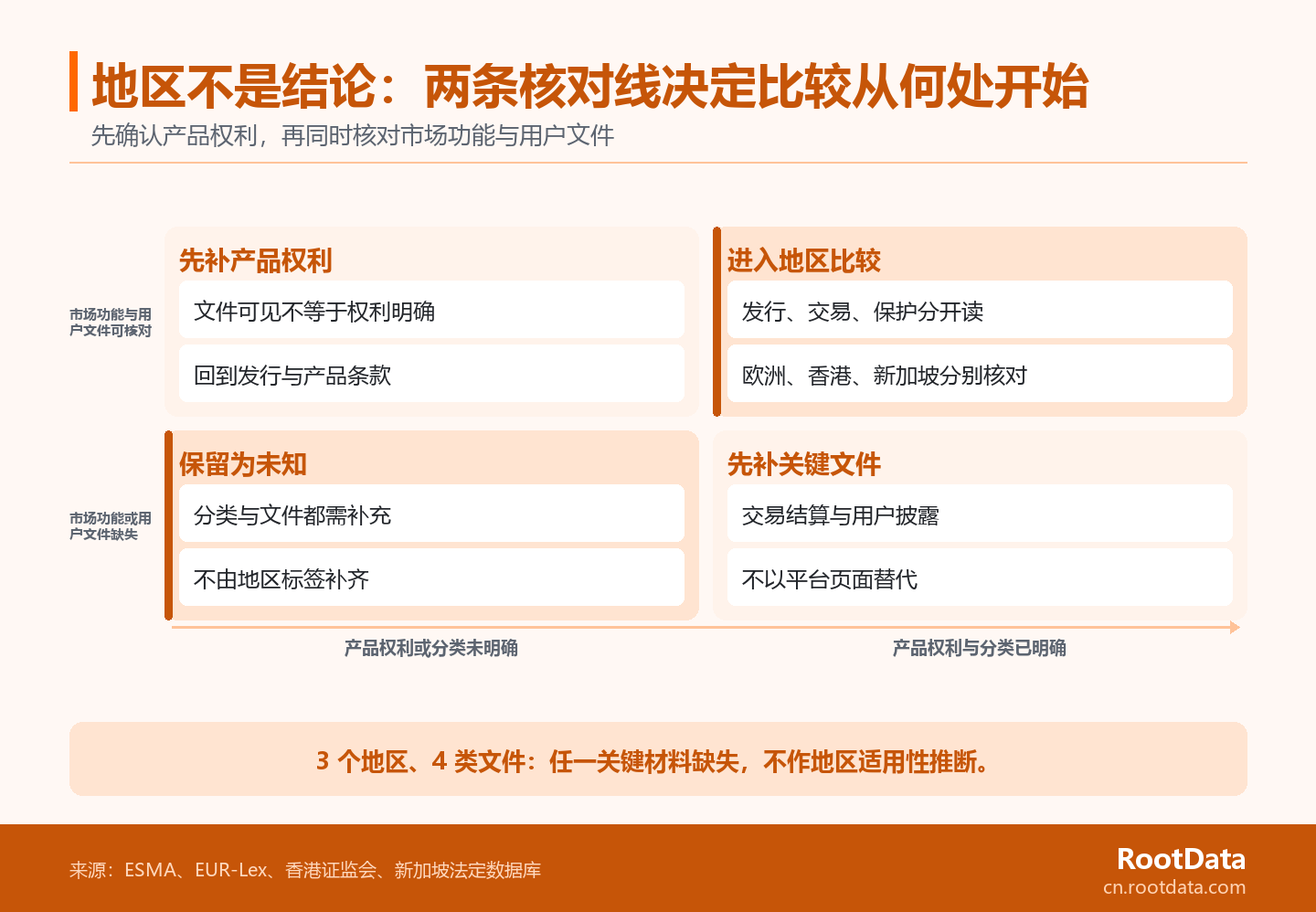
- First confirm what rights token holders get and how the products are classified.
- Record issuing or distribution entities separately from trading, settlement or technical operations entities.
- Separate trading mechanisms from market conditions: the former looks at rules and responsibilities, and the latter looks at data fields.
- Check risk disclosures, scope of services and limitations as part of user documentation.
| link | What to ask first | Public materials prioritized for verification |
|---|---|---|
| Product Rights and Classification | What rights or price exposure do token holders receive? How are products classified? | Product terms, release notes, statutory definitions or classification descriptions |
| Issuance and distribution | Who issues, promotes, distributes or intermediaries services? | Issuer information, intermediary disclosure, applicable conditions |
| Trading and Settlement | Who brokers, executes, records, settles or has technical operational responsibilities? | Market facility description, trading rules, settlement and exception handling arrangements |
| User protection | How are risks, limitations, escrow or recording mechanisms, and dispute handling explained? | Risk Disclosure, Customer Documentation, Technical Controls and Restrictions Statement |
This sequence can also avoid a common misunderstanding: the appearance of on-chain records, token codes or cross-regional access portals on the page does not automatically answer whether product rights, subject responsibilities or user protection have been covered by the same document. When key material is missing, leaving the conclusion "to be verified" is more reliable than filling in the information with regional impressions.
For the use of RootData's market data, these four types of documents are also prerequisites: only if the product type and service scope are fixed first, fields such as trading activity, liquidity or product coverage will not be misinterpreted as rights or regional conclusions.
Europe: First identify product classification boundaries, then look at trading and settlement arrangements
In the EU context, tokenized securities that meet the definition of financial instruments are outside the scope of MiCA. “Financial instruments” here can be understood as product categories such as securities that are subject to existing rules.ESMA’s public page for MiCA Article 2Crypto-assets that meet the definition of financial instruments are specifically excluded;Note from the European CommissionIt also reminds that tokenized securities should still be understood in the context of existing securities and banking rules. Thus, seeing “tokenization” is not enough to infer that MiCA should be the starting point.
Distribution: Technical forms do not substitute for identification of underlying rights
For researchers, at least two things need to be separated at the issuance level: first, whether the underlying rights are described as securities or other financial instruments; second, whether the on-chain records perform registration, transfer, access, or other functions in the arrangement. The point here is not to classify any product, but to remind readers not to regard technical labels as classification conclusions.
Transaction: In addition to issuance documents, market facilities and settlement paths must also be considered
The EU’s DLT Pilot Regime puts the discussion of trading and settlement into a pilot framework for distributed ledger market infrastructure. DLT market infrastructure refers to regulated market arrangements that use distributed ledgers to process transactions and settlements.Relevant EU regulationsTherefore, it is a reminder that when researching an arrangement, you should not just stop at the issuer's description, but also identify the actual trading venue, recording or settlement mechanism, and the conditions stated in the corresponding documents. The pilot framework itself is not equivalent to drawing conclusions about a certain product or entity.
If the trading venue, recording mechanism or settlement path does not correspond to a specific entity in the public materials, no matter how complete the issuance materials are, it will not be enough to explain how the trading link operates; this gap should be recorded separately.
In the European part, the "Issuance" and "Transaction" columns in the comparison table should not be combined: the former answers how products and rights are explained, and the latter answers what kind of infrastructure carries the market function. The roles of the two types of documents are different, and without either type, regional comparisons lose a key dimension.
Hong Kong: Securities rules and ownership and technology risks brought about by tokenization
The Hong Kong Securities and Futures Commission (SFC) regards tokenized securities as traditional financial instruments using distributed ledger technology, and handles related intermediary activities based on the idea of "same business, same risk, same rules". ThatCircular on Tokenized Securities Related ActivitiesReaders are reminded that the securities attributes of the product and specific intermediary activities are still the main reading objects; the technical arrangement on the chain is to add risks and control issues that need to be managed on this basis.
Distribution and Distribution: Make it clear who is responsible for what
Under the Hong Kong framework, product research should not only look at the technical introduction of the project party. At least the roles played by the issuer, intermediary, custody or technical service-related entities should be separately recorded, and whether the product documentation explains the ownership recording or transfer mechanism of the token. This is not done to label the subject, but to prevent the three types of responsibilities of distribution, distribution and technical operation from being mixed together in a piece of marketing text.
When descriptions of issuance, trading, custody and technical services appear on the same page, the most important thing is not to summarize them into one brand impression, but to map each function to the actual body and file.
After the initial alignment of these files, market data is suitable for comparison. If you need to observe the activity, liquidity or coverage of similar products, you can fix the product type, service scope and data time point.View RootData Equity Derivatives Trading Platform Ranking. It serves as an observation of market conditions and is not a substitute for document checking of intermediaries, rights or territorial restrictions.
User Protection: Proprietary Rights, Technical Exceptions and Customer Disclosure Needs Go Together
The relevant Hong Kong circulars require attention to ownership records, technical risks, due diligence and customer disclosures. Secondary trading arrangements should also be read in conjunction with the associated documents. the institution'sCircular on Tokenized Securities Related ActivitiesTips on ownership and technology risks, which regardingTokenized secondary trading of approved investment productsThe circular states that secondary market arrangements cannot be replaced by issuance introduction alone. User documentation should also enable readers to find how holder rights are recorded, what arrangements are relied upon in the event of a network fork or system outage, and what limitations and risks need to be identified.
For users, the key is not the number of files, but whether each risk can be mapped to rights records, responsible parties, or exception handling instructions; when corresponding materials cannot be found, it should not be assumed that equal protection is available.
Singapore: Product classification and market function are starting points for public reconciliation
Singapore's reading portal is a statutory classification of capital markets products. The specific offer arrangements and related obligations also need to be understood together. in forceSecurities and Futures LawOrganizes categories such as securities, collective investment scheme units and derivative contracts into statutory definitions of capital market products; relevantSection 309BIssuers are also required to determine product classification under specified circumstances. For the study of tokenized stocks, this reminds readers to first find out in which product and service context the underlying rights and actual activities fall, rather than inferring from the general term "on-chain assets".
Distribution: Classification should be read together with the specific offer schedule
Section 309B relating to specific offers indicates that the classification steps should be read in conjunction with the specific offer and document conditions. For external readers, a reasonable research move would be to place the product category, offer recipients, distribution materials and service scope on the same page of notes; excerpting a definition alone is usually not enough to illustrate the complete path.
If the offer objects, issuance materials and service scope do not correspond to each other, the product classification itself is still not enough to restore the complete issuance path.
Transaction: Looking back at the responsible entities from the perspective of actual market functions
When a product enters the trading, matching, settlement or customer interface, the focus turns to who provides the actual functionality. Product issuers, trading or operating entities, custody or recording mechanisms should be separated, rather than assuming that all functions are performed by the same brand. This can also form a comparable three-part series with the market infrastructure issues in Europe and the intermediary and technical control issues in Hong Kong: who issues, who operates the market functions, and what documents and control arrangements users rely on.
Separating the actual market functions can prevent readers from mistaking product names, customer interfaces and transaction settlement responsibilities as being borne by the same entity.
User protection does not rely on regional sorting, but on five material alignments
Regime entrances vary across Europe, Hong Kong and Singapore, but the unit of comparison for user protection should not be just the region name. A more practical approach is to check whether the same product can map the five pieces of information - rights, responsible entities, transactions and settlements, custody or recording mechanisms, risks and restrictions - to public documents one by one. When a product page answers only one part of the question, it shouldn’t burden it with the entire set of judgments.
- right:Do token holders obtain registered interests, beneficial interests, price exposure, or another contractual right?
- Responsible entity:Who does the issuance, distribution, trading, custody, recording and technical operations?
- Transaction and Settlement:How are orders executed, how are records updated, and what processes are relied upon in the event of disruptions or disputes?
- Control and custody:Who controls access, transfer, private keys or other control mechanisms, and how are abnormal events handled?
- Disclosures and Restrictions:Does the product documentation clearly describe risks, customer classifications, service scope, and geographic restrictions?
These five items are not a fixed list of rules for a certain area, nor do they replace professional advice; their role is to transform "user protection" from an abstract concept into a traceable document issue. If there are inconsistencies between documents regarding the same matter, or if key roles are not clearly stated, the safest record is to continue to check, rather than fill it in with regional impressions.
Once you’ve identified your product and service range, use RootData to compare market conditions
Market data only has its proper place when the product type, service range and transaction segments to be compared have been aligned.RootData’s Equity Derivatives InstructionsComparative context for understanding market fields. Market data can assist in observing market conditions but should not be used to demonstrate product rights, regional suitability, or user qualifications.
If the next step is to compare market conditions for similar products, the product type, target contract, service scope and data time point should be fixed first. This step should be placed after document verification: market data can answer "what is currently observable" and cannot be a substitute for "what rights or protections are provided by the product under which arrangements".
FAQ
Does MiCA apply directly to all tokenized equity products?
It is not appropriate to make this inference directly. ESMA’s MiCA scope page excludes crypto-assets that meet the definition of financial instruments, so specific products still need to be checked in terms of their rights, classification and trading arrangements, rather than just whether they are tokenized. If the product documentation does not clearly state the rights it represents, or the trading arrangements are not clearly set out, the territory name itself will not fill the gap. A more appropriate record at this time is to mark the items to be checked, rather than extending the technical form into a rule conclusion.
Do tokenized securities in Hong Kong only require reading the blockchain technology description?
Not enough. The Hong Kong Securities and Futures Commission's public materials place traditional financial instruments, intermediary activities, ownership risks, technology risks and customer disclosures in the same reading frame. Technical descriptions should be checked with product documentation and service entity information, especially to identify how on-chain records affect ownership records, transfer control, and exception handling. If these key points only remain in a brief product introduction, you should still go back to the official document and continue to check.
Why does Singapore first ask what type of capital market product a token belongs to?
Because the disclosure statutory framework starts with product categories and actual activities. First identify the underlying rights and specific offers or service arrangements before continuing to read the corresponding entities, market functions and document conditions. For research records, product classification, offer objects, service entities and transaction functions should be kept separately; if any of them is unclear, the label "Singapore Project" should not be used instead. This can also avoid confusing the issuer, interface provider and the entity that actually performs the transaction function.
Can regional restriction alerts individually indicate whether I can use a product?
cannot be stated individually. The regional reminder is only part of the product document; specific research also requires a combination of product structure, service entities, customer classification, transaction arrangements and current terms. It may indicate that the service provider has set a certain scope, but it cannot independently prove that product rights, transaction mechanisms or user protection arrangements have met any specific conditions. If there is any discrepancy between the terms and product introduction, the current official document shall prevail. This article does not make any judgment about the availability of any individual or product.