
Bybit stock exchange data files: spot tokenization, perpetual contracts and regional access
The exchange's high ranking cannot conclude that the spot tokenized products, perpetual contracts and account access under the platform's name are "better to use". They respectively correspond to platform fields, product structures and current applicable conditions: first confirm which path you are researching, and then Bybit’s ranking in the stock exchange snapshot will have available interpretation boundaries.
 Flowie, ChainCatcher content author, focuses on RWA and interprets the true narrative of Web3.Follow Flowie
Layer first, then read the rankings: Bybit’s ranking cannot answer two product questions
In the frozen snapshot of 2026-07-23 17:30, Bybit ranked 2nd among 29 platforms, showing 131 contracts and a 24-hour trading volume of $896.59M.RootData’s Ranking of Equity Derivatives ExchangesPresent these fields at the same point in time; it is suitable for judging "which platform should be reviewed first", but is not suitable for replacing the current conclusion of a certain token, a certain contract or a certain account.
Bybit’s xStocks spot tokenization and TradFi’s perpetual contracts are two different paths for stock-related products. xStocks is a tokenized product traded in the secondary spot market and does not mean holding shares directly; TradFi perpetual contracts are priced and settled in USDT and do not mean holding the underlying.xStocks FAQandTradFi Perpetual Contract DescriptionThe product boundaries of the two paths are given respectively: the former must first identify the equity and spot rules of tokenized products, and the latter must look at the contract, margin, funding rate and position risk; the same platform name should not allow these two sets of check items to borrow from each other.
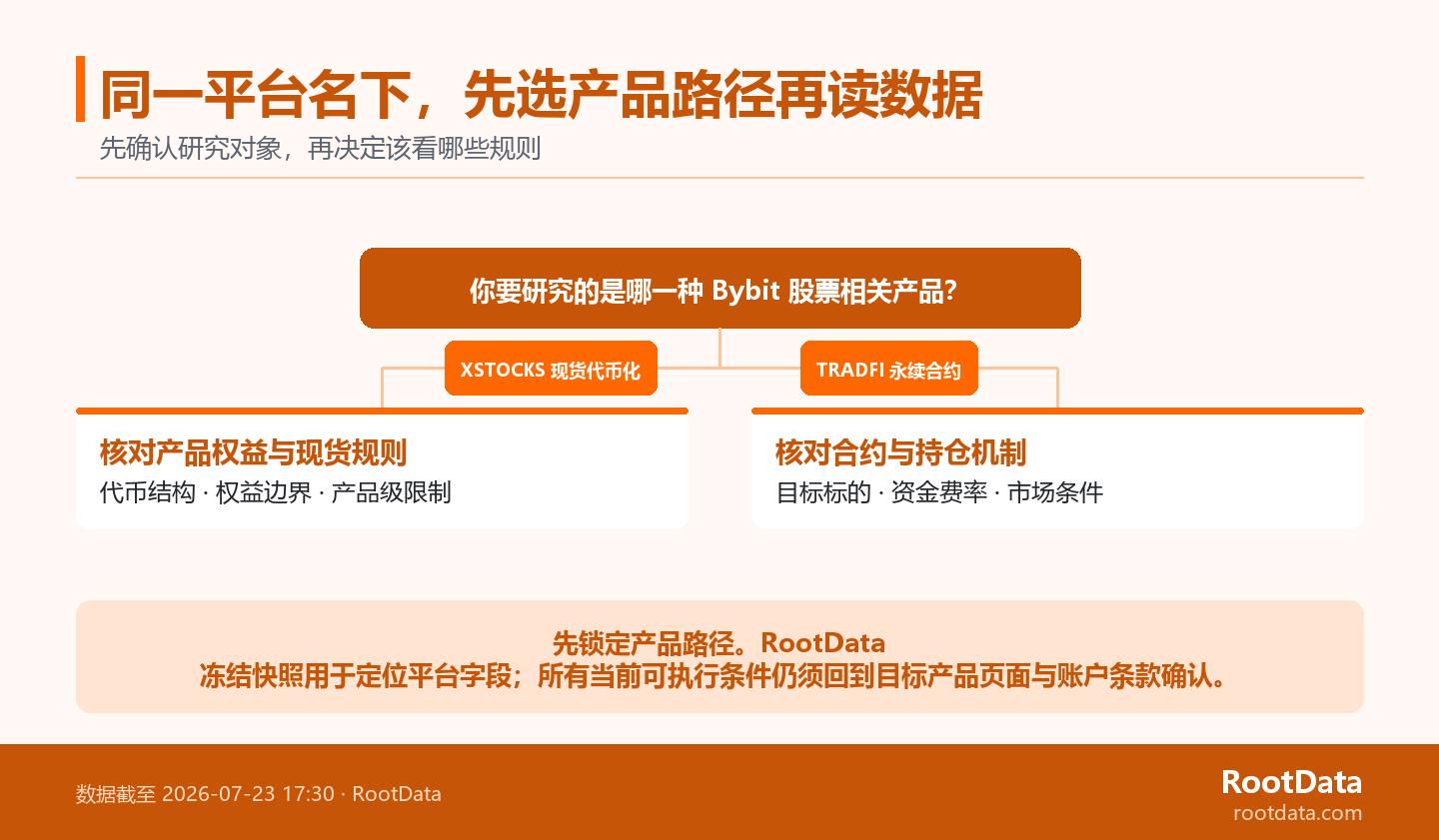
- When looking at the rankings:Keep freeze time, sample range and field size.
- When looking at xStocks:Start by asking what the product itself represents and what it does not represent.
- When looking at perpetual contracts:Lock in the target and contract rules first, then discuss fees or liquidity.
- When looking at regional access:Review product restrictions, authentication, and general terms of service separately.
Bybit in the frozen snapshot: it records the stock derivatives field
Bybit's rankings and fields can only be interpreted within the display scope of the fixed time and stock derivatives page.Ranking descriptionTogether with the page caliber, it determines the comparable range of the numbers: "No. 2" here is the relative position of the 29 platforms in the same frozen section, not the total rating of xStocks spot, all TradFi products or real-time order books.
The following set of values should be read as a section, not a quote. Open interest is the size of the contract that has not yet been closed, not the transaction volume; ±2% weighted liquidity is a signal of the depth of the order book near the price range, and cannot directly replace the actual transaction result of a certain order.
| Freeze fields | Bybit display value | Questions suitable to be answered | Questions that cannot be answered alone |
|---|---|---|---|
| Ranking / Rating | 2nd / 91.2 | Platform positioning within the same section | Whether a product is suitable for personal use |
| Number of contracts | 131 | Derivatives coverage signals displayed at frozen time | xStocks spot token quantity or availability |
| Open interest / 24h trading volume | $97.48M / $896.59M | Size signals for ongoing positions and completed trades | The transaction price of the next order |
| ±2% weighted liquidity/spread | $1.01M / 0.051% | Depth and spacing around quotes within snapshots | Fixed slippage or fixed total cost |
| Funding Rate / Maker / Taker | -0.0002% / 0% / 0.0275% | Rate field in snapshot | Uniform fees across products and cycles |
| margin | USDT | Settlement related fields shown in snapshot | Full terms for all TradFi products |
This is also the value of the platform data archive: it first gives comparable coordinates, and then leaves the question of "can it be traded and how to trade" to the current page of the target product. By skipping this step, trading volumes, liquidity or rates can easily be misinterpreted as being universal across all equity-related products.
Two stock paths on the same platform cannot share a cost table.
These two paths are easily confused because they both borrow stock-related names and price narratives; the real difference is what kind of product relationship the reader gets on each path, what kind of mechanism needs to be undertaken, and which page to ask questions. Once the evidence scope is separated, the rate field in the frozen snapshot should not be applied to xStocks, and the description of the tokenized product should not be moved to explain the perpetual contract.
xStocks: First confirm the rights and spot rules of tokenized products
The description of Bybit xStocks reminds that it does not confer voting, dividend or legal claim rights.xStocks FAQIt is also placed on the secondary spot market and stated to be tradable 24/7. The order of judgment here should be "product structure and equity boundary" first, and "fees or quotations" last: even if the name comes from a familiar US stock, it cannot be equated to directly holding the underlying stock based on the name alone.
TradFi Perpetual Contract: First confirm the target, funding mechanism and position conditions
Bybit TradFi’s perpetual contract is priced and settled in USDT, and adopts perpetual contract mechanisms such as funding rates.Bybit product descriptionMargin and liquidation mechanisms are also mentioned, so for this path, price exposure, current contract parameters and holding period are the next level to check.
Bybit TradFi perpetual contracts do not represent ownership of the underlying assets and do not provide shareholder rights.The contract descriptionMake this clear: neither it nor xStocks should be written as an equity relationship, but the product structure and conditions to be verified are different; readers should decide the next step of verification based on the current parameters of the target contract, rather than the word "stock".
A snapshot of a stock derivatives exchange can help locate Bybit; it cannot decide for you whether to check the spot rules of xStocks or the capital and risk rules of TradFi perpetual contracts.
This is the core reasoning of this article: fields such as rankings and 131 contracts answer "the position of the platform in the cross-section of similar derivatives"; xStocks FAQ answers the rights and product restrictions of tokenized products; the perpetual contract information answers the contract mechanism. The scope of evidence for the three types of information is different, so they should not be added together to form a "unified cost or unified access conclusion for a certain platform's stock products."
Regional access is not a “platform available/unavailable” dichotomy
xStocks’ product-level restrictions and Bybit’s general service restrictions need to be reviewed together and cannot be used to replace personal qualification judgments.xStocks FAQPrompt for authentication and product-level restrictions, Bybit’sService restrictions pageExplain the limitations at the general service level; readers should unpack "Can I use it" back to the current product, account type and applicable terms, rather than looking for an answer to a list of regions without conditions.
This split also explains why it is not appropriate to write “Bybit is legal somewhere” or “It must be tradable somewhere”. Restrictions, identity verification requirements, terms of service, and update times may vary between products; this article can only indicate which levels of review are provided on the official page and cannot make qualification, legal, or compliance judgments about individuals or entities. If you need to put the platform back into similar fields for comparison first, you canView RootData Equity Derivatives Exchange Rankings, and then return to the target product page to complete the check of account and regional conditions.
Use a four-column checklist to link data files back to the current page
After using frozen data, it should be reviewed based on product category, target, current market conditions and account terms.RootData data standardsIt reminds the importance of time and caliber: the data file is responsible for establishing comparison coordinates, and the current page is responsible for confirming the contract, fees, market and account conditions at this moment.
| What to ask first | Pages or fields that should be checked | Misreadings to avoid |
|---|---|---|
| 1. Which product path to study? | xStocks spot tokenization, or TradFi perpetual contract | Treat the platform name as a unified product |
| 2. What is the goal? | Specific token or specific contract, trading period and product parameters | Replace targets with platform-level fields |
| 3. What are the current market conditions? | Order books, quotes, fee rules and funding mechanisms | Treat frozen spreads or rates as fixed results |
| 4. Do the account conditions apply? | Authentication, Product Limitations, General Service Limitations and Latest Terms | Treat the general description as a conclusion of personal qualifications |
The point of doing this is not to pursue a "total score answer", but to separate what the data can prove from what still needs to be confirmed before entering specific products.
FAQ
Bybit’s stock derivatives rank 2nd, does it mean that xStocks spot also ranks 2nd?
No explanation. The 2nd place belongs to the stock derivatives exchange field displayed by RootData at a fixed point in time, rather than a separate ranking of xStocks spot products. The function of this position is to remind readers that Bybit deserves priority review in the field of similar derivatives; if the question points to xStocks, they should still confirm the product structure, current trading pair, fee description and account conditions, and cannot directly transfer the platform cross-section to the spot conclusion.
Is xStocks equivalent to directly holding the corresponding US stocks?
It’s not about directly holding U.S. stocks. Bybit's product description refers to xStocks as a tokenized product path and reminds that it does not grant voting, dividend or legal claim rights; therefore, readers should not directly equate familiar stock names with shareholder status. If you need to compare the trading conditions of a certain token, you should continue to check the current market, product description and account applicable conditions of the token, rather than infer the rights and interests based on the company name alone.
Can Bybit stock perpetual contracts bring shareholder rights or dividends?
cannot. TradFi Perpetual Contracts provide contract exposure that tracks the price of traditional financial assets. They do not represent underlying ownership, and do not include shareholder, voting or dividend rights. Its cost and risk will also change with the target contract, funding mechanism, margin requirements and market periods; when judging the position conditions, you should return to the current parameters of the target contract rather than deriving equity or dividends from the stock name.
Is it enough to just look at Bybit’s general platform rules for regional restrictions?
not enough. There may be additional product-level restrictions on the product page, and whether the account is applicable also involves identity verification and the then-current terms of service; target products and general service restrictions should be checked at the same time, rather than using a general rule to replace personal conclusions. Page updates, account types, and product paths may change the conditions that require confirmation, so the scope statement in this article should not be interpreted as a personal judgment on regional availability.