
Bitget Stock Perpetual Exchange Data File: Trading Volume, Depth, Funding Rates and Transaction Costs
When looking at the Bitget Stock Perpetual Exchange data, the most common misinterpretation is to compress a series of percentages into the conclusion that "transaction costs are very low." Trading volume, open interest, order book depth, spreads, transaction fees and funding rates are not on the same time scale: some describe transactions that have already occurred, some describe acceptances near quotes, and some only have an impact during the holding period. They need to be read separately so that the historical snapshot is not mistaken for a commitment to the next order.
This article uses the stock derivatives ranking field fixed by RootData at 17:30 on July 23, 2026, to sort out Bitget’s position among the 29 platforms. This is a data file used for horizontal verification. It is not a real-time market situation and does not constitute trading advice. When you really need to make a judgment, you should still go back to the target contract, the current order book and your own account conditions.
Let’s look at the conclusion first: Bitget’s strong signal cannot be directly rewritten as low cost
In the frozen snapshot of 2026-07-23 17:30, Bitget ranked 4th out of 29 platforms, showing 252 contracts, $2.03B of 24-hour trading volume, and $4.19M of ±2% weighted liquidity. The corresponding open interest is $740.22M and the displayed spread is 0.061%. These fields are from the same point in timeRootData Equity Derivatives Exchange Ranking, so it can be used as the starting point for horizontal positioning.
Bitget’s trading volume, open interest, liquidity, and spreads describe trading activity, existing positions, order book taking, and quote spacing respectively. RootData'sEquity Derivatives Ranking DescriptionThese items are also included in the comparison dimension along with the number of contracts, fees, funding rates, etc. In other words, high trading volume indicates that there has been too much activity in the specified window, which is not enough to answer alone the price at which a new order will be filled.
- Look at the activity level:Let’s first look at 24-hour trading volume and open interest.
- Check out quotes for nearby undertakings:Looking again at ±2% weighted liquidity and spreads.
- Look at cost and availability:Check the transaction fees, funding rates, target contracts and account conditions separately.
What this Bitget Stock Perpetual Exchange Snapshot Record
RootData's frozen data is used for horizontal comparison at the same point in time, not real-time market conditions. "Freezing" here refers to locking the page fields at 17:30 on July 23, 2026; it helps readers compare similar fields on 29 platforms at that time, but will not be automatically updated with the current order book, contract list or fee rules. When using this data, time, field names, and missing value status should be retained at the same time, which can be combinedDescription of ranking range and caliberUnderstand its boundaries.
Bitget defines stock contracts as stock asset perpetual contracts using USDT as the pricing and settlement currency. According to itsOfficial product description, this type of contract belongs to the same contract trading system as the conventional USDT contract, and the index source of the stock underlying can be adjusted with market activity and data source stability. Therefore, this article discusses price exposure and contract data and does not equate it with spot holdings of stocks.
| Field | Bitget display value | It's closer to answering what |
|---|---|---|
| 24 hour trading volume | $2.03B | Completed trading activities within the specified window |
| open interest | $740.22M | The notional size of the contract that has not been closed, not the transaction amount |
| ±2% weighted liquidity | $4.19M | Order book depth signal near the quote and within the specified price range |
| Display spread | 0.061% | The distance between the buying and selling quotations at that time is not equal to the total cost. |
| Number of contracts / margin | 252/USDT | Coverage and Margin Path Shown by Snapshots |
Open interest and ±2% weighted liquidity in the table should not be interchanged: the former looks at the size of contracts still on the market, while the latter is a closer signal of whether orders can be taken near the quote. If readers are concerned about a certain order, they should look at the historical fields of the platform layer together with the current market price of the contract, rather than using a platform's total trading volume to replace all execution conditions.
Transaction costs are not a number: spreads, transaction fees and funding rates should be separated
The 0.061% display spread, 0.02% Maker, 0.06% Taker and -0.0002% funding rate do not add up to a fixed total cost. The spread in the first two categories comes from the quotation, the Maker/Taker is the transaction fee under the transaction method and account rules, and the funding rate is related to the position direction and cycle. Snapshot fields are available atRootData freeze ranking pageReview; Bitget'sStock Contract FAQThe listed 0.02% for Maker and 0.06% for Taker also indicate that transaction fees should be listed separately according to specific rules.
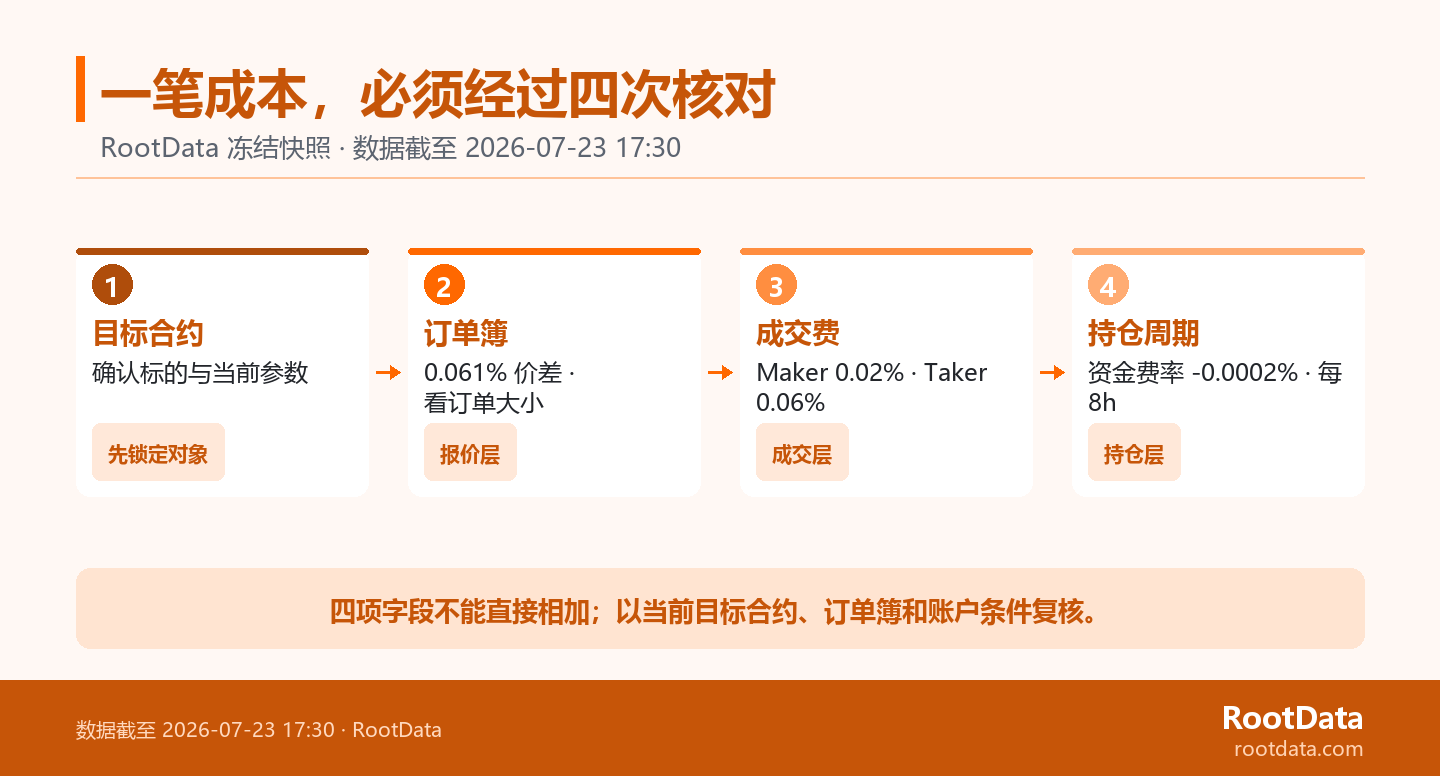
Bitget officials state that funding rates for stock contracts are settled on an 8-hour basis, and direction and levels should not be treated as fixed income or fixed fees. Even if the frozen snapshot shows -0.0002% at a certain point in time, it is only a field at that time; changes in position direction, long and short strength, target contract, and the next settlement will all affect the actual receipt and payment. Regarding settlement frequency, mark price and index source, you can reviewBitget’s Stock Contract Mechanism Explanation.
A practical way to read it is: first use the spread to observe whether the current quotation is tight, then confirm whether you are likely to place an order or take an order, and then look at the funding rate based on the estimated holding time. The order size cannot be omitted: when the order is larger than the visible market acceptance range, the possible price impact is not within a displayed spread. Breaking these items down won’t automatically give you a “cheaper or expensive” answer, but it will avoid comparing them on the wrong dimensions.
This data file can't confirm anything for you
The maximum leverage and tradable contracts must be based on the latest parameters of the target contract. Bitget announced a stock perpetual contract launch on July 2, 2026. The seven contracts listed are USDT settled, with a maximum of 20x, and it is clear that the platform can adjust the leverage ratio and margin rate according to market conditions. This example illustrates that the “highest” description at the platform level cannot replace the current parameters of each target contract; the specific range should beCorresponding announcement and contract pagesshall prevail.
Stock perpetual contracts do not represent actual ownership of the underlying stock, underlying stock token or index. Bitget in the sameAnnounced risk warningIt also states that the product does not provide dividends, interest, voting rights or shareholder rights. Thus, neither volume, number of contracts, nor funding rates can be used to derive equity holder rights; they answer different questions about derivatives markets.
Additionally, frozen snapshots do not confirm regional availability, account qualifications, actual handicaps, activity rates, or quote performance under stress scenarios at that moment. Its correct purpose is to help you determine which set of fields to look at first; it should not replace the product rules, account rate table, and target contract pages after logging in.
From frozen snapshot to current judgment: four steps of review
The order of review should be time, target contract, order book, fees and account conditions. First confirm whether the page you see is at the same time as the snapshot in this article; then confirm that the target stock perpetual contract is still within the current range; then check the current order book and quotation; and finally check the Maker/Taker, funding rate, leverage and account applicable conditions. This is a set of information checks, not trading advice. Field caliber can refer toRootData data standard.
- Lock time:Don't mix frozen snapshots with numbers for the current page.
- Lock contract:Confirm that the target, settlement currency and latest parameters belong to what you want to compare.
- Check the order book:Review depth, quotes and potential price impact in conjunction with your own order size.
- Check Fees and Accounts:Confirm that rates, funding rates, leverage and availability conditions apply.
When you need to review the platform fields horizontally, you can directlyView RootData Equity Derivatives Exchange Rankings, and then check the historical snapshot and the page of the current target contract separately. Using data in this way allows platform-level archives to serve comparisons rather than replace them.
FAQ
Does Bitget’s high 24-hour trading volume mean that every order is easily filled?
It does not mean that the trading volume records completed transactions and cannot independently replace the current order book of the target contract. The results of an individual order are also affected by the size of the order, the price quoted at the moment, the visible depth and market volatility. Higher trading volume can be a reason to check the platform first, but there is no guarantee that any order will have the same price impact or deal quality. If the order size is large, you should go back to the buy and sell order of the target contract instead of just citing the platform-level historical transaction volume.
Can the price difference of 0.061% be directly regarded as the total transaction cost of Bitget?
No, the price difference is just the distance between the bid and ask quotes at the freezing time. The actual cost also needs to consider the Maker/Taker rate corresponding to your own transaction method, the possible price impact caused by the order size, and the funding rate incurred during the position holding period. Different projects occur at different points in time and will also change with the target contract and account conditions. Adding them directly to a fixed percentage obscures the current quote and applicable rates that most need to be confirmed before placing an order.
Can negative funding rates be treated as fixed income?
No, the negative funding rate only describes the capital exchange signal under a certain settlement cycle and position direction, and is not a guaranteed benefit that will continue to exist. The funding rate will be adjusted according to the long and short strength, mark price, index and market conditions, and the direction and level of the next settlement may be different. To evaluate the cost of holding a position, you should first confirm your position direction, settlement frequency and current fee rate, and then combine it with the expected holding time, rather than just looking at a negative number in a historical snapshot.
Are Bitget stock perpetual contracts equivalent to owning stocks?
They are not equivalent. The stock perpetual contract provides price exposure around the stock-related underlying and does not represent actual ownership of the underlying stock, related stock tokens or indexes. It does not automatically carry dividends, voting rights or other shareholder rights just because it has stock in its name. When reading the product, "can participate in price fluctuations" and "own the rights to the underlying securities" should be confirmed separately, and the official rules and risk warnings of the target contract shall prevail.