
Binance Stock Perpetual Exchange Data Archive: Volume, Liquidity, Spreads and Contract Coverage
When readers search for data on the Binance stock perpetual exchange, it is easiest to directly translate “high trading volume” into “any order is better filled.” This is not rigorous. Active trading, existing positions, order book depth, quotation interval and contract coverage each answer different questions; only by putting them back to the same point in time can we see the conclusion that a ranking snapshot can really support.
This article uses the stock derivatives page fields fixed by RootData at 17:30 on July 23, 2026, to sort out Binance’s position among 29 platforms. It is a historical data archive: suitable to help readers prioritize next steps to check, and does not replace confirmation of the current page, target contract, or account conditions.
Let’s look at the conclusion first: leading in intensity does not mean leading in coverage or cost.
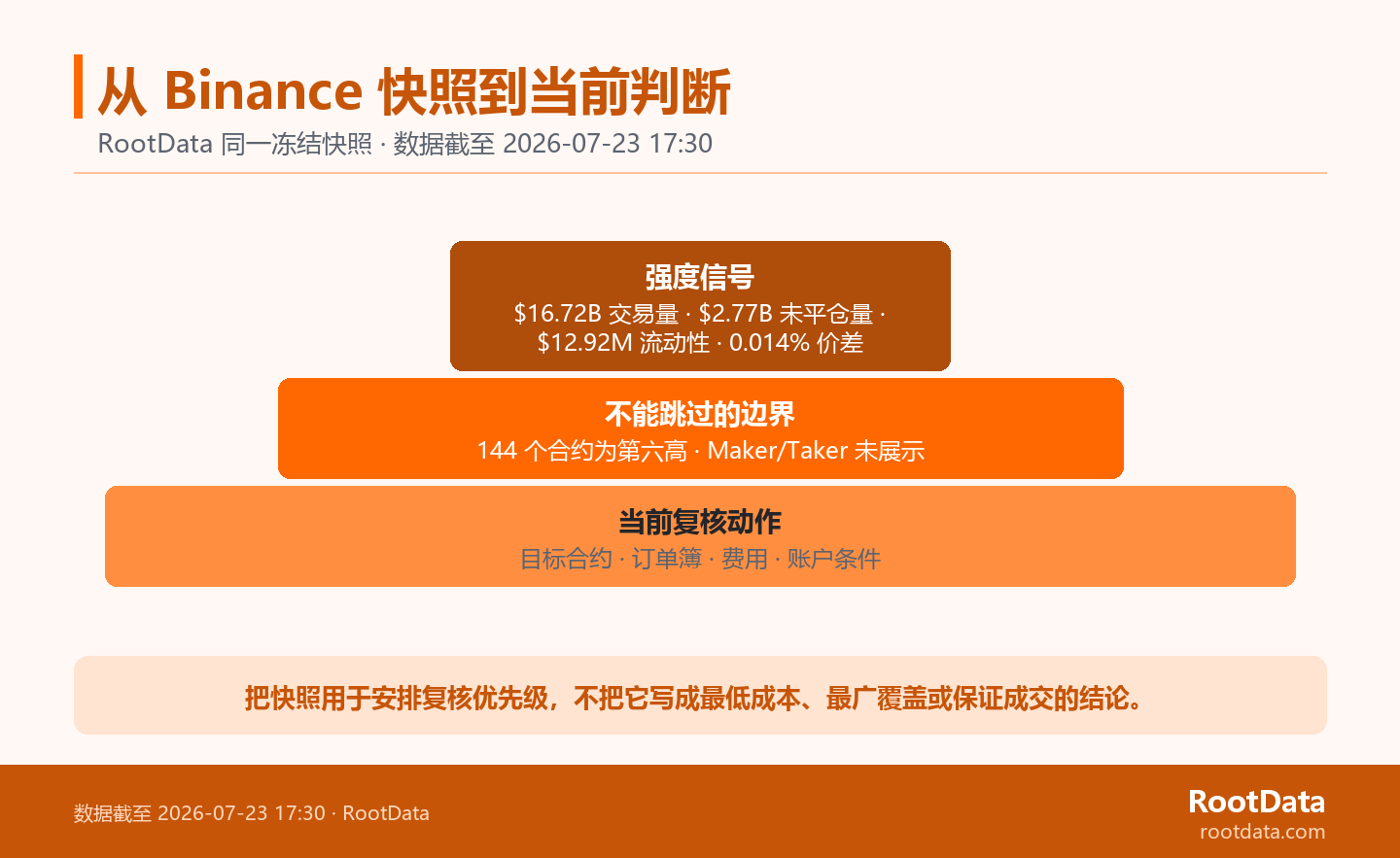
Binance has the highest displayed values for volume, open interest, and ±2% weighted liquidity in this frozen snapshot. Expanding, its 24-hour trading volume is$16.72B, the open position is$2.77B, ±2% weighted liquidity is$12.92M;The display price difference is0.014%, the number of contracts is144. These fields are from the same time sectionRootData stock derivatives trading platform ranking, so they can be compared together. Strength leadership is not a substitute for coverage and total cost judgments. For the boundaries of different liquidity dimensions, please refer toBIS Market Liquidity Notes.
The key word here is "intensity." It shows that the trading activity, existing positions, and liquidity around quotes that have occurred at that point in time are concentrated on Binance; but it does not automatically mean that its contract coverage is the widest, nor does it mean that the total cost of any account is the lowest. Maker/Taker in the datasheet is--, it can only be processed as "Field not displayed", and the vacancy cannot be filled with zero rate or cost advantage.
- Want to see activity level:Let’s first look at trading volume and open interest.
- If you want to see the quotation, please contact us nearby:Looking again at ±2% weighted liquidity and spreads.
- Want to see the product range and actual costs:The number of contracts, target contract page and account application rules must also be listed separately.
What does this data file record?
The data is as of 2026-07-23 17:30, covering 29 platforms displayed on the ranking page. "Stock Perpetual" in this article refers to the data fields of perpetual contracts surrounding stock-related targets, which is not equivalent to holding spot stocks; "frozen snapshot" refers to page fields recorded at a fixed time and will not automatically change with the current page. Can be combinedRootData’s Equity Derivatives Ranking ExplainedUnderstand this scope.
| Field | Binance Display Value | It comes closer to answering the question of what |
|---|---|---|
| 24 hour trading volume | $16.72B | Completed transaction activities within the specified window |
| open interest | $2.77B | The nominal size of the contract that has not yet been closed, rather than the completed transaction |
| ±2% weighted liquidity | $12.92M | Order book depth signal within the price range and near the quote |
| spread | 0.014% | The spacing of the bid and ask quotes displayed does not equal the total cost |
| Number of contracts / Maker/Taker | 144/- | Coverage; rate field not shown in this snapshot |
Liquidity should be observed in combination with dimensions such as depth, price impact, trading volume, open interest, and bid and offer quotes. BIS's liquidity framework lists these items as observation dimensions; among them, the depth of concern is whether the market can absorb larger transaction flows without significant price impact, and the price spread is closer to the tightness of the quotation. Can be referencedBIS Liquidity Indicator DescriptionandBIS explanation of depth and tightness. This is why this article does not rewrite "No. 1 in trading volume" as "No. 1 in all execution conditions."
Why can’t the four fields replace each other?
If the next displayed value of each field in the same snapshot is used as a magnitude reference, Binance’s trading volume is approximately3.66 times($16.72B ÷ $4.57B), the open interest is approximately1.44 times($2.77B ÷ $1.92B), ±2% weighted liquidity is approx.1.20 times($12.92M ÷ $10.74M). 16.72/4.57≈3.66; 2.77/1.92≈1.44; 12.92/10.74≈1.20.There are 5 platforms showing more than 144 contracts, so Binance is the sixth highest.Maker/Taker displayed as -- can only mean that the field is not displayed, and it cannot be inferred that the rate is zero. -- Indicates that this field is not displayed in this snapshot, rather than that the rate is zero.Check RootData frozen snapshot. These ratios and counts only describe relative magnitudes at the same time, not market shares, and do not predict the future.
Trading volume and open interest: one means it has occurred, the other means it is still present.
The 24-hour trading volume records completed transactions; the open interest volume records the size of the existing contracts that have not yet been closed. The fact that both items are at high levels at the same time can indicate that there are strong activities and existing positions within this time window, but the inability to launch a new order must have a smaller price impact. If an order can be absorbed smoothly and directly answered by "trading volume", the two conditions of order book and order size will be missed.
Liquidity and price difference: one depends on the acceptance, the other depends on the quotation interval
Binance has a ±2% weighted liquidity of $12.92M and a demonstrated spread of 0.014%. The former is more suitable for observing the depth signals that can be accepted near the quotation, and the latter reflects the displayed bid-ask quotation interval. Volume records completed transactions and is not a substitute for judgment on the price impact of new orders. BIS also pointed out that tightness and depth are different dimensions, and a single indicator only captures a part of market liquidity; therefore, high trading volume cannot alone prove the impact or transaction quality of a new order.View the indicator dimensions of BISandMarket Depth Explained.
Contract Coverage and Fees: Cannot be "sequentially extrapolated" from the Strength field
Binance shows 144 contracts, but 5 platforms have higher contracts in the same snapshot, giving it the sixth-highest number in this column. Contract count is a clue to coverage and does not comment on each contract's depth, quote quality, or suitability for an account. Likewise, Maker/Taker appears as--Just to note that this field is not shown in this snapshot; it is neither zero, nor can specific rates be inferred for any account, tier, or region.
Four things this snapshot can’t confirm for you
First, it does not confirm the current total cost: the displayed spread does not include account applicable rates, price shocks due to order size, or other possible conditions. Second, it does not confirm the order book status of a target contract at the time you view it. Third, it cannot confirm region, account, or product availability. Fourth, it does not account for performance under stressed conditions; volatility and stress can alter spreads and liquidity, and current account conditions must be checked individually. Static spreads and depth do not justify stress scenarios, current total costs or account availability. Relevant boundaries can be referred toMarket Making Research by BIS,CFTC risk warningandRootData Disclaimer.
On this last point, BIS research on market making notes that under conditions of stress or volatility, spreads may widen and liquidity may decrease. This information is not a legal judgment on a specific platform or region, just an explanation of why a static data table cannot be used in place of current checks.
If you want to quote the numbers in this article, the safest way to write them is to bring "data as of 2026-07-23 17:30" and the field name; do not delete the time,--Change it to zero, or change "Exhibition Value Lead" to "Guaranteed Low Cost". When you need to re-check the fields of each platform, you can directlyView RootData Equity Derivatives Trading Platform Ranking, then return to the target contract to confirm the current conditions.
From frozen snapshot to current judgment: review in this order
Time—Contract—Order Book—Fees and Account Conditions is the order of review before using the frozen snapshot. First confirm whether the data time you see is the same as this article; then confirm whether the target stock perpetual contract is within the display range; then check the current depth and quotation; and finally check the applicable rates, account restrictions and other conditions. This sequence can separate "historical strength at the platform level" from "current tradable conditions of the target contract" and should be combinedRootData data standardUnderstand field caliber.
- Lock time:Separate historical snapshots from the current page, do not mix values.
- Lock contract:Confirm whether the target you are concerned about belongs to the same product and the same field range.
- Check the order book:Combined with your own order size, re-examine the depth, quotation and potential impact.
- Check Fees and Accounts:Check against currently applicable rates, rules and availability.
This sequence is suitable for returning to the same data entry for horizontal verification; before placing a specific order or making an external reference, the current page and target contract information should still prevail.
FAQ
Does Binance’s high 24-hour trading volume mean that every order is easier to fill?
It does not mean; trading volume records completed transactions and cannot independently predict the impact or transaction quality of a new order. Order size, target contract, prevailing order book and market volatility will all affect actual results. High trading volume allows you to check the current depth and quotation of the platform first, but it cannot replace this step of checking. If the order size is large, it is more necessary to consider the current depth, visible quotation and possible price impact together in the judgment, rather than treating the historical transaction volume as a transaction commitment.
Would a 0.014% spread equate to my total transaction costs?
No; 0.014% is the displayed spread in this frozen snapshot and reflects the spacing between bids and offers displayed. It does not include the rate applicable to the account, the price impact caused by the size of the order, nor is it a guarantee that the current quotation will remain the same. To determine the total cost, you should review it under the conditions of the target contract and your own account. Especially when the quotation changes rapidly, the same displayed spread cannot replace the actual buying and selling orders and applicable fees you see before placing an order.
Maker/Taker is displayed as --, does it mean that the rate is zero?
no;--It only means that this field is not displayed in this snapshot, and the specific rate cannot be inferred based on this. Interpreting non-display as a zero value will misinterpret "lack of information" as "cost advantage". If fees will affect your choice, you should directly check the current applicable rate and account level, and confirm whether the rate is applicable to the contract, account type and current activity rules you are concerned about. If the page does not give a clear number, the safest approach is to leave it as a pending item.
When should you revisit your current data?
Always review before posting, comparing or placing an order. The numbers in this article only represent a page snapshot at 17:30 on July 23, 2026; product range, quotation, depth, fees and account conditions may change. Keeping the timestamp and returning to the current page for review will allow this data file to be used for its correct purpose. If it needs to be relayed to others, the data range and field boundaries should also be stated at the same time to prevent readers from misunderstanding the historical display value as real-time status. Keeping the update time and field source together makes it easier to review the original data later.