
Aster stock perpetual data archive: on-chain transactions, funding rates and risk parameters
When studying Aster stock sustainability, the most common misunderstanding is to regard a ranking, a fee rate and a maximum leverage as conclusions under the same trading path at the same time point. They actually come from three different layers of information: RootData's frozen data is used to locate similar platforms; the specific transaction patterns in Aster's current page are used to identify paths; rates, reference prices and margin rules are parameter layers that need to be reviewed at any time. By dismantling these three layers, "on-chain transactions" will not be written as a set of fixed conditions.
The 22nd, 96th contract is not in the same table as the current risk parameters
First give the reading rules:Aster's frozen data location, product model and current risk parameters must be read in layers. The 22nd and 96th contracts answer the sideways position in the fixed sample; the specific trading mode answers which stock perpetual rule is being viewed; the rate, reference price, and maintenance margin answer how the position is measured by the rule under current conditions. No layer automatically replaces another layer.
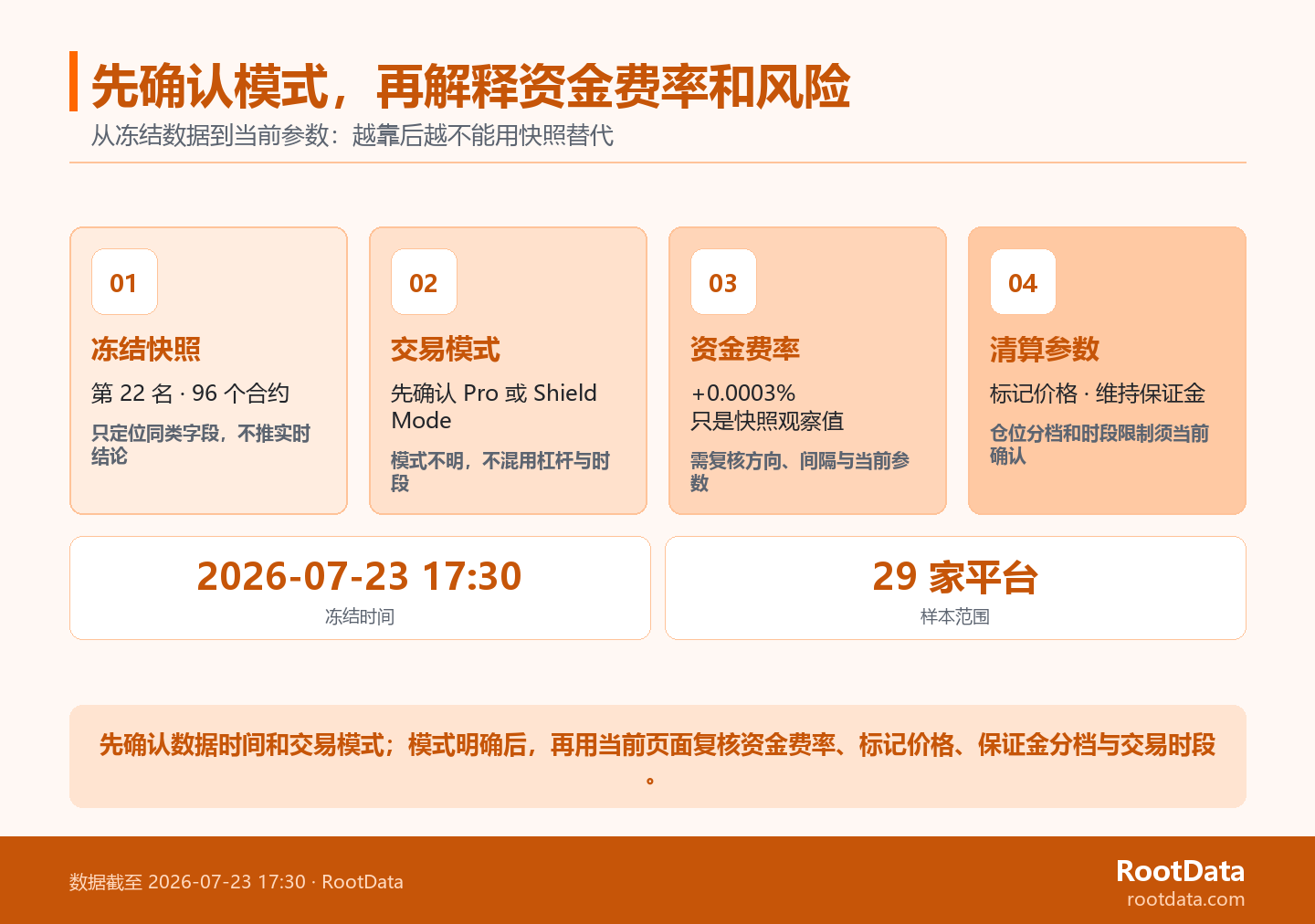
In the RootData frozen snapshot of 2026-07-23 17:30, Aster ranked 22nd out of 29 platforms, showing 96 contracts, $23.75M open interest, and $28.42M 24-hour trading volume.View this frozen data. This is a cross-section used to compare similar fields, and is not a judgment on order-taking capabilities, account conditions or future performance at a certain moment.
- Answer location with snapshot:Ranking, number of contracts, open interest, trading volume, liquidity and spreads can be viewed side by side within the same section.
- Answer path with pattern:First determine which trading mode you are looking at, and then you will know which page the subsequent rules should fall on.
- Answer parameters with current page:Rate direction, settlement intervals, margin tranches, reference prices and trading periods all need to be reviewed according to current rules.
Aster in RootData snapshot: first put the frozen fields back into similar comparison
funding rateIt is a periodic payment made by both long and short parties of the perpetual contract according to the settlement rules, not a one-time fixed handling fee; it must be understood separately from the current displayed value, settlement interval and current rules.
The liquidity, spread and funding rate fields in the Aster row can be used to compare similar fields at a fixed point in time, but they cannot replace the current trading rules. The following fields should be used along with the time tag.
| Field | Freeze display value | Questions suitable to be answered | Conclusions that should not be drawn from this |
|---|---|---|---|
| Ranking and Rating | 22nd; 73.8 | Relative positions within the same frozen sample | Current platform quality or future performance |
| Contracts and Open Interest | 96 pieces; $23.75M | Product field coverage and position background at this point in time | Real-time tradability of all targets |
| 24 hour trading volume | $28.42M | The activity has been completed within the specified window | The actual transaction result of the next order |
| Liquidity and spreads | $1.06M;0.563% | Liquidity and quotation difference signals at the freezing point | Fixed slippage or execution cost |
| Rate field | +0.0003% | Single rate observation recorded by snapshot | Long-term or personalized holding costs |
| handling fee | Maker / Taker are both displayed as -- | The snapshot does not show the corresponding field | Zero or constant fees |
This form deliberately retains “nothing to answer”. For example, 24-hour trading volume records the trading activity that has occurred; it cannot alone indicate whether an order can be filled at a certain price at this moment. ±2% weighted liquidity and 0.563% spread are also fields under the observation point and should not be condensed into "better deals" or "fixed cost" slogans. As for the Maker and Taker fees that are not shown in the snapshot, the correct treatment is to record them as not shown, rather than--Zero understanding.
This boundary is also related toRootData’s Equity Derivatives Ranking ExplainedConsistent: Fields need to be understood within the scope, definition, and time context of the page. Rankings are the starting point for horizontal research; the rules page is the starting point for checking current product conditions.
Aster’s stock sustainability is not a single path: first separate Pro and Shield Mode
"On-chain transactions" should not be written as a general label here. First things first: Which Aster trading pattern are you checking? The Aster Stock Perpetual page describes the product in Pro mode as being settled in USDT and states that it has up to 10x leverage.View Pro Stock Perpetuity Rules. This page also gives order processing restrictions for pre-market and post-market periods, so it is not a static parameter table that can be read outside of the period.
The Aster Shield Mode stock market page uses independent period and risk rule representation and states up to 50x leverage. Shield Mode is another stock market trading mode listed on the Aster page.View Shield Mode Stock Market Rules. The page also explains that there are independent rules for price updates, trading availability and maximum leverage processing during closed and abnormal periods. Therefore, "10x" and "50x" are not two optional numbers in the same product conditions, but respective expressions in two model pages.
| Dimensions to check first | Pro stock perpetual page | Shield Mode Stock Market Page |
|---|---|---|
| Rule entry | Stock Perpetuals | Shield Mode/Stock Market |
| Settlement and Leverage Statement | USDT settlement; up to 10x representation | Up to 50x representation |
| time period issue | There are additional processing restrictions for pre-market and after-market orders. | Segmented periods, market breaks and abnormal periods are handled independently |
| Correct action | First confirm the mode and contract page used, and then read the corresponding current time period, leverage and risk limits. | |
This also explains why the 96 contracts in the snapshot cannot be used to infer the available contracts, available time periods, or the highest leverage in a certain mode. The snapshot field and the product page are both real, but solve different problems; juxtaposing the two into a "platform parameter" will lose the most critical branch of the pattern.
Funding rate: +0.0003% is an observation value, not a conclusion on the holding cost
The RootData frozen row shows that Aster's funding rate is +0.0003%, which is the field value at that point in time only.View this snapshot field. This sign and value are informative: it records the rate status presented on the page at that time. However, it cannot be directly multiplied by a certain position size and written as "actual cost", because the actual payment also depends on the settlement interval, rate parameters, position direction, margin balance and whether the rules are updated for the current contract.
Aster describes the funding rate as a periodic payment between long and short; settlement intervals, upper and lower limits, and other parameters may be adjusted according to market conditions.View funding rate rules. When the funding rate is positive, longs pay to shorts; when the funding rate is negative, the direction is opposite. Therefore, when reading snapshots, you should read"+0.0003%"Record it as a past observation point, and record the intervals and parameters in the current page as subsequent review objects.
A more reliable judgment sequence is: first confirm the mode and contract the position is in; then confirm the fee direction and settlement time; then check the current fee parameters and whether funds are deducted from the available balance or position margin. This does not predict rates, but it avoids mistaking a single displayed value for a long-term, fixed or risk-independent fee.
Risk Parameters: Margin, Mark Price and Trading Period must be read together
mark priceIt is the reference price used to calculate unrealized profits and losses and liquidation judgments, and is not the same as the last transaction price that readers saw. Aster's liquidation instructions use mark prices for unrealized profit and loss and liquidation judgments.View liquidation rules. Therefore, the risk parameter cannot be understood only from the "highest leverage".
Aster explains that larger positions require higher margins and lower leverage, and if the margin is lower than the maintenance margin, it will enter the liquidation process.View liquidation instructions;View Leverage and Margin Rules. Aster's trading rules further link initial margin, maintenance margin, position size and tranche parameters, and indicate possible adjustments to limits under extreme conditions. The point here is not to plug in a formula to calculate the liquidation price for an account, but to confirm that position size, leverage, mark price and maintenance margin are not four independent labels.
Trading sessions should also join this set of linkages. Order processing, price updates, maximum leverage or risk limits may differ from regular hours before the market opens, after the market closes, and during periods of market volatility. If you only look at trading volume, liquidity or funding rates from frozen snapshots, and then skip the current mode and time period, it is easy to misread the historical activity fields as the risk boundary at this moment.
Read the four-step review of Aster's stock perpetual file
When reading Aster stock perpetual files, you should first confirm the data time and mode, and then check the current time period, funding rate and margin parameters. The conclusion of this article is not to choose a certain trading path, but to establish a repeatable check sequence.RootData data standardIt is emphasized that data fields should be understood in conjunction with public definitions, calibers and update times; therefore, the current information review can be completed in the following four steps.
When you need to return to the entry of similar fields, you canView RootData Equity Derivatives Trading Platform Ranking, rechecking Aster's data position with other platforms on the same page at the same time and caliber. As for the current mode and rules, you should return to the corresponding Aster official page to confirm.
- Lock the data time first.Consider 22nd, 96 Contracts, Open Interest, Volume, Liquidity, Spread and +0.0003% as frozen fields only for 2026-07-23 17:30.
- Confirm the transaction mode again.Make it clear whether it is Pro or Shield Mode; do not directly connect the levers, time periods and rules of the two pages.
- Then check the funding rate.Confirm payment direction, settlement interval and current parameters on target mode and contract pages instead of reusing historical display values.
- Finally check the risk parameters.Confirm the mark price, maintenance margin tranches, position limits and current trading session together; these are the complete package to understand the risk of the rules.
Finally, a basic boundary must be retained: this article summarizes how public data and rules can be read correctly, and does not constitute trading, position, qualification or risk tolerance recommendations. When the live page is updated, the frozen snapshot can still be retained as a historical research record, but the new parameter descriptions should not be overwritten.
FAQ
The FAQ can only help locate the problem; the current funding rate, trading hours and risk limits should still be based on the official page in the corresponding mode.View funding rates page;View the Stock Market Sessions page.
What does Aster's 22nd place in the RootData frozen snapshot mean?
It represents the same field position of Aster in the frozen sample at 2026-07-23 17:30. This position can be used to understand the relative distribution of rankings, number of contracts, open interest, trading volume, liquidity and spreads in the same page sample, and can also help readers review the fields at that time. It does not represent current execution quality, nor can it be extended to conclusions about future performance, real-time liquidity, or individual account conditions. If the page is later updated, the new data should be read as a new section, rather than overwriting the timestamp of the old snapshot.
Is the funding rate +0.0003% in the snapshot equal to the actual holding cost?
no. It is a display value at the freezing point and is used to record the rate observations of the page at that time. The actual payment direction also needs to be distinguished between long or short positions. The settlement cycle must be based on the interval of the current contract. The upper and lower limits of the parameters and the margin balance may also affect the final fund processing. Therefore, the snapshot value is suitable for historical field records and is not suitable for directly replacing the actual cost of a certain account or a certain holding period. If you need to understand fee risk, you should look at the current model, the current contract, and the current settlement parameters together.
Are the stock perpetual parameters of Aster Pro and Shield Mode directly interchangeable?
cannot. The two pages use different expressions for leverage, trading periods and market closing processing. The mode itself is the prerequisite for reading the rules. The correct sequence is to first confirm the trading mode and specific contract you are viewing, and then check the current leverage, time period, order processing and risk limits listed on this page. Putting Pro's numbers into Shield Mode, or vice versa, will make subsequent rate and margin judgments lose scope. When a page is updated, old parameters should also be replaced with new rules rather than filling in missing information from another schema.