
Token issuance games have been ruined: there are only two paths for tokens that can survive in the future
Author: donn (Tze Donn Ng, Investor at Brevan Howard Digital)
Compiled by: Deep Tide TechFlow
Deep Tide Introduction: In the current landscape where token production and selling processes at token factories like Pump.fun have reached extreme industrialization, and retail investors' holding periods have dramatically shortened to "measured in seconds," the crypto industry is undergoing a brutal cognitive clearing: creating tokens has become extremely cheap, but building a long-lasting asset worth holding for over a year has become increasingly difficult.
Tze Donn Ng (@tzedonn), an investor from the renowned hedge fund Brevan Howard Digital (BH Digital), published an in-depth article proposing the "Crypto Endgame Dual Peak Model" that penetrates the market fog. He points out that tokens capable of transcending cycles and solidifying real demand actually have two distinctly different yet highly clear climbing paths: the left side is a purely "faith asset" supported by spiritual leaders, near-death rebirth, and fervent communities; the right side is a "cash flow asset" with on-chain verifiable real profits, excluding equity siphoning and implementing mandatory buyback dividends.
In this article, the author not only performs a scalpel-like classification dissection of BTC, ZEC, HYPE, PUMP, LIT, and SKY but also raises sharp inquiries about numerous projects that delay dividends under the guise of "investing in growth," and makes forward-looking projections on U.S. stocks RWA, on-chain casinos, and next-generation perpetual DEX tokens. Deep Tide TechFlow has conducted a comprehensive deep compilation of this, providing a penetrating framework guide for every investor seeking true alpha in the secondary market.
The token issuance game in cryptocurrency has been thoroughly conquered. The Pump.fun style of price manipulation and selling factory has achieved high automation, with every token release being preemptively bundled by robots, while KOLs fearing missing out have long mastered the art of secretly unloading through bypass wallets. The average holding duration of tokens is now measured in seconds.
The entire industry has become extremely efficient in creating new tokens, but creating an asset with lasting vitality that is worth holding for over a year has become unprecedentedly difficult.
When considering how tokens form enduring real demand, I found it extremely effective to approach from two distinctly different core dimensions: the strength of the belief power supporting the asset; and whether the economic value flowing to token holders is real and reliable.
Faith Assets: A Consensus Religion Beyond Cash Flow
Faith assets refer to those that have no underlying cash flow, and their value entirely derives from the collective belief of the group. Their value exists solely based on whether others firmly believe they have value.
As a rational investor who does not blindly believe in Bitcoin dogma, the reason I buy BTC is simply that I believe there are enough people who hold an unshakeable faith in it.
However, what exactly distinguishes ephemeral memes like WIF or BONK from the eternally enduring super meme like BTC?
Looking back at history, those enduring faith assets that can transcend cycles generally possess the following five highly overlapping hallmark characteristics:
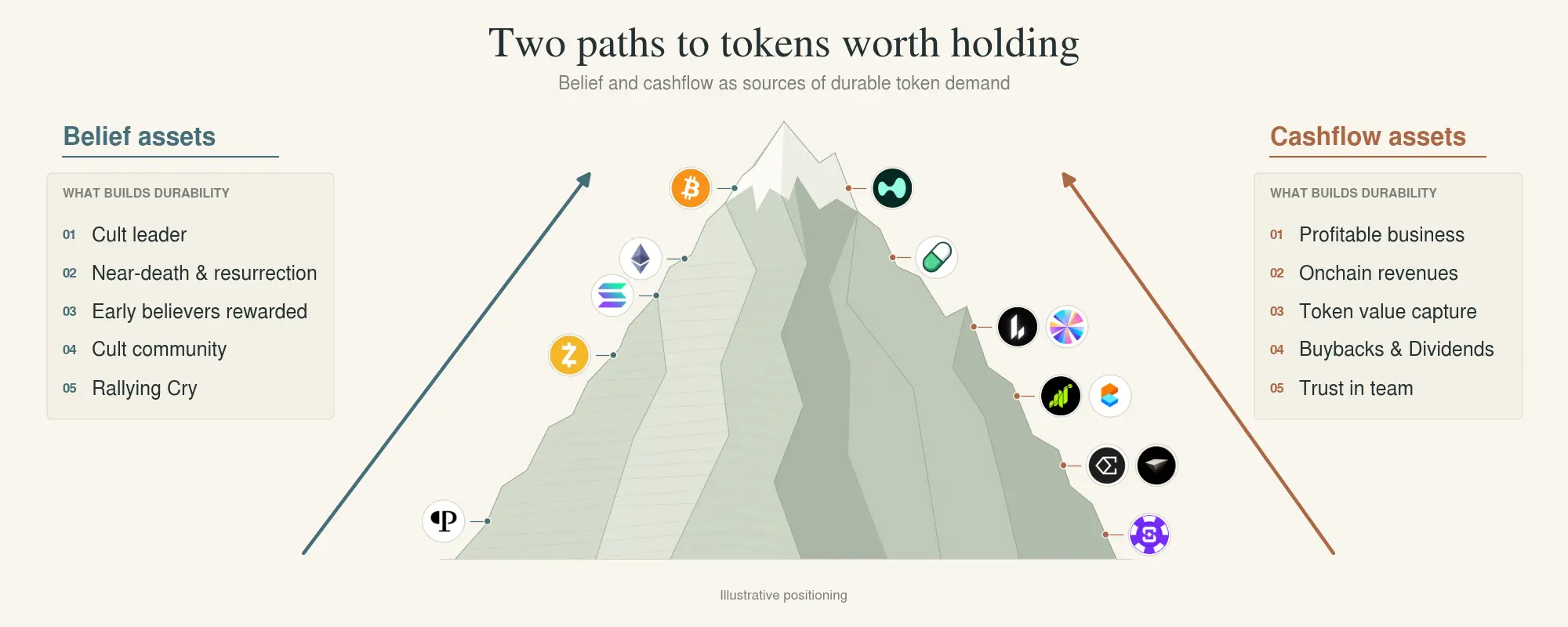
First, they have a sacred spiritual totem and a god-like leader. For faith assets, there must be a transcendent spiritual leader. BTC has Satoshi Nakamoto, ETH has Vitalik, SOL has Anatoly who engages in heated debates with Ethereum minimalists on Twitter daily, and HYPE has Jeff. The leading figures of faith assets must possess a surreal sense of nobility, and whenever people mention the token, that name must instantly and reflexively come to mind.
Second, they have experienced near-death moments and rebirth through fire. BTC survived the catastrophic collapse of Mt. Gox, ETH went through the split and reconstruction of The DAO, and SOL was deeply entrenched in the ruins of the FTX empire, yet they all escaped death. HYPE faced a JellyJelly attack, with its price once plummeting to single digits, and the entire market questioned whether it would completely vanish. The test of surviving near the gates of hell filters out all speculators, leaving only the most fervent loyalists, thereby forging your most core and hardcore consensus foundation.
Third, they allow early believers to become wealthy. Price increases are the best business development (Number go up is the best BD), and those you lead to financial freedom will naturally evolve into your most fervent evangelists. BTC brought 200 times returns to early participants from 2013 to 2018, ETH achieved a 40 times increase from 2020 to 2022, and SOL also created a hundredfold myth. HYPE achieved a 30 times growth under sufficient liquidity and distributed extremely generous large airdrops to early believers.
Fourth, they establish a fervent community with exclusive symbols and unique insider jokes. Even with real wealth incentives, you still need a meme that can spread virally. You need internal jargon that the community understands, creating a sense of belonging to an exclusive elite club; you need people to blindly follow for a grander vision. BTC has "laser eyes," ETH has ".eth" domains, SOL has "◎" and ".sol," while HYPE has its active and slightly provocative ".hl" supporters.
Fifth, a simple and impactful slogan that resonates. To spread a digital religion, a highly concise slogan is needed. BTC's slogan is "digital gold"; ETH's banner is "world computer"; SOL was once called "Ethereum killer" or "decentralized Nasdaq"; and HYPE's positioning is "house of all finance."
In the recent market, ZEC (Zcash) has approached these standards to some extent: it has faced life-and-death tests from significant vulnerabilities in shielded pools; its price skyrocketed from $40 to $1200 within a year; and it has highly recognizable narrative slogans like "privacy version of Bitcoin" and "upcoming quantum-resistant Bitcoin."
These traits cannot be artificially industrialized or forged. You cannot simply declare a community a religion just because you created it; that would be extremely awkward. In this space, I personally pay attention to PRL (the so-called "AI Bitcoin") and view it as an early asymmetric bet, observing whether it can gradually solidify the aforementioned characteristics.
However, there is actually a more straightforward path to reach the peak of lasting tokens.
Cash Flow Assets: Verifiable Real Economic Surplus
In the crypto world, assets that can generate real positive cash flow are extremely rare. The reasons are mainly twofold:
First, selling tokens to the market with grand narratives to obtain exit liquidity is far easier than building a real business with positive free cash flow (FCF);
Second, if a team truly has a cash cow business that operates day and night without needing external financing for expansion, then choosing not to issue tokens and directly pocketing all net profits can save endless compliance and governance troubles.
Teams with extremely lucrative profits, such as DexScreener, Axiom, and Trojan, have long been happy to claim 100% of their business profits. The entire industry has tacitly allowed this unspoken rule until Hyperliquid's emergence completely broke the deadlock.
Hyperliquid has proven to the market with irrefutable facts: you can build a business empire with extremely strong cash flow and continuously empower value to the token, ultimately achieving market cap leverage and ecological results that far exceed the outcome of greedily pocketing short-term profits.
When screening for this type of asset, the core must ask the following five key questions:
First, Economic Foundation: Is there a lasting economic surplus and business profit? HYPE and PUMP are the best examples in this dimension, as they can consistently generate $1 million to $2 million in real profits every day throughout the year. The income of perpetual contract DEXs is usually more sustainable and less volatile, especially after introducing U.S. stocks and other RWA perpetual contracts. The income sustainability of launchpad platforms is often questioned, and the market previously deemed that platforms like PONS, STONK, and GP could not sustain income, but PUMP has continuously disproven this stereotype.
Second, Data Transparency: Can these economic surpluses be transparently verified on-chain? The purest and most flawless income occurs entirely on-chain, such as HYPE and PUMP, as they require extremely low trust costs. In contrast, projects like GRASS generate income entirely off-chain (through private commercial contracts signed with leading AI labs), leading the market to inevitably question the authenticity of these revenues, even though I am confident they exist.
Third, Token vs. Equity Ownership: Is the economic surplus empowering the token or being siphoned off by equity companies? Is there a traditional equity entity quietly draining value behind the scenes? This has sparked widespread debate recently: Venice just completed financing through equity but distributed tokens to the community for free; GRASS also had to urgently hold a communication meeting to clarify that all commercial value belongs to token holders.
The most typical counterexample is SHFL: it is indeed a highly profitable gambling business, but all the real money flows to a traditional equity company registered in Curacao (which just distributed up to $18 million in cash dividends), while secondary market token holders only received a meager lottery qualification.
Fourth, Value Capture Path: Is value directly deposited to the token through buybacks or dividends? This is self-evident, but automatic buybacks and dividends enforced by smart contracts (such as HYPE, LIT, SKY) far exceed the transparency and certainty of discretionary buybacks relying entirely on the team's subjective will (like PUMP).
Fifth, Trust and Growth Generations: If dividends are delayed to invest in business growth, is the team truly trustworthy? This model is most similar to traditional venture capital. Tokens like GRASS, ENA, CHIP, and CARDS fall into this quadrant. They clearly state that all commercial value ultimately belongs to the token, but they are currently reinvesting profits into scaling expansion.
This heavily relies on moral trust in the project team, as token holders do not have legal protection and often lack even a board of directors and audited financial reports. For this reason, frameworks like the Token Transparency Framework (TTF) launched by Blockworks are particularly important.
Demanding an early-stage startup to distribute all profits without reservation will undoubtedly stifle its long-term growth potential. However, it is equally understandable that token holders prefer the certainty of cash dividends at present. If holders cannot confirm how retained earnings will ultimately benefit them, the so-called "investing in growth" is essentially asking investors to bet on both the team's business capabilities and future integrity. Automatic buybacks have alleviated this significant uncertainty today, and I also greatly appreciate the recent positive improvements made by CHIP in clarifying the logic of token value retention.
In the current market, the golden samples that perfectly meet the five stringent conditions mentioned above are only HYPE, LIT, PUMP, and SKY. New tokens that can check all five boxes are rare.
PAPER was one of the best recent attempts; it originally had the potential to generate substantial revenue. Unfortunately, the team ultimately abandoned the token because its mechanism design inadvertently created arbitrage loopholes that maliciously attacked exchanges.
I believe the cash flow token sector is on the brink of a major transformation. HYPE has pioneered the paradigm of high-value appreciation tokens, while PAPER has allowed everyone to glimpse the immense appeal of this structure. Imagine if a high cash flow business like Polymarket, which rakes in about $20 million in profit monthly, officially issued a token and fully retained all profits for the token; it would unleash an astonishing valuation potential.
In fact, the Shuffle team is currently discussing the launch of a purely on-chain decentralized casino. If such a system is truly implemented and 90% of the net gambling revenue is used daily for automatic token buybacks in the open market, SHFL would instantly rise to the top of the entire evaluation list. Buying into projects at the bottom of the list is essentially betting that their teams will genuinely reform and actively advance toward the upper right corner.
Looking ahead, I am closely watching the emergence of the next generation of perpetual contract DEX tokens, such as VAR (Variational) and XTEN (Extended). Other quality trading targets worth continuous tracking include ARCUS, ENTROPY, and the potentially upcoming POLYMARKET.
The Endgame of Crypto: Two Peaks and the Evolution of Tokens
In the long history of crypto development, there are ultimately only two narrow paths to becoming a durable hard currency that can traverse multiple bull and bear cycles:
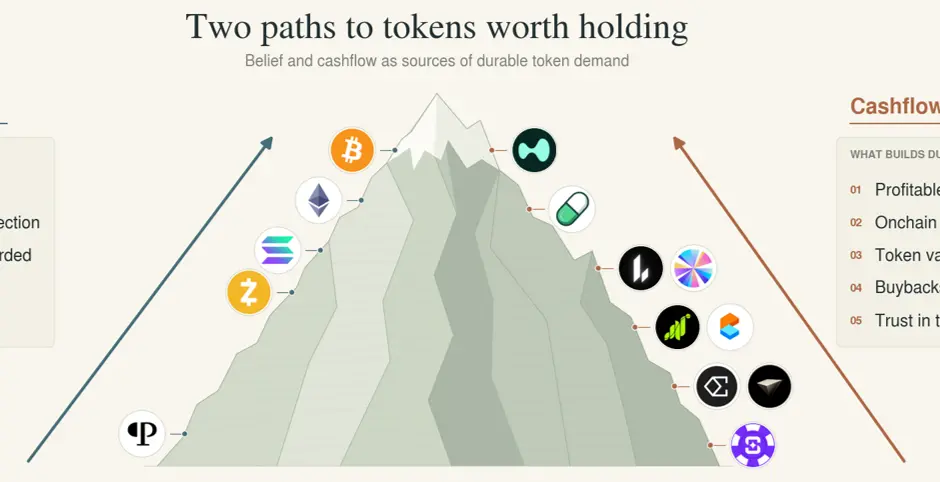
BTC, ZEC, and early HYPE chose to climb the "Mountain of Faith" on the left side; while HYPE, LIT, and PUMP are steadily making their way to the peak along the "Mountain of Cash Flow" on the right side.
Among all digital assets, HYPE is undoubtedly the most comfortable asset to hold, as it demonstrates high certainty as a cash flow asset while showing immense potential to transform into a lasting faith asset.
In contrast, the vast majority of other tokens, despite repeatedly attempting to scale the heights, ultimately fall into the abyss. This includes new Layer 1 tokens that have long since become excess stock games, as well as those "ancient relic" DeFi tokens that lack real protocol revenue and cannot provide value back to holders.
Many purely concept-driven speculative narratives (such as various shallow AI concept coins) attempt to repeatedly rush up the left side of the Mountain of Faith, but in the face of the harsh gravity of reality and the laws of time, they will ultimately crash heavily to the bottom.