
Tokenized Stock Bid-Ask Spread Ranking: Comparing Quote Tightness and Implicit Costs
Author: Flowie|ChainCatcher content author, focusing on RWA, interpreting the true narrative of Web3.
Narrower spreads allow for the closeness of quotes at the same snapshot to be observed, but do not alone prove that full transaction costs are lower. It describes the distance between the bid and ask quotes at a certain point in time, and is not a cost bill that already includes order book acceptance, fee rules and post-deal price effects. Therefore, price difference ranking is suitable for research entry, but not suitable for directly launching "lowest cost exchange".
Let me draw the conclusion first: the narrow spread is a clue to the tightness of the quotation, not a complete cost conclusion
- First look at what it answers. Narrower spreads provide clues to a closer comparison of quotes at the same snapshot.
- Look again it doesn’t answer anything. It does not explain how much size a specific contract can undertake, nor does it give in advance the price changes after the transaction.
- Finally fix the review order. Read the spread first, then look at the depth of both sides of the sale and purchase, Maker / Taker fees and page update time; without any one of them, you should not draw a complete cost conclusion.
What does the bid-ask spread record: the tightness of real-time quotes, not the full picture of the order book
The bid-ask spread can be used to observe how closely the market matches supply and demand at low costs. BIS's Market Liquidity Note links tightness to bid-ask spreads: it focuses on the ability to match supply and demand at lower costs. For readers, a narrower spread means that the best quote at this point in time is closer, not that all trading conditions are better.
The bid-ask spread can only describe the quotation cost of marginal real-time transactions, and cannot separately explain the depth of the order book or the price impact after the transaction. BIS study on market liquidity Discuss spread, depth and price continuity separately: the quote distance of marginal transactions does not tell us how much quantity can be taken after the best quote has been consumed, or how prices will change.
Therefore, this article refers to the spread as "quote closeness ranking" rather than "transaction cost ranking". This is not to devalue the indicator, but to put it back in its proper place: it can help narrow the scope of research, but is not a substitute for real-time order book and fee conditions on specific stock perpetual contracts.
Ranking of bid-ask spreads of 29 exchanges: from low to high, retain the page display value
The following table completely retains the price difference displayed by RootData on 2026-07-23 17:30 for 29 platforms, and retains Pending in a non-numeric state. RootData Equity Derivatives Ranking Page is the source of this table. The sort only sorts by page spread from lowest to highest; it does not override the page's overall ranking, nor does it interpret the value as a full cost.
RootData compares spreads to OI, volume, liquidity, funding rates and fees as independent comparison fields. RootData's Stock Derivatives Ranking Note provides a framework for this field. Therefore, the table can answer "Which row's quotation distance is closer at the same time point", but it does not replace the check of fees, liquidity and contract rules.
| Price difference order | Page comprehensive ranking | Exchanges and related platforms | Buy-ask spread |
|---|---|---|---|
| 1 | 3 | OKX | 0.013% |
| 2 | 1 | Binance | 0.014% |
| 3 | 2 | Bybit | 0.051% |
| 4 | 5 | Ourbit | 0.053% |
| 5 | 4 | Bitget | 0.061% |
| 6 | 6 | Gate | 0.061% |
| 7 | 14 | < td>Bitunix0.073% | |
| 8 | 15 | GRVT | 0.083% |
| 9 | 11 | Ondo Perps | 0.137% |
| 10 | 12 | Extended | 0.146% |
| 11 | 7 | Hyperliquid | 0.176% |
| 12 | 10 | XT.COM | 0.262% |
| 13 | 8 | Lighter | 0.277% |
| 14 | 18 | MEXC | 0.3% |
| 15 | 13 | Phemex | 0.308% |
| 16 | 17 | edgeX | 0.347% |
| 17 | 16< /td> | KuCoin | 0.36% |
| 18 | 25 | B itMEX | 0.365% |
| 19 | 21 | Coinbase | 0.38% |
| 20 | 9 | BingX | 0. 409% |
| 21 | 26 | Kraken | 0.45% |
| 22 | 20 | OrangeX | 0.517% | 23 | 22 | Aster | 0.563% |
| 2 4 | 19 | MSX | 0.673% |
| 25 | 2 4 | HTX | 0.908% |
| 26 | 28 | P aradex | 0.928% |
| 27 | 27 | Crypto.com | 1.35% |
| 28 | 23 | BitMart | 4.24% |
| — | 29 | Ostium | Pending |
Ostium's spread is shown as Pending in this snapshot and therefore does not enter numerical sorting. It is not zero, nor is it a proxy value that can be used to infer costs. All values in the table also only belong to the observation point of 17:30 on July 23, 2026; if the page is updated, the sorting and explanation should be updated together.
Before reading the price difference as an implicit cost, three things need to be separated
Spread, order book depth and explicit fees are three layers of information that cannot be combined before comparing transaction costs. The spread answers the distance between the best bid and offer quotes; the in-depth answer shows how much quantity the quote can accept; the Maker/Taker fee goes back to the order type and platform rules. Combining them into a "low-cost" label mixes facts from different times, different contracts and different order conditions.
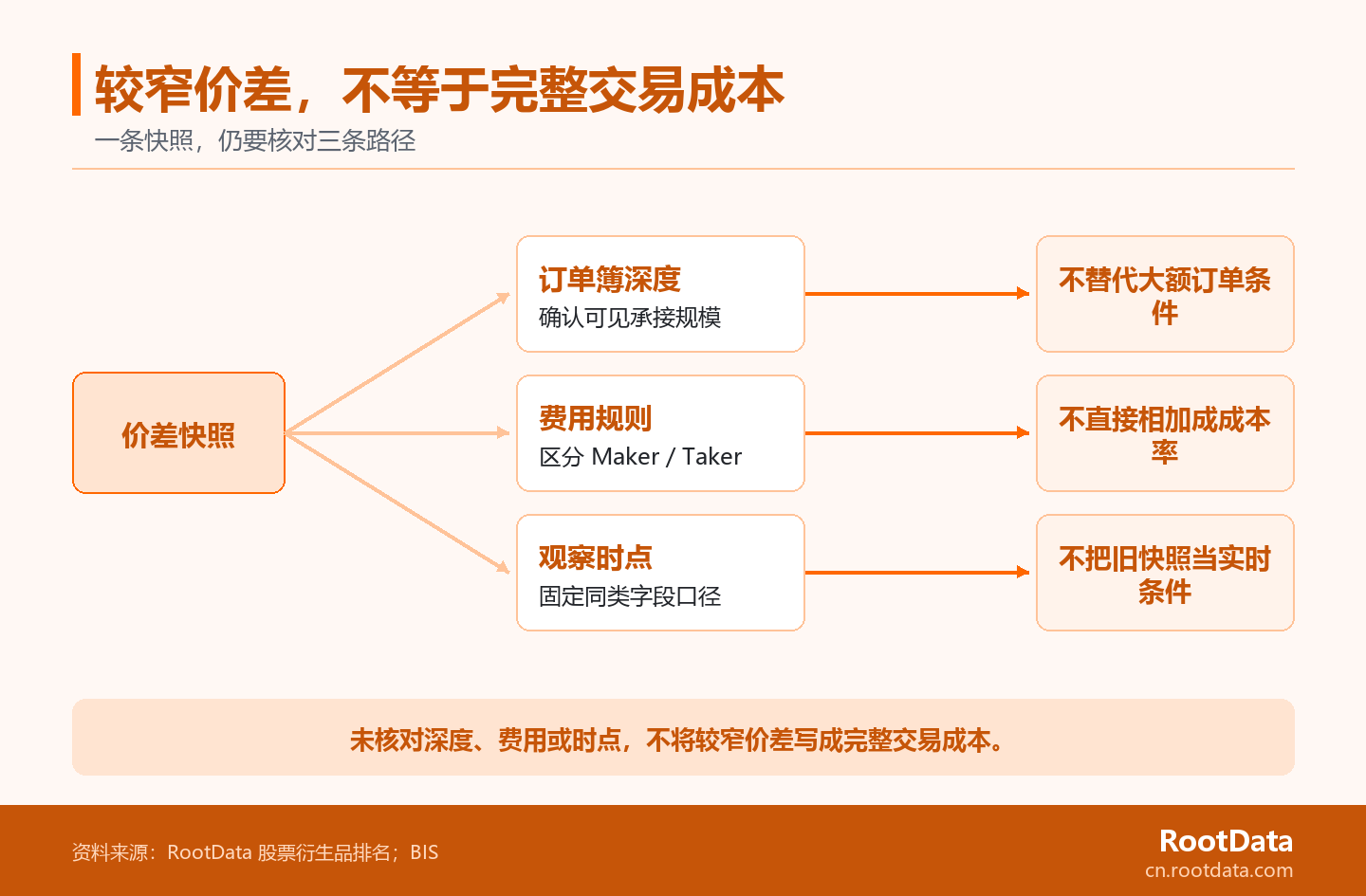
Look at the depth first: a narrow price difference does not mean that there is enough to accept large orders
Narrow spreads do not alone indicate that a specific contract is deep enough to handle larger orders. The distance around the best bid and ask quotation can be very tight, but the number of visible pending orders may still be limited; when the order size approaches these pending orders, the research focus should shift to the depth and price impact of the buying and selling sides, rather than continuing to compare only one column of percentages.
Look at the fees again: the quoted cost and the Maker / Taker rate are not the same field
The spread and Maker / Taker fees need to be read separately and cannot be added directly under unknown order conditions. The former is the current quotation distance, and the latter depends on the specific platform, order type and rules; without first confirming the applicable conditions, combining the two into a "total cost rate" will only create a conclusion that seems accurate but cannot be reviewed. When researching, you should also go back to the specific rate terms to check.
Last viewing time: Snapshot spreads do not replace real-time executable quotes
The price difference only has horizontal comparative significance at the same observation time point and the same field caliber. There is no guarantee that the last spread on the page will still be the executable condition at this moment; market conditions and specific contracts will change. Time tags should be retained when reading rankings to avoid rewriting frozen snapshots as "currently lowest" or "real-time tightest".
Research example: why the same price difference cannot directly exclude the complete cost
If the same displayed spread corresponds to different depths, fee rules or specific contracts, it cannot be directly concluded which platform has a lower complete transaction cost. Imagine that two platforms display similar spreads at the same time: the depth of the buying and selling sides of one of the target stock contracts has not yet been confirmed, and the fee applicable conditions of the other have not yet been confirmed. Even if the two percentages are the same, it cannot be judged that the same research task will face the same quoted or explicit costs.
This example is not a deal estimate. What it illustrates is the sequence: first compare the two spread values within the same snapshot; then locate the target stock perpetual contract; then check the depth of the buying and selling sides, order type and fee rules; and finally decide whether the information is sufficient to support further research. When either is missing, a safer conclusion is not to guess which one is lower, but to mark it as "full costs cannot be compared directly at this time."
From snapshot to contract: A four-step review of comparing bid-ask spreads
RootData public data standard states that when comparing frozen snapshots and dynamic pages, you should first confirm the observation time and field caliber. When viewing the RootData data standard, the time tag should be recorded together with the field name to avoid combining values seen at different times into the same conclusion without tags.
Fixing the time, positioning the contract, checking the quotation and depth at the same time, and then checking the fee rules are a set of research sequences that make the spread comparison reviewable.
- Fixed observation point. Record page time and spread fields, do not treat old snapshots as current conditions.
- Locate target contracts. Platform-level sorting is only responsible for narrowing the scope, and specific research must go back to the stock perpetual contract.
- Look at both quotation and depth. Check the quotations, price differences and acceptance scale visible on both sides of the sale and purchase respectively.
- Check fee rules. Reconfirm the order type and fee conditions; if you need to update the research entrance, you can View RootData stock trading platform ranking and remark the time.
Four judgments that this spread ranking does not replace
RootData's disclaimer positions the content as an information service and not as investment advice. RootData Public Disclaimer defines the boundaries of this article: Tables may be used for data comparison and research and are not a substitute for personalized trading, leverage, returns or product selection judgments.
- It is not a guarantee for large transactions. Spreads are not a substitute for contract-level depth and price impact.
- Not a complete fee schedule. Maker/Taker, funding rates and other rules must be checked separately.
- Not real-time quotes. Fixed-time snapshots are not a substitute for quotes at the moment.
- Not a product or region entry conclusion. Platform coverage does not mean that any account can use a specific product.
FAQ
The FAQ only clarifies meter reading boundaries for Spread, Depth, Fee and Pending. Do not add platform functionality, regional qualifications or legal conclusions.
The smaller the bid-ask spread, does it mean that the transaction cost must be lower?
It does not mean; the smaller price difference only means that the quotes under this snapshot are closer, and the depth, transaction fees and price impact after the actual transaction still need to be checked separately. The price difference can help researchers first observe which platform has a smaller distance between the best quotes, but it cannot guarantee that different order sizes, different stock contracts or different times will face the same results. Full cost requires putting order conditions and other fields back into the same study object, rather than just reading one column for sorting.
Does the narrower price spread mean that large orders are easier to complete?
It cannot be explained separately; the price difference mainly reflects the closeness of quotes in marginal real-time transactions, while large orders also depend on the visible depth and price impact of the specific contract. Even if the distance around the best quote is small, the number of pending orders may still not be enough to cover the larger study size. Spread sorting can be used as a preliminary screening, but the closer the order size is to the visible acceptance level, the more attention should be turned to the depth and dynamic status of both buying and selling sides.
Can the price difference be directly added to the Maker / Taker fee?
It cannot be directly added up and used as a unified cost rate; the fee rules, order types, specific contracts and transaction conditions need to be confirmed separately. The spread is the current quote distance, and the Maker/Taker fee depends on how the order is recognized by the platform rules; the two objects of observation are different. Without first confirming these premises, simple addition will result in a number that cannot illustrate the scope of application, rather than a reviewable cost conclusion.
Why does the Ostium spread show as Pending?
It means that this RootData snapshot is displayed as Pending and should not be regarded as a zero spread or used for numerical sorting. Pending does not automatically interpret the platform conditions, nor should it be written as a high or low value; it only indicates that at this point in time, the reader does not have a page display value that can enter the same caliber comparison. If the page is updated later, it should be re-read with the new timestamp and complete snapshot, rather than speculating on the old table.