
List of Tokenized Stock Low Spread Platforms: Combining Depth and Slippage to See True Trading Costs
A low spread is a screening signal, not a conclusion that "real transaction costs are lower".The bid/ask quotation interval displayed on the page can only illustrate the quotation relationship at one point in time; whether the same order will penetrate multiple quotations and how much the transaction price deviates depends on the target contract, order size, depth at the time, order type, and fee arrangement. This article uses RootDataThe frozen snapshots are used as boundaries, and the quotation intervals and depth fields within adjacent price ranges of 29 platforms are sorted out, and they are used to establish candidate ranges without writing static fields into transaction commitments.
All values in the table correspond to the above time points. Subsequent changes in quotes, rates, product availability and regional conditions on the page are beyond the scope of this article's extrapolation; if you want to study a specific order, you still have to return to the current target contract page.
Check this out first: This list is filtered by displayed spreads, not ranked by actual slippage.
The displayed spread describes the quotation interval and cannot separately explain the actual average transaction price or slippage of a single order.Show spreadJust on the pageBid priceandselling pricedisplayed betweenQuotation interval;Investor.gov definition of bid-ask spreadIt is also defined as the difference between the bid and offer quotes and is stated separately from other transaction costs.See Investor.gov’s distinction between spreads and fees. of this article±2% weighted liquidityThe page is used to observe a certain price range on both sides of the quotation.depthfield; itnot a guaranteeTransaction is not the guaranteed transaction volume of a certain order. Putting the two items together can determine "whether it is worth continuing to watch"; but to determine the deviation of subsequent transactions, it must still be fixedtarget contractandOrder size.
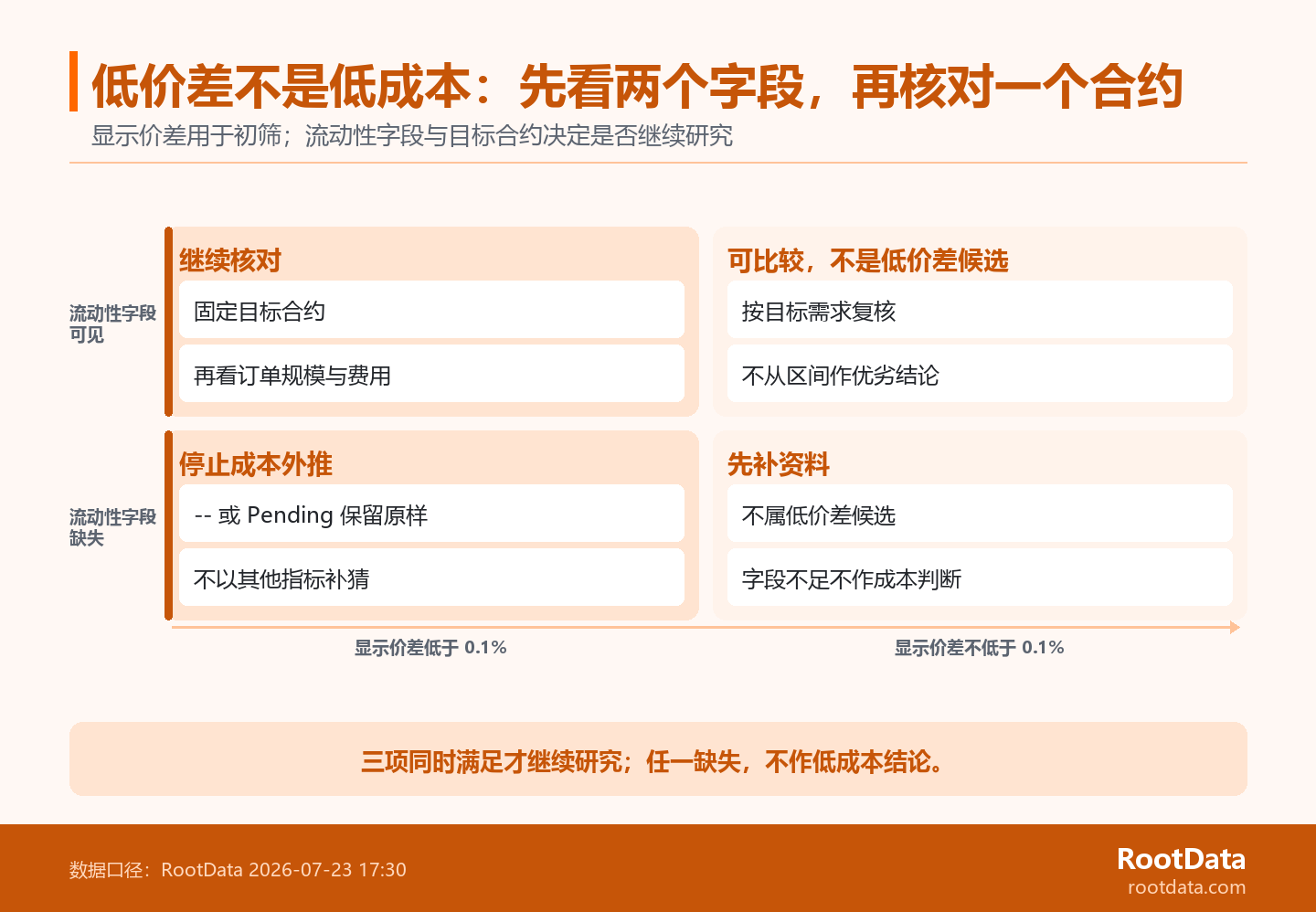
- First use the spread to narrow the range:Below 0.1% is just a preliminary screening line for this article, not a “lowest cost” label.
- Then use depth to exclude whitespace:Only when the ±2% weighted liquidity is visible, there is a basis for further comparison; when it is empty or Pending, no supplementary guessing is allowed.
- Final fixed contract:For different targets, different directions and different order sizes on the same platform, the actual execution conditions may be different.
Display price differences of 29 platforms: organized by range and field status
RootData recorded 29 platforms in the frozen snapshot at 17:30 on 2026-07-23.The table below is divided into three intervals according to the spread displayed on the page, and the ±2% weighted liquidity is fully retained.--Or the spread isPendingstatus.View the RootData Equity Derivatives page, the dynamic page data should be read separately from the frozen time point of this article.
| This article is grouped | platform | Show spread | ±2% weighted liquidity | How to deal with this article |
|---|---|---|---|---|
| Less than 0.1% | OKX | 0.013% | $3.90M | To enter the low spread candidate, the target contract still needs to be checked. |
| Less than 0.1% | Binance | 0.014% | $12.92M | To enter the low spread candidate, the target contract still needs to be checked. |
| Less than 0.1% | Bybit | 0.051% | $1.01M | To enter the low spread candidate, the target contract still needs to be checked. |
| Less than 0.1% | Ourbit | 0.053% | $4.50M | To enter the low spread candidate, the target contract still needs to be checked. |
| Less than 0.1% | Bitget | 0.061% | $4.19M | To enter the low spread candidate, the target contract still needs to be checked. |
| Less than 0.1% | Gate | 0.061% | $3.90M | To enter the low spread candidate, the target contract still needs to be checked. |
| Less than 0.1% | Bitunix | 0.073% | $3.17M | To enter the low spread candidate, the target contract still needs to be checked. |
| Less than 0.1% | GRVT | 0.083% | $517.49K | To enter the low spread candidate, the target contract still needs to be checked. |
| 0.10%–0.30% | Ondo Perps | 0.137% | $1.97M | It can be used for horizontal comparison and is not a candidate for low price difference in this article. |
| 0.10%–0.30% | Extended | 0.146% | $265.00K | It can be used for horizontal comparison and is not a candidate for low price difference in this article. |
| 0.10%–0.30% | Hyperliquid | 0.176% | $2.10M | It can be used for horizontal comparison and is not a candidate for low price difference in this article. |
| 0.10%–0.30% | XT.COM | 0.262% | $193.05K | It can be used for horizontal comparison and is not a candidate for low price difference in this article. |
| 0.10%–0.30% | Lighter | 0.277% | $4.24M | It can be used for horizontal comparison and is not a candidate for low price difference in this article. |
| 0.10%–0.30% | MEXC | 0.300% | $10.74M | It can be used for horizontal comparison and is not a candidate for low price difference in this article. |
| higher than 0.30% | Phemex | 0.308% | $85.12K | Not a low spread candidate; fields can still be researched by target contract. |
| higher than 0.30% | edgeX | 0.347% | $219.15K | Not a low spread candidate; fields can still be researched by target contract. |
| higher than 0.30% | KuCoin | 0.360% | $63.49K | Not a low spread candidate; fields can still be researched by target contract. |
| higher than 0.30% | BitMEX | 0.365% | $226.33K | Not a low spread candidate; fields can still be researched by target contract. |
| higher than 0.30% | Coinbase | 0.380% | -- | The liquidity field is missing and no cost extrapolation is performed. |
| higher than 0.30% | BingX | 0.409% | $3.25M | Not a low spread candidate; fields can still be researched by target contract. |
| higher than 0.30% | Kraken | 0.450% | $455.29K | Not a low spread candidate; fields can still be researched by target contract. |
| higher than 0.30% | OrangeX | 0.517% | $27.58K | Not a low spread candidate; fields can still be researched by target contract. |
| higher than 0.30% | Aster | 0.563% | $1.06M | Not a low spread candidate; fields can still be researched by target contract. |
| higher than 0.30% | MSX | 0.673% | $183.65K | Not a low spread candidate; fields can still be researched by target contract. |
| higher than 0.30% | HTX | 0.908% | $963.37K | Not a low spread candidate; fields can still be researched by target contract. |
| higher than 0.30% | Paradex | 0.928% | $1.59K | Not a low spread candidate; fields can still be researched by target contract. |
| higher than 0.30% | Crypto.com | 1.350% | $424.48K | Not a low spread candidate; fields can still be researched by target contract. |
| higher than 0.30% | BitMart | 4.240% | $554.08K | Not a low spread candidate; fields can still be researched by target contract. |
| Field to be confirmed | Ostium | Pending | -- | Insufficient fields; no cost conclusions included. |
Eight platforms in the snapshot showed spreads below 0.1%.They are OKX, Binance, Bybit, Ourbit, Bitget, Gate, Bitunix and GRVT.Check a set of records against frozen snapshotsAt this time, the purpose of this grouping is to narrow down the 29 records into a candidate pool that needs to be prioritized, rather than to declare that the execution of the eight platforms must be better. To continue viewing market fields on the same page, you canOpen RootData Equity Derivatives Ranking to continue checking fields.
Why can’t low spreads be directly converted into low slippage?
Quotation intervals, visibility depth, and order size all combine to influence how actual execution is read.Slippageis an orderactual transactionThe price is relative when placing an orderexpected pricedeviation; orderscaleWhen increasing, whether more quotation levels need to be consumed also needs to be observed separately. The closeness of the buying and selling quotations in one bracket can only mean that the distance between the quotations in this bracket is small. FINRA's materials also suggest that when quotes decrease, spreads may widen and the size of the quoted quotes may also decrease.View FINRA’s explanation of quotes and liquidity; and Investor.gov breaks down the bid-ask spread separately from other trading fees.View instructions from Investor.gov. Therefore, the platform-level spread display is suitable for screening first, but it is not enough to replace the actual transaction observation under a certain target contract and a certain nominal amount.
Narrow bid-ask spreads cannot be taken alone as evidence of low liquidity risk.The Bank for International Settlements (BIS) pointed out in its market liquidity study that there is no single indicator of liquidity, and narrow bid-ask spreads should not be read alone as lower liquidity risk.View BIS discussion of market liquidity. Put in the snapshot of this article, the ±2% weighted liquidity can be used as a second layer of in-depth observation: it can help judge whether the page gives a range field that can continue to be studied, but it cannot pre-calculate the true slippage of different target contracts, different times or different sizes.
Put the three words back into their respective places:The quotation interval, visible depth and transaction deviation of specific orders belong to different observation layers. Only by dismantling them in order can a static percentage not be burdened with questions that it cannot answer.
- Show spread:Answer how far apart the quotes on both sides were at that time.
- ±2% weighted liquidity:Answer whether the page displays the depth observation field within a certain range near the quote.
- Slippage:It is only observed after fixing the target contract, direction, size and time point, and cannot be replaced by platform-level static fields in advance.
The true transaction cost also needs to be broken down into fees, funding rates and missing fields.
Handling fees, holding period funding rates and displayed spreads are different cost fields and must be checked separately on the current page of the target contract.RootData's description of equity derivatives puts fields such as spreads, liquidity, fees, and funding rates in the same comparison context, but they don't answer the same question.View RootData Equity Derivatives Description. Meanwhile, Investor.gov also breaks down bid-ask spreads separately from commissions or other trading fees.View Investor.gov’s explanation of spreads and fees.
A more reliable reading sequence is: first check whether the displayed spread has entered the candidate range; then check whether there is a readable liquidity field at the same time; then fix the buying or selling direction, target contract and order size, and read the taker or pending order fees respectively; if it involves a position, then add the direction of the funding rate, settlement interval and position length separately. There is no "total platform cost" number that can be added up directly without conditions.
-- and Pending fields should block cost extrapolation rather than being replaced by other indicators.For example Coinbase’s ±2% weighted liquidity in this snapshot is--, Ostium’s displayed spread isPending.View the original field status in the frozen snapshot. These statuses only mean that this article cannot continue to compare the corresponding fields under the same caliber; they do not mean that the platform cannot trade, nor can it use transaction volume, rankings or other platform numbers to make up a cost conclusion.
Turn "low spread" into a reusable three-way check
Only when the displayed price difference is less than 0.1%, the liquidity field is visible, and the target contract has been verified are all met, the next step of research will be entered.This is the research priority rule of this article, not a platform recommendation: if the three conditions are met together, it only means that the information is enough to continue looking at the order book, rates and product rules; if any one is missing, the record will be left in the candidate pool, and "low spread" will not be extrapolated to low slippage or low cost. After establishing the candidate range with the frozen snapshot of RootData, and then returning to the current contract page, you can avoid mistaking platform-level fields for personal order results.
| Check items | What needs to be confirmed | Actions when not satisfied |
|---|---|---|
| 1. Display price difference | Whether it is lower than the 0.1% initial screening line, and whether the snapshot time is consistent. | Does not make it into the low spread candidate group for this article. |
| 2. Liquidity field | Whether ±2% weighted liquidity is displayed as an explicit value. | Stop cost extrapolation without using other indicators to make guesses. |
| 3. Target Contract | Specific targets, order direction, size, fees, funding rates and region/account conditions. | Return to the current contract page to complete the process, and do not draw any conclusions before confirmation. |
FAQ
Static fields cannot replace actual conditions for an order, region qualification, or position period.The snapshot list in this article is suitable for establishing a research scope of the same caliber; once the question turns to "can it be traded", "at what price will it be traded" or "how long will it be held", you must return to the current target contract, account conditions and product rules.
Does showing spreads below 0.1% mean slippage is lower?
Doesn't mean. 0.1% is the displayed spread line used for initial screening in this article; the actual execution results still depend on the target contract, order size, depth at the time and order type. Records below this line are only worthy of priority checking and are not a commitment to transaction results. If the target contract is inconsistent, or the time of order placement has changed, even if the platform-level fields are the same, the value in one snapshot cannot be copied to another order; if necessary, you should also observe the changes in the order book before and after placing the order.
When the ±2% weighted liquidity is -- or Pending, can other fields be used to make the judgment?
Not recommended. The missing status only means that this article cannot be further verified using this field, and should not be replaced by trading volume, rankings, historical screenshots or other platform data. Keeping the gap and returning to the target contract page is a safer approach than guessing. If the fields are later restored to display, they should be re-read with the target contract, order direction and time tag at that time, rather than combining the old and new data into one conclusion; only when the caliber is consistent can the new fields be entered into a new comparison.
How should handling fees and funding rates be viewed together with spreads?
First fix the order direction, target contract and position length, and then read the buying and selling fees and funding rates respectively; do not directly add the fields for different times and different products. The spread serves the initial screening of quotations, while fees and funding rates serve specific transaction and position conditions, and they need to be reviewed under the same contract. If it is only a short-term comparison, the weight of the holding period field will be different; if overnight or longer holding is involved, the settlement rhythm of the funding rate must also be recorded separately.