
Tokenized Stock Exchange Liquidity Ranking: Using ±2% Depth to Assess Large-Order Execution Capacity
Author: Flowie|ChainCatcher content author, focusing on RWA, interpreting the true narrative of Web3.
Higher liquidity numbers provide clues to static comparisons of the same snapshot, but do not alone prove that an order can be filled at a specific cost. For those who study large orders, it is suitable to screen the platform first, and then enter the specific contract to view real-time pending orders.
First conclusion: ±2% depth can be used for preliminary screening, and large transactions cannot be promised
- Let’s see what it answers first. ±2% weighted liquidity puts the price band depth in the same snapshot into a comparable caliber, which is suitable for observing relatively static acceptance clues on different platforms.
- Look again it doesn’t answer anything. This aggregation field is not the total transactable amount of a certain side or contract, nor can it give in advance the slippage after submitting the order.
- Finally fix the review order. First look at the liquidity ranking, and then look at the relationship between the planned order size and the magnitude; the larger the order and the closer it is to the magnitude, the more it is necessary to return to the real-time buying and selling order and quotation situation.
What are the answers to ±2% weighted liquidity, spread and actual transactions
The spread is the distance between the buying and selling quotes, which can be used to observe the closeness of the quotes in real-time transactions. BIS Study on Market Liquidity and RootData's Equity Derivatives Ranking Notes provides the conceptual background for this article. Market liquidity research considers depth, the closeness represented by the spread and the price impact after the transaction as different dimensions; RootData also lists depth and spread as independent comparison fields.
Depth can be used to observe visible acceptance clues near the current price, but it cannot alone answer how much price impact a larger order will have after execution. BIS's same study also discusses depth and dynamic price impacts and resilience separately; BIS research on transaction costs, depth and spreads also studies these indicators separately. Therefore, writing depth as the only answer to "how much can be undertaken" skips both the price difference and the price impact after the order is executed.
This is why the values in the table should be read as "comparison clues". A higher value means that in this snapshot of the same caliber, the researcher has reason to check the platform's contract-level market first; it does not mean that whether buying or selling, no matter what the target and when, it can be completed under the same conditions.
Liquidity snapshot of 29 tokenized stock exchanges and related platforms
RootData Equity Derivatives Ranking Page is the data source for this table. The table below fully retains the ±2% weighted liquidity and original missing status of 29 platforms shown by RootData at 17:30 on July 23, 2026. The liquidity ranking is the result of reordering this article according to this field; the "comprehensive page ranking" still retains the original page ranking, and the two should not be confused.
| Liquidity Rank | Page comprehensive ranking | Platform | ±2% Weighted Liquidity | Spread |
|---|---|---|---|---|
| 1 | 1 | Binance | $12.92M | 0.014% |
| 2 | 18 | MEXC | $10.74M | 0.3% |
| 3 | 5 | Ourbit | $4.5M | 0.053% |
| 4 | 8 | Lighter | $4.24M | 0.277% |
| 5 | 4 | Bitget | $4.19M | 0.061% |
| 6 | 3 | OKX | $3.9M | 0.013% |
| 7 | 6 | Gate | $3.9M | 0.061% |
| 8 | 9 | BingX | $3.25M | 0.409% |
| 9 | 14 | Bitunix | $3.17M | 0.073% |
| 10 | 7 | Hyperliquid | $2.1M | 0.176% |
| 11 | 11 | Ondo Perps | $1.97M | 0.137% |
| 12 | 22 | Aster | $1.06M | 0.563% |
| 13 | 2 | Bybit | $1.01M | 0.051% |
| 14 | 24 | HTX | $963.37K | 0.908% |
| 15 | 23 | BitMart | $554.08K | 4.24% |
| 16 | 15 | GRVT | $517.49K | 0.083% |
| 17 | 26 | Kraken | $455.29K | 0.45% |
| 18 | 27 | Crypto.com | $424.48K | 1.35% |
| 19 | 12 | Extended | $265K | 0.146% |
| 20 | 25 | BitMEX | $226.33K | 0.365% |
| 21 | 17 | edgeX | $219.15K | 0.347% |
| 22 | 10 | XT.COM | $193.05K | 0.262% |
| 23 | 19 | MSX | $183.65K | 0.673% |
| 24 | 13 | Phemex | $85.12K | 0.308% |
| 25 | 16 | KuCoin | $63.49K | 0.36% |
| 26 | 20 | OrangeX | $27.58K | 0.517% |
| 27 | 28 | Paradex | $1.59K | 0.928% |
| — | 21 | Coinbase | -- | 0.38% |
| — | 29 | Ostium | -- | Pending |
The two missing states in the table should not participate in numerical sorting. Coinbase's liquidity field is displayed as -- on this page; Ostium displays both liquidity -- and spread Pending. Keeping it as is is not to avoid comparison, but to avoid mistakenly writing "page does not show available values" as "liquidity is zero".
From this snapshot, the head, middle, and tail platforms are not simply arranged along the overall page ranking. For example, MEXC ranks 2nd in the liquidity ranking, while Bybit's page comprehensive ranking is 2nd and the liquidity ranking is 13th; this just shows that the comprehensive ranking also includes other fields. Researchers who only want to narrow down the scope from static depth should read this column first; if they want to judge whether the order is suitable for further research, they should return to the specific contract.
How to put the depth number back into the order scale instead of treating it as the transaction limit
When the planned order size is close to the aggregation depth level displayed on the page, the ranking should be used as the screening entry and turn to the real-time buying and selling order and spread review of the specific contract. The order book is a collection of currently public buy and sell orders that must be viewed under specific contracts and real-time status. There is no universal "order amount ÷ depth = whether the transaction can be completed" formula here: the page fields are aggregated comparison clues, and the real transaction will be affected by the direction, target, handicap update speed and visible pending order distribution.
Example: How a nominal size of $500,000 triggers a review
Example (non-deal measurement): Suppose a researcher is going to observe an order with a nominal size of $500,000. For Ourbit, $4.19M Bitget, or $3.9M OKX and Gate, which show $4.5M in this snapshot, this order of magnitude provides a static starting point "worthy of further inspection"; for $63.49K KuCoin, $27.58K OrangeX, or $1.59K Paradex, the same research task triggers a contract-level review earlier. The conclusion here is not that the former must be completed and the latter must not be completed, but that the latter cannot only rely on the aggregated liquidity field.
When reviewing specifically, first confirm which stock contract you are studying; then check the visible order book, current spread, and data refresh time in the buying and selling directions; and finally decide whether you need to reduce the order size, split the observation window, or continue to collect information. The purpose of this is to restore "higher liquidity" to a verifiable starting point, rather than to replace it with transaction results that are not displayed on the page.
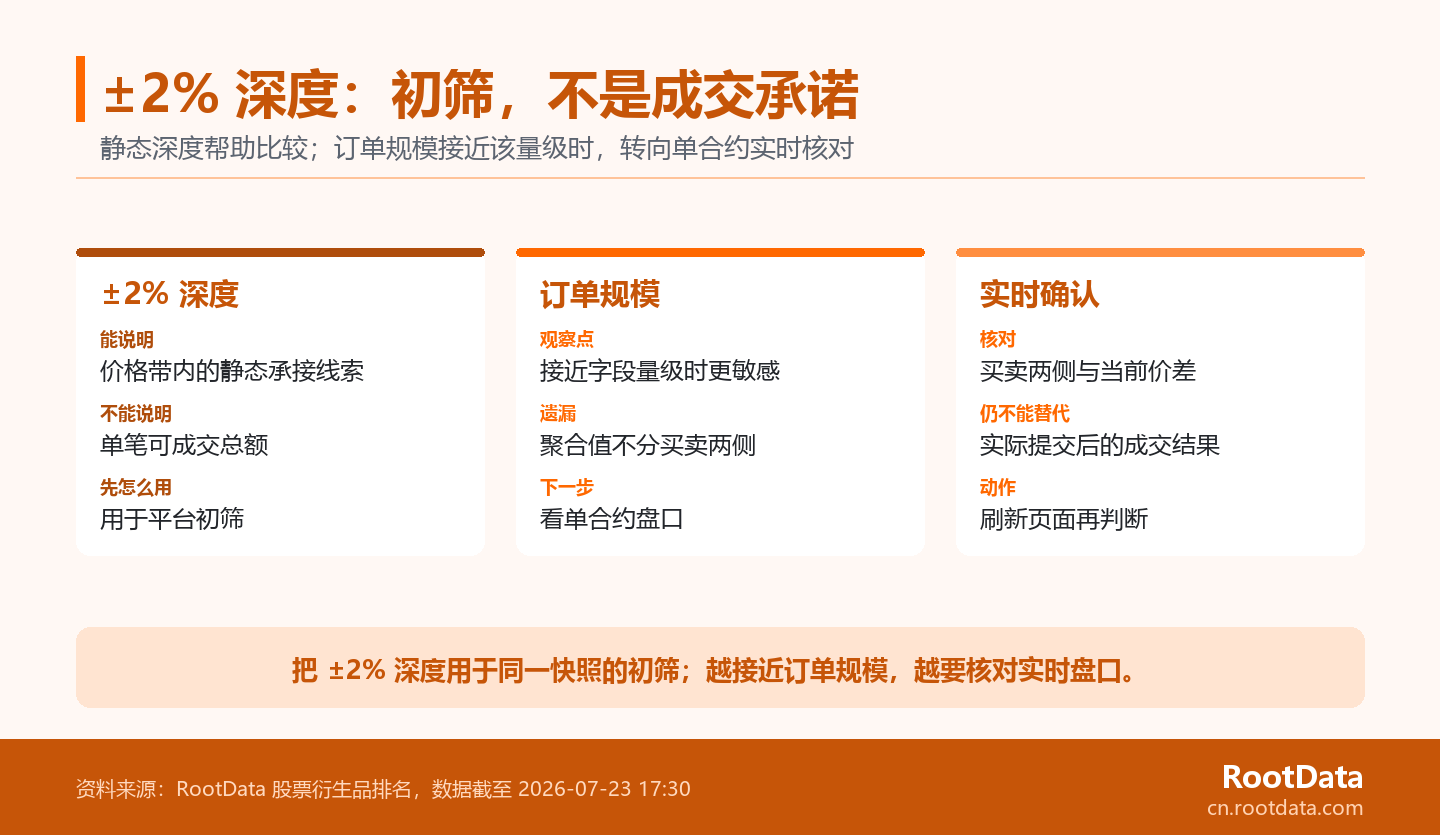
Three-step review of large order research: fix snapshot, view single contract, and refresh again
First fix the snapshot, then look at the specific contract, and finally refresh the dynamic fields. This is a more reviewable research sequence than just saving a ranking value. RootData's data standard description also reminds the importance of clear caliber: fields with different update times should not be spliced into a comparative conclusion without marking.
- Fixed comparison entry. Record the page timestamp and planned observation fields, without mixing the numbers of old screenshots and new pages.
- Drill down to a single contract. Liquidity sorting is only responsible for narrowing the scope; when conducting specific research, it is necessary to distinguish the target, direction, depth of both buying and selling sides, and the current price difference.
- Refresh before taking action. If you want to continue research, you can View the RootData stock trading platform ranking, and then check the latest snapshot with the actual page display.
Four judgments that this liquidity snapshot cannot replace
RootData's Disclaimer provides the usage boundaries of this article. RootData's public disclaimer positions its content as an information service rather than investment advice, so this ranking list is suitable for comparison and research and is not a substitute for personal judgment.
- Not a contractual availability judgment. Different stock contracts on the same platform may have different market openings and price band depths.
- Not a live order book replay. The snapshot at 17:30 on July 23, 2026 cannot replace the buying and selling sides at this time.
- Not a cost or terms comparison. Fees, deposits and settlement conditions should be reviewed with first-hand information at the time of actual research.
- Not a regional admission conclusion. The region, account and product scope need to be subject to the actual page and rules used.
FAQ
The FAQ only explains the meter reading boundary and does not add new platform functions, regional qualifications or legal conclusions. Their purpose is to help the reader understand the fields and missing states in the same snapshot, rather than to fill in any platform conclusions outside of the table.
±2% The higher the weighted liquidity, does it mean that it is easier for large orders to be filled?
It does not mean; it is a clue of comparable depth within a similar price band, and is not equal to the transaction guarantee of a certain unilateral side, a certain contract or a certain point in time. Numerical values can help researchers decide where to look first, but they cannot skip direction, actual order books, and spreads. Especially when the order size is close to the page display level, the distribution and update speed of pending orders in real-time may affect the final observation results more than static sorting, so transaction quality cannot be extrapolated from a single value.
Why do some platforms in the same ranking display -- or Pending?
Because this page snapshot does not show available values; retaining the original state rather than converting it to zero avoids creating non-existent sorting conclusions. Missing status does not explain the cause of the platform, nor does it automatically indicate that the condition is worse. It only means that in this traceable page display, the researcher lacks a value that can be sorted by the same caliber; if there is any subsequent update, the new snapshot should be rearranged as a whole instead of adding a guessed value to the old table.
Can liquidity values from different dates be put together and compared?
Not recommended; fields used for side-by-side comparisons should be from the same time snapshot, otherwise differences may come from update times rather than relative conditions between platforms. When the conclusion needs to be updated, the table, timestamp and related text should be refreshed simultaneously. Replacing only one or two rows will cause the reader to lose the baseline for comparison, and will not be able to determine whether the numerical change comes from market conditions, page updates, or changes in field display caliber. If old data must be quoted, the time of observation should be clearly marked, rather than treating it as current conditions.
Can this ranking determine whether my region or account can use a certain platform?
No; regional access, product scope and account conditions should be based on first-hand platform information at the time of actual use, and ranking snapshots are not responsible for such judgments. Even if the same platform appears in the data table, it cannot be inferred that a certain region, a certain type of account, or a specific contract can be used; these conditions will change with page rules, identity requirements, and product settings. Such conditions should be checked individually when studying liquidity to avoid inferring available qualifications from data coverage.