
Kraken vs Bybit: What is the difference between exchange xStocks spot tokenization and stock perpetual contracts?
 Author: Flowie|ChainCatcher content author, pays attention to RWA, interprets the true narrative of Web3.Follow X
Kraken xStocks is not the same product as Bybit stock perpetual. Using the number of contracts or ranking to give a total score first will mix the rights boundary, data scope and real-time availability. A more useful comparison sequence is: first confirm whether you need tokenized representation or price exposure; then look at the derivatives fields of the same time and caliber; and finally return to your own region, account and target product page.
“Tokenized stocks” here refers to tokenized products that are presented in the form of on-chain or platform accounting and are related to the value of stocks or ETFs; it is not a general term that automatically equates to direct shareholdings. This article uses RootData inJuly 23, 2026 17:30Saved frozen snapshot of equity derivatives exchanges, covering 29 platforms. A frozen snapshot is a non-real-time field record at a fixed point in time, suitable for same-caliber reading, and does not replace the current quotation or personal account qualifications.
Let’s first look at the two paths separately.
A comparison of Kraken xStocks and Bybit stock perpetuals must in turn differentiate between products and rights, frozen snapshots of similar fields, and real-time account conditions.
- Ask about the product first:Do you want to confirm the structure and rights of the tokenized representation, or the derivatives contract surrounding changes in stock prices? This determines which type of rule to read.
- Read the numbers again:RootData's fields such as number of contracts, open interest, and spread can give a horizontal starting point for similar stock derivatives, but they cannot replace the catalog of another type of product.
- Last check:Territory qualifications, account status, target contracts and order books are all subject to change and cannot be extrapolated from historical snapshots.
Therefore, this is not a “which exchange is better” ranking article. What it wants to solve is: when Kraken's page talks about xStocks and Bybit's page talks about TradFi Perpetual Contracts, which conclusions can be read together and which ones must keep boundaries.
The product structure is different: xStocks is not a stock perpetual contract
The tokenized representation of Kraken xStocks and Bybit TradFi Perpetual are not the same stock product: the official information of the former revolves around tokenized representation and rights boundaries, while the latter revolves around price exposure contracts and rule adjustments.
Kraken willxStocksIt is described as a tokenized representation of real-world stocks and ETFs, and explains that the corresponding xStock has 1:1 support for related securities; however, whether the product is available is still affected by conditions such as region. This description answers how the product is presented and supported, rather than giving everyone an "equal holding" conclusion.Check out Kraken’s product description for xStocks.
Rights boundaries need to be read separately. Kraken’s FAQ clearly states that holding xStocks is not equivalent to purchasing shares of the underlying company, does not carry shareholder or voting rights, and does not constitute a legal claim to the shares of the underlying company. In other words, "1:1 support" product disclosure and "what corporate rights the holder obtains" are two different things; the former cannot be used to replace the latter when comparing.Read the rights boundaries of Kraken xStocks.
Bybit’s TradFi Perpetual Contracts are perpetual contracts designed around traditional asset price exposure. so-calledStock Perpetual Contract, can be understood as a derivatives contract that tracks stock prices and has no fixed expiration date; its focus is on contract rules, settlement and price changes, rather than stock delivery. related to positionsfunding rate, which is the fee or payment mechanism for the perpetual contract to be settled between the two parties according to the rules. Bybit also reminds that the impact of the company's actions will not be automatically given to users unless the product price or contract adjustment is clearly reflected.View Bybit’s explanation of TradFi perpetual contract.
| Compare dimensions | Kraken xStocks | Bybit stock perpetual | Don’t draw conclusions directly |
|---|---|---|---|
| product object | A tokenized representation of a stock or ETF. | Perpetual contracts for traditional asset price exposure. | If they are both "stock related", they must be the same product. |
| rights issue | It depends on the product FAQ and regional conditions; it does not mean buying company shares. | It depends on the contract rules and adjustment arrangements. | Price correlation means obtaining shareholder rights. |
| Compare data | Product Description, Rights Disclosure, Current Availability. | Contract description, settlement rules, current contract page. | A platform ranking page can illustrate both. |
Based on this comparison, the first thing to do is not to compare "who has more coverage", but to determine which issue you want to check: If you care about tokenization representation and rights boundaries, you should use the product information of xStocks as the starting point; if you care about the price exposure and trading conditions of a certain stock-related contract, you should return to the stock perpetual rules and target contract page.
What can and cannot be compared with RootData snapshots?
RootData 2026-07-23 17:30 The Kraken and Bybit contract numbers in the frozen snapshot belong to the stock derivatives field and cannot be used as a complete list or proof of rights for Kraken xStocks spot tokens.
In this fixed-point snapshot of RootData’s equity derivatives exchanges, Bybit ranks second, showing 131 contracts; Kraken ranks 26th, showing 11 contracts. They are the same kind of fields on the same derivatives ranking page, so they can be used to ask "What is the difference between the contract coverage displayed on the page at this point in time and the market field", but they cannot be rewritten as "Bybit has 131 xStocks" or "Kraken only has 11 xStocks".View RootData’s Equity Derivatives Freeze Snapshot Fields.
| RootData frozen snapshot field | Bybit | Kraken | What does this field answer? |
|---|---|---|---|
| Ranking | 2nd | No. 26 | How they are arranged in the composite fields of this snapshot. |
| Number of contracts | 131 | 11 | Page showing equity derivatives coverage leads. |
| Open interest (OI) | US$97.48 million | $4.47 million | The open position size field of the relevant contract at this point in time. |
| 24 hour trading volume | $897 million | $4.44 million | Completed transaction activity within a fixed window. |
| ±2% weighted liquidity / page spread | $1.01 million / 0.051% | $455,300 / 0.45% | Market fields displayed on the page within a specific range and time. |
| Margin assets | USDT | USD | The asset fields listed on the page are not a judgment of personal account qualifications. |
The conclusions of this table should remain within the caliber of the table: Bybit’s number of contracts, OI, 24-hour trading volume, and ±2% weighted liquidity shown in this frozen snapshot are higher than those of Kraken; but these fields are not enough to prove that a certain target contract can definitely be traded at this moment, let alone the scope of xStocks’ spot tokens or shareholder rights. Field meaning and comparison range should be combinedRootData Equity Derivatives Ranking Descriptionread.
If you need to put the numbers back into the same time and field range, firstOpen RootData Equity Derivatives Ranking to check the same time field; Then return to the platform page for a certain product and target. The ranking page is the starting point for screening and interpretation, and is not a commitment to individual trading results.
When comparing, check in three steps instead of giving the platform a total score.
To compare the stock-related entrances of Kraken and Bybit, you should first confirm the product and rights, then read the frozen snapshot of similar fields, and finally check the real-time conditions of the region, account, and target product.
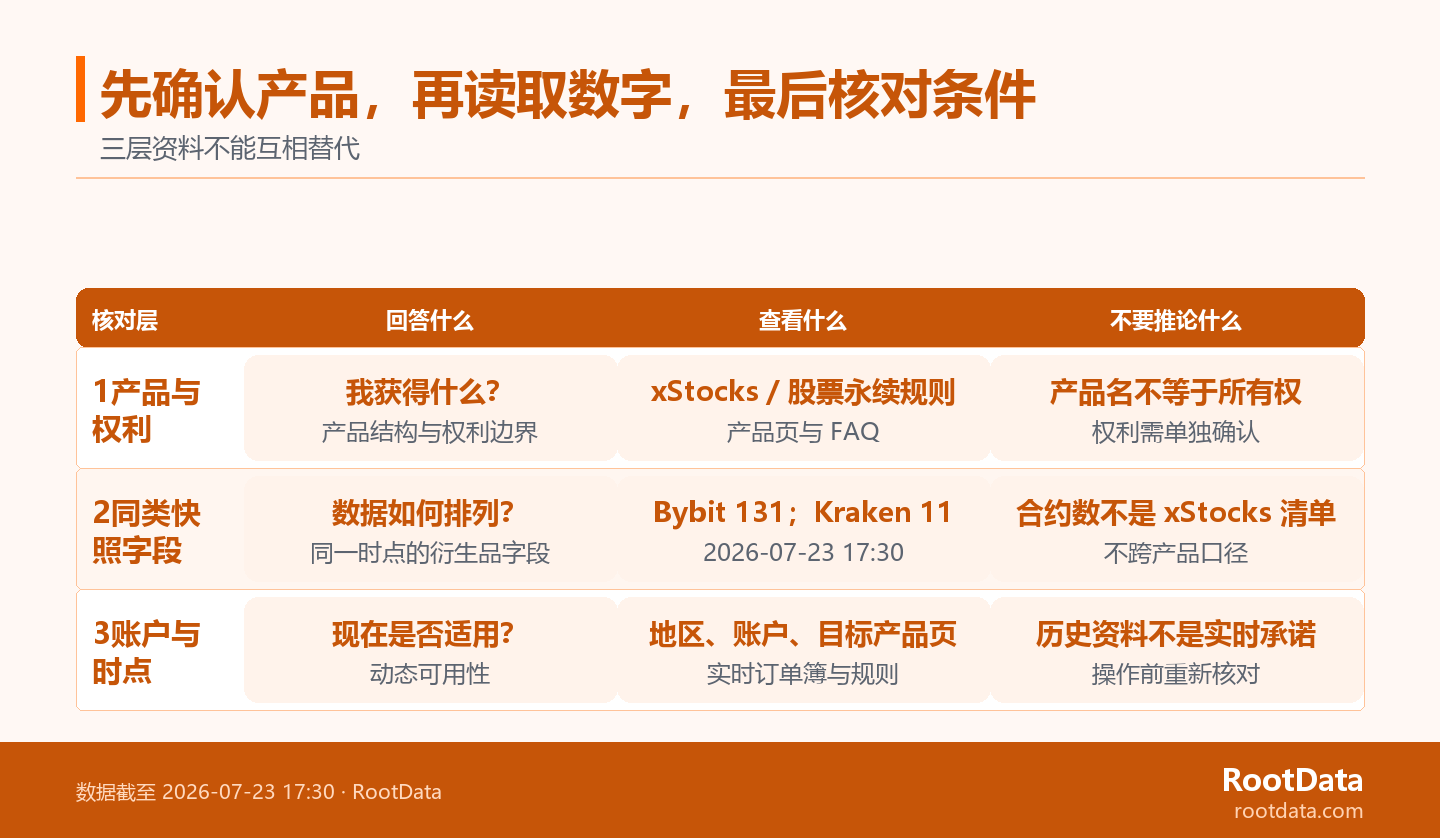
Step 1: Confirm the product and rights, and decide which set of information to look at
First make it clear "what do I want to achieve". If the question is whether the tokenized representation corresponds to shareholdings and whether it carries shareholder rights, you should read the Kraken xStocks product and FAQ; if the question is how a TradFi perpetual will track the price, how it will be settled, and how corporate actions will be handled, you should read Bybit's description of the contract. Bybit’s official education page also introduces xStocks, CFD and perpetual contracts separately, indicating that “stock-related” is not a label sufficient to skip product classification.Check out Bybit’s distinction between xStocks, CFD and perpetual contracts.
Step 2: Read snapshots only in similar fields to determine whether the numbers are relevant
RootData's frozen snapshot was entered when the question turned to "how many contracts, OI or liquidity does the platform display on the equity derivatives page?" This step can put the comparison objects under the same point in time and the same field, but it cannot cross to another product structure. The number of contracts can help narrow down the platforms and targets to continue to look at; it cannot alone tell you the rights of the holder, whether the target contract is still visible, or whether the current order can be filled as expected.
Step 3: Check the account and time to determine whether the disclosed information can fall into the current situation
Finally, check the regional qualifications, account status, product parameters, trading period and target contract order book. This order is not to increase the process, but to prevent a static number from overstepping its authority to answer dynamic questions: product availability may change by region, and order books and spreads may also change by underlying and time. Only when these three layers are aligned with the same target product, can the public information be qualified to enter the next step of judgment.
Before citing any conclusions, refresh these four types of conditions
Territory qualifications, account conditions, product parameters and real-time order books cannot be replaced by this frozen snapshot or public comparison.
- Region and product qualifications:Confirm whether the specific product you are looking at can be used in your current place of residence or within the scope of your account, rather than just looking at the homepage of the platform.
- Target and contract parameters:Confirm which stock-related product you are looking at, which margin asset, and what settlement and fee rules you are seeing.
- Account conditions:Check KYC, account status, risk limits and the conditions displayed for the account on the current page; the public instructions are not guaranteed to be exactly the same for every account.
- Live market fields:If the judgment involves tradability or cost, the order book, spread and time period of the target contract should be re-examined rather than relying on the July 23 snapshot numbers.
Exposure of RootDataData standards and definitionsIt helps to put the ranking field back within the scope of its method; the role of this article is limited to providing a verification framework of products and data, and does not constitute investment advice. For this, see RootData'sDisclaimer.
FAQ
Are Kraken’s xStocks equivalent to owning real stocks or company equity?
It is not equivalent to directly holding stocks or company equity in the target company. Kraken describes xStocks as tokenized representations related to stocks or ETFs, but its FAQ also explains that holding xStocks does not carry shareholder or voting rights and does not constitute a legal claim to shares of the underlying company. "Product support structure" and "holder rights" should be checked separately; for company actions, available regions and specific target scope, the current product terms should also prevail.
Does Bybit’s stock perpetual contract have dividends or shareholder rights?
No shares or shareholder rights are delivered to the contract holder. Bybit’s TradFi Perpetual Information defines it as a price exposure contract and reminds that the impact of the company’s actions will only be reflected when the product price or contract adjustment is clearly reflected. The specific treatment method should be based on the current rules of the target contract and cannot be inferred from the word "stock"; different targets may also have differences in settlement, funding rates and adjustment arrangements.
Can RootData’s Kraken vs Bybit contract numbers be directly compared to xStocks?
It cannot be compared directly like this. The contract numbers in this RootData snapshot belong to the stock derivatives field, and are meant for horizontal reading of the platform’s derivatives coverage at the same point in time, rather than the full list of Kraken xStocks spot tokens. It can help you determine which pages and subjects to review later, but it should not replace confirmation of product rights or spot product range; timestamps and field calibers should also be retained when quoting numbers.
Why do I need to recheck the region and account conditions before placing an order?
Because product availability, account qualifications, trading sessions, and specific contract parameters may vary based on region, account status, or page updates. Historical snapshots can illustrate fields at a fixed point in time. They cannot confirm whether your current account can use a certain product, nor can they replace the real-time order book. When it comes to specific operations, the target product page currently displayed on the platform should prevail; if the page conditions change, the old comparison conclusion should be stopped.