
Centralized exchange vs on-chain platform: liquidity, custody and trading mechanism of stock products
When comparing centralized exchanges and on-chain platforms together, it is easy to merge three issues into one: who operates the assets, what rights are given to the product, and whether the order can be completed at an acceptable cost. But these three things each correspond to different data. Centralized or on-chain, the first description is how funds and status enter the trading system; the rights to tokenized stocks must be returned to the issuer and product documents; execution quality requires order book data at the same point in time.
Therefore, this article does not judge which type of platform is generally "better", but breaks the comparison into verifiable levels: first look at the product, then look at the asset path, and finally look at whether the market can be closed at the target scale.
Let’s break down three issues first: product rights, asset paths and transaction quality.
Centralized exchanges and on-chain platforms are, first of all, differentiating trading paths and cannot simultaneously replace the judgment of product rights and liquidity.Behind the same product name, there may be different issuance arrangements, account recording methods, mortgage asset locations and market rules. Separating these three layers prevents the transaction interface, wallet balance or on-chain browser records from being misinterpreted as complete product descriptions.
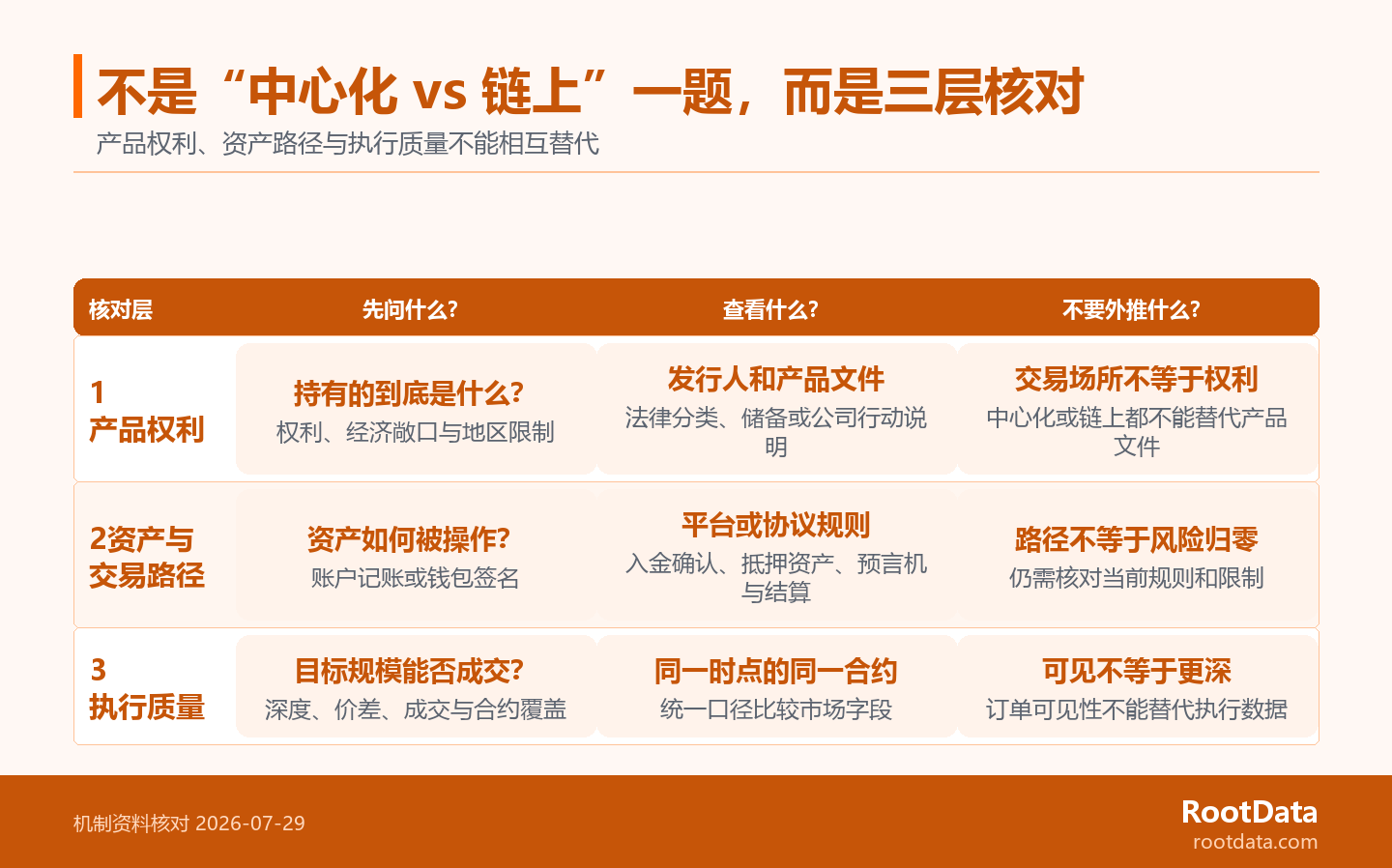
- Product Rights:First confirm what kind of economic exposure the holder gets, whether it comes with corporate governance rights, and where the issuance and redemption rules are written.
- Asset path:Confirm again whether the funds and collateral are located in the platform account, wallet address or smart contract, as well as the conditions for transfer and settlement.
- Transaction quality:Finally, compare the pending order thickness, spread, trading volume and open interest at the same time, same contract and similar order size.
| Questions to answer first | Centralized exchange path | On-chain platform path | Conclusions that cannot be drawn directly |
|---|---|---|---|
| What rights are given to the product? | View the offering, trading and settlement documents for this product | View token issuance, contracts and product legal documents | The platform type itself cannot prove that the underlying stocks are held |
| How do assets operate? | Account balance, recharge and withdrawal rules constitute the operation path | Wallet signature, contract interaction and mortgage asset rules constitute the operation path | Being able to operate assets does not mean automatically owning the rights to the same product. |
| Can the order be effectively completed? | View the order book and risk rules for this market | View protocol order books, market deployments and risk parameters | The fact that the order is visible or can be checked on the chain does not mean that the depth is sufficient |
Custody is not a single-choice question: accounts, wallets and product rights should be looked at at three levels
Account accounting and wallet signing are different ways of operating assets; neither alone can explain what legal or economic rights tokenized stocks give.wallet signatureIt is a method in which the wallet controller authorizes on-chain operations and does not automatically indicate product rights or the location of mortgage assets. The platform account can display the balance, support certain recharge or currency withdrawal operations, and does not automatically indicate that the user has obtained the shareholder status of the target company. When comparing, "who can initiate the operation", "where the assets or collateral are" and "what rights are conferred by the product" should be clarified separately.
Taking Bybit's deposit instructions as an example, deposits on a specific chain will be credited to its Funding Account or Unified Trading Account after meeting the confirmation conditions. This example illustrates an account deposit path on the platform. Not all centralized exchanges adopt the same process, and the legal attributes of a certain stock product cannot be deduced based on this.
xStocks’ official legal overview defines it as a tracker certificate that provides economic exposure, rather than direct equity or shareholder voting rights.View xStocks’ Product Legal Overview. This is an arrangement for a specific product and should not be extrapolated to other platforms or other stock products; readers still need to check the issuer, mortgage arrangements, transfer restrictions and redemption conditions item by item.
Trading mechanism: On-chain records are not just “on-chain”, but also include market definitions and risk parameters
Hyperliquid describes its HyperCore’s perpetual and spot order books as an on-chain system for recording orders, cancellations, fills, and liquidations.Check out Hyperliquid’s official documentation. This is an example implementation of a specific protocol and it cannot be assumed that all on-chain platforms will have the same order books, clearing or available markets.
OracleIs a mechanism that provides external price or data input to a contract, affecting how the risk parameters of the underlying contract operate. For stock perpetual contracts or other derivatives, price input, leverage caps, margin rules, funding fees and settlement arrangements will jointly affect the order process from placement to transaction to risk disposal.
Market deployers of HIP-3 bear responsibility for market definitions, oracle definitions, leverage limits, and settlement where necessary in public statements, so the rules for the target market still need to be read individually.Check out Hyperliquid’s HIP-3 instructions. The document also states that the relevant perpetual market has independent margins and order books; when reading any specific market, you should continue to return to the market's current deployment instructions and rules page, rather than just judging the trading conditions based on the word "on-chain".
Liquidity: Visibility does not mean depth, comparison can only be made at the same time point
Whether the platform is more suitable for orders of a certain target size requires comparing the depth, spread and other comparable fields of the same contract at the same point in time; whether the order is visible on the chain cannot give this conclusion alone.Order book depthIt is the number of pending orders available for transaction at different price ranges and is used to judge the executability of target size orders. The order book can be seen, which at best means that the pending order information can be observed; whether a transaction of the target size can be completed with a smaller slippage also depends on the tradable quantity, bid-ask spread, contract direction and risk parameters at that time.
When comparing centralized exchanges to on-chain platforms, the most common error is side-by-side data from different times, different contracts, or different order sizes. A higher trading volume may reflect the activity in the previous window; open interest reflects existing positions; spreads and pending orders at different prices are closer to the immediate execution conditions at a certain point in time. They should complement each other and should not be compressed into a single "liquidity ranking."
RootData's Equity Derivatives platform description lists volume, open interest, depth, spread, fees, funding fees, contract coverage and margin routing as comparison fields.View RootData’s Equity Derivatives Platform Description. When using these fields, the important thing is not to find a permanently leading platform, but to confirm at the same timestamp: whether you are comparing the same type of stock products, contracts in the same direction, and similar target trade sizes.
Make comparisons come down to data: Five checks to avoid treating rankings as product certification
After the product and routing rules are confirmed, the depth, spread, fee, funding fee, OI and contract coverage of the platform layer can be returned to RootData's stock derivatives data entry for verification at the same point in time.RootData’s Equity Derivatives InstructionsThese platform comparison fields are listed; to continue comparing data from different trading platforms, you canView RootData Equity Derivatives Trading Platform Ranking, and then return to the target product page to confirm the current rules. The data in the rankings is an observation and not a commitment to product rights, hosting arrangements or applicability.
The comparison sequence should first confirm the product file, then confirm the account or wallet path, then read the market rules, then compare the execution data at the same time point, and finally save the missing fields.
- Confirm product type and issuer:Is it a spot token, a tracking certificate, a perpetual contract, or another structure? Who issues the rights statement and risk disclosure?
- Confirm asset path:Are funds, collateral, and product records located in accounts, wallets, or contracts? What are the current conditions for top-ups, transfers and settlements?
- Confirm market rules:What price inputs does this market use, how are margin, leverage, funding fees and settlement parameters set, and who maintains the rules?
- Look at the execution fields at the same point in time:Read order book depth, spreads, volume, open interest, fees and contract coverage together at the target size.
- Single column missing items:Fields that have no disclosures, unavailable areas, or cannot be confirmed should be left as pending items rather than completing the conclusion with platform labels.
These five checks will transform the question of "where to trade" into the question of "what to trade, how to hold it, and under what rules". For readers of the data, this is closer to the boundary of information needed for actual decision-making than comparing just one ranking position.
FAQ
Rights, funding paths or market parameters that are not clearly disclosed on the current page should be left open for verification and not completed by centralized or on-chain tags. The following answers are used to clarify the order of comparison and do not constitute a judgment on the applicability of any platform, product or region; specific conditions should be subject to the latest original description of the relevant products and platforms.
Is trading stock products on the chain equivalent to self-custody?
No, wallet signature, mortgage asset location, smart contract rules and tokenized product rights need to be confirmed separately. The ability of a wallet to sign a transaction only indicates that an address can authorize on-chain operations; it cannot independently prove who keeps the collateral, whether it can be redeemed, or whether the holder has direct equity in the underlying company. If the page only displays the balance or contract address, you should continue to look for the issuance instructions, mortgage arrangements and current transfer or settlement rules, and then determine the operable range.
Does the visible order book on the chain mean that the transaction must be better?
Without saying anything, whether the order is visible and whether the order book is deep enough at the target size are two different things. It can be seen that pending orders can help observe the market status, but the actual execution is still affected by the target order size, price range, bid-ask spread, contract direction and risk parameters at that time. You should also pay attention to the time window corresponding to the data and avoid directly taking the trading volume in the past period as the amount that can be traded at this moment. Depth, spread, volume and open interest should be read together at the same point in time.
Can I withdraw cash from stock products in a centralized exchange account?
It cannot be generalized. Whether, what and when you can transfer out depends on the current rules of the platform and product. Some pages describe the recharge and withdrawal paths for funds or mortgage assets; some products have transfer, redemption or settlement restrictions. Before checking, you should distinguish between the account balance, the tokens on the chain and the rights of the product itself; if it is only confirmed that the funds can be transferred out, it still cannot be inferred that the product can be transferred or redeemed, and then confirm with the latest documents from the platform and the issuer.