
Gate vs Kraken: Multi-product TradFi platform versus spot path to tokenized stocks
 Author: Flowie|ChainCatcher content author, focusing on RWA, interpreting the true narrative of Web3.Follow X
Gate's and Kraken's tokenized stock paths can be studied side by side, but one cannot directly determine which spot path is "better traded" using an exchange data table. Gate’s TradFi portal involves multiple product layers; Kraken’s xStocks is a set of tokenized stock paths with separate product pages and terms. A snapshot of RootData at the same time providesEquity Derivativesfield. Mixing the product structure, frozen snapshots and the current page of the target token is where this type of exchange is most prone to distortion.
Let’s break down two issues first: product path and derivatives snapshot
The product paths for Gate TradFi and Kraken xStocks cannot be directly determined by a snapshot of exchange stock derivatives. The former first answers "Which traditional financial related products does the platform put into the same entrance?" The latter first answers "How is a tokenized stock product defined and applied?" RootData’s ranking row answers the third question: what does the two exchanges display on the verifiable equity derivatives field at a fixed point in time.
- Let’s look at the product layer first.CFDs, equity perpetuals and tokenized equity spot are not the same risk and fee structure.
- Let’s look at the data layer again.The number of contracts, open interest, trading volume, liquidity and spreads at the same time can be compared, but the field names and timestamps must be retained.
- Finally look at the current page.The terms, availability, quotes, fees and order books of the target token cannot be replaced by historical derivatives lines.
This order is not to avoid comparison, but to put the comparison on the right issues: if readers want to understand the product lines covered by the platform, they should look at the official product information; if they want to check the stock derivatives activities at the exchange level, they should look at the RootData snapshot; if they want to understand the actual conditions of a token, they need to return to the current trading page of the token.
Gate’s multi-product TradFi portal answers different questions than Kraken’s xStocks spot path
TradFi here is the platform’s response to traditional finance-relatedproduct lineA classification used, rather than an individual asset. Gate's TradFi page puts such transactions at a unified entrance and displays traditional financial related products such as CFD; at the same time, Gate also has independent stock token areas and spot-related content. For Gate, the correct first question to ask is not "does it have tokenized stocks?" but rather are you looking at CFDs, perpetuals, or the spot page for a certain stock token.View Gate TradFi product portal.
Gate’s xStocks product article describes the zone as an asset-backed tokenized stock trading zone that corresponds to real stocks. This can help readers locate their "spot path" as a stock token product within a crypto exchange, rather than mistaking the entire TradFi entry as a spot instrument. Product coverage, tradable objects and applicable conditions may change, so it is not appropriate to extrapolate the product descriptions on the page to services available to all users.
Kraken explains xStocks as a separate product path for tokenized stocks and ETFs: the official product page emphasizes that it is tokenized representations of real stocks and ETFs, and uses corresponding asset support as part of the product structure. This description answers how xStocks is packaged and presented; it does not equate to Kraken’s stock derivatives rankings, nor does it equate to the current trading quality of each token.View the Kraken xStocks product page.
| Compare dimensions | Gate | Kraken | It cannot be inferred from this |
|---|---|---|---|
| starting data | TradFi product entrance and stock token area | xStocks product page and terms | Which one is more suitable for everyone? |
| What to confirm first | CFD, perpetual or target token | Target xStocks token and applicable terms | The same exchange house represents all products |
| rights issue | Confirm according to the issuance and transaction terms of the target token | Confirm by xStocks terms | "Tokenized shares" automatically equal common shares |
Tokenized shares cannot by default amount to legal rights to directly own the underlying shares. Kraken’s global terms clearly describe xStocks as on-chain representation and note that holders do not thereby acquire legal rights to the underlying stocks; Gate Learn’s description of this type of product also reminds that tokenized stocks generally do not equate to real stock ownership or fixed dividend rights. A safer approach is to put voting, information, distribution, redemption and regional conditions back into the current terms of the target product one by one, rather than just inferring from the words "1:1 support" or "stock token".View Kraken xStocks Terms, and readGate’s Tokenized Stock Instructions.
How to read the derivatives fields of Gate and Kraken in the same RootData snapshot
The following data comes from 29 platform snapshots solidified by RootData at 17:30 on July 23, 2026. This ranking covers equity perpetual or equity-related derivatives; it is not a listing of real stock spot trades, nor is it a target token order book for gStocks or xStocks. Therefore, the data in the table can be used to compare the exchange derivatives fields of Gate and Kraken, but it cannot be rewritten into a real-time comparison of the two types of token spot.Read the RootData Equity Derivatives Ranking Notes.
The number of contracts, open interest, 24-hour volume, ±2% weighted liquidity and spreads at the same time can be read sideways. Open interest refers to the nominal size of the contract that has not yet been closed or settled; the "frozen snapshot" is a non-real-time field version recorded at a fixed time. Both should be read in conjunction with a specific time and not be interpreted as the current order status.View RootData same time field.
| RootData field (2026-07-23 17:30) | Gate | Kraken |
|---|---|---|
| Ranking / Comprehensive Rating | 6/90 | 26/64.9 |
| Number of equity derivatives contracts | 275 | 11 |
| open interest | $247.73M | $4.47M |
| 24 hour trading volume | $1.02B | $4.44M |
| ±2% weighted liquidity | $3.90M | $455.29K |
| Show spread | 0.061% | 0.45% |
| maker / taker | -0.01% / 0.075% | 0.02% / 0.05% |
RootData's stock rankings are designed to compare verifiable equity-related derivatives data, not real stock spot trading lists. Ratings combine multiple public fields, but the complete weights are not made public; therefore, rankings can assist in locating fields for review and cannot replace judgment on a single product or transaction.View ranking range description. If you want to review this table at the same point in time, you canView RootData Equity Derivatives Trading Platform Ranking.
Magnitude calculation can only arrange the checking sequence and cannot verify the token spot transaction.
Calculated based on the values shown in the same frozen snapshot, Gate’s number of contracts is 25 times that of Kraken; open interest is approximately 55.4 times; 24-hour trading volume is approximately 229.7 times; ±2% weighted liquidity is approximately 8.6 times. Looking at it the other way around, Kraken’s displayed spread is about 7.4 times that of Gate. This calculation only describes the relative magnitudes at 17:30 on July 23, 2026: 275÷11, 247.73÷4.47, 1,020÷4.44, 3.90÷0.45529 and 0.45÷0.061. It does not predict the future, nor does it represent the price at which a certain order will be filled.Check RootData frozen snapshot.
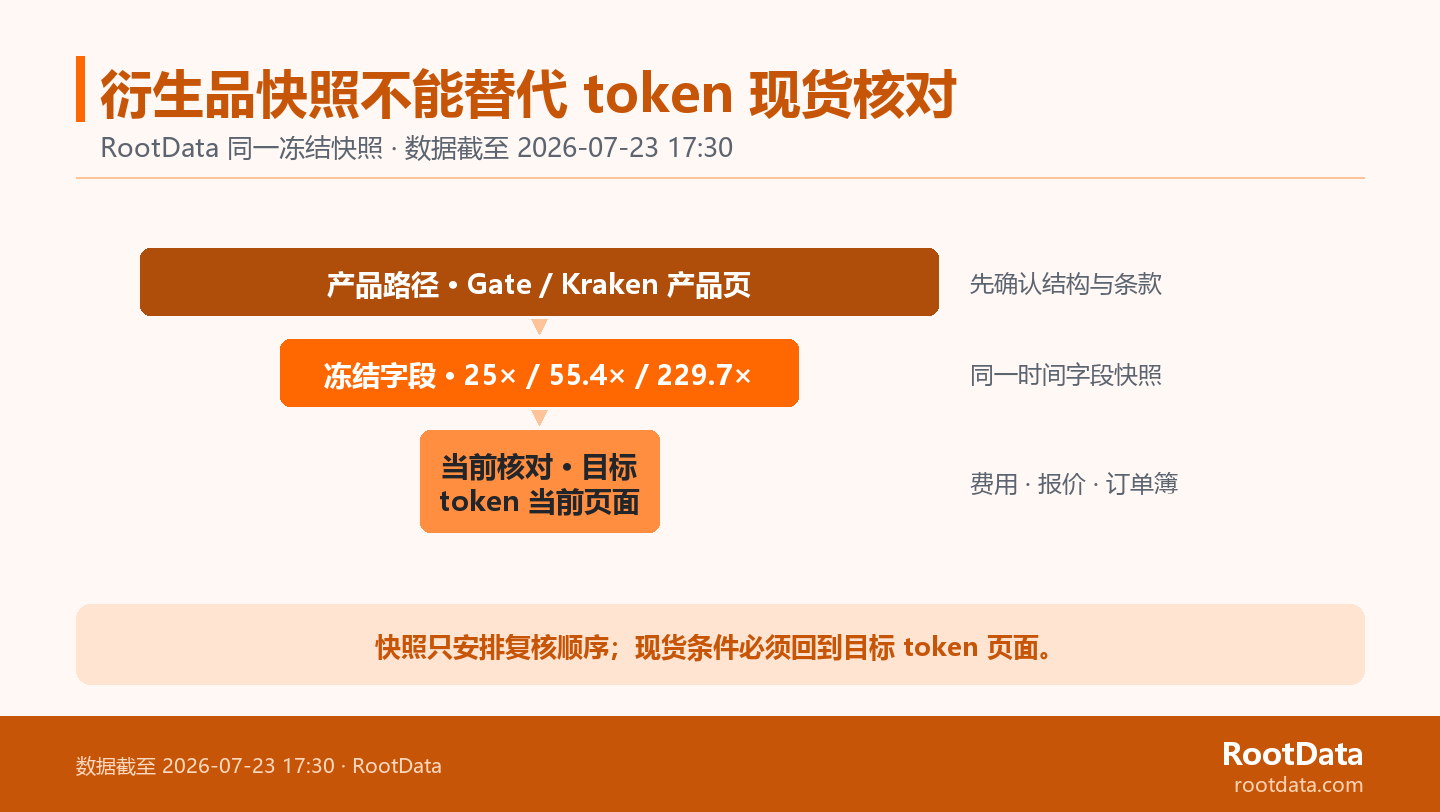
The purpose of these five multiples is to narrow the problem, not to create a "total score." For example, if you just want to verify stock derivatives coverage and activity at the platform level, the differences in the table are worth continuing to look at; but if the question becomes the current spreads, fees, and tradable quantities of a certain xStocks or Gate stock token, the required evidence has been replaced by the trading interface of the target token. There is no indicator that can be automatically inherited between the product layer, derivatives layer and spot layer.
The maker/taker fields in the RootData snapshot belong to the stock derivatives row and cannot be directly applied to Gate or Kraken's tokenized stock spot fees. They can help readers discover "there's a cost issue here to verify," but they don't prove gStocks or xStocks' current spot rates, rebates, minimum price moves, or trading pair spreads. If there is a difference in the field display, the next step is to open the fee description of the target product and the real-time market, rather than copying the derivatives fee rate to the token spot.
Gate, Kraken, stock derivatives, tokenized stocks and frozen snapshots must be understood in the same logic: the RootData field records historical derivatives activities at the exchange level; the product information of Gate and Kraken illustrates different tokenization paths; the spot order book of the target token answers the current execution conditions. Therefore, the derivatives field cannot verify the spot transaction of the target token of gStocks or xStocks, nor can it replace the terms check of the holder's rights.
From the product page to the current transaction page: three steps to complete the conditions
Product information, frozen snapshots and current transaction pages are used to check structure, historical fields and real-time conditions respectively. Using them in order preserves the value of the Gate vs Kraken exchange comparison without pushing a historical indicator beyond the range it would otherwise be able to support.
- Confirm product.First determine whether you are discussing Gate's CFDs, perpetual or stock tokens, or which of Kraken's xStocks products; read the current terms, supported assets and region tips.
- Check the snapshot.Keep the timestamp, field name and missing status of RootData, and only perform horizontal comparisons within the same level.
- Refresh real-time conditions.Review the current fees, quotes, order book, minimum trading size, and account availability for the target token or contract and decide whether these conditions answer your specific questions.
RootData exposes data standards and fields should be read in conjunction with their methods and time ranges. For the purposes of this article, the most important thing is not to amplify any one number into a recommendation, but to ensure that the number remains within its verifiable product range.Read the RootData data standard.
RootData information does not constitute investment advice. This article does not judge whether an individual meets the region, account or risk conditions of any product; these conditions should be subject to the page and terms provided by the target platform at the time of viewing.View RootData disclaimer.
FAQ
Can Gate TradFi's CFD, perpetual and spot tokens be substituted for each other?
They cannot be directly substituted for each other because their corresponding product rules, position holding methods, fee display and risk mechanisms are different. Even if the page puts them in the same TradFi or exchange entrance, CFD, perpetual and spot tokens are still products of different levels. Before comparing, lock in the specific product and then read its own terms and transaction page to avoid writing the indicators or fees of one product onto another.
Are xStocks or Gate stock tokens equivalent to directly holding stocks?
It does not mean that the legal and economic rights of tokenized stocks depend on the current terms of issuance, custody and platform, and they cannot default to the rights of ordinary shareholders. Kraken's terms clearly state the rights boundaries of xStocks; Gate's related products should also be subject to the specific page. If the issue involves voting, distribution, redemption or asset support, you must check each item one by one and do not judge based on the token name alone.
Can RootData's Gate and Kraken fields prove which token has better spot transactions?
No, because this snapshot records the equity derivatives field, not the spot order book for any target token. 24-hour trading volume, open interest, and liquidity can let you know which platform fields are worth checking, but they are not a substitute for current buy and sell orders, quote direction, order size, trading pairs, and fee information. When judging spot execution, the current trading interface of the corresponding token should be opened.
Can the derivatives fee fields of Gate and Kraken be directly applied to tokenized stock spot?
It cannot be applied directly. The maker/taker field in the RootData snapshot belongs to the stock derivatives row. The fees and spreads of spot tokens should be based on the current trading page. Fees may also depend on the product, region, account level, trading pair and platform rules. Differences in the snapshot are suitable for triggering a review but are not a substitute for costing the target token. Even if a platform displays lower rates in the derivatives row, it cannot be assumed that the actual transaction costs of token spot are the same.