
Aster vs Hyperliquid HIP-3: Comparison of coverage, liquidity and fees of on-chain stock perpetuals
 Author: Flowie|ChainCatcher content author, focusing on RWA, interpreting the true narrative of Web3.Follow X
Aster and Hyperliquid HIP-3’s stock perpetuals can compare fields within the same data snapshot, but cannot directly translate volume, fee display, or “on-chain” labels into exchange conclusions that apply to everyone. A more useful sequence is: first look at who defined the contract and parameters; then look at the same fields at a fixed time; and finally return to the real-time rules, order book and account conditions of the target contract.
This article uses RootData for2026-07-23 17:30Saved frozen snapshots of 29 equity derivatives platforms. Here'sfreeze snapshotIt is a non-real-time version of the public fields recorded at a fixed point in time, suitable for horizontal reading of the number of contracts, open interest, 24-hour trading volume, ±2% weighted liquidity and spread; it is not the tradable size, fee quotation or product availability of a certain stock at this moment.
First determine whether the comparison is market structure or data at the same time.
- Structure answers "where do rules come from":Contract specifications, price sources, leverage limits and exceptions should be checked with the target market's official information.
- Snapshots answer "what was shown at the same point in time":The number of contracts, open interest, trading volume, liquidity and spreads can be read side by side in the same caliber.
- The current page answers "What are the conditions now":Order books, fees, funding rates, margin and account limits may all change after the snapshot.
Aster vs. Hyperliquid HIP-3’s stock perpetuals can compare fields within the same data snapshot, but one cannot draw conclusions about which one is better for everyone based solely on volume, fees, or “on-chain” tags. The market structure describes how the contract is defined; the ranking field describes the public status at a certain point in time; and the actual conditions also depend on the specific contract. Condensing these three layers of information into one total score will discard the parts that need the most review.
The difference between Aster and HIP-3, let’s first look at who defines the contract parameters
HIP-3Not a stock contract, but a mechanism that Hyperliquid allows builders to deploy and operate perpetual markets.Stock Perpetual ContractIt is a derivative contract that tracks the price of a stock and does not have a fixed expiry date; when you read such a name, the point is not to equate it with owning a stock, but to identify what the target market tracks, how it is priced, and who maintains the rules.
Hyperliquid's HIP-3 is a mechanism for deploying perpetual markets by builders, who are responsible for market definition and operational matters such as oracles, leverage limits, and settlement when necessary.View the official mechanism description of HIP-3. Therefore, the starting point for comparison on the HIP-3 side is the target markets themselves: being in the same protocol environment does not mean that each market shares the same oracle definitions, leverage limits, or settlement arrangements.
Aster's equity perpetual description sets US equity-related perpetual contracts as USDT settlement and states that index prices come from multiple providers, including Pyth.View Aster Stock Perpetual Contract Description. This gives a path to data on one side of Aster, but should not replace individual confirmation of an underlying, trading session, index status or current parameters.
"On-chain" describes the product infrastructure and data path and cannot replace the verification of the target stock perpetual contract rules. It can tell readers where to look first for market definitions, but it cannot prejudge a contract's fees, depth, risk disposition, or account availability.
| Dimensions to compare first | Hyperliquid HIP-3 | Aster stock perpetual | Still need to check each target contract |
|---|---|---|---|
| Rule path | Builders deploy markets and are responsible for market definition and operations. | Official product information explains settlement and index data paths. | Target, trading period, contract specifications and exception handling. |
| price data | View oracle definitions and contract specifications for your target market. | View the Multi-Provider Index and Target Contracts page. | Current index, mark price and applicable limits. |
| cannot be launched directly | The name of the agreement equals uniform quality of execution. | Product description equals the same rules for all bids. | personal availability, costs or actual closing results. |
Which data in the same RootData snapshot can be read side by side?
RootData recorded Aster and Hyperliquid as stock derivatives platforms in the frozen snapshot of 2026-07-23 17:30; this snapshot is not a real-time market or target contract rule.View RootData Equity Derivatives Ranking Fields, and combined withEquity Derivatives Ranking DescriptionUnderstand field scopes.
open interestis the notional size of the contract that has not yet been liquidated or settled; it is not the same issue as 24-hour trading volume. The former is an existing clue at a fixed point in time, and the latter is an activity that has been completed within a window. Adding ±2% weighted liquidity and displayed spreads can form a more complete comparison perspective on the same page.
| RootData frozen field | Hyperliquid | Aster | The reading boundaries of the field |
|---|---|---|---|
| Ranking / Comprehensive Rating | Chapter 7 / 88.2 | No. 22 / 73.8 | Comprehensive comparison starting point is not equal to the best single item. |
| Number of contracts | 103 | 96 | The coverage clues displayed on the page are not equal to the current tradability of each target. |
| open interest | $1.92B | $23.75M | The inventory size at a fixed point in time is not the depth of the order book. |
| 24 hour trading volume | $4.57B | $28.42M | The activity has been completed within the window, and the current transaction size is not guaranteed. |
| ±2% weighted liquidity / displayed spread | $2.10M / 0.176% | $1.06M / 0.563% | Read along with target contract, direction, timing and order book. |
| Margin currency | USDC | USDT | The margin paths shown do not replace account or contract rules. |
| Maker / Taker fee | 0.015% / 0.045% | -- / -- | Missing display values are not zero-cost and should not be filled in on your own. |
In this snapshot, Aster shows 96 contracts, $23.75M open interest, $28.42M 24-hour volume, $1.06M ±2% weighted liquidity, and 0.563% spread; Hyperliquid shows 103, $1.92B, $4.57B, $2.10M, and 0.176% respectively.View the field source of this frozen snapshot. This is a set of page display values at a fixed point in time, suitable for horizontal reading of similar fields, and is not a substitute for the real-time order book.
RootData's stock ranking descriptions use contract count, open interest, volume, liquidity, spreads, fees and margin paths as comparison factors, but the full weighting formula is not disclosed.Read the RootData Equity Derivatives Ranking Notes. Therefore, rankings can help organize matters and are not a substitute for independent checks of a field or an order book.
If you want to continue viewing similar fields, you canOpen RootData Equity Derivatives Ranking to check the same time field, and retain the viewing time point and missing value status.
Magnitude differences can narrow the scope of verification and cannot replace the order book of the target contract.
Calculated based on the values shown in the same snapshot, Hyperliquid's 24-hour trading volume is approximately 160.8 times that of Aster, its open interest is approximately 80.8 times, and its ±2% weighted liquidity is approximately 2.0 times; Aster's displayed spread is approximately 3.2 times that of Hyperliquid. The calculation only describes the relative magnitude of this frozen time point and does not predict the slippage, tradable size, position cost or future results of a certain order.
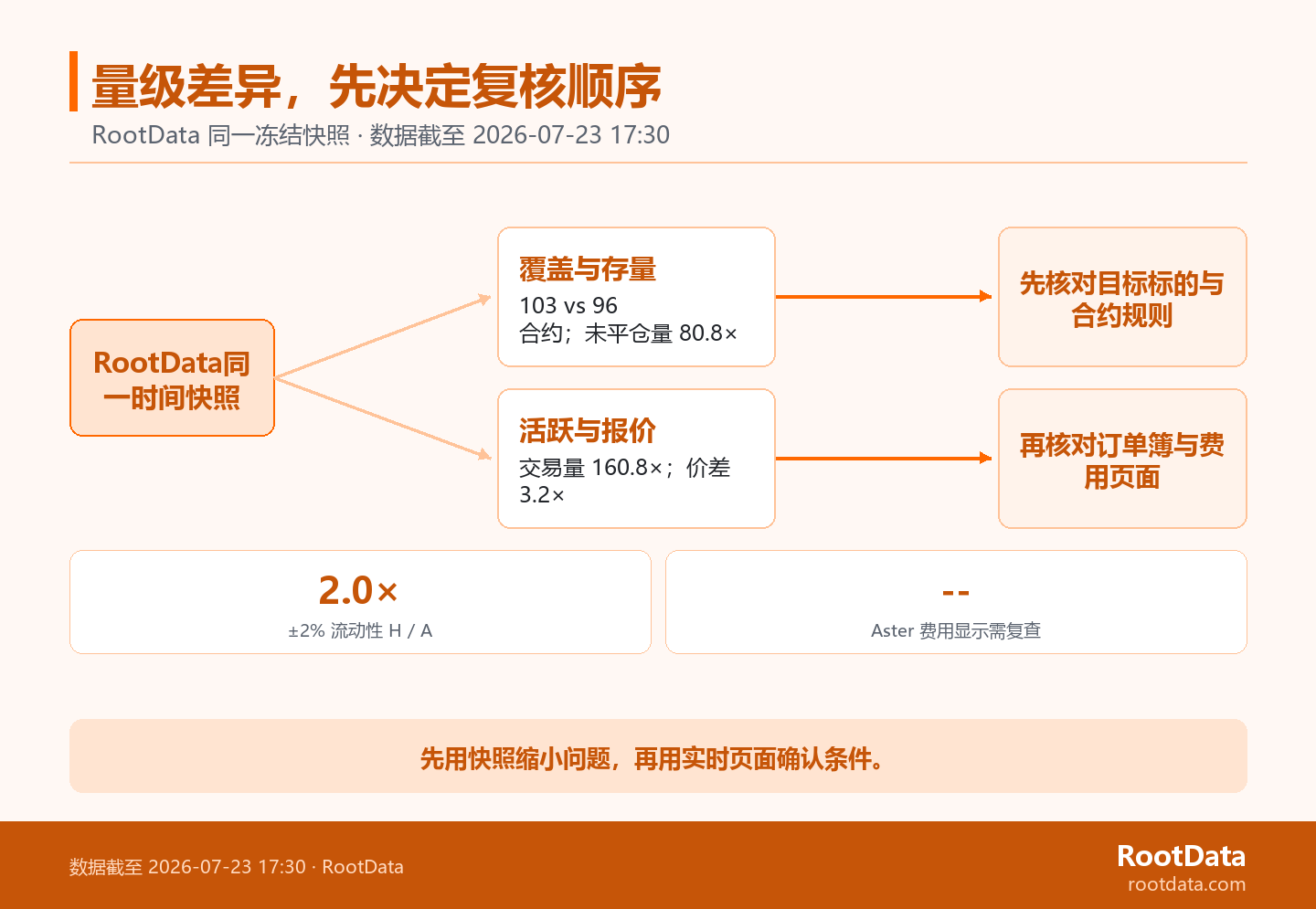
The value of these four multiples lies in arranging the order of review. The difference between trading volume and open interest reminds you not to just look at the platform name; liquidity and price difference remind you to continue drilling down to the specific target, quotation direction and order size. They cannot answer "at what price can a certain order be filled now?" This is why writing a piece of 24-hour trading volume as sufficient evidence of "better transactions" would go beyond what the data itself can support.
Hyperliquid's perpetual data interface provides market context such as mark prices, current funding rates, and open interest, and supports querying by HIP-3 dex.View the Hyperliquid Persistible Data Interface Description. When the comparison is narrowed down to a specific market, this type of current field is better suited for checking market status than a historical snapshot.
Aster's perpetual fee description describes fees in terms of order notional value and applicable rates; current fees and specifications for target stock contracts remain to be checked against the target page.View Aster Perpetual Fee Description. Therefore, in the RootData snapshot--Should be left as "not shown" and not read as free, zero fee or any established rate.
Before the comparison ends, use three types of data to complete the conditions
When comparing Aster vs. Hyperliquid HIP-3 stock perpetuals, you should first check how the target market defines the contract and parameters, then read the derivatives fields at the same time, and finally refresh the current order book, funding rate, and account conditions.
- Let’s look at the structural data first:Confirm the target market tracking objects, price sources, settlement methods, specification update responsibilities and abnormal situation handling paths.
- Let’s look at the fixed time point data:Preserves RootData's timestamps, field names, and missing values; use it to compare coverage and magnitude, but does not extrapolate to real-time conditions.
- Finally look at the current page:Refresh the target contract, order book, funding rate, margin, fees, and account visible limits; this information corresponds to the current rules environment.
RootData's data standards are used to describe data fields and data processing boundaries and cannot replace the exchange's current description of specific contracts.View RootData data standards.
The structure and data comparison in this article are for research and information verification only and do not constitute investment advice.Read the RootData disclaimer
FAQ
Are Aster and HIP-3 stock perpetuals equivalent to buying real stocks?
Not equal to. They discuss the path of perpetual derivatives relative to stock prices, rather than the automatic acquisition of shares or shareholder rights in the underlying company. HIP-3 is a mechanism for deploying a sustainable market; Aster's product data defines its stock's sustainable settlement and index data path. Readers should judge the tracking objects, settlement methods and rights boundaries based on the terms of the target contract. They should not directly equate the contract name with stock holdings, nor should they regard the price index as a substitute for shareholder rights.
Can RootData’s trading volume difference directly prove which exchange is better at trading?
cannot. Trading volume records completed activities within a fixed window; it does not separately indicate whether a certain target, a certain direction and a certain order size can be traded at the moment. The 160.8x for this article is the relative magnitude of the two lines of 24-hour trading volume in the frozen snapshot. If you are concerned about execution, you should simultaneously view the order book, spreads, and quotes similar to your order size in the specific market, rather than relying solely on platform-level fields, and record the actual time of viewing.
Why does Aster's fee field showing "--" not be processed as zero?
Because "--" only means that the frozen snapshot does not show directly comparable Maker/Taker values, it is not proof that the cost is zero. Fee rules may change by product, contract, rate tier, or subsequent updates. The correct approach is to retain the missing status, check the current fee page of the contract after having a clear target contract, and confirm whether the page is suitable for stock perpetual; filling the missing value with zero will create a price advantage that does not exist.
Why should we review funding rates, leverage and margin before comparing?
Because these are current contract conditions, and RootData's data table is a fixed-time field snapshot. Funding rates, leverage caps, margin requirements, tradable assets and account visibility limits may change with market or product rules. Structural data and ranking tables can help you pinpoint what to look for, but only the current page, order book, and account environment of your target market can answer what conditions apply at that moment; the page timestamp should also be retained.