
Hyperliquid HIP-3 vs Binance: Data comparison of on-chain and centralized exchange stock perpetuals
 Author: Flowie|ChainCatcher content author, focusing on RWA, interpreting the true narrative of Web3.Follow X
Hyperliquid HIP-3 and Binance’s stock perpetuals can compare fields within the same data snapshot, but one cannot draw conclusions about which one is better for everyone based solely on trading volume or the “on-chain/centralized” label. The former is first of all a mechanism for builders to deploy a sustainable market, while the latter is the TradFi Perps product path within a centralized exchange; both sides need to read the target contract, fixed-time data and real-time conditions separately.
This article uses RootData inJuly 23, 2026 17:30Saved frozen snapshot of equity derivatives exchanges, covering 29 platforms. Here'sfreeze snapshotIt is a non-real-time version of the public fields recorded at a fixed time, suitable for comparing the number of contracts, open interest, trading volume, liquidity and spreads of the same caliber; it does not replace the current order book, funding rate or account qualifications of a certain stock.
First determine whether the comparison is market structure or data at the same time.
- Let’s look at the market structure first:Who defines the contract specifications, oracles, leverage and settlement conditions for the target market?
- Read similar fields again:RootData's snapshots compare the equity derivatives fields of two exchanges over the same time slice.
- Finally refresh the current conditions:Target contracts, order books, funding rates, margin and account conditions are all subject to change.
Hyperliquid HIP-3 and Binance’s stock perpetuals can compare fields within the same data snapshot, but one cannot draw conclusions about which one is better for everyone based solely on trading volume or the “on-chain/centralized” label. This is also the reason why this article does not make a "who is better" conclusion: the market structure explains how the contract is formed and who maintains it; the snapshot numbers explain the visible fields at a certain point in time; and the real execution conditions need to return to the specific market. Compressing the three into a total platform score will obscure the information that readers really need to check.
The difference between HIP-3 and Binance depends on who defines the contract and parameters first
Hyperliquid's HIP-3 is a mechanism for deploying perpetual markets by builders, who are responsible for market definition and operational matters such as oracles, leverage limits, and settlement when necessary.View Hyperliquid’s mechanism description of HIP-3. This means that when seeing a market related to a HIP-3 stock, the first thing to confirm is the contract definition, price source and parameters of the market, rather than just treating "on Hyperliquid" as a complete product description.
Binance classifies stock perpetuals as TradFi Perps: they track a company’s stock price, have no fixed expiry date, and do not require ownership of the underlying stock.Read Binance’s explanation of stock perpetual contracts. Therefore, the question on Binance’s side should fall on price exposure, settlement units, funding rates and specific contract parameters, rather than understanding perpetual positions as obtaining ownership rights in company stocks.
“On-chain” and “centralized exchange” describe market infrastructure and data paths and cannot replace the verification of the target stock perpetual contract rules.HIP-3 official informationandBinance Product DescriptionThe mechanisms and contract boundaries that need to be checked on both sides were explained respectively.
| Compare dimensions | Hyperliquid HIP-3 | Binance Stock Perpetual | Readers should continue to check |
|---|---|---|---|
| market formation | Builders deploy sustainable markets and are responsible for market definition and operations. | Appears as the Equity Perpetual Product Path of TradFi Perps. | The current rules of the target market or contract. |
| price relationship | It depends on the oracle and contract specifications of the target market. | Perpetual contracts provide price exposure relative to stock prices. | Target, index, mark price and exception handling. |
| cannot be launched directly | On-chain records automatically equal lower costs or lower risks. | A perpetual position is equal to holding the underlying stock. | The same conditions apply to anyone's account. |
The two paths do not need to be forcibly judged as the same product. A safer approach is to use official data to define the target market, and then use the data snapshot as a horizontal starting point for similar derivatives fields. This not only retains the mechanical differences of HIP-3, but also does not simplify Binance’s stock perpetual trading into a generalized “stock trading”.
Which data in the same RootData snapshot can be read side by side?
RootData recorded Binance and Hyperliquid as stock derivatives platforms in the frozen snapshot of 2026-07-23 17:30; this snapshot is not a real-time market or target contract rule.View RootData Equity Derivatives Ranking Fields, and combined withEquity Derivatives Ranking DescriptionUnderstand field scopes.
open interestis the notional size of the contract that has not yet been liquidated or settled; it answers a different question than 24-hour volume, ±2% weighted liquidity, and spreads. The following values all retain the page display format and are only used for comparison of the same caliber at this frozen time point.
| RootData frozen snapshot field | Binance | Hyperliquid | The reading boundaries of the field |
|---|---|---|---|
| Ranking / Comprehensive Rating | No. 1 / 92.1 | Chapter 7 / 88.2 | Comprehensive comparison starting point is not equal to the best single item. |
| Number of contracts | 144 | 103 | Page showing equity derivatives coverage leads. |
| open interest | $2.77B | $1.92B | The inventory size at a fixed point in time does not represent the depth of the order book. |
| 24 hour trading volume | $16.72B | $4.57B | Activities completed within the window do not guarantee the current transaction size. |
| ±2% weighted liquidity/spread | $12.92M / 0.014% | $2.10M / 0.176% | Must be read together with the target contract, time point and order book. |
| Margin currency | USD1, USDT | USDC | The margin path displayed in the field does not replace the current account rules. |
In this snapshot, Binance shows 144 contracts, $2.77B open interest, $16.72B 24-hour volume, $12.92M ±2% weighted liquidity, and 0.014% spread; Hyperliquid shows 103, $1.92B, $4.57B, $2.10M, and 0.176% respectively.View the field source of this frozen snapshot.
RootData's stock ranking descriptions use contract count, open interest, volume, liquidity, spreads, fees and margin paths as comparison factors, but the full weighting formula is not disclosed.Read the RootData Equity Derivatives Ranking Notes. Therefore, rankings can help organize comparisons, but they are not a substitute for independent judgment on a specific field or an order book.
When you need to continue to view such fields at the same time, you canOpen RootData Equity Derivatives Ranking to check the same time field.
Magnitude differences can narrow the scope of verification and cannot replace the order book of the target contract.
Based on the values shown in the same snapshot, Binance's 24-hour trading volume is approximately 3.7 times that of Hyperliquid, and its ±2% weighted liquidity is approximately 6.2 times; Hyperliquid's displayed spread is approximately 12.6 times that of Binance.Calculate the page display value based on RootData at the same time.
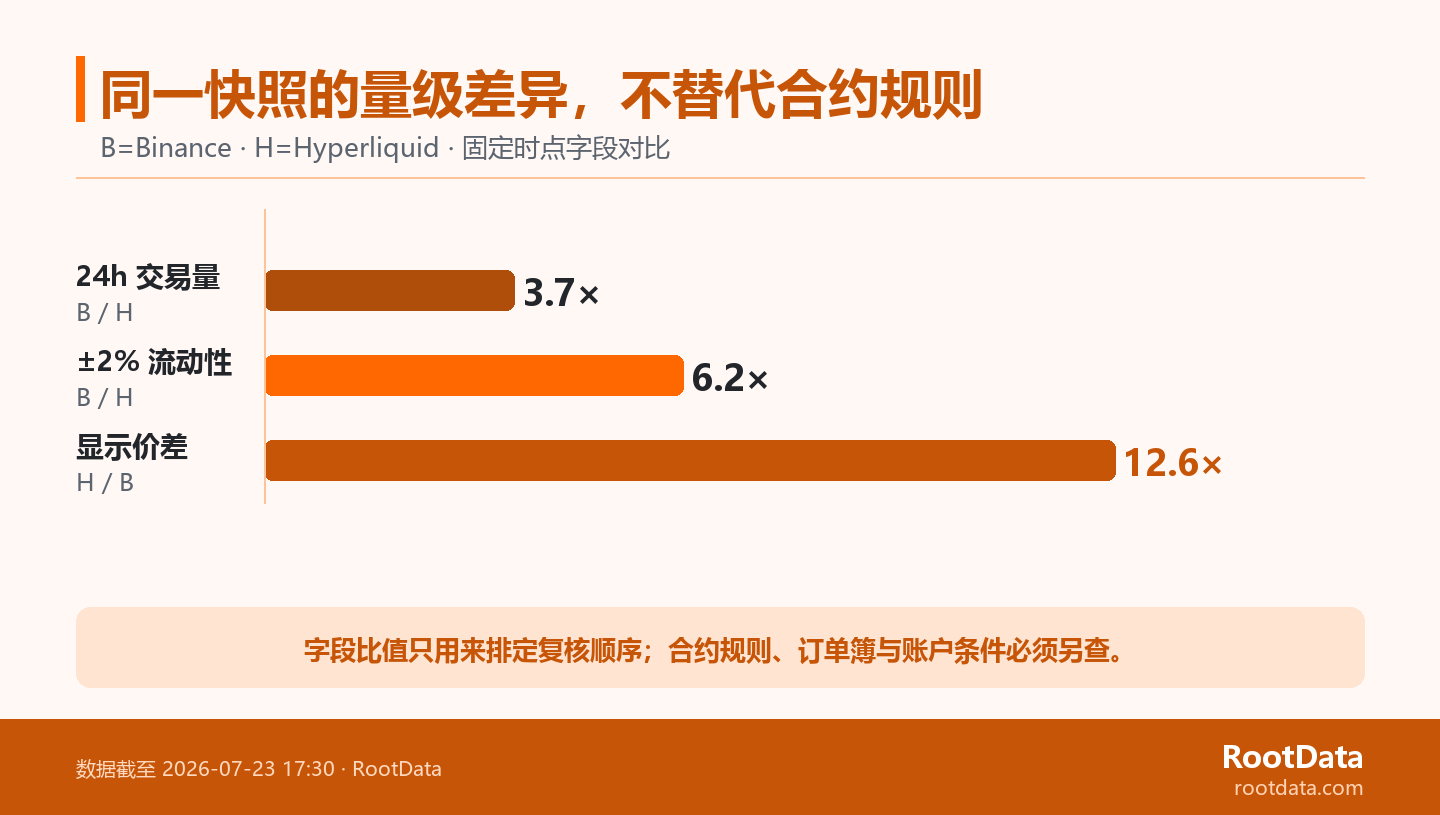
The purpose of this calculation is to arrange the review sequence, not to predict the price at which an order will be completed. Volume tells how much activity has occurred in the past 24 hours; ±2% weighted liquidity gives a clue about the depth of the page display; and spread describes how close the quotes were at that time. Putting the three data together is closer to the question of "what should I check next" than looking at trading volume alone; but they are still not equivalent to the slippage, available leverage or position results of a certain stock contract at this moment.
Hyperliquid's perpetual data interface provides market context such as mark prices, current funding rates, and open interest, and supports querying by HIP-3 dex.View Hyperliquid’s description of the resilient data interface. Such current fields are suitable for review after locking a specific market and should not be replaced by frozen snapshots.
Binance’s funding rate description defines it as a periodic payment between long and short positions in a perpetual contract, and notes that the default interval and parameters can be changed according to rules.Check out Binance’s funding rate description. The funding rate is part of the position conditions, and it is not appropriate to write the value displayed at a certain historical point as a long-term cost conclusion.
Before the comparison ends, use three types of data to complete the conditions
When comparing Hyperliquid HIP-3 to Binance stock perpetuals, you should first check how the target market defines the contract and parameters, then read the derivatives fields at the same time, and finally refresh the current order book, funding rate and account conditions.
- Structural information:Confirm who the target market is tracking, contract specifications, price sources, and who is responsible for updating parameters.
- Fixed time point data:Keep the timestamp, field names and missing values of RootData, and do not fill undisplayed fields with zeros.
- Real-time conditions:Review the target contract, order book, funding rates, margins, and your own account limits before making any actual judgments.
RootData's data standards are used to describe data fields and data processing boundaries and cannot replace the exchange's current description of specific contracts.View RootData data standards.
The structure and data comparison in this article are for research and information verification only and do not constitute investment advice.Read the RootData disclaimer
FAQ
Are stock perpetual contracts on HIP-3 equivalent to buying real stocks?
It does not mean that HIP-3 is a mechanism for builders to deploy a sustainable market; what the specific contract tracks, how to settle it, and the boundaries of rights depend on the rules of the target market. Even if the name is associated with a stock, it is first and foremost a price exposure to the perpetual contract, rather than an automatic delivery or holding of shares in the corresponding company. When reading, you should separately identify the agreement mechanism, target contract terms and possible corporate action handling, and do not directly equate the oracle price or mark price with the shareholder rights that can be obtained.
Can the difference in trading volume of RootData directly prove which one has better deals?
This cannot be directly proven, as volume reflects completed activity within a fixed window, and the depth, spread and order status of the target contract still need to be viewed simultaneously. The 3.7 times in this article only represents the relative magnitude of the 24-hour trading volume of the two lines in the frozen snapshot; it cannot replace the actual transaction verification at a certain time, a certain contract and a certain order size. If you are concerned about execution, you should return to the target order book before operating and recheck the quotes in the same direction and approximate order size.
Why do you need to review funding rates and margin rules?
Because funding rates, leverage, margins, and contract parameters will change with products and market conditions, frozen snapshots cannot replace the current contract page. The funding rate is a rule-based settlement mechanism between the two parties, and the margin currency is just a field entry; you should still confirm the current interval, upper limit, margin requirements, and rules actually visible to the account before operating. If the platform provides different permissions based on region, product or account status, the current page and applicable terms should prevail.
Do on-chain records automatically represent lower risk or cost?
Not automatically represented, on-chain records and market structure are part of the source of information, and specific fees, liquidity, oracles and contract rules still need to be confirmed according to the target market. HIP-3’s market definition and operational responsibilities have clear information available, but this does not translate the order book quality, fee levels or risk management of any specific market into a preset conclusion; similarly, the product rules of centralized exchanges must also be based on the current page.