
Gate vs Binance: Comparison of product structure, contract coverage and trading experience of stock product exchanges
 Author: Flowie|ChainCatcher content author, pays attention to RWA, interprets the true narrative of Web3.Follow X
Putting Gate and Binance in the same "stock product exchange" list, the most likely misunderstanding is to put themProduct structure, contract coverage and trading experiencePressed into a question of "who is better?" They actually answer three different things: the product structure determines what kind of price exposure and rights boundaries you are exposed to; the number of contracts only provides coverage clues at a certain point in time; the trading experience also returns to a certain target contract, account status and current time period.
This article uses RootData inJuly 23, 2026 17:30The saved frozen snapshots of stock derivatives exchanges cover 29 platforms; the structural description is supplemented with public product information from both parties. Frozen snapshots are page data saved at a specific time, suitable for comparison with the same caliber, and are not real-time market conditions, nor executable quotes for personal accounts. Let’s start with the conclusion: Gate has a higher number of visible contracts than Binance in this snapshot, but this is not enough to mean that a certain target is easier to trade, nor is it equivalent to holding a stock.
This comparison can directly take away the judgment
- First confirm whether the comparison is stock perpetual, CFD, or another stock-related entry.
- Then use the number of contracts and market fields at the same time and in the same field to establish a coverage baseline.
- Finally, check the order book, account conditions, regional qualifications and time period rules for the target contract.
Let’s first break down the product structure: both are called stock products, but answer different questions.
The stock-related entrances of Gate and Binance should first be distinguished by product structure; the related contracts or spread structures do not automatically become the same product just because of the platform name. "Stock products" is a classification name for easy comparison, not a single product definition. Taking Gate as an example, its official description combines traditional asset-relatedCFDDescribed separately from USDT Perpetual: The trading periods, order book shapes, order units and fee mechanisms of the two are different. CFD can be understood as a contract for difference designed around changes in the underlying price; whether it is suitable to be used alongside another type of perpetual contract depends first on the actual product description, not whether the word "stock" appears on the page.Check out Gate’s distinction between CFD and USDT perpetual mechanisms..
The second level is the rights boundary. Gate’s TFP protocol defines the underlying contract as a contract that tracks the price of a reference asset and makes it clear that it does not confer ownership of or rights attached to the reference asset. This means that "stock related" itself cannot be rewritten as "obtaining stock ownership"; whether there are shareholder rights, dividend processing or corporate action arrangements must go back to the specific product terms and cannot be inferred from the contract name.Read the rights boundaries of the Gate TFP contract.
Binance’s public information describes stock perpetuals as derivatives that track individual stock prices, are settled in USDT, have no fixed expiry date, and state that there is no need to hold the underlying stock. The "stock perpetuity" here also needs to be understood in terms of derivatives: it answers the questions of price tracking, settlement and funding mechanisms, not the question of equity ownership. The common conclusion that the two pages can support is very restrained - the platform name cannot replace the product form, and the product form cannot replace the current rules of the specific subject.Check out Binance’s product description for stock perpetuals.
| First question | Why ask first | Nothing can be directly inferred from this |
|---|---|---|
| Is this CFD, stock perpetual, or other stock-related entry? | Decide which trading sessions, margins, orders and settlement rules need to be read. | Product rights or risks cannot be judged based on “stock type” alone. |
| Does the contract track price rather than delivery of the underlying? | Define whether you have ownership or rights attached to the reference asset. | Price exposure cannot be written as holdings or shareholder equity. |
| To which region and account do the conditions on the product page apply? | Availability and parameters may come with qualifications and account ranges. | Cannot be extrapolated to all users, all regions, or all targets. |
Contract coverage looks at the same snapshot first: a higher Gate does not mean that each target is easier to trade.
In RootData's July 23, 2026 17:30 frozen snapshot, Gate is ranked 6th, showing275contracts; Binance ranked #1, showing144a contract. This difference can be used as a starting point for coverage: Gate has a higher number of visible contracts on the same page, at the same time, and within the same field range. But it doesn't answer whether a particular stock contract is still listed, can be accessed by your account, or whether an order is filling as expected at this moment.View the same frozen snapshot field of RootData.
| RootData frozen snapshot field | Gate | Binance | This list of questions that can be answered |
|---|---|---|---|
| Ranking | No. 6 | No. 1 | How it is arranged under the composite fields of this snapshot. |
| Number of contracts | 275 | 144 | A clue to the quantity covered by equity derivatives can be seen. |
| ±2% weighted liquidity | $3.9 million | $12.92 million | An agent with visible liquidity within a fixed price range. |
| page spread | 0.061% | 0.014% | The spread field displayed on the page at this point in time. |
| Margin assets | USDT | USD1, USDT | The margin assets listed on the page are not individual account qualification conclusions. |
The point of this table is not to create an overall score. The number of contracts and ±2% weighted liquidity answer "how wide is the coverage" and "how much visible commitment does the page show in a fixed range" respectively; spread is another real-time field. They should all be understood within the context of ranking descriptions and not be spelled out of scope into assertions of "better deals."Read RootData’s Equity Derivatives Ranking Explained.
If your question is "Which company is worth checking first for a certain target?", the coverage number can help narrow the search scope; if the question is "Can it be traded under certain conditions now?", it is only the starting point. To put the field back to the same point in time, you canOpen RootData Equity Derivatives Ranking to check the same time field, and then enter the target contract page for verification.
Trading experience is not a total score: split the question into three checks
Gate's traditional asset perpetual page lists trading periods, settlement and fees or funding rate rules separately.
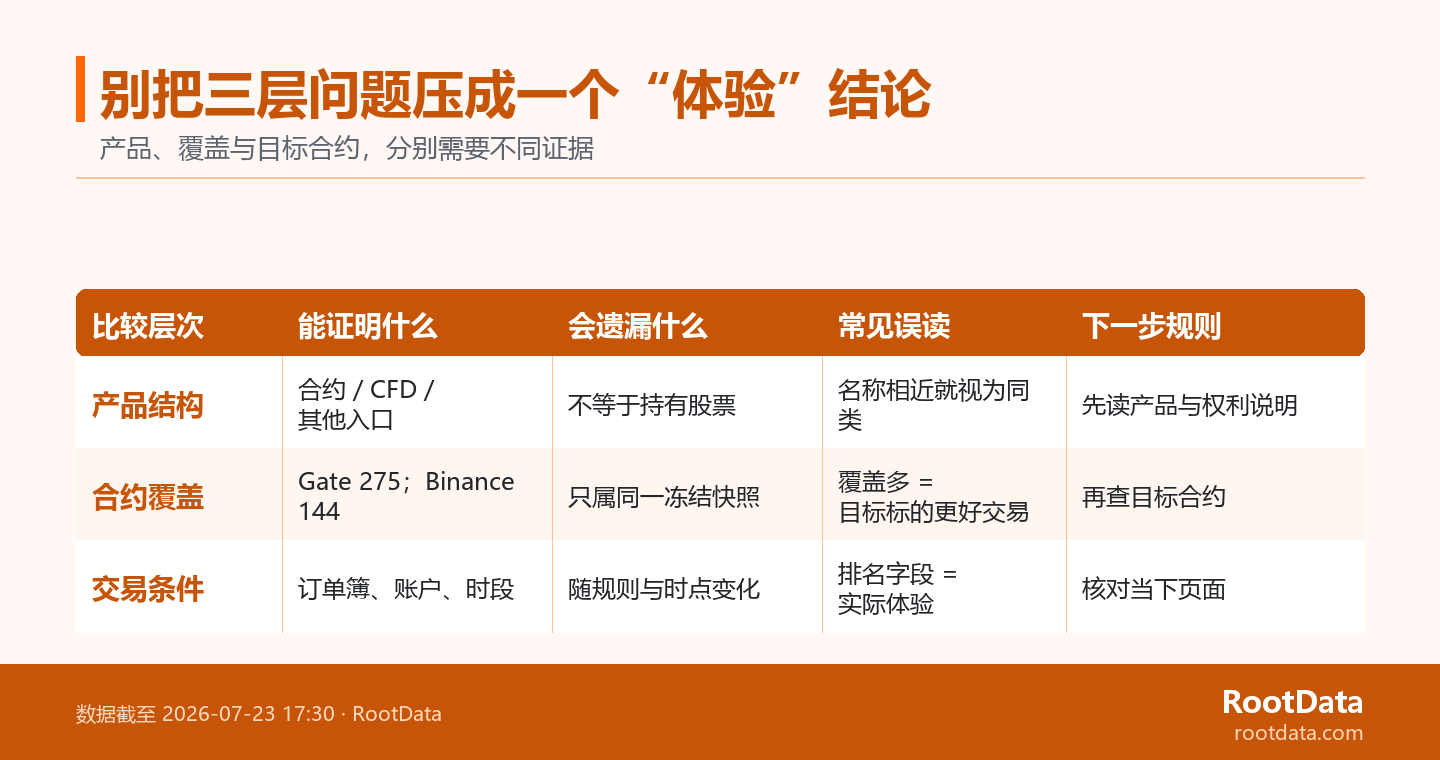
Trading experience is not a column in a ranking list, but the result of a certain product, a certain target contract, a certain account and time. A more reliable comparison sequence is: first confirm the product form, then confirm the target contract, and finally confirm the account and time period conditions. This is not about adding steps, but rather avoiding letting "more contracts", "ranking higher" or "page with more features" substitute for facts that would otherwise require independent verification.
The first time: confirm the product form and decide which set of rules to read
If readers are comparing Gate's traditional asset perpetuals, they should directly read the product's asset coverage, trading periods, settlement and fee/funding rate descriptions; the Gate page also reminds that traditional asset contracts may involve non-trading or low liquidity periods. For Binance stock perpetuals, it should go back to its stock perpetual product rules, rather than replacing it with another type of spot, CFD or general exchange functionality. The experience here is "whether the rules match the selected product", not a subjective rating of the platform interface.Check the time period, settlement and fee rules of Gate traditional asset perpetuality.
Second time: confirm the target contract and decide whether the coverage is really relevant
275 and 144 are not direct substitutes for the answers to the target questions. Whether a contract appears, whether it is tradable, and what price and margin conditions are displayed must be based on the target contract you are viewing. The order book is the currently visible bid and ask prices and quantities of a contract, which changes over time; therefore, higher visible liquidity in a frozen snapshot only means that it is worth opening the order book further, and does not mean that any size, direction or order type will get the same result.
The third time: Confirm the account and time, and decide whether the disclosure rules apply
Finally, look at regional qualifications, KYC/account status, VIP rates or margin conditions, and whether the underlying market is currently closed or in a low liquidity window. The reason they cannot be resolved by a ranking field ahead of time is because these conditions may change from product to product, account to account, or time to time. Especially in stock-related products, the trading hours of the underlying market are not equivalent to the rules of the contract page; any description of "all-weather" or "tradable" still needs to be read in conjunction with the current page of the target contract.
Reusable judgment rules:When you are just filtering information, first use the same snapshot to look at the coverage and fields; when you have locked the product, read the official product description; when you are about to form a judgment on a certain target contract, then check its order book, account and time period conditions. The end point of the three steps is to reduce misunderstandings, not to label Gate or Binance as unconditionally good or bad.
Four things this Gate vs Binance comparison can’t confirm for you
Regional qualifications, account levels, dynamic product rules and real-time handicap cannot be confirmed by this frozen snapshot or public comparison.
- Regional Qualifications.Public product information is not a substitute for actual prompts for your region, authentication status, and account page.
- Account Conditions.Fees, margin equity, limits or features may be related to product groupings, VIP levels and account status.
- Dynamic product rules.Contract listings, suspensions, parameters, pricing and risk control arrangements may be updated; historical snapshots should not be considered current listings.
- Real-time handicap.The quotation, pending orders and visible liquidity of the target contract change over time and cannot be replaced by the table in this article.
The data fields of RootData should be understood according to public data standards and definitions; this article retains the frozen time in order not to disguise the page display at that time into the current real-time state.View RootData data standards.
Likewise, this article only provides a framework for checking information and fields, and does not constitute investment advice, nor does it make a judgment on the suitability of any individual account.Read the RootData disclaimer.
FAQ
Is stock perpetual contract equivalent to holding stocks?
Not equal to. Stock perpetuals are typically derivatives that track stock prices and do not automatically create underlying ownership, voting or other shareholder rights just because they have "stock" in the name. Whether there are special arrangements for specific products should be based on the current agreement and product page of the contract, rather than inferring from platform classification or search results. Even if a page displays contracts related to stock prices, readers should still identify "price exposure" and "asset rights" as separate issues.
How to distinguish between Gate's CFD and stock perpetual trading in actual comparison?
First look at the trading mechanism, trading periods, margin or settlement unit, order method and fee rules in the product description. CFDs and perpetuals may both revolve around stock or traditional asset prices, but they are not names that can be used interchangeably. Align the product form before comparison to know which set of rules should be checked later; if the product category or applicable conditions are not clearly marked on the page, a safer approach is to leave "Unconfirmed" instead of completing it with rules from other entrances.
Does a larger number of contracts mean that the target is easier to trade?
Doesn't mean. The number of contracts only indicates the visible coverage in a certain frozen snapshot; whether the target is displayed, whether the account is accessible, whether the order book has sufficient quotes, and how the spread changes all need to be confirmed separately on the current target contract page. More coverage can help with filtering, not actual execution results. Especially when the comparison object has been narrowed down to one or two targets, the value of continuing to compare the total number of contracts will decrease, and the current rules of the target contract will be more critical.
Why do we need to review the rules when the stock market is closed?
Because the underlying market is closed or liquidity is low, prices, markings, margins, order limits or risk control arrangements may differ from ordinary hours. Even if the relevant contract page shows that it is tradable, this period should be regarded as a trigger point that requires rechecking the conditions, rather than continuing the assumption of normal periods. What needs to be reviewed here is the current page and account prompts of the target contract, rather than relying on a historical snapshot to determine the actual quotation or transaction result during the market break.