
Bitget vs Bybit: Comparison of Depth, Slippage and Funding Rates of Stock Perpetual Exchanges
Higher visible depth does not automatically equal lower actual slippage. It first explains how many pending orders can be seen in a certain price range; the real slippage does not make sense until the order size, direction, order type and real-time order book appear together. This article uses the frozen snapshots of 29 platforms displayed by RootData at 17:30 on July 23, 2026: Bitget's visibility depth is higher, and Bybit's snapshot spread is slightly narrower; the funding rate issue between the two should be separately reviewed on the timeline of "whether to hold positions across settlements."
 Author: Flowie|ChainCatcher content author, pays attention to RWA, interprets the true narrative of Web3.Follow X
First, separate "real-time transactions" and "cross-settlement positions"
- Orders to be executed immediately:First look at the visible depth, spread and target contract order book at the same time; total trading volume cannot replace this step.
- When the order size becomes larger:Use the ratio of the nominal amount to the visible depth to determine whether the handicap verification should be increased, rather than treating the ratio as a slippage prediction.
- Possible cross-settlement positions:Then check the payment direction of the funding rate, settlement cycle, position value and the actual conditions of the personal account.
- Any static comparison:All data time, target contracts, regional qualifications and undisplayed fields must be retained, and they should not be rewritten into the total platform victory or defeat.
The same snapshot first gives the conclusion: depth leadership does not equal the slippage conclusion.
RootData 2026-07-23 17:30 In the frozen snapshot, Bitget's ±2% weighted liquidity is $4.19 million and the spread is 0.061%, and Bybit is $1.01 million and 0.051% respectively; these fields must remain read at the same point in time and within the same product range. The "±2% weighted liquidity" here can be understood as a proxy for the observable order book acceptance size within a given price range on the ranking page; it is not the same thing as the spread, number of contracts, fees and funding rates.RootData Equity Derivatives Ranking PageGiven this same caliber entrance,Ranking descriptionDepth, spread, fee, funding rate, number of contracts and margin are also listed as fields that need to be read together.
| same snapshot field | Bitget | Bybit | What to answer first |
|---|---|---|---|
| Number of stock contracts | 252 | 131 | Whether the target object enters visible coverage |
| Open interest (OI) | $740.22M | $97.48M | The size of the contracts that are still open |
| 24h trading volume | $2.03B | $896.59M | Trading activity within a specified window |
| ±2% weighted liquidity | $4.19M | $1.01M | Visible order book taking agent |
| bid-ask spread | 0.061% | 0.051% | Visible quote closeness proxy |
| funding rate | 0.0002 (page display value) | 0.0002 (page display value) | Position settlement input at the time of display |
| Maker/Taker | 0.02% / 0.06% | 0/0.0275% | Explicit fees that must be confirmed based on product grouping and account conditions |
The most useful conclusion from this table is not "which exchange is better", but that there is a conflict between the fields: Bitget's visible depth is higher in this snapshot, and Bybit's displayed spread is narrower. The two results can be true at the same time, because the former observes the size of pending orders within a specified range, and the latter observes the distance between visible buy and sell quotes; neither of them is a transaction guarantee for a certain target stock, a certain direction, and a certain order amount.
The stock perpetual materials of Bitget and Bybit both position the products as perpetual derivatives related to stock prices, rather than as a way to automatically obtain ownership of the underlying stocks. You also need to lock the product level before comparing:Bitget’s stock perpetual descriptionDefine them as USDT margined perpetual futures tracking traditional stocks;Bybit’s TradFi Perpetual DataIt is clarified that such contracts provide price exposure rather than ownership of the underlying. The number of contracts and market fields therefore cannot be used to infer shareholder rights, dividends or voting rights.
The difference between depth and slippage is the order size and order book status.
Visible depth and spreads are observational starting points for instant execution and are not a commitment to actual slippage on any order. Slippage refers to the possible gap between the actual transaction price of an order and the quoted price visible when the order is placed; the meaning of the same depth field will change when faced with different stock contracts, buying and selling directions, limit prices or market prices, and order splitting methods. Putting "visible depth", "actual slippage", "order size", "target contract" and "real-time order book" in the same judgment can avoid writing a static ranking list as a transaction test.
Bybit’s data suggests that TradFi’s perpetual liquidity may be significantly reduced when the underlying market closes, and the bid-ask spread may widen.View Bybit’s TradFi Perpetual Risk Description. This fact does not prove what will happen to Bitget at the same time period, but it is enough to show that there is no basis for applying snapshots across time points: even if the spread in the table is narrower, you should return to the real-time market price of the target contract when preparing to place an order. To continue checking the unified fields used in this article, you canOpen RootData Equity Derivatives Ranking Reconciliation Snapshot Field; It should help you decide what to check on the next page, rather than confirm the transaction result for you.
Example: Putting a $100,000 order back into the "scale" of the snapshot
In a notional amount of $100,000, it represents approximately 2.4% of Bitget’s visible ±2% weighted liquidity of $4.19 million and approximately 9.9% of Bybit’s $1.01 million. This calculation only asks "how much relative pressure does the same order put on the visible range" and does not calculate slippage, nor does it represent any account, direction or transaction price. When the ratio is higher, the correct action is to first expand the real-time order book of the target contract and check the changes in pending order levels and order cancellations, rather than translating 9.9% into a certain expected cost.
Likewise, if the order does not seek immediate execution, limit, batch, or wait condition changes will change the weight of depth and spread. Rather than finding a fixed threshold, a more prudent approach is to put the order nominal amount, order type and real-time market price in the same round of review.
The funding rate has its own timeline and is not the handling fee at the moment the order is placed.
The funding rate of the perpetual contract is related to the position value, payment direction and settlement time, and is not the platform transaction fee at the moment the order is placed.Bitget’s Futures Fees ExplainedWrite it as "position value × funding rate" and explain that it is usually settled on a periodic basis between long and short position holders;Bybit’s TradFi Perpetual DataThe funding mechanism is also listed as a rule component of the product. Only if you still hold a position at the target settlement time will this layer enter the cost or income calculation. Therefore, the fact that two companies show the same funding rate value in the snapshot does not mean that their actual position results are also the same.
Bybit G9 VIP0's 0.0275% Taker announcement value and Bitget USDT perpetual 0.06% Taker examples both have their own products and account conditions and cannot be directly added, replaced or written into a complete cost ranking. Maker/Taker should also be separated from the funding rate: Maker is the party that provides pending orders that are not immediately executed, and Taker is the party that immediately executes existing pending orders; the former corresponds to the order placing role, and the latter is a cross-settlement position issue. Bybit will be effective in June 2026G9 TradFi Perpetual Rate AnnouncementThe Taker listed in VIP0 is 0.0275%, and the Maker is 0%;Bitget’s Futures Fees ExplainedTake the USDT-based perpetual 0.02% Maker and 0.06% Taker as examples, and note that the actual rate is affected by the account level. Before their product ranges and account conditions are aligned, they cannot be added to or substitute for each other, let alone cover spreads, order impacts and funding rates.
Turn the comparison into two stages of review: before placing an order and before cross settlement
The comparison should be divided into review before placing an order and review before cross-settlement: the former looks at the order book, spread and order size of the target contract, and the latter looks at the funding rate rules, position value and account conditions. The advantage of this is that Bitget’s $4.19 million and Bybit’s $1.01 million are no longer misinterpreted as “necessarily lower slippage”, and the funding rates displayed by the two are no longer misinterpreted as “necessarily the same cost”. This is a set reading order for the fields and is not a recommendation for anyone to place orders, leverage or hold positions.
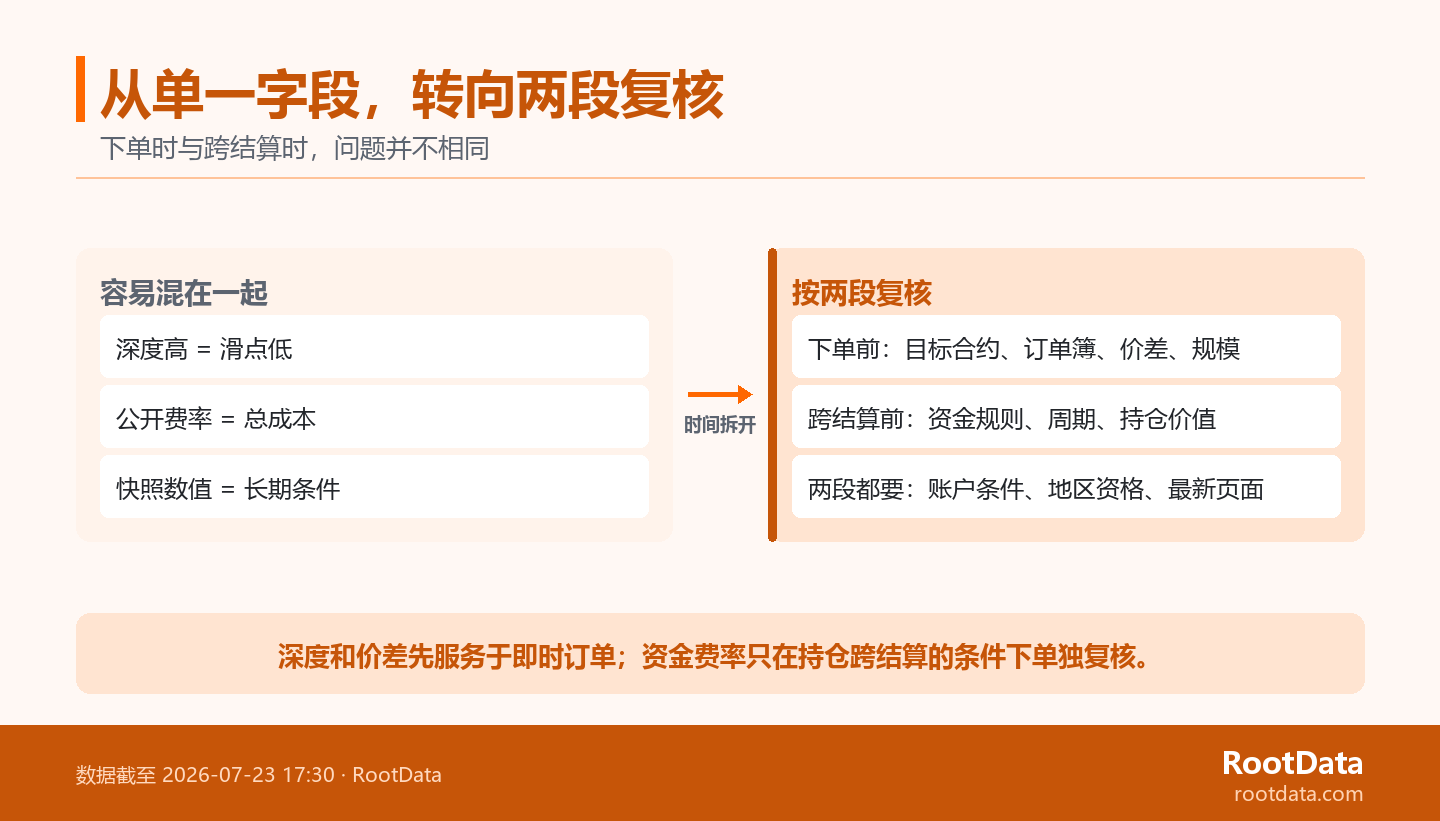
- Before placing an order:Confirm that the target stock perpetual contract is still listed, available in location and account, and then look at the real-time order book, visible spread, order direction and notional size.
- If you plan to cross-settlement:Confirm the current value of the funding rate, payment direction, settlement cycle, position value, and whether the page has any other parameters for the specific contract.
- If neither party meets the conditions:Keep missing fields and fill in the blanks without default values, and then extend the same set of conditions to more platforms.
Four things this comparison cannot confirm for you
Frozen snapshots, regional qualifications, account levels and dynamic product rules limit the conclusions of this article; RootData data comparisons do not constitute investment advice.RootData data standardsExplain that publicly available information may be updated or need to be corrected from verifiable sources,DisclaimerIt is also clear that platform information does not constitute investment, financial or trading advice.
- Live order book:This article does not measure the fill price or slippage of any specific order.
- Personal account rates:Tiers, product groupings and offer conditions may vary from actual Maker/Taker.
- Fund settlement parameters:Rate display values, directions, periods and specific contract rules may all be updated.
- Region and product qualifications:It must be checked on the personal account and corresponding product page and cannot be replaced by this article.
FAQ
Does higher ±2% weighted liquidity guarantee lower slippage?
There is no guarantee; it is only a visible taking agent observed within a fixed price range, and actual slippage also depends on the specific contract, direction, order size and instantaneous order book. It is more suitable to help you decide whether to give priority to which market opening, rather than replacing a pre-deal check. If the order is not executed immediately, the price limit and batching methods will also change the weight of this group of fields; pending orders visible in the market may also be withdrawn or added before the order is placed.
Is the funding rate the transaction fee charged by the platform?
They are not the same type of fees; the perpetual contract funding rate is usually settled according to rules between long and short position holders, and whether it occurs depends on whether you hold a position at the target settlement time. Maker/Taker is the explicit fee corresponding to the order transaction role, and the price difference and order impact are costs at the execution level. The four should not be combined into a conclusion of "lower rates". First distinguish between real-time execution and cross-settlement positions, so that no layer of cost will be missed.
Can Bybit’s announced 0.0275% Taker rate be directly compared to Bitget’s 0.06% example?
It cannot be directly regarded as a complete cost conclusion; the product range, account level and actual applicable conditions of the two public figures need to be aligned first, and both do not include spreads, order shocks and funding rates. Bybit's announcement is for the designated G9 TradFi perpetual group, while the Bitget page explains an example of USDT-based perpetual; before the target contract and personal account are confirmed, the safest statement can only be "explicit fee input to be reviewed." The actual rate should also be subject to the account page and specific contract rules.