
Binance vs Bybit: Comparing Stock Perpetual Products, Contract Coverage, and Trading Costs
Trading costs under the same snapshot are not a single number that lets you declare "who is cheaper" outright: it first depends on whether you are comparing the same type of stock perpetual products, and then on the target asset, immediate execution needs, and account conditions. This article uses a fixed snapshot from RootData at 17:30 on July 23, 2026. Among the visible fields, Binance shows stronger liquidity and tighter spreads, while Bybit displays Maker/Taker fields. This difference only provides a starting point for comparison and does not replace checking real‑time order books, personal fee rates, or regional eligibility.
 Author: Flowie|ChainCatcher content writer, focusing on RWA and interpreting authentic Web3 narratives. Follow on X
Define your comparison question first – don’t turn one field into a total win/loss
- To check whether a target stock can be traded, first look at the contract list, your location, and account eligibility; the number of contracts does not equal execution quality.
- To assess immediate execution conditions, first examine liquidity and bid‑ask spreads at the same point in time, then open the real‑time order book for the target contract.
- To control explicit fees, separately verify Maker/Taker rates, account tier, product group, and funding rates; blank fields must not be treated as zero.
- Before any use, refresh the snapshot time, contract status, and your personal account page; this article does not constitute investment advice.
First, put both exchanges under the same snapshot: what each field answers
In the frozen RootData snapshot of 2026-07-23 17:30, Binance shows stronger visible liquidity and spread fields, while Bybit’s Maker/Taker and margin‑path fields are more complete. These fields cannot be condensed into an overall winner. The table below keeps the original displayed values from the page: it places both exchanges at the same observation time, but does not guarantee the next minute’s quotes or the execution result of any specific order. RootData’s stock derivatives ranking page provides the data entry, and the ranking guide explains why contracts, OI, volume, liquidity, spreads, fees, and margin should be read together.
| Same‑snapshot field | Binance | Bybit | What this field primarily answers |
|---|---|---|---|
| Rank / Composite Score | 1 / 92.1 | 2 / 91.2 | Page position for this multi‑field comparison, not a universal recommendation |
| Number of stock contracts | 144 | 131 | Whether the target asset is in visible coverage |
| Open Interest (OI) | $2.77B | $97.48M | Size of still‑open contracts, not single‑trade execution capacity |
| 24h trading volume | $16.72B | $896.59M | Trading activity within the specified window, not alone equal to low slippage |
| ±2% weighted liquidity | $12.92M | $1.01M | Proxy for visible order‑book depth within the given range |
| Bid‑ask spread | 0.014% | 0.051% | Proxy for visible quote tightness |
| Funding rate | +0.0001% | -0.0002% | Position settlement field at the displayed time, not a long‑term cost forecast |
| Maker / Taker | Not displayed this time | 0% / 0.0275% | Explicit trading fee field; needs to be combined with product and account conditions |
| Margin currency | USD1|USDT | USDT | Margin path, does not represent product rights or regional eligibility |
OI in the table stands for Open Interest – the size of contracts still outstanding. Both OI and 24‑hour volume indicate market activity, but they cannot replace your own check of the specific order book. If your primary concern is immediate execution, Binance’s higher ±2% weighted liquidity and narrower spread in this snapshot are worth verifying first. If you have not yet identified a target stock, you should not skip the contract list and jump directly to fee discussions.
Align products first: both offer stock‑price exposure, not stock ownership
Both Binance and Bybit stock perpetuals provide derivative exposure linked to traditional stock prices, and do not automatically represent ownership, voting rights, or dividend rights of the underlying stocks. Binance describes these products as perpetual derivatives tracking company stock prices with no expiry date, and gives an example of USDT‑settled contracts; its stock perpetual funding rate is settled every eight hours, and specifications and margin parameters may be adjusted. Binance’s official guide is therefore suitable for confirming the product mechanism, but should not be used to replace cross‑sectional market data from the same snapshot.
Bybit calls its similar products TradFi Perpetuals, which can be understood as “perpetual contracts tracking traditional financial asset prices”. Its help centre explicitly states that these contracts provide exposure to price movements but do not grant ownership, voting rights, or dividend rights of the underlying assets; during traditional market closures or transition periods, the index price is also handled using special methods. Bybit’s TradFi perpetual contract guide makes this boundary clearer: if your needs involve corporate governance, dividend arrangements, or redemption mechanisms, the comparison should not stop at stock perpetual exchanges.
Aligning at this level ensures that the later sections on “contract coverage” and “trading costs” do not go astray. Both exchanges may offer 24/7 derivative price exposure, but the opening/closing hours of traditional stock markets, the treatment of index and mark prices, regional availability, and the specific list of assets will still affect the actual experience. Similar product names do not mean that every contract’s terms, parameters, or eligibility are identical.
Contract coverage first answers “is it available”, not “how well it trades”
The number of contracts first answers whether the target stock is within visible coverage; it alone does not indicate the real‑time depth, account eligibility, or execution quality of that contract. In the same RootData snapshot, Binance shows 144 contracts and Bybit shows 131. This difference is useful for a first‑round filter: first write down the actual stock names you need, then check the exchange’s product page to confirm they are still listed, whether they are open for your location and account, and which trading group they belong to.
For example, if a reader cares only about price exposure to one specific stock, the total of 132 or 144 does not directly determine the outcome; the key is whether the target asset appears and whether it is actionable under your account. Conversely, if a reader is still exploring comparable instruments, contract coverage can help narrow down the next pages to check, but it cannot replace the judgement on liquidity, spreads, and fees. Separating “availability” from “tradability” is the first step to avoiding turning an exchange comparison into a mere list comparison.
Trading costs must be broken down: published rates are not full costs, nor do they fill blanks
Published Maker/Taker numbers only indicate explicit fees under specific product and account conditions; they cannot replace spreads, order‑book impact, funding rates, nor can they be filled with zero for missing fields on another exchange. A Maker is one who adds a quote to the order book, and a Taker is one who immediately fills an existing quote; the fee rates for the two roles are usually different. Binance’s official fee materials also emphasise that applicable fees vary with product, order role, VIP tier, and promotional conditions. Binance’s fee calculation guide explains why the Maker/Taker fields not displayed in this snapshot must remain blank and cannot be filled in with general rates.
Bybit’s 2026 announcement places the specified USDT‑margined TradFi perpetuals into the G9 fee group; the announced values for VIP0 are 0% Maker and 0.0275% Taker, but actual applicability still depends on account tier, product scope, and regional pages. Bybit’s TradFi perpetual fee announcement provides a verifiable explicit‑fee input, but it does not compute spreads, order‑book impact, or funding rates for you.
For illustration using a notional amount of $100,000: if we only apply the one‑sided Taker rate of 0.0275%, the explicit fee would be approximately $27.5 (100,000 × 0.0275%). This is not a round‑trip cost, nor a quote for any account; it does not include funding rates that may appear after opening a position, bid‑ask spreads, order‑book impact, tier discounts, or regional differences. More importantly, Binance does not display Maker/Taker fields in this RootData snapshot, so you cannot place $27.5 against “0” in a one‑line comparison.
Therefore, the cost‑first comparison order should be: first confirm which product category your target stock perpetual belongs to, then go to your own account to check the actual Maker/Taker rates, then observe the order book and spreads based on your expected order size, and finally treat the funding rate as a time‑dimension variable for holding positions. Short‑term, staggered, limit orders and larger orders that require immediate execution are affected by these layers in different ways.
Choose an exchange according to your question: immediate execution and target assets are not the same path
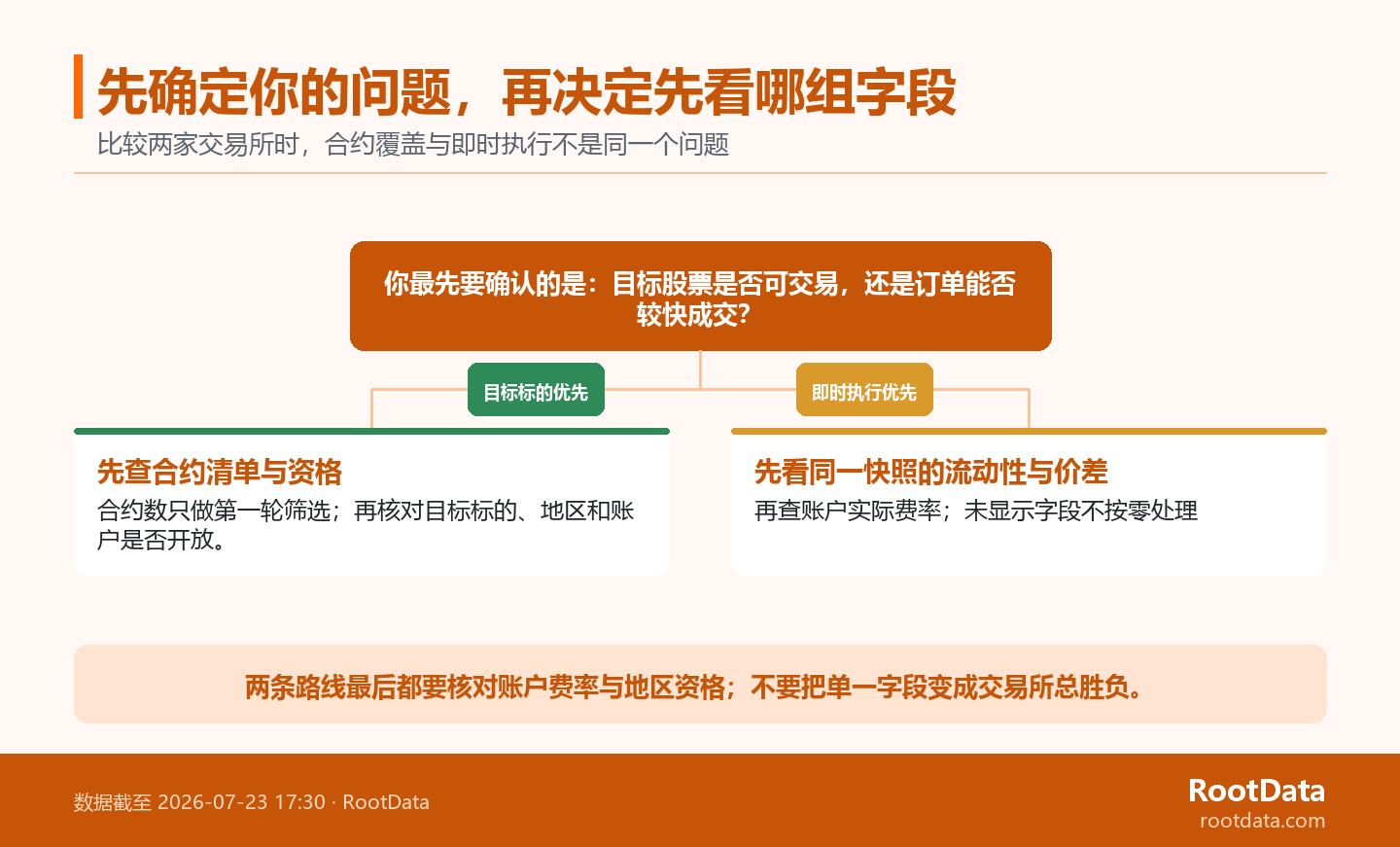
Those who prioritise immediate execution should first look at liquidity and spreads from the same snapshot, while those who prioritise target assets should first look at the contract list; both paths ultimately require checking personal account fee rates and regional eligibility. The reason is straightforward: the first path handles “how this order might be filled right now”, while the second handles “whether the product I need exists and is available”. The same RootData snapshot puts both questions on one table, but does not conflate them into one.
- Target‑asset first: write down the stock names you want to confirm, check the product pages and location eligibility of both exchanges; only when the target contract actually exists should you compare fees, liquidity, and margin paths.
- Immediate execution first: at the same time point, look at ±2% weighted liquidity and bid‑ask spreads, then open the real‑time order book for the target contract; do not replace this check with total volume.
- Fee first: check your own account’s Maker/Taker and product group, estimate explicit fees, spreads, impact, and funding rates separately; blank fields are signals that further verification is needed.
- Horizontal expansion: if neither exchange meets your asset or cost criteria, go back to the same‑metric data and screen more platforms. View RootData stock derivatives ranking.
This is also the practical role of RootData in this article: it does not choose an exchange for the reader, but places the comparison objects under a unified time, unified fields, and clear gaps. Whichever path you take first, you will ultimately need to reconfirm account fee rates, target contracts, and regional conditions; the fields in the article only help you decide what to look up on the next page.
Four things this comparison cannot decide for you
The frozen snapshot, regional eligibility, account tier, and dynamic product parameters limit the conclusions of this article; RootData data comparisons do not constitute investment advice. First, market fields change, and the values here correspond only to the page snapshot of 29 platforms at 2026-07-23 17:30. Second, Maker/Taker, funding rates, and product parameters may adjust by account, asset, and time. Third, regional access and identity verification must be checked on your personal account and applicable local pages. Fourth, price exposure from stock perpetuals does not automatically grant stock rights. RootData’s data standard requires fields to be understood through verifiable sources and standardised definitions, and its disclaimer clearly defines the non‑investment‑advice boundary.
If you are preparing to publish or use this comparison, the minimum re‑verification actions are: refresh the update time on the ranking page; confirm that your target contract is still on the exchange’s available list; check your own account fee rates and margin settings; and finally confirm regional and product eligibility. A change in any of these four items can make the conditional conclusions in the table inapplicable.
FAQ
The FAQ only complements the boundaries of product rights, fee applicability, and update frequency; it does not replace the comparison paths in the main text.
Are Binance and Bybit stock perpetual contracts equivalent to holding actual stocks?
No. Both official sources describe these products as perpetual derivatives that track traditional financial asset prices, not as stock holdings that automatically grant shareholder rights. They can provide price exposure, but should not be taken to imply voting, dividends, redemption, or other corporate action rights. If such rights are central to your needs, you should consult the terms of the corresponding spot‑type products, issuers, or custody arrangements item by item.
Does Bybit’s 0.0275% Taker rate directly represent my trading cost?
Not directly. This figure belongs to a specified TradFi perpetual fee schedule, and actual applicability still requires checking against your account tier, product scope, and regional pages. Even if the rate applies, it is only one part of explicit one‑sided fees and still does not include spreads, order‑book impact, funding rates, or potential tier changes. When comparing, treat it as an input to be verified, not as the final cost answer.
Does a higher number of contracts mean Bybit is necessarily better for me?
Not necessarily. The contract count only indicates coverage breadth in the snapshot; what you truly need to confirm first is your target asset, whether that product is still open, and whether your account and region are eligible. Even if the target contract exists, order‑book depth, spreads, actual fees, and funding rates can still change the usability. Contract numbers are good for narrowing the search, not for directly deciding which exchange to choose.
Why should I re‑check data and fees before publishing or using this comparison?
Because market fields, contract lists, account fee rates, and regional availability all change. The values in this article correspond only to the page snapshot of 2026‑07‑23 17:30. Updating is not about chasing every short‑term fluctuation, but about confirming that the comparison still holds under the same product scope and account conditions. If the snapshot time, target contract, or fee group has changed, the safest approach is to re‑verify rather than reuse the old table.