
Binance vs Bitget: Comparing Stock Perpetual Liquidity, Spread, and Fees
RootData 2026-07-23 17:30 Frozen snapshot shows Binance has higher or better visible liquidity, spreads, OI and 24-hour volume than Bitget, while Bitget has more contracts and shows Maker/Taker fields. This conclusion is limited to the visible fields of 29 platform snapshots and does not represent the real-time market or complete rates; RootData stock derivatives ranking page retains the original entry of this set of data of the same caliber.
 Author: Flowie|ChainCatcher content author, focusing on RWA, interpreting the true narrative of Web3. Follow X
With different order goals, the order of comparison should also be different
- Immediate execution priority: first look at the liquidity and spread of the same snapshot, and then open the target contract order book.
- Coverage priority: First confirm whether the target stock perpetual contract exists, and then check the visible fee field.
- Fees priority: distinguish Maker/Taker, spread, order impact and funding rate, no need to guess the rate in missing fields.
- Before release or use: Refresh the snapshot time, account conditions and regional qualifications. Old data will not be extrapolated to the current conditions.
Under the same snapshot, look at tradability proxies first instead of drawing conclusions
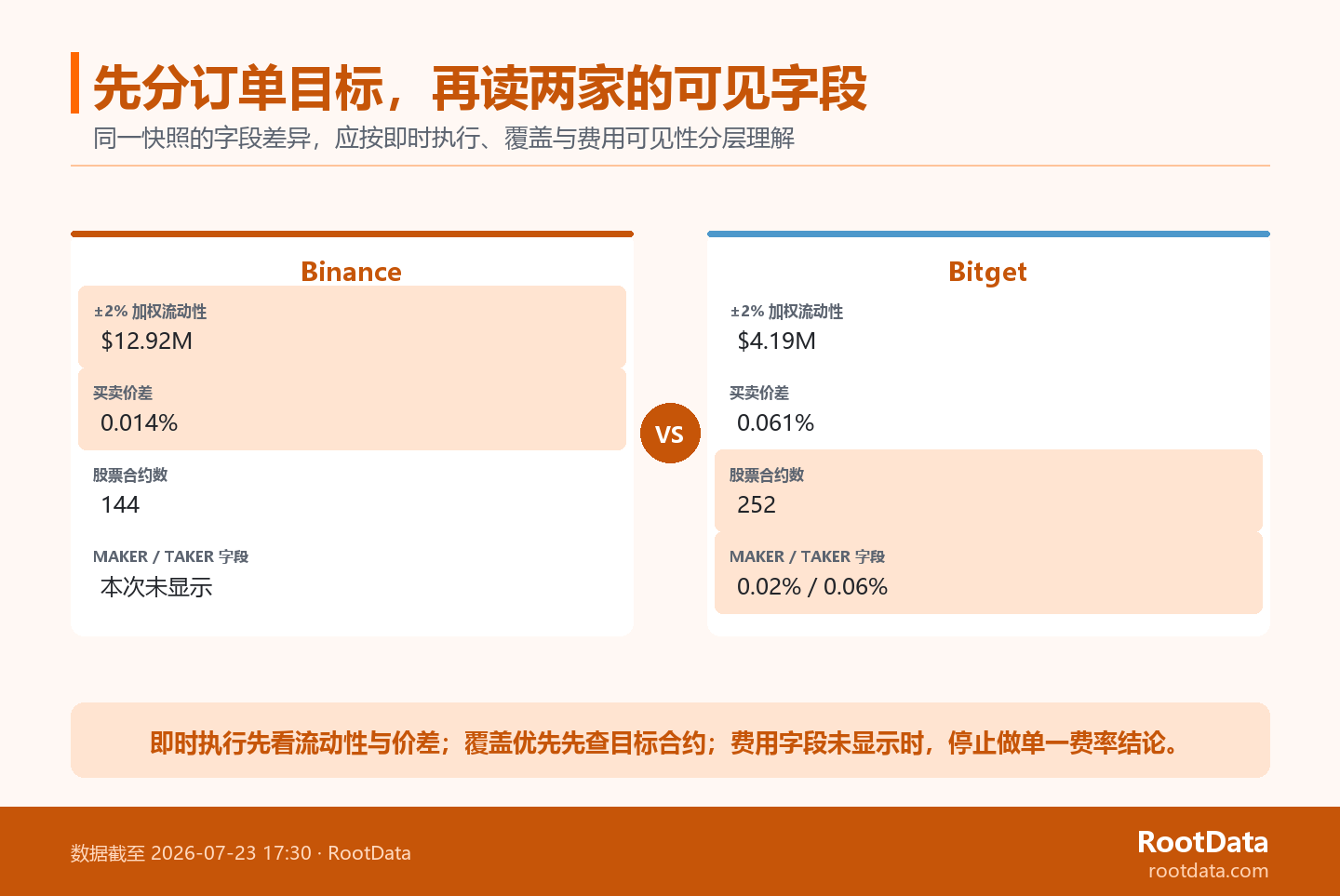
When comparing exchanges, volume, open interest, liquidity, spreads and fees do not answer the same question. The ±2% weighted liquidity here can be understood as the measurable scale of pending orders within a given price range on the page; the bid-ask spread is the distance between the visible quotes of the buyer and seller. The former indicates how thick the order book is within a certain range, and the latter indicates how tight the quotation is, but neither guarantees the result of any order.
| Same snapshot field | Binance | Bitget | Reading |
|---|---|---|---|
| Ranking/Rating | 1 / 92.1 | 4 / 90.9 | Only reflects this page snapshot |
| Number of contracts | 144 | 252 | First confirm whether the target contract is listed |
| Open interest (OI) | $2.77B | $740.22M | Observation field of position size |
| 24-hour trading volume | $16.72B | $2.03B | Tradability cannot be inferred alone |
| ±2% weighted liquidity | $12.92M | $4.19M | Order book acceptance scale agent |
| Ask-ask spread | 0.014% | 0.061% | Quote tightness agent |
| Maker / Taker | This snapshot is not displayed | 0.02% / 0.06% | Field gaps cannot be guessed |
| Funding rate | +0.0001% | -0.0002% | Only displayed at this time |
The instant execution proxies in the table show that in this observation, Binance has higher visible liquidity and narrower spreads; Bitget has more contract coverage. They respectively correspond to "how the order may be accepted" and "whether the target product can be found" and cannot be compressed into a total score.
Liquidity and spread should be read together: they answer the immediate execution conditions
In situations where immediate execution is required, higher visible liquidity and tighter spreads should together be considered a better starting point, but still do not guarantee actual slippage on any order. This is a comparison framework based on public fields. The actual transaction will still be affected by the target contract, order direction, order volume, order splitting method and instant order cancellation; Stock Derivatives Ranking Instructions The page caliber used to review these fields.
A more practical sequence is: first confirm the specific stock perpetual contract to be traded, then look at the liquidity and spread at the same time point, and finally check the order book with your own order size. If the reader's goal is small, batch, and price-limit transactions, the importance of the overall trading volume in the table will decrease; if the goal is larger orders that require immediate execution, liquidity and spreads should be placed before the number of contracts. What is discussed here is the verification sequence and does not constitute a transaction instruction.
Cost is not a series of numbers: explicit fees, spreads, impacts and funding rates belong to different levels
Maker/Taker transaction fees, funding rates and quote costs when orders are executed do not belong to the same level; Bitget's public sample rates need to be read in conjunction with account conditions, while Binance's snapshot fee field is not displayed. Maker is the party that adds pending orders to the order book, and Taker is the party that immediately eats existing pending orders; the funding rate is a periodic payment settled according to rules between long and short perpetual contract holders, and is not a separate transaction fee charged by the platform. Confusing these layers into "high and low fees" will make the holding period and order placement method disappear from the comparison. Bitget Fee Description and Binance's Fee Calculation Instructions lists the applicable conditions for these two types of public rules respectively.
Bitget's public futures fee description uses USDT-based perpetual as an example to list 0.02% Maker and 0.06% Taker, and explains that the actual rate will change with the account level; the description also explains the funding rate as a periodic payment between long and short. Calculated based on the public example of a one-sided Taker with a nominal amount of $100,000, the explicit transaction fee is approximately $60; this is just an illustration of the calculation method and is not a quote for any account or any stock perpetual contract.
Binance’s public fee materials also use Maker/Taker logic, but clearly state that actual fees will be affected by products, order roles, VIP levels and preferential conditions. More importantly, this RootData snapshot does not show Binance’s Maker/Taker field, so it is impossible to use Bitget’s public example to make up a “peer-to-peer rate” for Binance.
The contract covers a lot, first confirm whether you want stock price exposure or rights
Stock perpetual contracts are derivative exposures related to stock prices. Contract coverage does not automatically confer real stock holdings, dividends or voting rights. Bitget shows 252 contracts and Binance shows 144 contracts in this snapshot, indicating that the number of coverage visible on the page is different; it does not automatically indicate that a specific target must be open, suitable for a certain region, or come with real stock holdings, dividends, and voting rights. Binance's Stock Perpetual Contract Description and Bitget's Product Guide should be read in conjunction with each Product Rule.
If your needs involve cash flow rights or corporate governance rights, you cannot just compare based on the "number of contracts". You should turn to an item-by-item verification of the corresponding product terms and spot products.
Return the comparison results to the order: the review order of the two types of requirements is different
Readers with immediate execution priority should first check liquidity and spreads; readers with coverage priority should first confirm the target contract and fee fields, but both need to check account and regional conditions. This sequence is not a trading suggestion or platform recommendation for anyone, but turns the fields in the same snapshot into a reviewable comparison action; when viewing RootData's original ranking data again, its update time and missing fields should also be retained.
- Fix the comparison objects at the same point in time and the same product range.
- According to your order goals, choose execution quality or contract coverage first.
- Check the fee fields displayed on the page separately from the account, order role, and position period.
- When you continue to view more platforms with the same caliber other than the two, you can View the RootData stock trading platform rankings, and then leave the missing fields as missing.
Four things this comparison cannot judge for you
Frozen snapshots, missing fields, individual account levels and regional qualifications limit the conclusions of this article; this article does not constitute investment advice. First, snapshots will expire as markets and pages are updated; second, fee fields not shown are not zero and should not be replaced by rates from other exchanges; third, account levels, regions and specific product qualifications may change availability; fourth, any public data comparison cannot replace personal risk judgment. RootData's data standard illustrates the boundaries of data collection, cleaning and standardization, and its Disclaimer also makes it clear that the relevant information does not constitute investment advice.
Therefore, before publishing or citing this comparison, you should refresh the ranking page timestamp, target contract status, order book and personal account fees; if any of them cannot be confirmed, you should stop extrapolating the old snapshot to the current trading conditions.
FAQ
Is Binance’s higher liquidity necessarily more suitable for all orders?
Not necessarily. The higher visible liquidity only shows that in this snapshot and the given price range, the size of pending orders is stronger; it does not guarantee the transaction result of a certain stock perpetual contract, a certain time or a certain order size. Before placing an order, you still need to check the target contract order book, order direction, whether the order is split, and whether the account and region are available. If the order does not seek immediate execution, the price limit and batch methods will also change the weight of this group of fields.
Can Bitget’s Maker and Taker rates be directly compared to Binance?
A single published rate cannot be taken directly as a complete comparison. Bitget’s public example needs to be read in combination with product and account level. Binance’s actual fees will also be affected by the order role, product, VIP level and preferential conditions; at the same time, the Maker/Taker field of this Binance snapshot is not displayed. To make an effective comparison, you need to at least align similar products, the same account conditions, ordering methods and holding periods at the same time, rather than just comparing a percentage.
Will the stock perpetual contract automatically give me stock dividends or voting rights?
Such rights do not automatically arise just because "stock" is in the name. Stock perpetual contracts usually provide derivative exposure related to the underlying price. The specific settlement, adjustments, qualifications and rights arrangements are subject to the current rules of each product. If the demand itself is to hold equity, obtain cash flow, or participate in corporate governance, the legal and economic rights of the product should be confirmed first, and this judgment cannot be replaced by contract coverage or transaction activity.
What platform and account information need to be checked before making comparisons?
Check at least five items: the update time of the page snapshot, whether the target contract is still tradable, the actual Maker/Taker rate of the account, the settlement rules of the funding rate, and whether the product is open to the region and account. Then look at the order book depth and current spread. You should also confirm whether your order is executed immediately, at a limit price, or in batches, as this will change the priority of liquidity, spreads, and explicit fees in the comparison. Whenever an item in a fee field, qualification, or target contract status cannot be confirmed, it should be treated as a comparison boundary rather than padded with history pages, other platform data, or default values.