
Where does 95% of Pump.fun's revenue come from: making money through zero-value tokens, turning the Meme ecosystem into a zero-sum game
Written by: Sparsity
Compiled by: Saoirse, Foresight News
"The on-chain trading environment is not friendly to participants." "All KOLs are taking the opportunity to profit." "Yet we are still chasing after packaged traders."
These issues are widely criticized, but seeking the root cause only from the end of the trading chain is akin to losing sight of the main issue. The consensus among holders in the meme coin trading circle has already collapsed: no one is willing to hold positions for the long term. Participants are turning to arbitrage, mass token issuance, block packaging launches, and incentivizing calls ------ simply because these paths are profitable. The root of the problem lies at a higher level, namely the platforms that control this trading ecosystem. As the largest meme coin issuance platform, Pump.fun's incentive mechanism is precisely what fosters these behaviors criticized by many, ultimately shaping the meme coin market into a pattern of unlimited supply expansion and continuous demand loss.
Currently, public opinion generally calls for KOLs to be responsible for their call statements, a demand that is not unreasonable. However, if the incentivizing Pump.fun does not bear corresponding responsibilities and only restricts the callers, it ultimately addresses the symptoms rather than the root cause.
Pump.fun Gains Revenue from Tokens That Go to Zero
In the past thirty days, Pump.fun accounted for 92% of the issuance volume and 84% of the trading volume across all meme coin issuance platforms. It is this platform that determines which behaviors can be profitable in this trading ecosystem.
95% of the platform's protocol revenue comes from transactions involving tokens that are still in the binding curve phase or have a market cap of less than $250,000. In the binding curve trading range, each transaction incurs a 1.25% fee: of which 0.95% goes to Pump.fun and 0.30% goes to the token creators. In other words, disregarding price fluctuations, a complete buy-sell cycle incurs a transaction cost of 2.5%.
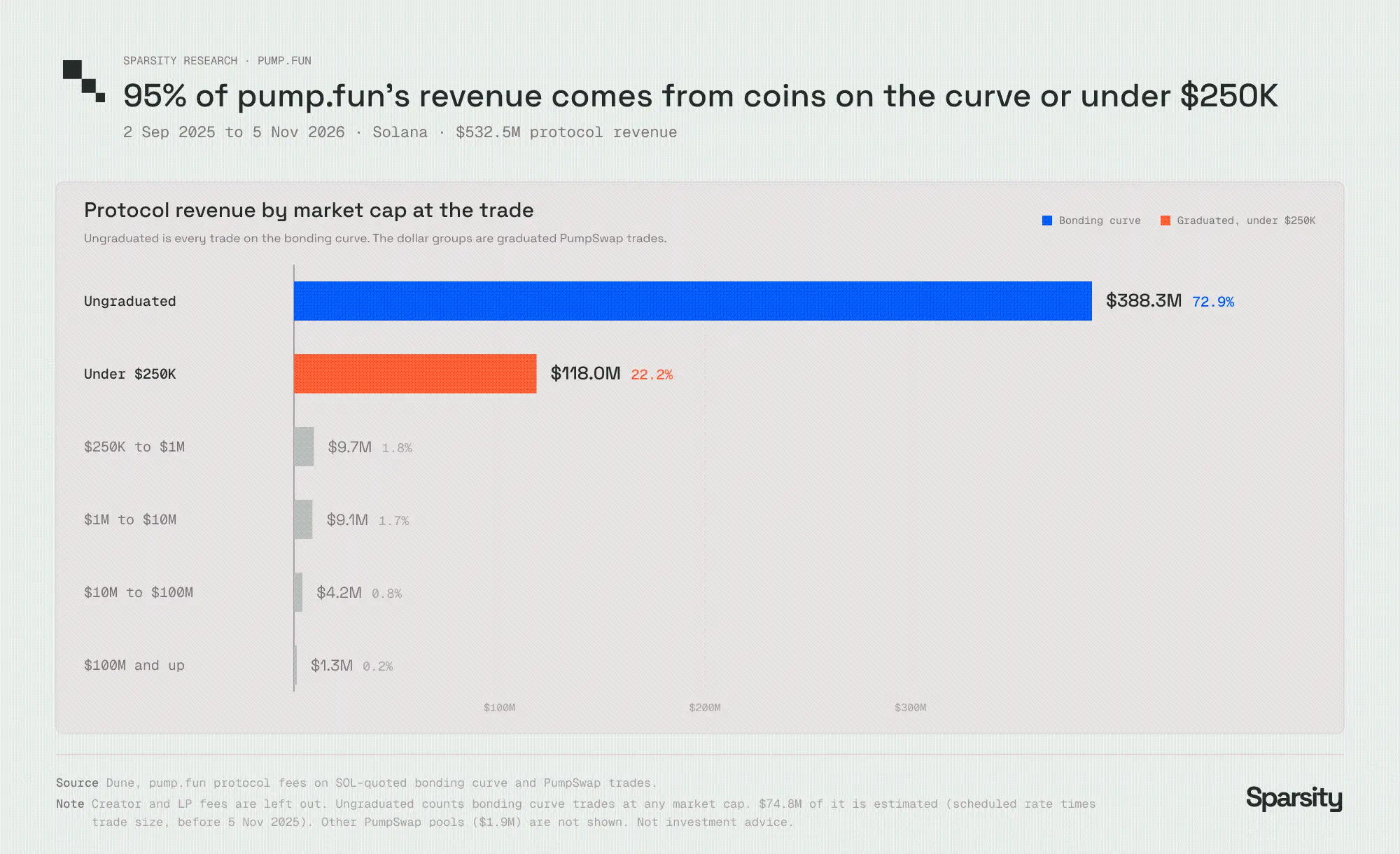
From September 2, 2025 to November 5, 2026, 95% of Pump.fun's protocol revenue came from tokens within the binding curve or with a market cap below $250,000.
Platform revenue is concentrated in the early stages when token market caps rise to several hundred thousand dollars, and the subsequent market performance of the tokens has little impact on platform revenue.
Analyzing by the duration of token existence, the conclusion is equally clear: three-quarters of the platform's revenue comes from tokens that have been online for less than an hour, and 87% of the revenue comes from tokens that have been online for less than a day. Pump.fun's revenue is highly concentrated in the first hour window after a token's birth.
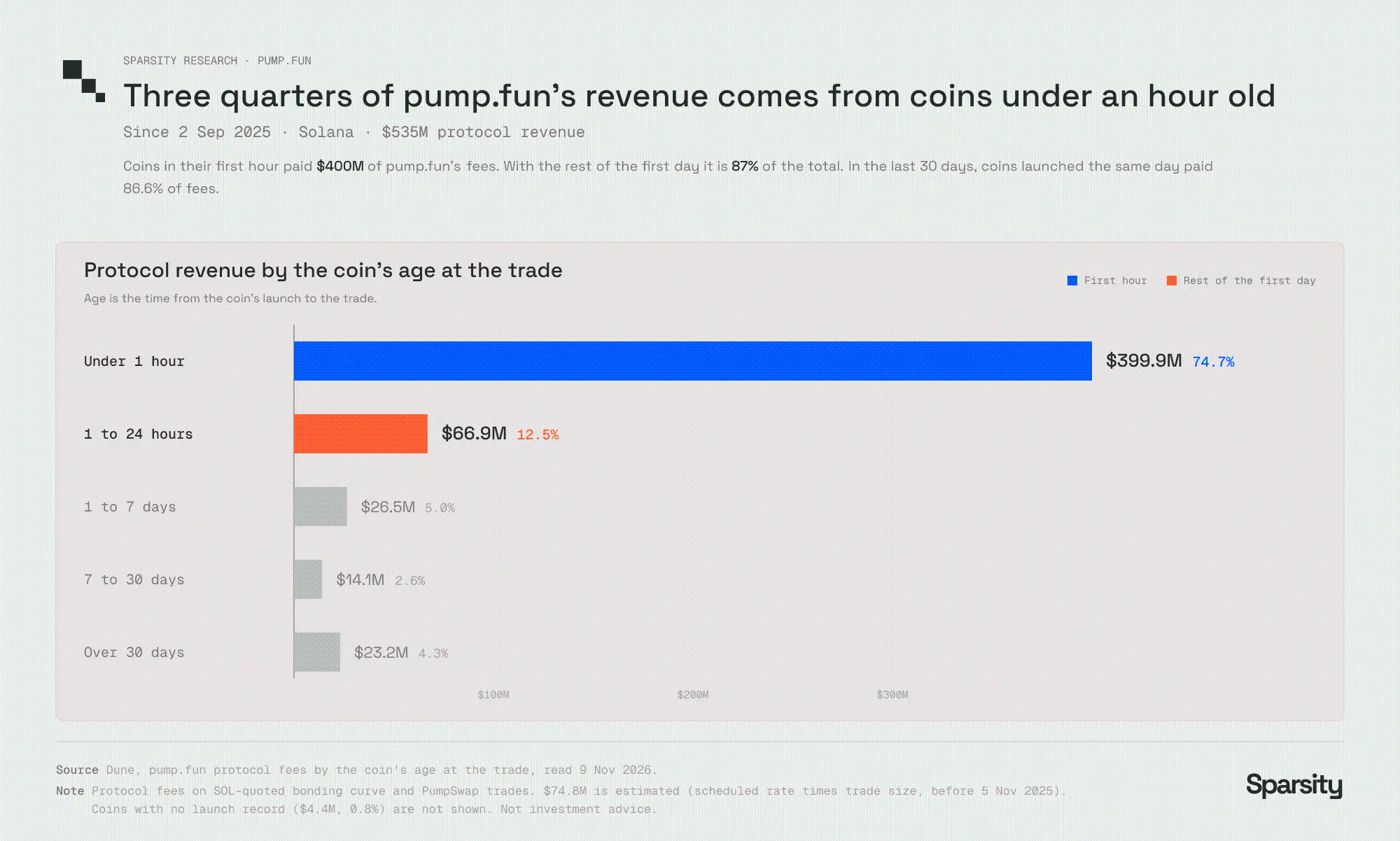
Since September 2, 2025, nearly 75% of Pump.fun's revenue has come from tokens that have been online for less than an hour, with the first-day tokens contributing a total of 87% of the revenue.
Those tokens that ultimately grow into top popular tokens contribute almost negligible fees to the platform: fifteen peak tokens with a total market cap of $1.4 billion only brought about $1.5 million in fees to Pump.fun; while small-cap tokens within the binding curve or with a market cap below $250,000 contributed a total of $506 million in revenue. In short, a thousand small-cap tokens that go to zero at a $20,000 market cap bring more revenue to the platform than a single popular token that grows to a $100 million market cap.
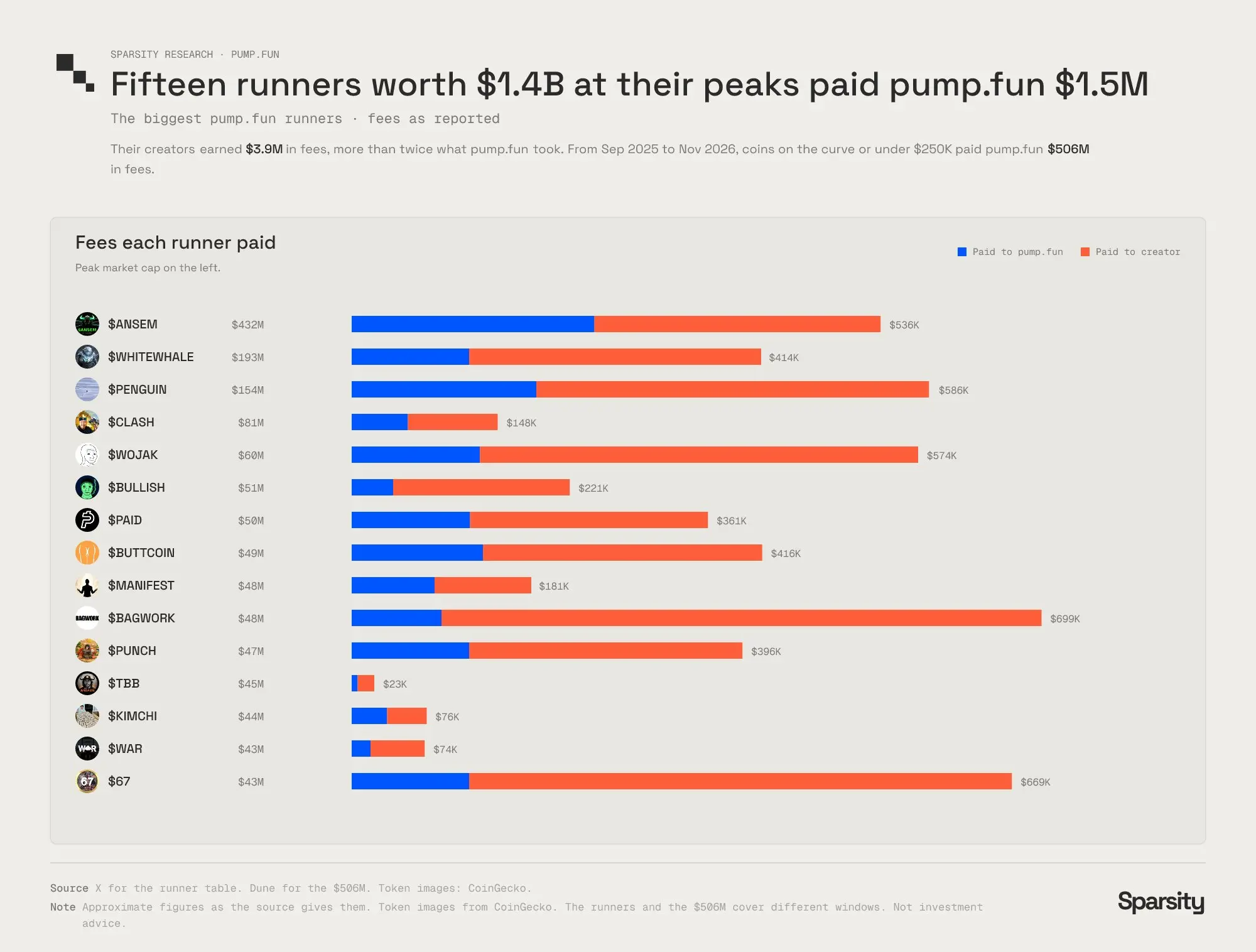
Fifteen peak tokens with a total market cap of $1.4 billion only contributed $1.5 million in fees to Pump.fun, far less than the $506 million brought in by small-cap tokens.
The fees contributed by these fifteen top tokens account for less than 0.33% of the total contribution from small-cap tokens.
Thus, the design direction of the platform's product mechanism is to continuously accept more new tokens for listing. All incentive rules of the platform guide the market to pursue the quantity of token issuance ------ the scale of trading volume is the foundation of the platform's revenue.
The Underlying Logic of Four Types of Incentive Behaviors
Every type of chaos condemned by the community has a corresponding revenue logic within the platform mechanism: packaged launches, mass token issuance workshops, call incentives, and player confrontation modes will ultimately generate trading fees, from which Pump.fun takes a cut from each transaction.
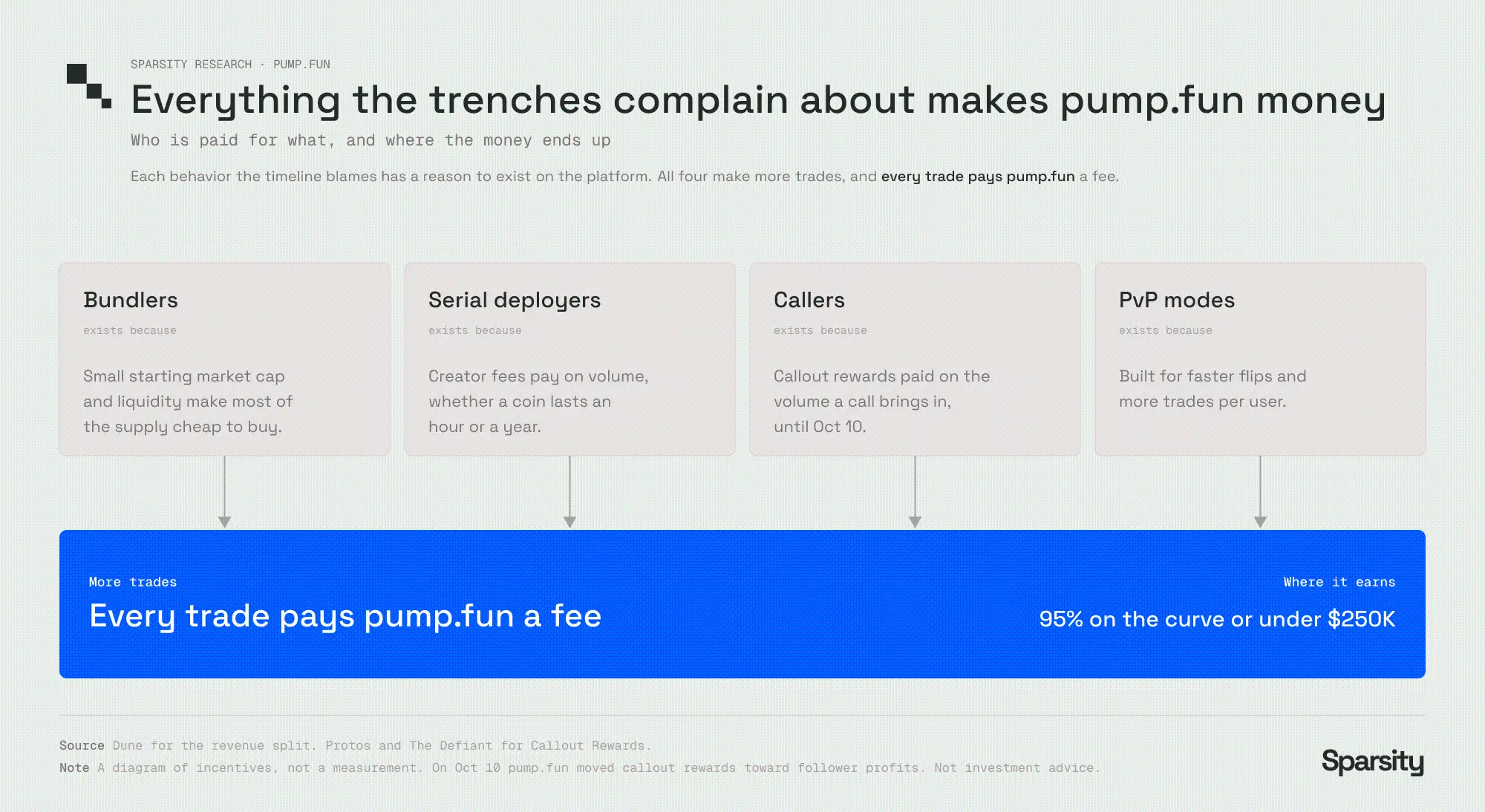
Market chaos such as packaged launches, mass token issuance, calls, and PvP games will increase trading frequency, allowing Pump.fun to earn fees from each transaction.
Bundlers: Achieving Launch Arbitrage with Extremely Low Initial Market Value and Liquidity
Bundlers can thrive due to the low standards set for the initial market value and liquidity of tokens. Traders only need to invest a small amount of SOL, spread across dozens of wallets, to absorb a large amount of chips within the launch block, and then directly dump them to ordinary traders. The lower the initial market value, the lower the cost of this operation, and this initial parameter is set by Pump.fun.
Mass Issuers: Issuing Tokens in Bulk, with Creator Fees Settled Based on Trading Volume
Developers who issue tokens in bulk are emerging one after another, as the creator fees reward the act of issuance rather than the long-term operation of the token. Whether a token lasts for only an hour or circulates for a long time, creators can extract a 0.30% fee from each transaction. Therefore, the rational strategy is to issue as many tokens as possible, quickly harvest early trading volume, and then shift to the next target. The top twenty-five token issuance addresses collectively issued 761,000 tokens, with less than one percent of these tokens successfully "graduating," but these addresses collectively profited $128 million.
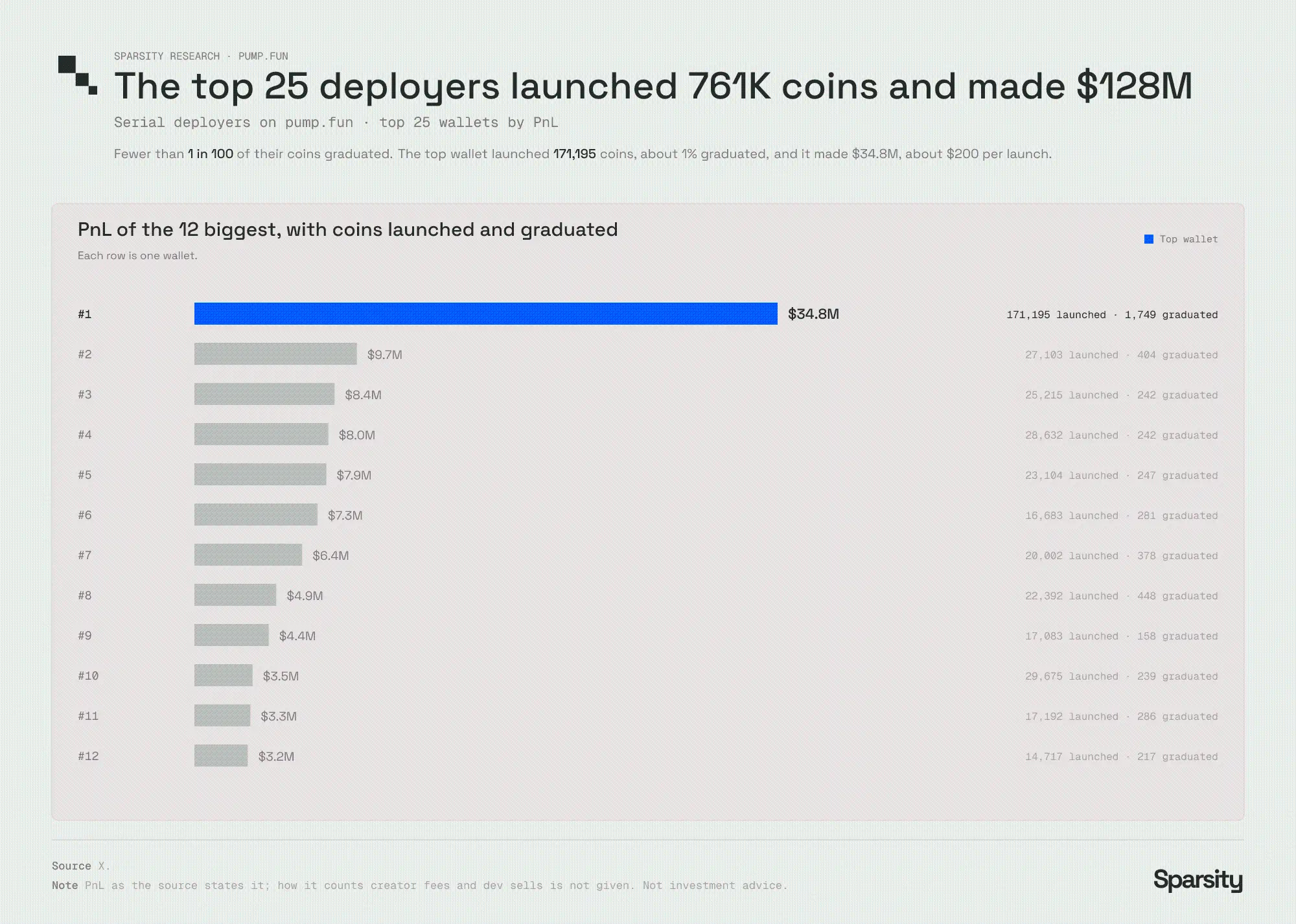
The top 25 token issuance addresses on Pump.fun collectively issued 761,000 tokens and profited $128 million, with a graduation rate of less than one percent.
Among them, the top-ranked wallet issued 171,195 tokens, with an average profit of about $200 per token.
Of course, these mass issuance workshops can occasionally give birth to popular tokens: two wallets issued tokens that reached peak market caps of $122 million and $327 million, respectively. However, for the issuers, the emergence of a blockbuster is merely a coincidental result; their core revenue source remains the early trading traffic itself.
Call KOLs: Favoring Small-Cap Tokens, Incentives Based on Trading Volume
The call incentive mechanism has opened up a new monetization channel for promotional marketing, converting call behavior into a profit avenue. Since August, the platform has distributed $29.6 million in call rewards to 51,115 wallets, with the prize distribution being extremely uneven: ten wallets share 16% of the total prize, while the median prize for ordinary recipients is only $13. The top ten winning wallets averaged about $485,000 in earnings.
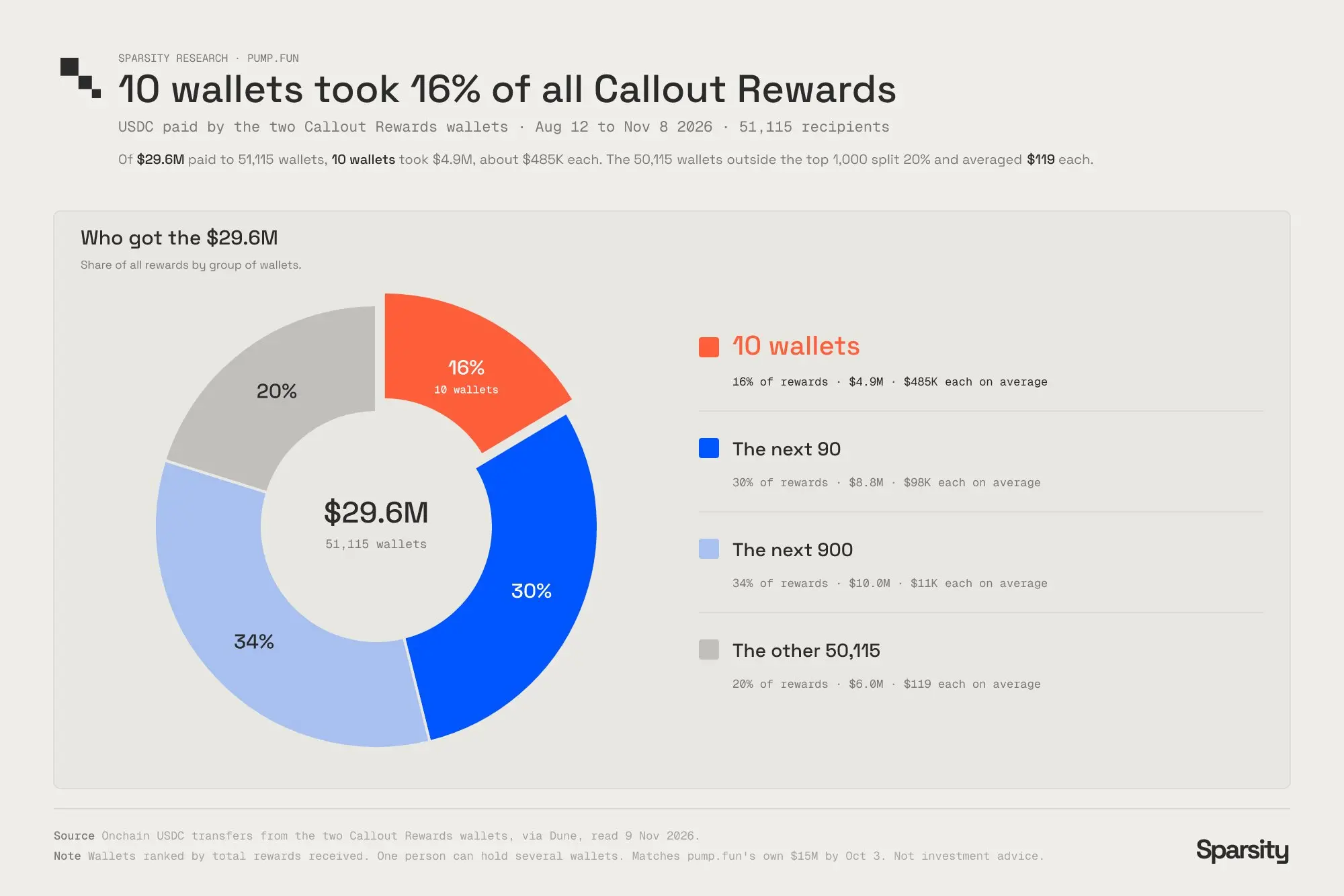
From August 12 to November 8, 2026, the distribution of Pump.fun's call rewards was highly concentrated, with only 10 wallets sharing 16% of the total $29.6 million in rewards.
The incentive amount is calculated based on the trading volume generated by the calls, and small-cap tokens, being thinly traded, are most easily manipulated to drive prices. In August, among the top fifty earners from calls, forty promoted tokens with an average market cap of less than $100,000; twelve of them promoted tokens with an average market cap even below $10,000.
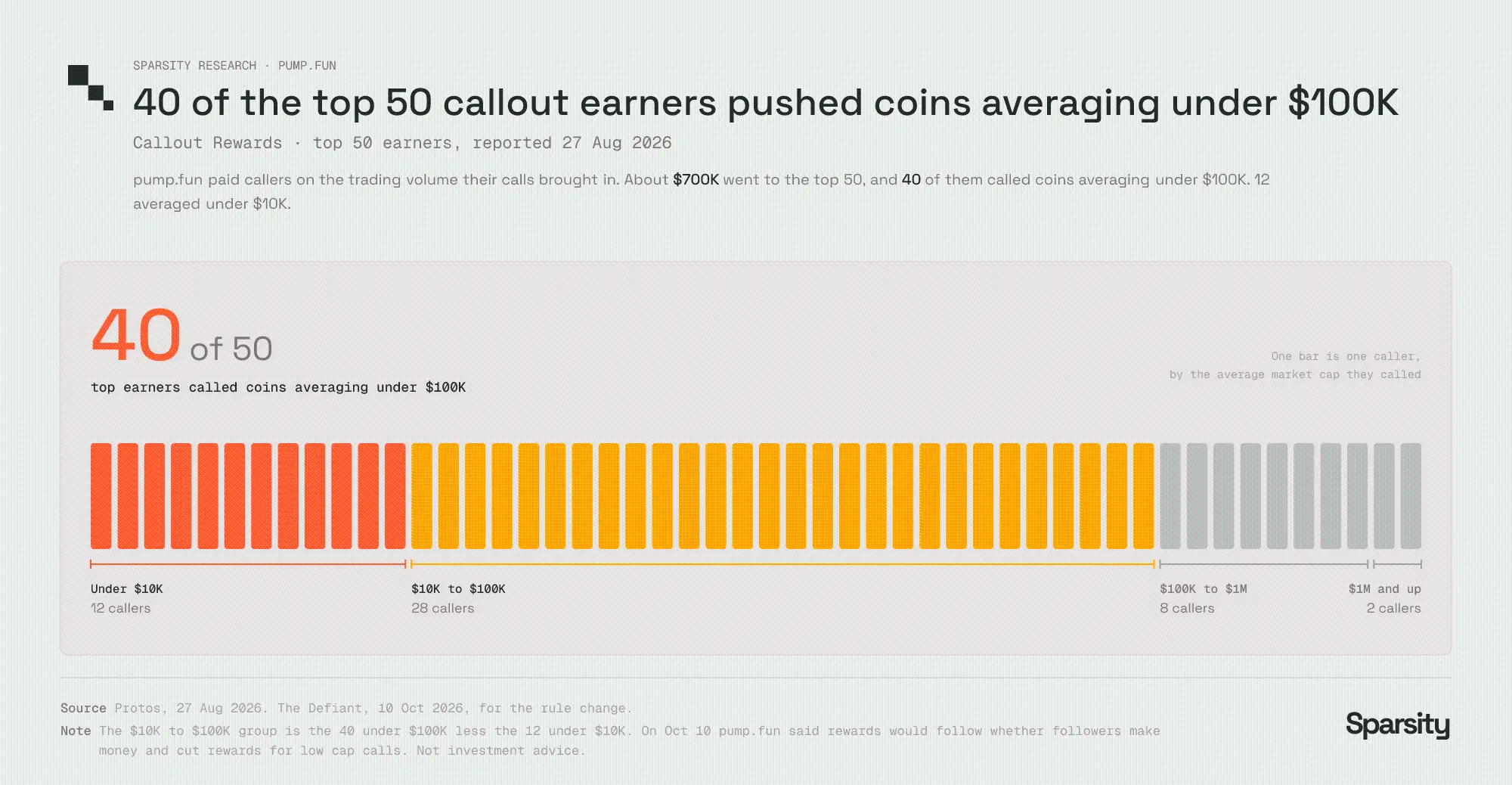
Among the top 50 call earners on Pump.fun, 40 promoted tokens with an average market cap of less than $100,000.
The critical voices in the market have been heard by Pump.fun. On October 10, the platform announced that future incentives would be linked to the profits and losses of followers, while also reducing the reward weight for calls on small-cap tokens. However, in the three weeks following the rule adjustment, the proportion of rewards directed towards tokens with a median market cap below $100,000 among the top twenty call earners increased from 68% to 94%, while the total amount of weekly distributed rewards actually rose by 53%.
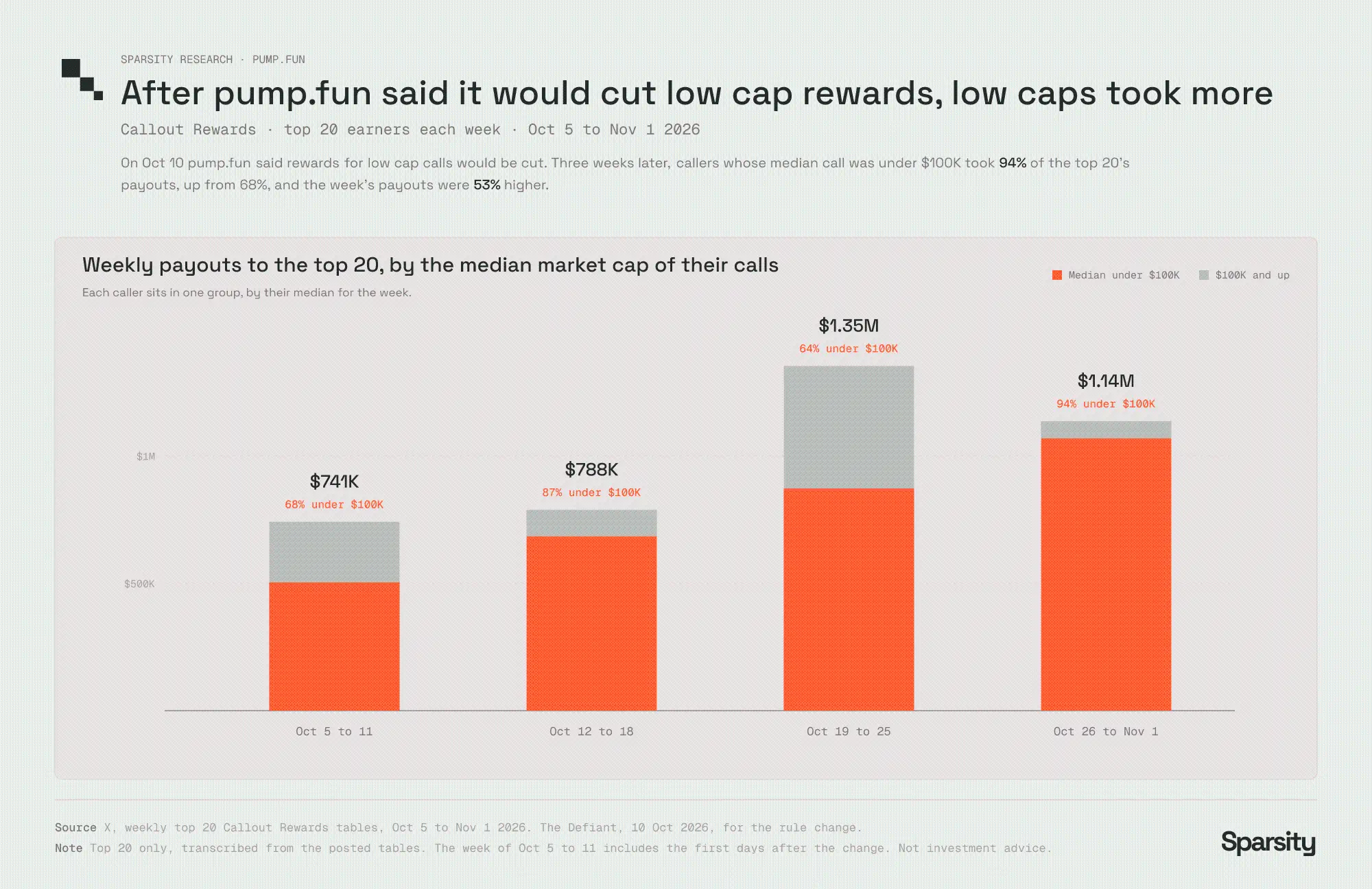
After Pump.fun announced the reduction of call rewards for low market cap tokens, the proportion of rewards for low market cap token calls actually increased to 94%.
As the scale of rewards expanded, the corresponding proportion of rewards for small-cap token calls also increased.
Ultimately, the losses are borne by the traders who follow the calls. A research team tracked fourteen callers: among them, ten promoted tokens with a median market cap below $100,000, and their followers collectively lost $926,000 the day after the calls were made. The prices of the tokens that were called rose by a median of 6% one minute after the announcement, but fell by 48% after an hour, and dropped by 74% after a day. Regardless of whether the token prices rise or fall, the callers can still earn rewards.
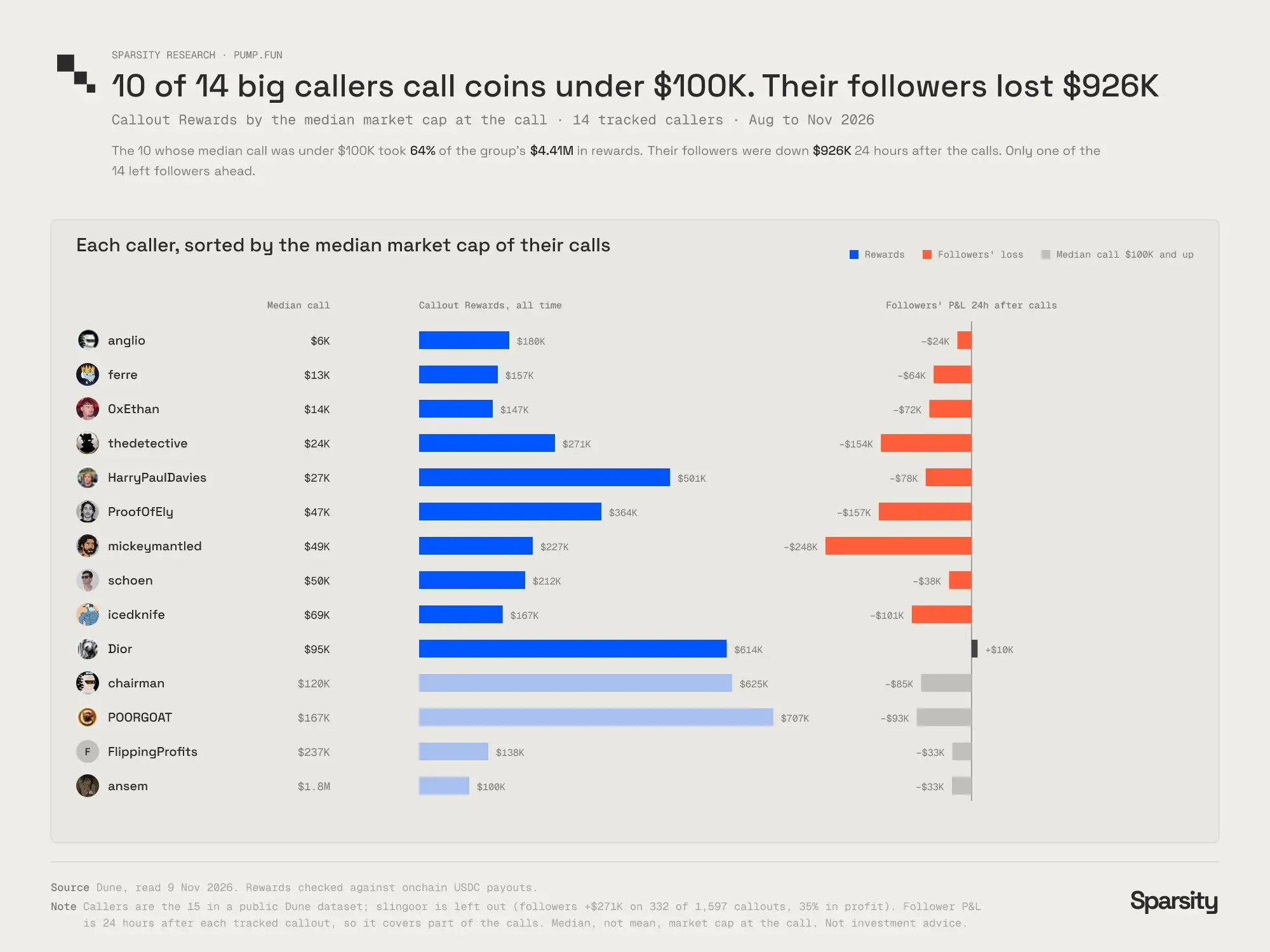
Among the fourteen top callers, ten primarily promoted tokens with a market cap below $100,000, resulting in their followers collectively losing $926,000.
Among the fourteen, only one caller managed to yield a slight profit of $10,000 for their followers. All tokens that were called saw their prices drop the day after the call was made.
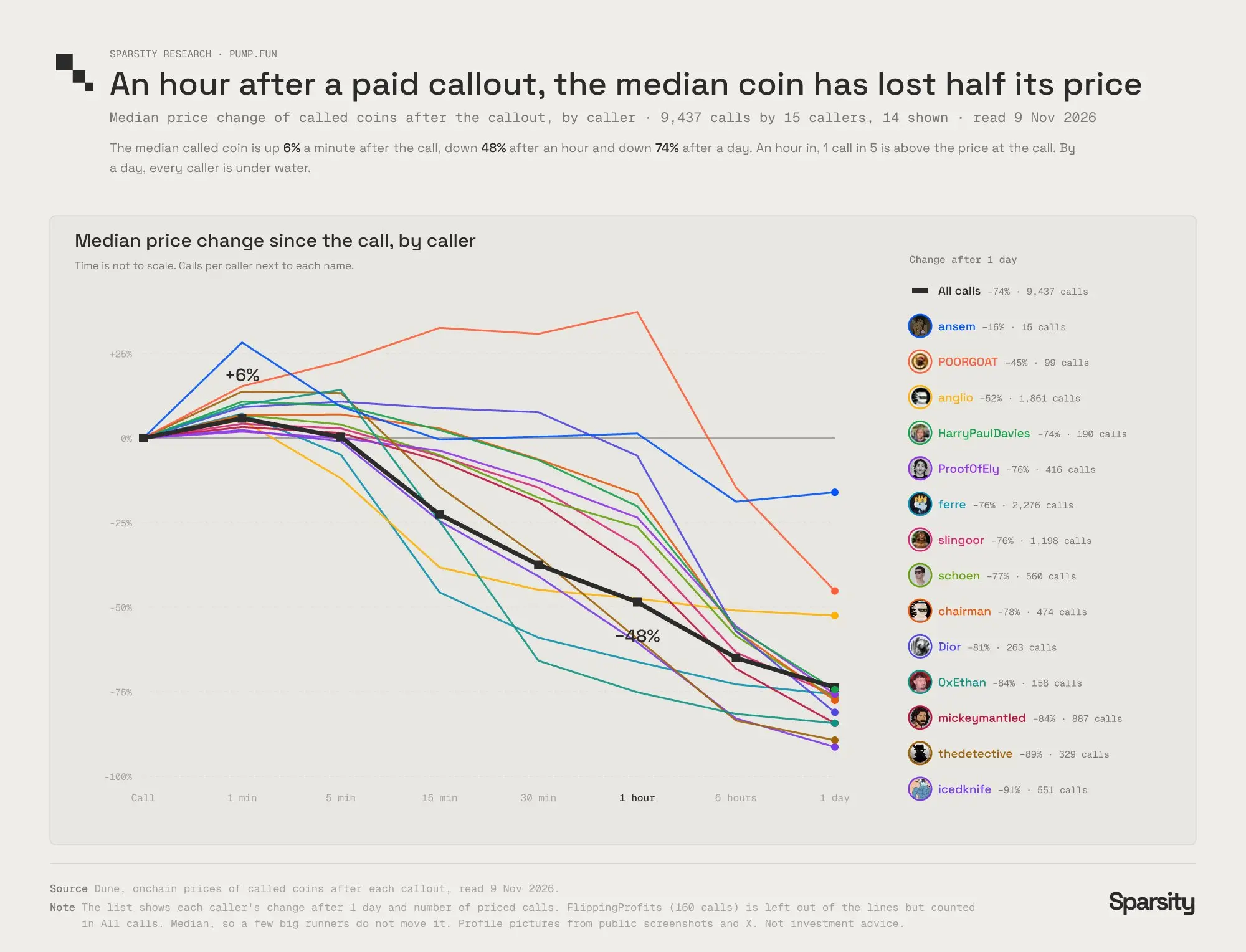
One hour after the paid call, the median price of the tokens dropped by 48%, and after one day, the drop reached 74%.
The reason why the public is confused about KOLs continuously recommending coins that lead to losses for followers largely lies in this: the platform's incentive design itself encourages such behavior through paid promotions.
PvP Player Combat Mode: The goal is to increase individual user trading frequency
The underlying logic of the player combat mode is that the market lacks new funds, and experienced traders extract profits from novices. The original intention of this mode's design is to facilitate faster transactions and increase the trading frequency of individual users, as every transaction generates a fee. Pump.fun itself has already taken down one of its modes, Tokenized Agent, on June 30, with the platform stating that too many token launch channels have created a "malicious player combat ecology."
Unlimited Supply Expansion, Continuous Demand Shrinkage
If this incentive mechanism operates in the long term, the market will split into two ends: Demand side: participating in speculation of meme coins, with most losing money in the long run, and only a very small number of wallets able to achieve considerable profits; Supply side: issuing tokens, earning profits with almost no risk.
Becoming a supplier has almost no threshold; tokens can be issued with a single click. Arbitrage methods have matured: quickly riding the popularity of hot tokens, creating false trading volumes to create an illusion of activity, and bulk purchasing old wallets for token issuance, with this gameplay iterating and optimizing every month.
As a result, more and more participants who originally preferred holding coins have transformed into token issuers. Issuing tokens is profitable, while holding positions tends to incur losses; every new participant who sees this will become a new issuer, sharing the already shrinking buyer's funding pool. This is the root cause of the collapse of the holding consensus: it is not that traders subjectively do not want to hold positions, but rather that the platform rules make long-term holding of tokens a disadvantageous choice.
This trend is intuitively reflected in the quality performance of new coins: The total amount of tokens issued by Pump.fun currently is roughly on par with the market peak at the end of 2024. In the fourth quarter of 2024, there were 3.16 million token issuances, resulting in 207 coins with a market value exceeding 10 million dollars; while in the third quarter of 2026, there were 3.05 million token issuances, producing only 24.
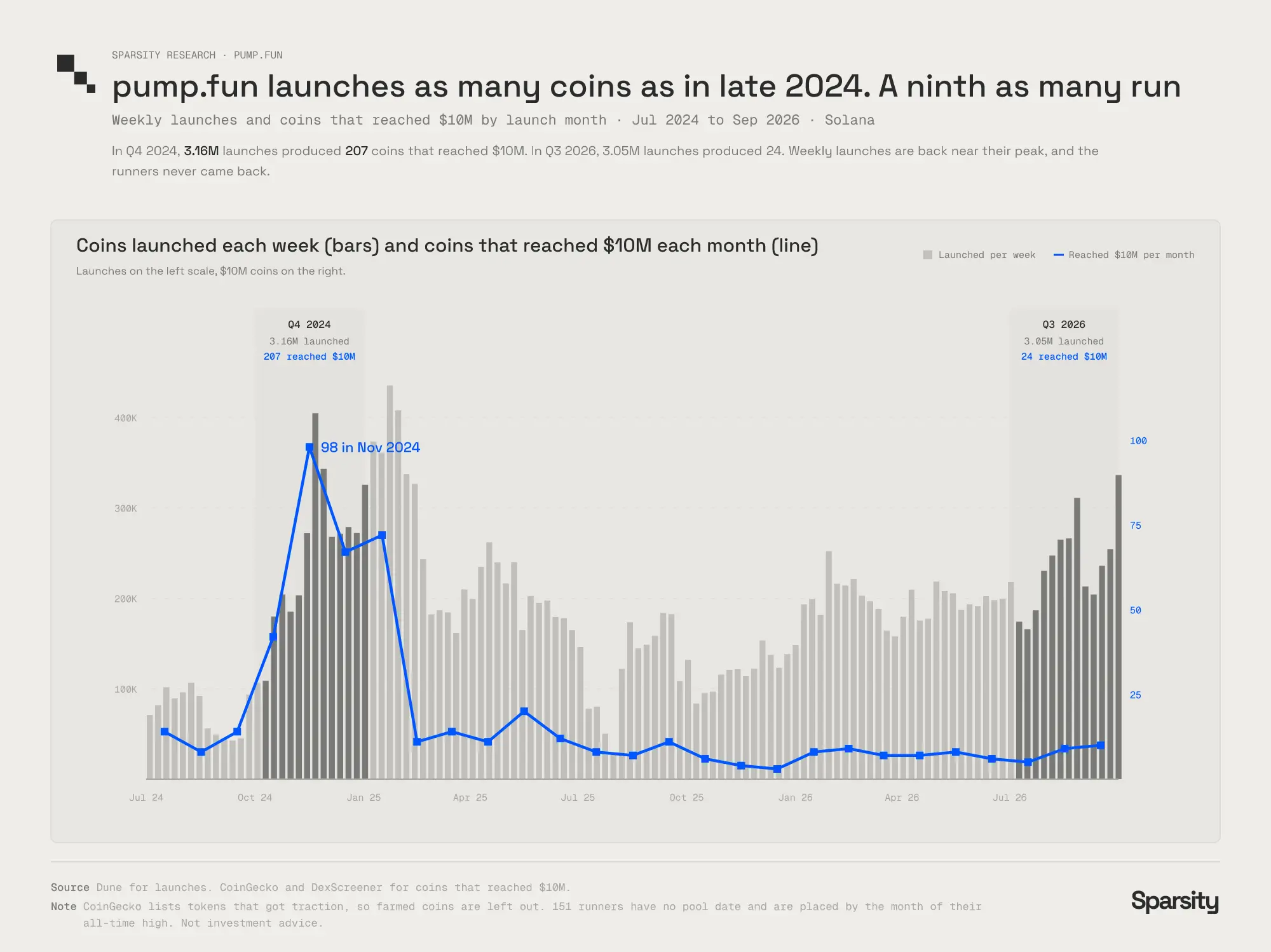
One hour after the paid promotion of a token, the median price drops by 48%, and after one day, the drop reaches 74%.
The number of newly issued tokens per week has returned to over 300,000. The probability of birthing a blockbuster with every 100,000 issuances has dropped from 6.5 to 0.8.
Some viewpoints suggest that the trading volume within the binding curve has continued to rise since June, which is true. However, the combined scale of the binding curve and PumpSwap's trading volume has shrunk from 25-30 billion dollars per month in the first quarter of 2026 to 13.8 billion dollars in October. The platform profits from transaction volume; while traders buying tokens derive their profits from the tokens becoming blockbusters—now the scale of blockbuster production is only one-ninth of what it used to be.
Token survival data also corroborates this conclusion: Among the 24.4 million issuance records accumulated by Pump.fun, as of the statistical date, only 312 tokens maintain a market value above 100,000 dollars, meaning approximately one in every 78,000 tokens survives, with a survival rate of only 0.0013%.
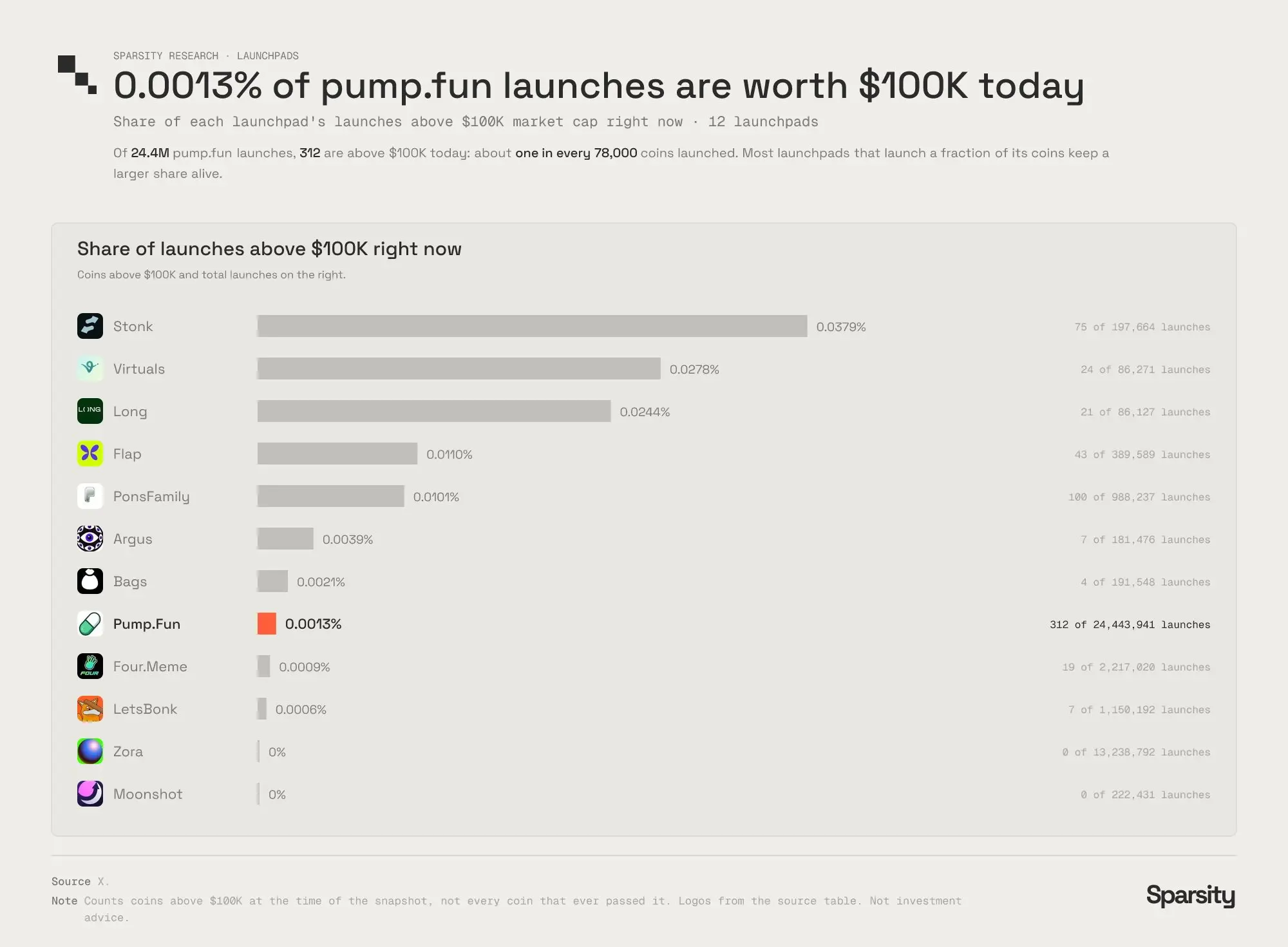
Among the tokens issued by Pump.fun, only 0.0013% currently have a market value exceeding 100,000 dollars, meaning approximately one in every 78,000.
The survival rate of Pump.fun's tokens is lower than that of most similar platforms with far smaller issuance scales.
This is the first market we have observed where supply expands rapidly while demand continues to decline. Without the platform's incentive mechanism continuously nurturing this system, it would never have developed to its current scale.
Market Participants Also Propel the Cycle
This system is built by Pump.fun, but the trading volume that maintains its operation comes from the traders themselves. The various arbitrage behaviors mentioned can only realize profits if there are counterparties to complete transactions, and most of the time, that counterparty is us.
While we condemn the chaos, we simultaneously contribute traffic to it through our own actions: We criticize packaged traders but turn around to follow their next launches; some profit from arbitraging hot tokens, while the community praises their clever operations; some KOLs issue promotions for twenty tokens daily, and their audience is only concerned with getting the news first, rather than whether their followers can profit. Among the fourteen tracked promoters, only one allowed followers to achieve profits, while the remaining followers collectively lost 926,000 dollars in a single day.
We bear a double cost for this: first, the trading volume we contribute allows Pump.fun and the creators to extract fees; second, our attention, as every subsequent round of hype and every promotion harvest is essentially a competition for this attention.
Long-Term Holding is No Longer a Viable Strategy
A year ago, the mainstream thought was to discover potential coins early and hold them long-term through volatility. However, currently, the median price of promoted coins drops by 74% after one day. The traders who can survive are those who sell first and exit. For individuals, selling early is a rational choice, but when everyone operates this way, it eliminates the possibility of a coin experiencing a long-term market cycle. If no one is willing to hold tokens beyond the first hour after launch, the coin will never grow to a market value of ten million dollars, and precisely this first hour window contributes three-quarters of Pump.fun's revenue.
Changes Traders Can Make
We do not need to wait for Pump.fun's permission to make adjustments. Hold the tokens you truly believe in, rather than frequently trading them with slight market fluctuations; the metric for evaluating KOLs should be whether their followers can profit, not how often they post; stop spreading the notion that front-running and packaged launches are clever trading strategies; redirect trading volume to another type of issuance platform—those that incentivize long-term token survival rather than encourage high-frequency trading.
Any single action mentioned above cannot directly correct the underlying incentives, but every transaction that no longer flows into this harvesting system will reduce the platform's fee income.
Direction for Reconstructing the Incentive Mechanism
We are not contract engineers; the following are merely reform ideas, not directly implementable engineering solutions. The core of all concepts is to shift the profit distribution node from the first hour after token launch to later:
Increase the initial market value of tokens, paired with deeper initial liquidity; liquidity grows with trading volume compounding, continuously expanding the funding pool;
Fees are not only distributed to creators but also to token holders and liquidity providers; creators' fee settings should have unlocking mechanisms tied to the duration of token survival;
Promotion incentives should no longer be settled based on trading volume but should lean towards holding behavior: whether KOLs can obtain bonuses depends on whether followers still hold and are in profit days later, rather than the transaction volume brought by promotions.
Such adjustments could sustain the vitality of the meme coin trading ecosystem, and Pump.fun itself has the financial conditions for trial and error: it holds approximately 2.84 billion dollars in assets on-chain, and the entire issuance chain is controlled by itself. A market capable of continuously nurturing long-cycle popular meme coins will generate long-term profits for the platform that exceed the harvesting model that continuously consumes buyer funds. The platform chooses short-term harvesting simply because this model is currently more profitable, but this model is unsustainable.
Even if the above plan is implemented, it may still be insufficient. Such reforms will raise the costs for suppliers (issuers, packaged arbitrage), but cannot change one reality: the tool advantages held by suppliers will always be difficult for demanders to catch up with.
Concept of an Issuance Model Detached from Binding Curves
All the previous plans are still based on binding curves. A further innovative idea is to completely abandon the binding curve issuance model:
In this new model, all participants have the same purchase price. Without a binding curve, entering blocks early no longer has a premium advantage, and sniping becomes meaningless. The issuer sets fundraising lower and upper limits; if the fundraising lower limit is not reached within a fixed window (24 or 48 hours), the contract automatically refunds the full amount, and the issuance failure does not incur losses for buyers. Once the fundraising amount reaches the upper limit, the contract automatically generates a liquidity pool, and LP certificates are destroyed or permanently locked, with developers unable to access the fundraising funds. Each wallet sets a purchase limit, for example, a maximum of 1% of the total fundraising amount, to prevent whales or bots from absorbing the majority of the chips.
The platform only charges fees when fundraising is successful; for thousands of failed issuances, the platform will not receive any income. The charging node for the issuance platform shifts from each transaction to each successful fundraising.
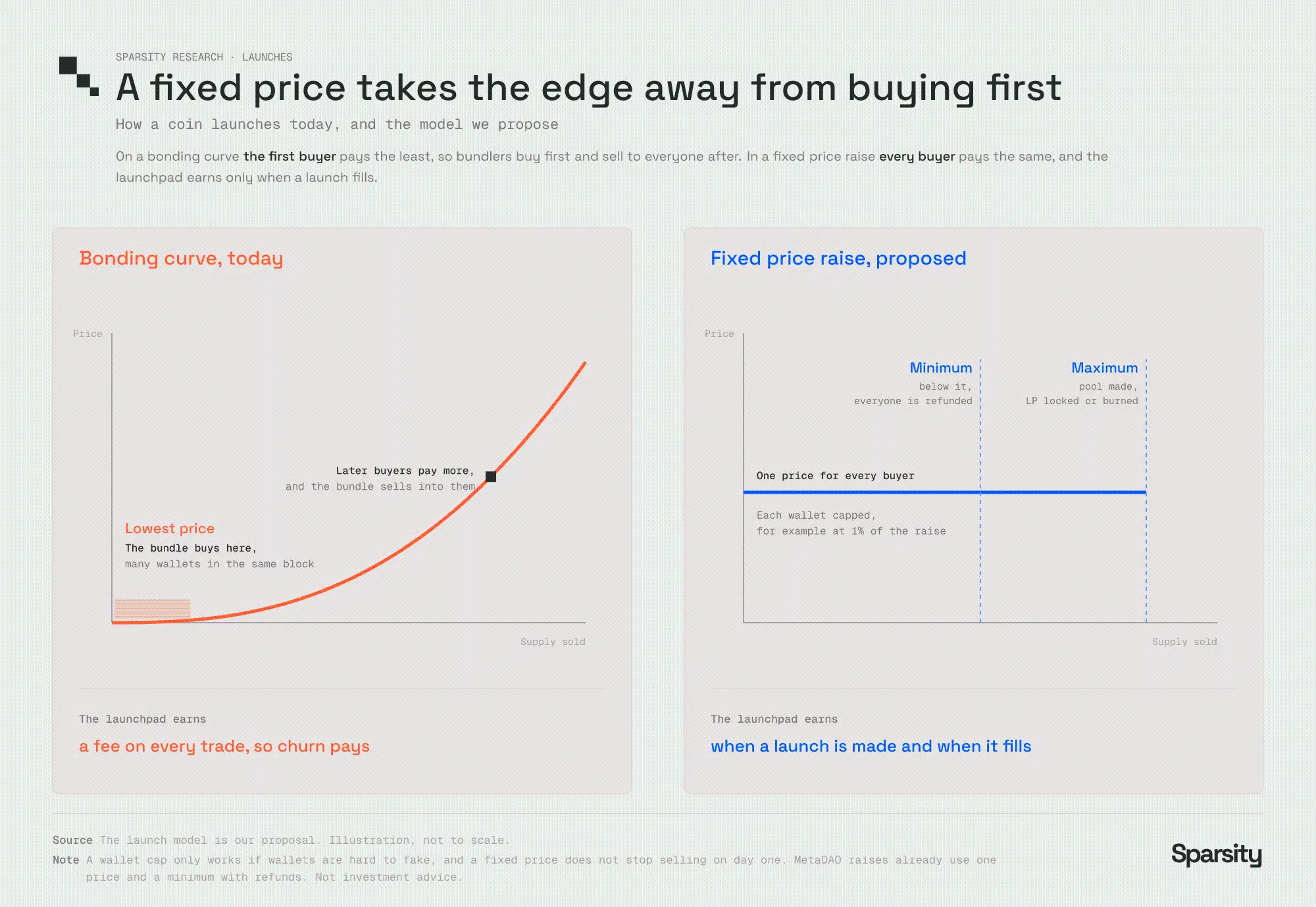
In the current binding curve model, the earlier you buy, the lower the cost, which is suitable for packaged bots to buy in early; while in the fixed-price fundraising model, everyone has the same purchase price, eliminating the advantage of early buying.
This plan can eliminate issues such as packaged sniping, block sniping, and developers running off with liquidity under the binding curve mechanism, while also removing the incentive of "issuing dozens of coins in bulk to bet on one becoming popular."
However, this model still has shortcomings that need to be objectively stated: the effect of single wallet limits in resisting witch attacks is limited, as the current cost of bulk purchasing old wallets is low, and packaged traders can still split funds and use numerous witch wallets to evade restrictions. A unified purchase price also cannot prevent dumping on the first day of a coin's launch; it merely achieves fairness in the starting phase.
Future Development Direction
The current narrative of meme coins has reached its end. We believe that unless the underlying issuance model undergoes a complete overhaul (similar to the aforementioned platform relying on successful fundraising for revenue rather than profiting from trading and tokens going to zero), it will be difficult for meme coins to restore their past ecosystem.
As long as there are issuance platforms relying on tokens going to zero and frequent trading for profits, this fertile ground for meme coin trading will lose vitality, and long-term holding will continue to be a disadvantageous strategy. New things will eventually emerge, but they will not be in the current form of meme coins, and they will not come quickly.