
The U.S. stock market evaporated a trillion dollars overnight, has the AI bubble burst?
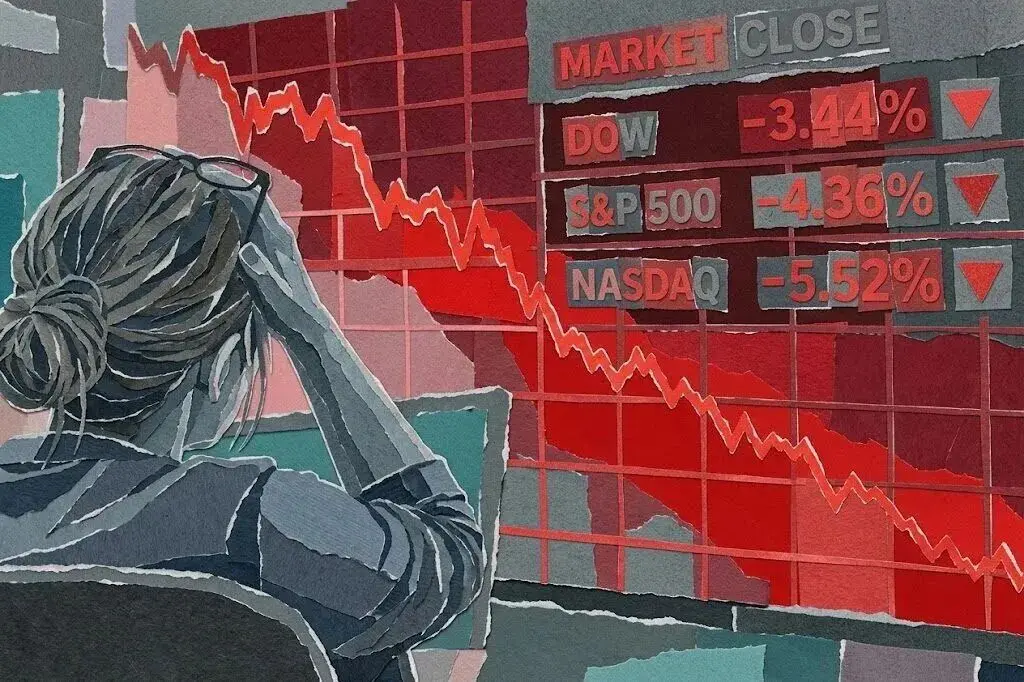
Image processed by AI
Written by|Zhou Xiaoyan
Editor|Xu Qingyang
The AI investment boom has encountered a severe setback.
On November 5, U.S. local time, the three major U.S. stock indices collectively plummeted. The Nasdaq 100 index fell by 6.4%, with a single-day market value evaporating by approximately $2.3 trillion; the S&P 500 index dropped by 4.4%, marking the largest single-day decline since April 2025.
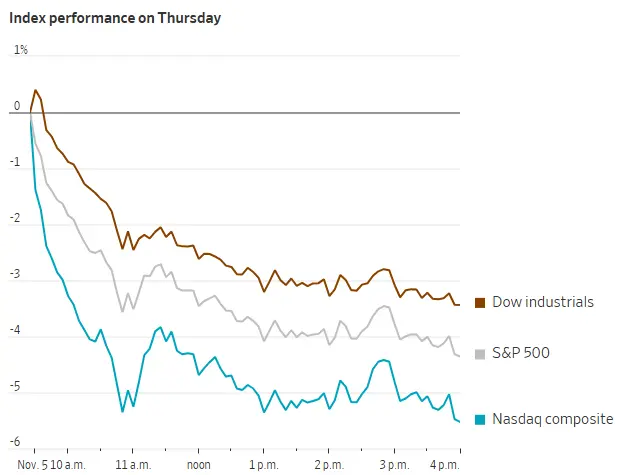
As of the close on November 5, U.S. local time, the decline of the three major indices, sourced from FactSet.
Technology stocks became the hardest hit by the sell-off. Chip companies like Nvidia and AMD saw their stock prices plummet, with the market value of the "Seven Giants" of technology shrinking by over a trillion dollars overnight. The decline spread to the storage, cloud computing, and data center supply chains, and the funds managed by "Cathie Wood" were also not spared.
Behind this sell-off, the market's attitude towards AI investment is changing.
In the past, the continuously expanding capital expenditures of tech giants were seen as proof of strong AI demand, supporting the high valuations of supply chain companies. Now, as investment scales continue to rise, investors are beginning to question: When will the hundreds of billions of dollars in AI investment be converted into revenue and profit?
The market's focus is shifting from chasing the scale of AI investment to examining the returns on AI investment.
01 Technology stocks collectively plummet, the market value of the Seven Giants shrinks by over a trillion
On November 5, the sell-off in technology stocks spread from chip companies to storage, server, and data center operators.
The Philadelphia Semiconductor Index fell nearly 11% at one point during the day, marking the largest intraday drop since March 2020, and ultimately closed down 5.23%.
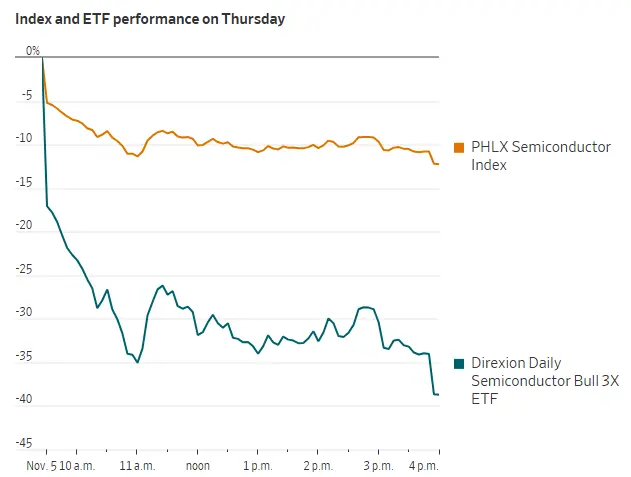
As of the close on November 5, U.S. local time, the decline of the semiconductor index, sourced from FactSet.
Among chip stocks, AMD fell by 17.3%, Micron dropped over 17%, Nvidia decreased by 9.3%, and companies like Broadcom, Intel, Arm, and Marvell also saw declines. The storage and hard drive supply chains were similarly under pressure, with SanDisk, Seagate, and Western Digital all experiencing significant drops.
Companies related to AI infrastructure were also not spared. Server manufacturers Dell, cloud computing service providers CoreWeave and Nebius, as well as data center operators IREN and Applied Digital were all affected. Data center power equipment supplier GE Vernova fell by 7.5%, indicating that the sell-off has spread to the energy and infrastructure sectors.
The so-called "Seven Giants" of U.S. stocks also faced a severe setback. The total market value of Apple, Microsoft, Nvidia, Amazon, Alphabet, Meta, and Tesla shrank by approximately $1.04 trillion in a single day. Among them, Nvidia fell by 9.3%, and Tesla dropped by 10.8%, leading the declines; Microsoft fell by 3.6%, Meta by 4.0%, and Amazon and Alphabet each dropped by about 2.2%, while Apple fell by 1.5%.
Not all individual stocks performed poorly. Advertising technology company AppLovin rose by about 31% after announcing strong performance and providing a forecast above market expectations. Funds are still seeking companies with performance support, but stocks closely tied to AI infrastructure investment and with high valuations have faced greater pressure.
02 Why did AI trading suddenly stall?
The immediate trigger for this round of sell-off was the results of the U.S. midterm elections.
The Democratic Party won control of both the House and Senate in this election and achieved key victories in data center hubs like Texas and Georgia. Some Democratic candidates had previously explicitly advocated for pausing or limiting data center development. The market is concerned that, as political forces opposing data center construction strengthen, future related projects may face stricter regulations, longer approval cycles, or even forced delays.
Additionally, this round of tech stock crashes is compounded by three noteworthy factors: doubts about AI investment returns, rising financing risks for data centers, and previously overly concentrated market trading.
First, AI investments are growing larger, but returns remain unclear.
Microsoft, Amazon, Alphabet, and Meta continue to increase capital expenditures, with large amounts of funds flowing into data centers, chips, and power facilities. In the past, the market viewed these investments as proof of strong AI demand, leading to rising valuations for related companies.
However, building data centers requires substantial upfront capital, and investments cannot be immediately converted into revenue. As capital expenditures continue to rise, investors are beginning to worry whether the revenue generated by AI businesses can cover construction costs and how much pressure ongoing expansions will place on corporate cash flow.
Second, AI infrastructure construction is increasingly reliant on external financing.
Tech giants have ample cash reserves, but some data center operators and new cloud service providers need to finance their computing power facilities through debt or equity. These projects involve large investments and long payback periods, making them sensitive to financing costs and construction timelines.
If financing conditions tighten, some projects may be forced to delay or scale back. The growth expectations for suppliers of chips, servers, storage, and energy equipment may also be affected.
Third, the concentration of AI stock trading has amplified market declines.
In recent years, AI-related stocks have continued to rise, attracting a large influx of funds. Some investors have also leveraged their positions to increase holdings.
When the market began to worry about investment returns, concentrated selling could trigger a chain reaction. Adjustments to leveraged positions, risk hedging, and systematic trading strategies could further exacerbate stock price volatility.
Steve Sosnick, Chief Strategist at Interactive Brokers, pointed out that investors were previously not eager to buy downside protection, but after the market suddenly turned, the demand for hedging quickly increased.
There are still differences on Wall Street regarding the future trend of AI trading.
David Rosenberg, founder of Rosenberg Research, is concerned that if data center construction slows, the growth expectations for chip and equipment suppliers will also be affected. Mohamed El-Erian, Chief Economic Advisor at Allianz, believes that the market may be overreacting to AI risks, and short-term stock price fluctuations do not directly negate long-term demand.
Currently, tech giants are still expanding AI investments, and the demand for cloud computing and computing power has not suddenly disappeared. However, investors are beginning to reassess how much profit these investments can ultimately generate and whether existing stock prices have already reflected future growth.
03 "Cathie Wood" increases positions against the trend
With the sharp decline in tech stocks, Cathie Wood, who heavily invests in high-growth tech companies, was also impacted.
Her ARK Innovation ETF (ARKK) has a highly concentrated portfolio. As of November 5, Tesla, SpaceX, Tempus AI, and Circle collectively accounted for over 28% of the fund's assets. With the sell-off in tech stocks, the fund faces significant pressure on its net asset value.
However, Wood did not stop buying. On November 5, ARK Invest's three ETFs collectively purchased 348,400 shares of SpaceX-related assets, with an estimated transaction amount of about $47.4 million, while selling approximately 46,200 shares of Alphabet stock.
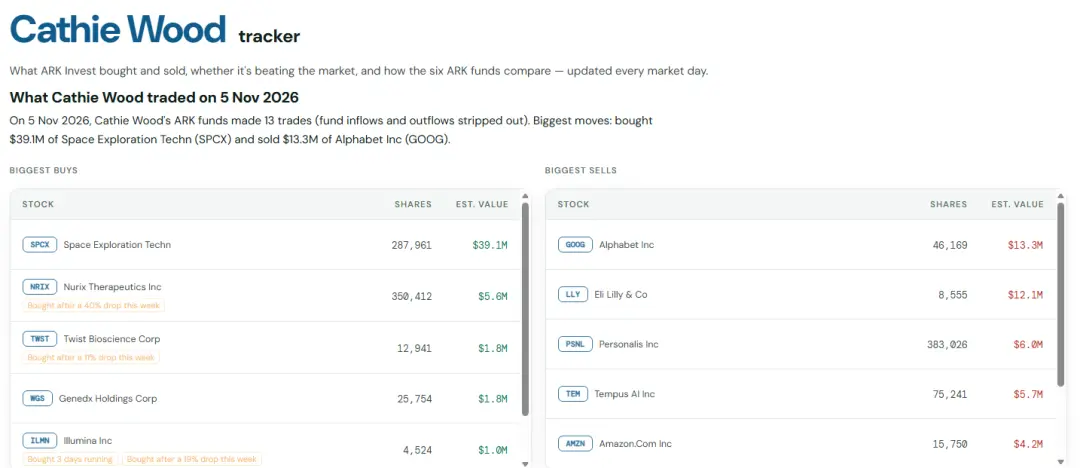
Wood's funds bought $39.1 million worth of SpaceX stock on November 5.
The market is reassessing the valuations of high-growth tech companies, but Wood continues to position herself against the trend. At least from the transactions on that day, she did not fully withdraw from high-growth assets due to this round of decline.