
AI trading retreat, U.S. stocks set a record "bloodbath" of 2.8 trillion! Nasdaq fell nearly 6%, chip index plummeted over 10%, data center industry chain plunged
On Thursday, November 5, Eastern Time, U.S. tech stocks faced a fierce sell-off, with a massive retreat in AI trading, causing a significant decline across the entire supply chain, including chips, cloud computing, data center energy, and optical communications. The Nasdaq Composite Index fell by 5.52%, marking the largest drop since the announcement of equivalent tariffs by the U.S. in April 2025. The Nasdaq 100 Index dropped about 6.4%, the largest decline since March 2020.
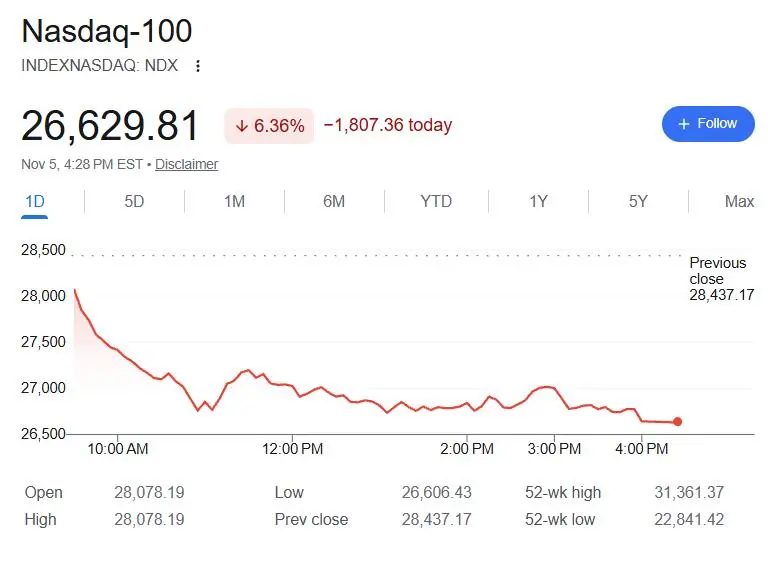
The tech stock sell-off quickly spread to the entire U.S. stock market. Among the three major U.S. indices, the Nasdaq closed down more than 10% from its record high on October 6, officially entering a technical correction zone; the S&P 500 fell by 4.36%, marking the largest single-day drop since April 2025; the Dow Jones, which surged 3% on Wednesday, opened up over 320 points but turned negative early, closing down over 1,830 points, a decline of 3.44%.
Media estimates suggest that the overall market capitalization of U.S. stocks evaporated by about $2.8 trillion in one day on Thursday, setting a new single-day record since the COVID-19 pandemic, surpassing the previous high of $2.69 trillion. Among this, the overall market capitalization of tech stocks evaporated by about $2.5 trillion on the same day.
This round of sell-off was not triggered by a single factor. The Democratic Party achieved significant victories in the midterm elections, prompting the market to reassess the potential policy and regulatory risks that U.S. data center construction may face. Meanwhile, the return cycle of massive capital expenditures in AI, financing costs, and the actual delivery capabilities of data center projects are increasingly being questioned. Qualcomm's performance and outlook failed to fully meet market expectations, and Microsoft's concerns about delays and cost issues with some emerging cloud service projects have made investors more cautious about the profitability prospects of the AI supply chain.
AMD down 17%, SanDisk plunges 22%, chip stocks face the worst sell-off since the pandemic
The semiconductor sector has become the hardest hit in this round of sell-offs. After the results of the U.S. midterm elections were announced, the Philadelphia Semiconductor Index (SOX), which had already fallen over 3% on Wednesday, further expanded its decline on Thursday, closing down over 12%, marking the largest single-day drop since March 2020, the early days of the COVID-19 pandemic.
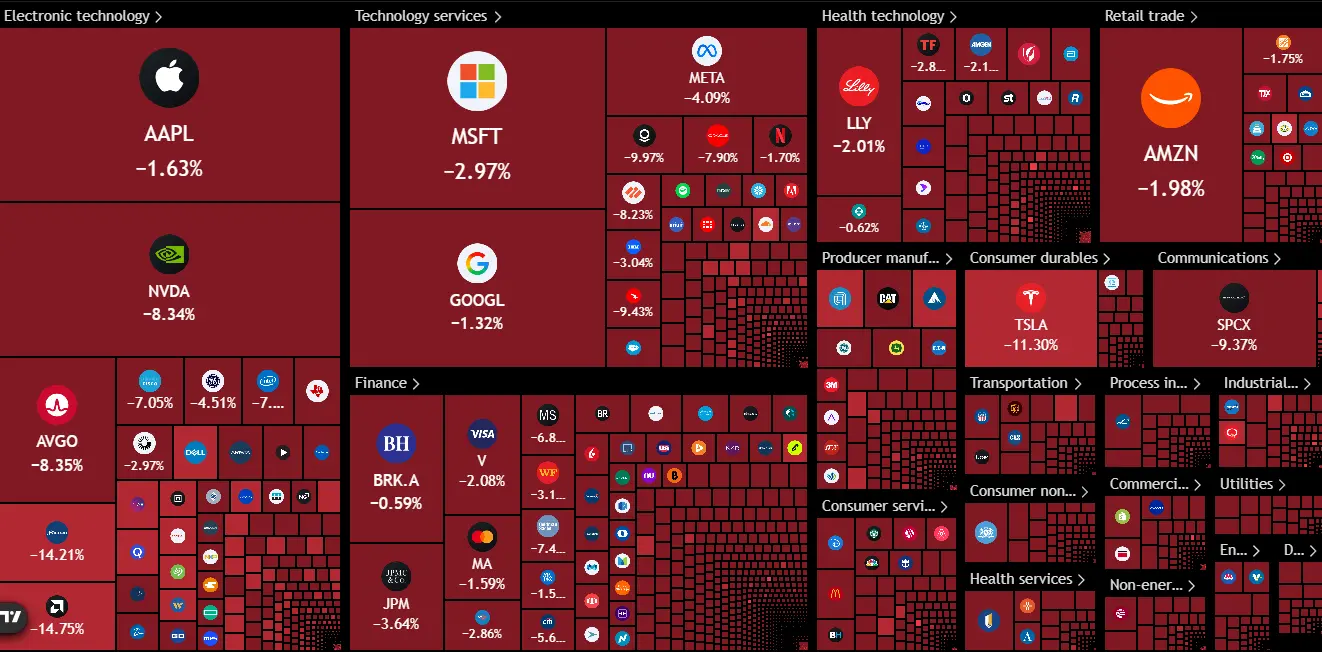
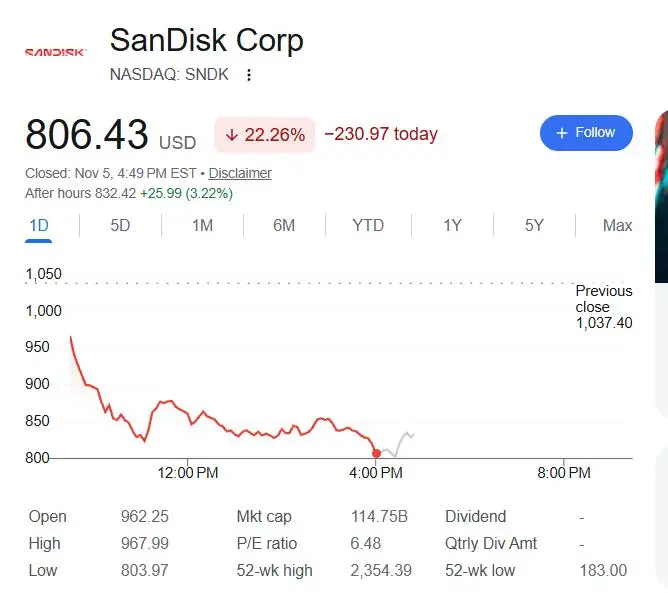
In terms of individual stocks, AI chip leader Nvidia (NVDA) closed down about 9.3%, erasing all accumulated gains for the year; SanDisk (SNDK) closed down about 22.3%, Micron (MU) fell about 17.5%, AMD (AMD) and Western Digital (WDC) dropped about 17%, Broadcom (AVGO) and Intel (INTC) fell about 10%, and Qualcomm (QCOM) closed down about 9.5%. Chip stocks, from AI computing leaders to storage chip manufacturers, were almost all affected.
The collective decline of chip stocks reflects both market concerns about the investment prospects for AI infrastructure and the previously high valuations and crowded funding levels in the semiconductor sector. The continuous growth in demand for AI computing does not mean that all chip manufacturers can simultaneously realize performance growth; investors are beginning to focus more on order fulfillment, product structure, profit margins, and the actual progress of capital expenditures converting into revenue.
Qualcomm's performance provided a direct negative catalyst for the chip sector. The company's latest performance and outlook failed to fully alleviate market concerns about weak smartphone business, especially as smartphone chip sales expectations fell short of Wall Street's expectations. Reuters pointed out that Qualcomm's fourth-quarter smartphone chip sales did not meet market expectations, with weak demand and declining revenue from Apple being significant drags.
Although Qualcomm is actively expanding into new markets such as data centers and automotive, the growth of new businesses has not yet fully translated into recent profit improvements. The market is not only reassessing Qualcomm's own profitability prospects but also examining whether the high growth expectations for the AI chip industry can be universally realized.
CoreWeave, Nebius, and other AI infrastructure companies plummet
The sell-off did not stop at chip manufacturers; other AI infrastructure-related companies also experienced significant declines.
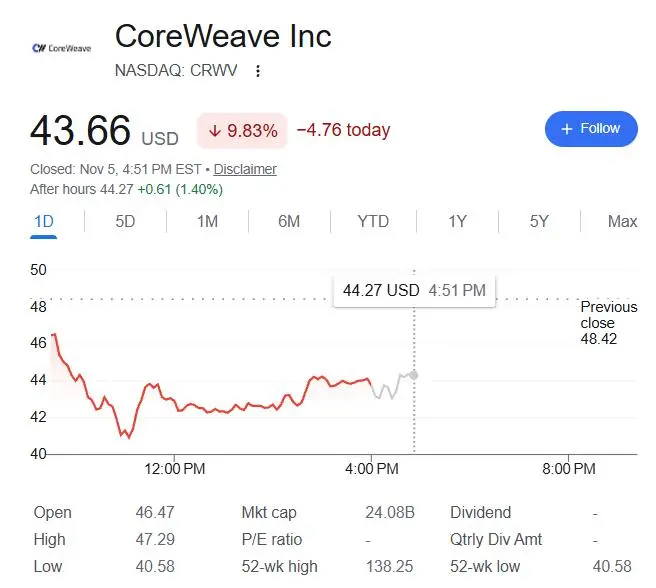
Emerging cloud service provider CoreWeave (CRWV), benefiting from the data center construction boom, fell over 10% during the day, closing down 9.8%. Nebius (NBIS) briefly dropped nearly 20%, closing down nearly 15%; data center energy supplier Bloom Energy (BE) saw its intraday decline exceed 20%, closing down 16.4%. Oracle (ORCL) briefly fell nearly 10%, closing down nearly 7%.
The optical communications sector also faced pressure, with Lumentum (LITE) closing down about 18.7% and Coherent (COHR) closing down about 13%. These companies share a common characteristic: their business growth relies to varying degrees on the continued expansion of AI data centers, making them more susceptible to changes in investor expectations regarding the speed of data center construction and capital returns.
Microsoft's recent change in attitude towards some emerging cloud service providers has also made the market more sensitive to the risks in the AI infrastructure supply chain.
Bloomberg reported on November 5 that Microsoft has become increasingly dissatisfied with delays and cost issues in its collaboration projects with some emerging cloud service providers (Neocloud), involving companies like IREN, Nebius, and Nscale. The delivery progress of related projects, infrastructure construction, and cost control issues highlight that while demand for AI computing is strong, completing and operating the planned data center capacity on time is not an easy task.
This is particularly important for emerging cloud service providers that rely on orders and financing support from large tech companies. They often need to invest large amounts of capital upfront to build data centers, purchase GPUs and supporting equipment, and then gradually recover costs by leasing computing power to customers. Once projects are delayed, they may simultaneously face issues such as delayed revenue recognition, increased financing costs, and cash flow pressure.
Therefore, the market's concerns are no longer just about how many AI data centers will ultimately be built, but whether these projects can be delivered as planned, whether they can secure sufficient power and equipment, and whether the massive capital invested can generate returns that match their valuations.
Tesla down over 10%, Mag 7 loses about $1 trillion in market value
Large tech stocks also could not escape this round of sell-offs.
Among the "Magnificent Seven" (Mag 7), Tesla (TSLA), which operates AI supercomputing infrastructure in Texas, closed down about 10.8%, while Nvidia closed down about 9.3%; Meta (META) closed down about 4%, Microsoft (MSFT) down 3.6%, Amazon (AMZN) and Google's parent company Alphabet (GOOGL) fell over 2% and nearly 2%, respectively, while Apple (AAPL), which opened high and closed low, had a relatively mild decline, closing down about 1.5%.
The Wall Street Journal reported that the overall market capitalization of tech stocks evaporated by about $2.5 trillion in one day, with the "Magnificent Seven" alone losing about $1 trillion. This round of sell-off not only impacted AI chip and data center companies that had previously seen significant gains but also put pressure on the valuations of large tech companies.
It is worth noting that the decline in large tech companies' stock prices does not necessarily mean that the market believes AI demand is disappearing. The deeper issue lies in the continuous expansion of AI infrastructure investment, but investors still lack certainty about when these investments will translate into profits and whether existing businesses can generate sufficient incremental revenue from AI.
Large tech companies are continuously increasing their expenditures on data centers, chips, and related infrastructure, with some companies also financing their investment plans through the bond market. Against the backdrop of still high interest rates, the scale of capital expenditures, financing costs, and investment return cycles are being scrutinized more rigorously.
The decline in tech giants' stock prices does not fully indicate that the market believes AI demand is disappearing. The deeper issue lies in the continuous expansion of AI infrastructure investment, but investors still lack certainty about when these investments will translate into profits and whether existing businesses can generate sufficient incremental revenue from AI.
Large tech companies are continuously increasing their expenditures on data centers, chips, and related infrastructure, with some companies also financing their investment plans through the bond market. Against the backdrop of still high interest rates, the scale of capital expenditures, financing costs, and investment return cycles are being scrutinized more rigorously.
Democratic Party's midterm election victory raises policy uncertainties for data center construction
Political factors are an important catalyst for this round of sell-off in AI infrastructure stocks.
In the U.S. midterm elections, the Democratic Party achieved significant victories, prompting the market to reassess the level of policy support from the U.S. government for the AI industry and the potential regulatory environment changes that data center expansion may face.
Previously, the Trump administration actively promoted AI infrastructure construction, viewing data centers, chips, and energy supply as important pillars for the U.S. to maintain its competitive advantage in AI. However, with the Democratic Party gaining an advantage in Congress, investors are concerned that the construction of AI data centers may face more scrutiny, especially regarding land use, energy supply, environmental requirements, and project approvals.
These concerns are not without a realistic basis. Residents and local governments in some areas of the U.S. have already expressed opposition to the rapid expansion of data centers, citing reasons such as the significant consumption of electricity and water resources by data centers and the potential increase in local residents' electricity bills. The Democratic Party's victories in some key states for data center construction have also made the market more attentive to potential changes in local policies.
However, policy risks do not necessarily mean that AI investment in the U.S. will stop. The more realistic impact may be longer project approval cycles, rising construction costs, and companies needing to reassess the site selection and investment pace for data centers.
AI investment returns and financing pressures questioned again, funds accelerate withdrawal from crowded trades
In addition to the policy uncertainties brought about by the midterm elections, market concerns about the business models and profitability of AI investments are deeper factors behind this round of tech stock adjustments.
In recent times, the explosive demand for AI has driven large tech companies to continuously increase capital expenditures, benefiting chip, cloud computing, data center, power equipment, and optical communication companies with valuation premiums. However, as the scale of investment continues to expand, the market has begun to shift from simply chasing AI demand growth to examining how much actual revenue and profit these massive investments can generate.
The Wall Street Journal pointed out that this sell-off has affected Asian chip manufacturers, U.S. power suppliers, computing service providers, software companies, and data center developers, with almost no corner of the tech supply chain being spared. Unlike previous capital rotations from AI stocks to other sectors, this sell-off has spread to all 11 sectors of the S&P 500 Index, indicating a broader contraction in market risk appetite.
At the same time, the AI companies' reliance on debt financing and the failure of some large tech companies' earnings reports to meet market expectations have also intensified investors' cautious sentiment. The market is not only worried about the scale of AI infrastructure investments being too large but is also beginning to question whether these investments can generate sufficient returns within a reasonable timeframe.
The Financial Times reported that some hedge funds are rapidly reducing their positions, shifting funds to cash, and there has been a noticeable decrease in investors willing to buy on dips. As the sell-off continues to expand, the previously accumulated high valuations and crowded trades in tech stocks have further amplified the declines.
In addition, the pressure faced by emerging cloud service providers is particularly evident. Compared to large-scale cloud service providers with strong financial backing, Neocloud companies often rely more on external financing and a small number of large clients. Once a data center project is delayed, or clients postpone receiving computing capacity, the company may face the issue of its initial investment not being converted into revenue in a timely manner.
From a market performance perspective, this is not merely a negative impact on the performance of a specific company, but rather a response to multiple factors affecting the previously highly concentrated AI trading: rising policy risks, doubts about capital expenditure returns, delays in some infrastructure projects, and individual chip companies' performance guidance falling short of expectations, all contributing to the withdrawal of funds from tech stocks.
On Wednesday, the clarity of the midterm election results drove a significant rebound in U.S. stocks, with the S&P 500 index recording its largest single-day gain in three months; however, just one trading day later, the market refocused on the policy, financing, and profitability risks within the AI industry chain. This historic sell-off not only erased the rebound following the election but also indicated that investors' attitudes toward AI trading are changing: from chasing computing capacity expansion to more rigorously examining investment returns, project execution, and valuations.
Risk Warning and Disclaimer
The market has risks, and investment should be cautious. This article does not constitute personal investment advice and does not take into account the specific investment goals, financial conditions, or needs of individual users. Users should consider whether any opinions, views, or conclusions in this article align with their specific circumstances. Investing based on this is at your own risk.