
Has the AI bubble in the US stock market already burst?
Author: Dong Jing, Wall Street Insights
Wall Street is experiencing a costly awakening.
As large tech stocks face the most severe monthly sell-off since March 2025, doubts about the return on investment in artificial intelligence infrastructure are rapidly intensifying, and signs of a retreat from AI trading are becoming increasingly evident.
On the last trading day of October, the market capitalization of U.S. stocks evaporated by over $1.5 trillion in a single month, with the Nasdaq Composite Index plunging 5.3% for the month, marking its worst monthly performance since March 2025; the S&P 500 Index has declined for two consecutive months.
Bert Dohmen and Dion Dohmen, senior analysts at market research and investment analysis firm Dohmen Capital Research, recently stated that this sell-off has spread from the AI and semiconductor sectors, triggering a chain reaction of massive leveraged liquidations and margin calls, with liquid assets like gold and silver also not spared.
Meanwhile, the market's questioning of whether AI capital expenditures can yield substantial returns has evolved from a fringe issue into a core cloud suppressing the entire sector.
Prominent institutions, represented by Elliott Investment Management, have been the first to issue warnings. According to an article by Wall Street Insights, Elliott, led by Paul Singer, explicitly stated in its October letter to investors that "almost every warning bell signaling a major bear market is ringing", comparing the current market environment to the "Roaring Twenties" before the Great Depression.
This judgment resonates strongly with the analysis by Bert Dohmen and Dion Dohmen in their latest article—both point to the same core question: Who will foot the bill for AI?
01 Trillion-Dollar Market Value Vanishes, AI is the Hardest Hit
The market's destructive power in October is shocking. Bert Dohmen and Dion Dohmen pointed out in their article that the $1.5 trillion market value evaporated in a single month is three times the approximately $500 billion crash on "Black Monday" in 1987.
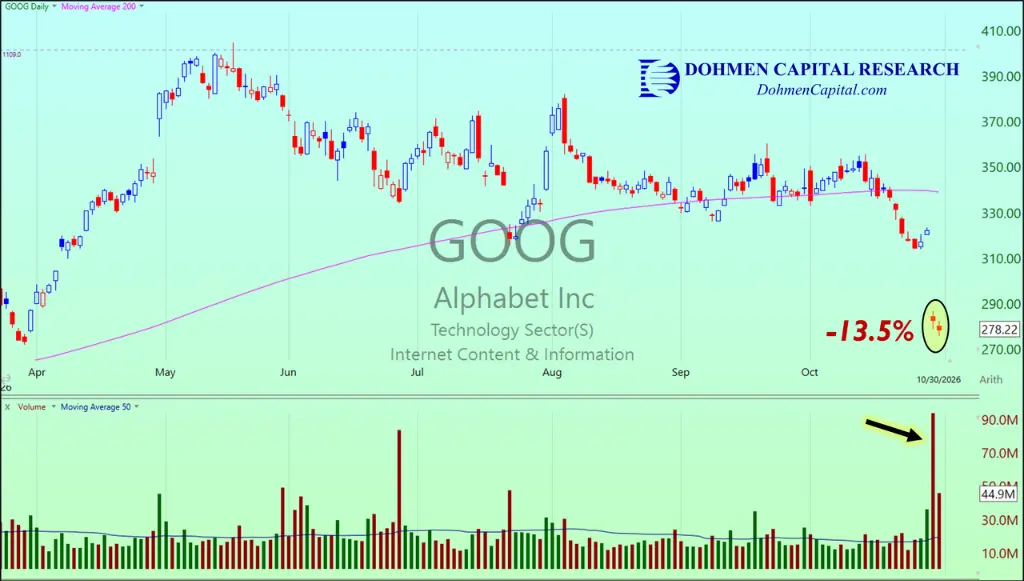
The fuse has been lit. After Meta's third-quarter earnings report was released after the market closed on October 21, market sentiment turned sharply; on October 28, Microsoft and Google released their earnings, with Google's parent company Alphabet plummeting 13.5% in a single day, dragging down the entire mega-cap tech sector.
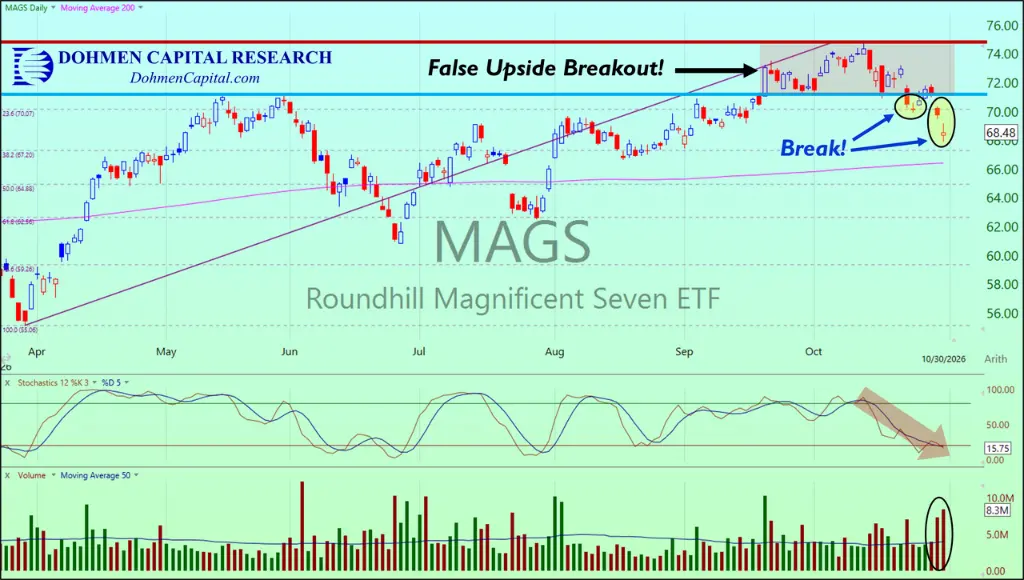
The MAGS ETF, representing the "Mag 7," has seen its momentum rapidly decline since its peak on October 13, and at the end of October, it closed below the critical support level of 70 points for two consecutive days, confirming the previous upward breakout as a false breakout.
It is worth noting that the actual peak of tech stocks and the semiconductor sector was formed as early as June this year, but the market did not trigger widespread attention at that time. The two Dohmens emphasized in their article that true market tops often appear months before a noticeable crash, and by the time most investors realize the risks, they are often already trapped.
02 Who Will Pay for AI? Core Contradictions Emerge
The fundamental driving force behind the current retreat from AI trading is the market beginning to confront a long-avoided question: Can massive investments in AI infrastructure translate into sustainable commercial returns?
Dohmen wrote in the article that concerns surrounding AI financing continue to fester, "casting a huge cloud over the market."
Elliott listed three specific concerns regarding the AI sector in its letter to investors:
The cyclical investment between AI model companies and AI infrastructure manufacturers, the capital expenditure expansion supported by debt, and the rising anti-AI social movement.
Elliott warned that if AI product pricing is challenged or market expectations for AI construction shrink, the impact on the market "could be historic, at least as severe as any bear market in the past few decades."
This logical loop is becoming evident in the market: mega-cap tech stocks enjoyed significant premiums due to the AI narrative, and when the commercialization of that narrative faces skepticism, the valuation system comes under pressure for reconstruction. Once leveraged funds heavily invested in these stocks begin to retreat, it will trigger margin calls, forcing investors to sell other assets to cash out, creating a chain reaction.
03 Signal Overlap: From FOMO to FOGO Emotional Shift
The underlying structure of market sentiment may be undergoing a qualitative change.
Elliott believes that the current bull market is supported by multiple factors, which constitutes systemic risk—once any one or two pillars, such as the expansion of the U.S. budget deficit, stubborn inflation, private credit risks, or the AI bubble, waver, market sentiment could abruptly shift from "fear of missing out" (FOMO) to "fear of getting obliterated" (FOGO), triggering a self-reinforcing chain collapse.
Elliott further characterizes the increasingly popular zero-day options trading and Meme stock betting in the current market as behaviors "closer to gambling," believing that these speculative activities are distorting the normal pricing mechanism of the market.
Elliott managing partner Jesse Cohn recently wrote on the X platform:
"The stock market feels different now because it truly is different. Winners keep winning, losers are getting crushed, and the market reactions during earnings season are becoming increasingly unpredictable, with greater volatility."
04 Institutions Shift to Defensive Stance, Waiting for "Tide to Turn"
In light of the aforementioned risk assessments, some leading institutions have begun to actively reduce their risk exposure and shift into defensive mode.
Elliott has shifted its investment focus to capital preservation. Singer and co-CEO Jonathan Pollock wrote in the letter:
"In Elliott's fifty-year history, there have indeed been quiet periods, but these periods have often been accompanied by market turmoil, followed by rare windows of opportunity. Our goal is to be well-prepared—protected against downside risks while holding capital that can buy cheap chips at market lows—waiting for the tide to turn again."
The two Dohmens also clearly advised in their article: Avoid buying the dip in AI and related stocks when they are falling. They likened it to a poker table saying—"If you can't tell who the sucker is, then the sucker is you."
05 Historical Reference: Tops Never Enter Quietly
Both Dohmen and Elliott are hinting at a counterintuitive market rule: The true market top often forms when the public is still unaware.
Dohmen pointed out in the article that the top of the AI and semiconductor sectors quietly formed in June this year, but it did not trigger sufficient vigilance at that time. Investors who added positions only after entering high levels are now facing significant unrealized losses and the psychological game of "reluctance to cut losses"—this is the classic path of accumulating trapped positions in a bear market and the source of the heavy selling pressure that every future rebound will encounter.
Elliott compares the current situation to the "Roaring Twenties" before the Great Depression, where there was also a combination of debt-driven risk appetite and new technology frenzy. History does not simply repeat itself, but often rhymes.