
Waiting for the final drop? Morgan Stanley's Wilson: Regardless of the election results, it could be a good opportunity to buy the dip in U.S. stocks
Author: Zhang Yaqi, Wallstreet News
Morgan Stanley's Chief U.S. Equity Strategist Mike Wilson stated that the adjustment in U.S. stocks since June has entered the "final stage." Once the midterm elections held tomorrow conclude, market uncertainty will significantly dissipate, and high-quality cyclical stocks may present buying opportunities.
In a client report released on Monday, Wilson pointed out that regardless of the election outcome, the midterm elections themselves constitute a classic "clearing event." He cited historical data indicating that since 1982, large-cap stocks have averaged a rise of about 15% (market-cap weighted) to 16% (equal-weighted) within six months after midterm elections, with the increase further expanding to about 22% over the following year.
Regarding the election results, Wilson believes that the scenario of the Democratic Party sweeping both chambers has been fully priced in by the market and does not constitute a significant surprise. Meanwhile, he also warned that post-election risks should not be overlooked—renewed military conflict with Iran and a new round of tariff policies are listed as the main potential threats.
Adjustment Nearing Conclusion, Market Showing Bottom Signals
Wilson and his team assess that the current adjustment is entering its final phase, based on resonance from multiple internal market indicators.
Among the constituents of the Russell 3000 Index, 60% have cumulatively fallen more than 20% from their June highs, while the S&P 500 Index has followed suit amid narrowing market breadth. Wilson noted that individual stocks declining ahead of the index, followed by the index catching up in decline, is a typical characteristic when the market is nearing a bottom historically.
From recent market dynamics, since the end of September, the yield on 10-year U.S. Treasuries has fallen nearly 40 basis points, and the proportion of S&P 500 constituents above the 200-day moving average has rebounded from about 42% to 62%, an increase of approximately 20 percentage points. The equal-weighted S&P 500 has risen nearly 5% during this period, outperforming the market-cap weighted index by about 6 percentage points. Wilson stated that this confirms the previous judgment—long-term interest rates are nearing their peak, and the equal-weighted S&P 500 is a more attractive expression of "broad-based trading."
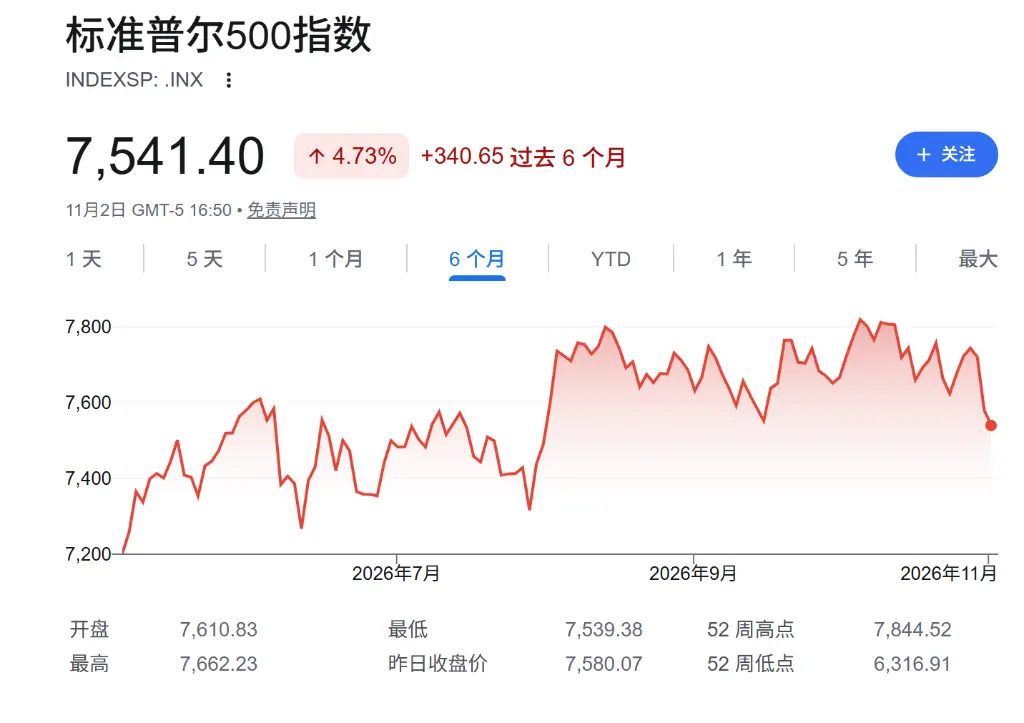
The Nasdaq 100 Index lost trillions of dollars in market value last month, coming close to a technical correction range. Wilson attributed the main trigger for this round of adjustment to the market's cautious attitude towards the earnings prospects of AI-related companies and emphasized that the investor assessment framework has shifted—free cash flow (FCF) gaps are no longer tolerated, and earnings sustainability and cash generation capabilities are weighted more heavily, aligning with the typical environment in the later stages of the economic cycle.
Limited Impact of Election Results, Policy Variables Remain Key
On the prediction markets Kalshi and Polymarket, the probability of the Democratic Party sweeping both chambers is 71% and 73%, respectively. Wilson believes this scenario has been digested by the market and is therefore unlikely to trigger a significant shock.
Even if the Democratic Party achieves full governance with a majority in the Senate, Wilson believes the direct impact may not necessarily be negative: delaying or reversing cuts to Medicaid and food stamps is expected to support consumer demand; companies may accelerate investment and merger activities in the short term to land before policy shifts in 2028.
However, Wilson emphasized that tariffs, foreign policy, and deregulation measures at the institutional level, which have had the most profound impact on the market over the past two years, are largely still directly dominated by the executive branch and will not change due to shifts in congressional seats. "The stock market typically does not, and will not, price in two years in advance," he wrote.
In the scenario where the Republican Party maintains control of the Senate—Kalshi shows a probability of about 24%—Wilson believes the market may be forced to extend its focus to 2028, assessing the risks of deregulation policies facing resistance.
Liquidity Supplement May Provide Additional Support
In terms of monetary policy, Wilson clearly stated that his judgment framework does not rely on the Federal Reserve shifting to rate cuts or introducing additional easing measures.
On the contrary, he views the decline in the balance of the U.S. Treasury General Account (TGA) as another path for liquidity supplementation. It is expected that the Treasury's cash balance will decrease from the current approximately $1.05 trillion to about $850 billion by the end of the year, and as government spending is executed, this portion of funds will flow back into the market, forming a certain liquidity buffer.
Regarding the Russell 2000 small-cap stocks, Wilson is relatively cautious, believing that the required decline in interest rates for effective recovery of this index is still greater than the declines that have already occurred. This means that at this stage, he prefers to allocate funds to high-quality cyclical large-cap stocks that have already undergone sufficient valuation corrections, rather than small-cap growth directions.