
Apple Conference: Gross margin hit by storage costs, supply chain for foldable screen Duo restricted, executives clarify AI commercialization path
The first "report card" of Apple's new CEO has set a record for fourth-quarter revenue, but Wall Street's optimism has faded due to underperformance in the Greater China region, pressure on holiday season gross margins, and an imbalance in supply and demand for foldable screens.
According to Wall Street Journal, after the U.S. stock market closed on November 2, Apple announced that its fourth-quarter revenue increased by 11.7% year-on-year to $114.477 billion, exceeding Wall Street's expectation of about $113.47 billion, and the growth rate was also higher than Apple's previously provided guidance range of 9%-11%.
Apple's fourth-quarter revenue exceeded analyst expectations, but weak sales in the Greater China region and holiday season guidance that fell short of some optimistic expectations put pressure on the stock price, which dropped about 4% in after-hours trading.
New CEO John Ternus attended the conference call for the first time, characterizing the performance in the Chinese market as "having great momentum," and stated that the production ramp-up of the iPhone Duo foldable phone is progressing smoothly, but supply constraints will continue to exert pressure in this fiscal quarter.
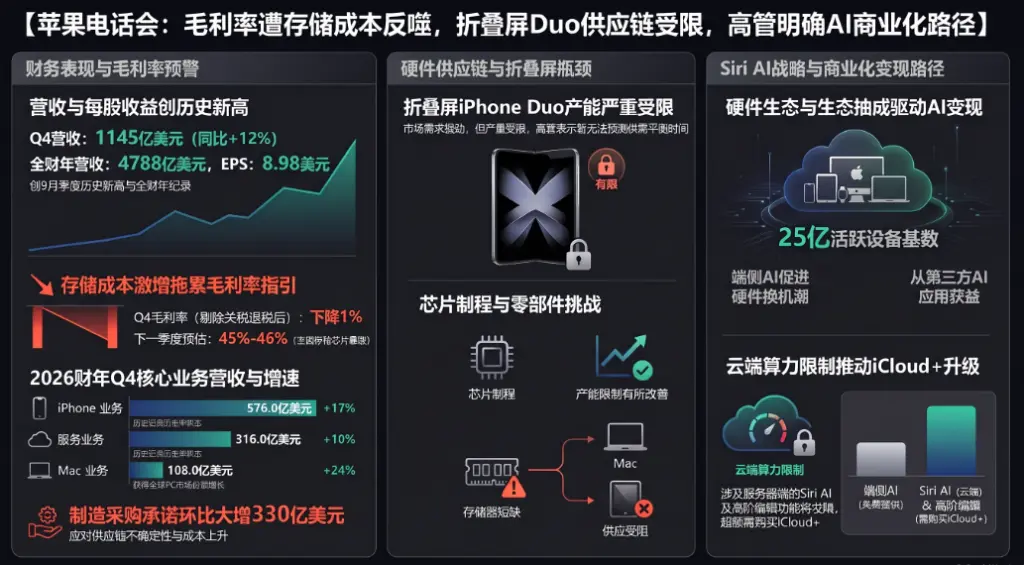
Memory price pressure was a core topic that repeatedly emerged during the conference call. Apple's management stated that the current trend of memory prices is "unprecedented," and the company has raised prices on Mac, iPad, and iPhone to partially offset costs, with manufacturing procurement obligations increasing by $33 billion from the June quarter to the September quarter.
The gross margin guidance for the December quarter is between 45% and 46%, significantly down from 47.9% in the September quarter, with management attributing the main reasons to higher memory costs and cloud inference costs brought by the launch of Siri AI.
Additionally, Ternus clarified the commercialization path for Siri AI for the first time. He revealed that features relying on server-side models, including Siri AI and smart image editing, will set usage limits, and users needing higher capacity can purchase extended access, integrating it into the iCloud+ subscription system.
Mixed Performance: Record Total Revenue, Disappointing Greater China
From an overall data perspective, Apple delivered a strong performance in the fourth quarter.
The company's total revenue for the fourth quarter reached $114.5 billion, a year-on-year increase of 12%, exceeding Wall Street's previous expectation of $113.47 billion. Among them, iPhone business revenue reached $57.58 billion, also surpassing the expected $56.49 billion.
Worldpanel survey data shows that the iPhone ranks among the best-selling models in the United States, urban China, India, the United Kingdom, Germany, Australia, and Japan. New CEO Ternus was generous in his praise when commenting on this performance:
Today, Apple is proud to report record revenue of $114.5 billion for the September quarter, a year-on-year increase of 12%... This is a perfect ending to our best fiscal year ever. We are ending this year with the most ambitious product lineup to date.
However, the market's focus quickly shifted to the performance in the Greater China region. Data shows that Apple's revenue in the Greater China region for the fourth quarter was $17.54 billion, nearly $1 billion less than the market consensus expectation of $18.75 billion.
In response to analysts' inquiries about the Chinese market, Ternus gave an optimistic response:
We are very satisfied with our performance in the Greater China market, which is mainly driven by iPhone and Mac.
He also mentioned the recent trip of the executive team to China, emphasizing that "there is a lot of growth momentum there." However, Bloomberg analysis pointed out that the underperformance in the Greater China region was largely due to the highly anticipated foldable phone iPhone Duo not being able to supply adequately during the reporting period.
Initial Signs of AI Commercialization Path: Usage Limits and "Dream Siri"
On the highly anticipated AI strategy, CEO John Ternus referred to the latest AI-driven Siri as a "new chapter" for the company. He emphasized multiple times during the conference call:
This is the Siri we have always wanted.
Regarding investors' concerns about how AI will generate revenue for the company, Apple provided a clear path: cloud AI limitations will serve as a booster for services.
Ternus reiterated that some server-side AI features will have usage limits. The direct purpose of this strategy is to encourage heavy users who want to exceed the default usage limits to subscribe to iCloud+ services.
However, Wall Street does not seem to fully buy into Apple's AI narrative. When asked whether AI agents would disrupt Apple's service business in the future and when Apple could launch agents that go beyond simple Q&A, Ternus chose to avoid the question. He only stated:
Currently, Siri is based on requests... but Apple sees opportunities to expand its capabilities over time. The most important thing is to protect people's data.
In terms of service business, Apple's service revenue for the fourth quarter was $31.57 billion, a year-on-year increase of about 10%, which was basically in line with expectations. However, CFO Kevan Parekh's guidance for service revenue in the next quarter was only "an increase of 8% to 9% year-on-year," which analysts believe suggests that the growth rate of this high-margin business is slowing down.
Supply Chain Pressure and Future Guidance: "Unprecedented" Storage Costs, Foldable Screen Capacity Still Ramp-Up
For the upcoming December holiday season (first quarter of fiscal year 2027), Apple provided a relatively positive overall revenue guidance. CFO Parekh stated:
We expect total company revenue for the December quarter to grow by 7% to 10% year-on-year, reflecting our best expectations under supply constraints. We expect this to be the best revenue quarter in the company's history.
CFO Kevan Parekh further pointed out that the cloud inference costs of Siri AI will be included in the cost of service sales and will adopt the same deferred recognition method as Maps, Siri, and iCloud, which will have a certain drag on the hardware business gross margin for the December quarter.
Parekh warned that the gross margin for the December quarter will be between 45% and 46%, below analysts' expectations of 47%, and significantly lower than the over 50% level in the June quarter.
The core pain point leading to gross margin pressure lies in costs and the supply chain. Ternus candidly stated during the meeting that the continuously rising storage costs are "unprecedented," and warned that the December quarter will face higher storage cost pressures.
To cope with this situation, Apple's procurement obligations have increased by $33 billion in the past few months. COO Sabih Khan, who participated in the earnings call for the first time, added that as Apple transitions more product lines to 2-nanometer chips, supply chain constraints will continue to ease.
Regarding the highly sought-after foldable phone iPhone Duo, management acknowledged the current imbalance between supply and demand. COO Sabih Khan stated that Apple is excited about the initial market response, and the Duo's capacity ramp-up is "progressing smoothly," but he also admitted:
At this moment, it is difficult to predict when supply and demand will reach balance.
Stable Capital Return, More Flexible Cash Policy
Apple's net profit for the fourth quarter was $30.7 billion, with diluted earnings per share of $2.10, a year-on-year increase of 14%, benefiting from a $0.05 favorable impact from tariff refunds. Operating cash flow was $28.1 billion.
As of the end of the quarter, Apple held $137 billion in cash and securities, with total debt of $80 billion. The company returned $28 billion to shareholders during the quarter, including $3.9 billion in dividends and equivalent items, as well as $24 billion in stock buybacks.
The board announced a cash dividend of $0.27 per share, payable on November 16, 2026, to shareholders registered as of November 12.
Kevan Parekh reiterated that Apple no longer aims for net cash neutrality but independently assesses cash and debt conditions to maintain flexibility. The company's capital allocation principle remains to prioritize investment in the business and return excess cash to shareholders.
Analysts believe that the key variables for investors in the future will be the speed of improvement in iPhone Duo supply, trends in memory costs, and whether Siri AI can translate into upgrades and service revenue growth while incurring costs.
Full transcript of Apple's Q4 fiscal conference call (AI-assisted translation):
Director of Investor Relations Suhasini Chandramouli: Good afternoon, and welcome to Apple's Q4 fiscal year 2026 earnings conference call. I am Suhasini Chandramouli, head of investor relations. This call is being recorded.
Today, we will first hear from Apple CEO John Ternus, followed by CFO Kevan Parekh. After that, we will open the floor for analyst questions.
Please note that today's discussion will include several forward-looking statements, including but not limited to revenue, gross margin, operating expenses, other income and expenses, taxes, and future business outlook. These statements involve risks and uncertainties that may cause actual results or trends to differ materially from those projected, including macroeconomic conditions, tariffs and other measures, and the potential impact of legal and regulatory processes on the company's business and operating performance.
For more information, please refer to the risk factors discussed in Apple's recent Form 10-Q and Form 10-K reports, as well as the Form 8-K filed with the SEC today along with the related press release. More information will also be included in our Form 10-K annual report for the fiscal year ended September 26, 2026, and other reports and documents filed with the SEC that we will submit tomorrow. Apple does not undertake any obligation to update any forward-looking statements, and such statements only reflect the situation at the time they were made.
Now, I will hand the floor to John for his opening remarks.
CEO John Ternus: Thank you, Suhasini. Good afternoon, everyone, and thank you for joining us. As Apple's CEO, this is my first time meeting with all of you, and I am honored. I am proud to represent our team and the work they do every day.
Apple is pleased to announce that this quarter's revenue reached $114.5 billion, a year-on-year increase of 12%, setting a record for the September quarter. This performance has helped Apple achieve the best fiscal year revenue and earnings per share in its history. This is an exciting moment in Apple's development. We have just completed one of the most product-intensive periods in the company's history, with remarkable innovations across all product lines.
Among them, one of the most representative achievements is the new iPhone Duo—this is the most transformative iPhone since the original iPhone. We are also very excited about the iPhone 18 Pro and 18 Pro Max, which have made significant leaps in camera, battery life, and performance, which are the features users value most.
At the same time, touch functionality has made its debut on the Mac platform, featured on the new MacBook Pro. We are also pleased to announce the new iMac and 14-inch MacBook Pro. The new iPad mini comes with a stunning OLED display, bringing ultra-thin design to the smallest member of the iPad family.
The Apple Watch now provides users with an unprecedented clear view of heart health monitoring. We launched AirPods 5, achieving industry-leading active noise cancellation in an open design. We have also laid the foundation for a smarter smart home experience with the new HomeView, Apple TV 4K, and HomePod mini.
In addition, we are releasing a more powerful AI experience across our entire product line, including the all-new Siri AI—a powerful, deeply personalized intelligent assistant that integrates seamlessly with all our platforms. Like all our products, Siri AI is built with necessary privacy protection mechanisms, ensuring that no one can access user data, including Apple itself.
We launched the beta version of Siri AI for U.S. English users in September and expanded it to French, Japanese, Korean, Portuguese, and Spanish users in October. We are very excited about the launch of these innovations, and there are more plans to come.
Looking ahead, I am confident about Apple's growth opportunities—whether it’s our product roadmap and extensive service layout, or in promising fields such as health, emerging markets, enterprise, and education.
For a specific example: we recently reached the largest education sector Mac collaboration agreement in Apple’s history with the Philippine Department of Education, deploying 170,000 MacBook Neos for teachers and staff. Such opportunities allow more users to integrate into our ecosystem and drive overall business growth.
Apple is the greatest company in the world. We have gathered a group of exceptional talents—top engineers, designers, developers, and experts across various business fields such as supply chain and retail stores. Every day, we bring together the best talents and ideas to create products and services that can change lives, all guided by a core set of values, adhering to the belief that "the best technology should make the world a better place."
We practice this belief by creating powerful, intuitive products that meet Apple’s consistently rigorous standards for quality, performance, design, and durability. This is the Apple experience that users love. With the launch of our latest product lineup, people have more reasons than ever to choose to upgrade or switch to Apple products.
At the same time, Apple services amplify the value of each device experience, helping people work, entertain, listen, watch, and stay connected with the world around them. I am very satisfied with the current position of our services business and its future direction. With a massive installed base of over 2.5 billion active devices, I look forward to continually expanding our service offerings and improving the lives of users worldwide.
We also see tremendous opportunities in the AI field. Siri AI marks a new chapter for Apple in AI. It is a thoroughly restructured intelligent assistant that is powerful, personalized, privacy-focused, and deeply relevant to users' daily lives. Siri AI can capture information relevant to users, understand content on the screen, and engage in natural, fluid conversations to help users manage daily tasks. This is the Siri we have always envisioned. We are very pleased with the feedback and reviews received and are excited that more and more users can experience it.
The iPhone has always been at the core of our strategy, serving as the smart personal hub that accompanies users, understanding their personal context—from messages, photos, and notes to various applications, providing powerful intelligent services precisely when users need them.
The Mac is also entering its own AI era. The Mac is the product that introduced me to Apple, opening up a world of infinite possibilities over the years. More than 40 years after the first Mac was born, this product line is experiencing its most glorious moment in history—every Mac in our latest lineup is a powerful AI platform. The Mac mini and Mac Studio, in particular, are breaking boundaries in the realm of local private AI, enabling users to achieve what was once unimaginable.
From Mac to iPhone to iPad, we take pride in our products being the best AI platforms in the industry, whether for first-party or third-party applications, and we are excited about the opportunities this brings.
Everything Apple does ultimately revolves around our users. The success of each innovation is ultimately measured by its impact on people's lives. This is what drives us to continuously create exceptional products and deliver them to users around the globe.
Now, let’s take a closer look at this quarter's performance. As mentioned earlier, Apple performed exceptionally well this quarter. While total company revenue reached a new high for the September quarter and fiscal year, the iPhone also set a revenue record for the September quarter, perfectly concluding its best fiscal year ever.
The services business also set a historical high this quarter, adding to our best service business fiscal year ever. We achieved growth in the vast majority of markets we track, with the Americas, Europe, Greater China, and other Asia-Pacific regions all setting revenue records for the September quarter. We also set revenue records for the September quarter in both mature and emerging markets, with India achieving its highest record ever.
iPhone Business:
iPhone revenue for this quarter was $57.6 billion, a 17% year-over-year increase, despite supply constraints and foreign exchange headwinds. We achieved strong double-digit growth in the U.S. and Greater China, reaching a revenue record for the September quarter. At the same time, the number of global upgrade users also set a record this quarter, with the U.S., mainland China, and India all achieving historical highs, helping us achieve the best fiscal year performance for global upgrade users ever.
At the launch in September, we introduced the all-new iPhone Duo. From the very beginning, we knew clearly what we wanted to create: a device with a larger display and a foldable form factor that feels as natural and intuitive as an iPad. We designed the hardware and software in tandem, making it undoubtedly an iPhone in appearance while pioneering a new way of use. The result is a series of outstanding innovations, and we believe this will redefine the boundaries of foldable phones.
We are very proud of the team's achievements. Developers are quickly adapting to this new form factor, and more applications are being optimized for the iPhone Duo, which excites us. Early feedback from reviewers and users has been encouraging, and we are working hard to get the iPhone Duo into the hands of more consumers as soon as possible.
We are also very satisfied with the market response to the iPhone 18 Pro and Pro Max. The reasons consumers favor them are obvious. Our latest models feature a significantly upgraded camera system, bringing groundbreaking improvements such as a variable aperture and new photography styles. The A20 Pro chip combined with the new generation of thermal plates delivers the highest sustained performance ever seen in an iPhone. The iPhone 18 Pro Max also achieves the largest battery life improvement in iPhone history. The A20 Pro also features a new dual 16-core neural engine, accelerating on-device AI and computational photography capabilities.
Mac Business:
Mac revenue for this quarter was $10.8 billion, a 24% year-over-year increase, despite also being affected by supply constraints. We achieved double-digit growth in most of the markets we track, with emerging markets performing particularly strongly, setting a revenue record for the September quarter. At the same time, the number of first-time Mac buyers also reached a new high for the September quarter.
According to IDC data, we achieved an increase in global market share this quarter and for the full fiscal year. This fiscal year, Mac sales also reached a historical high, which is the strongest testament to these outstanding products.
Last week, we launched a brand new way to experience Mac: the new MacBook Pro with PROLED XDR display, which brings touch functionality to the Mac platform for the first time, along with the best professional notebook display we have ever launched, all-day battery life, and the most immersive notebook audio experience, all integrated into a thinner and lighter design.
We also brought the powerful performance of the M6 chip to the new 14-inch MacBook Pro and the new iMac. The latest generation of Apple chips features the world's fastest CPU cores, accelerating everyday tasks, as well as a dual 16-core neural engine for driving local private AI tasks.
iPad Business:
iPad revenue for this quarter was $6.2 billion. Last week, we launched the all-new iPad mini, featuring a stunning OLED display, ultra-thin design, and powered by the A20 Pro chip. With this new addition, our iPad product lineup is stronger and more diverse than ever. No matter where users are, the iPad provides unique value—whether helping students explore the world in classrooms or offering vast creative space for artists and creatives in design studios.
Wearables, Home, and Accessories Business:
Revenue for this quarter was $8.3 billion. The Apple Watch has made the simple act of wearing a watch a powerful way to care for health. We are excited to introduce a new health sensor system that helps users fully leverage the value of health tracking. Combined with Apple’s most powerful wearable chip, the S11, the health sensor system achieves the most accurate heart rate monitoring in wearable devices.
We also introduced new features such as health age and readiness status, along with a newly designed health app that helps users determine when to increase exercise intensity and when to take appropriate rest. We look forward to the official launch of audio intelligence features through future software updates, helping users capture those memorable moments that might be forgotten.
The Apple Watch Series 12 incorporates all of these features into a sleek and beautiful design, while the Apple Watch Ultra 4 goes further, offering longer battery life compared to the previous generation and the most accurate on-device GPS in a sports watch.
AirPods 5 offers the best open active noise cancellation experience in its class at an excellent price, while also improving sound quality, battery life, and durability. Combined with the iPhone and Apple Intelligence (including Siri AI), AirPods enable users to achieve remarkable functionalities, such as communicating with people speaking different languages through real-time translation or freeing their hands to access a wide range of world knowledge answers.
Just a few weeks ago, we launched a new generation of home hardware products. This includes Apple HomeView—designed for core family scenarios while catering to the personalized needs of each family member, integrating entertainment, connectivity, and home management.
Additionally, we also launched the new Apple TV 4K (now smarter with Apple Intelligence), the all-new HomePod mini, and the Apple Home Collection—a new project that extends Apple Home beyond its own products through deep collaboration with core partners. All of these products continue to be built on Apple’s privacy philosophy.
Services Business:
Service revenue was $31.6 billion, a 10% year-over-year increase, setting a historical high. We achieved double-digit growth in most of the markets we track, with the Americas and Europe setting historical revenue records, and other Asia-Pacific regions achieving new highs for the September quarter.
The 78th Primetime Emmy Awards were a memorable highlight for Apple TV+, with our shows winning more awards than any other television network. The year’s hottest series, "Widow's Bay," set a historical record for the most awards won by a single comedy in a single year with 14 awards. We are excited about our program content—from fan favorites like "Slow Horses" and "Ted Lasso" to the upcoming film "Being Heumann." To date, Apple TV+’s produced content has accumulated over 900 awards and more than 3,800 nominations.
In terms of Apple Pay, we recently partnered with Axis Bank to officially launch in India, bringing a convenient and secure payment experience to one of the largest markets in the world. Currently, Apple Pay has expanded to over 90 markets, allowing global users to feel the embedded assurance in every transaction.
The mission of Apple Music is to bridge the gap between artists and fans. With the opening of the Apple Music Hall, we now have a brand new exquisite performance venue that further closes the distance between both parties. To celebrate the opening of this London venue, we hosted an unforgettable performance by Elton John.
People love Apple's products and services because they make life easier and better in countless ways. People also rely on Apple to create technology responsibly—doing the right thing instead of taking shortcuts. This means using more recyclable materials in products and reducing the demand on Earth's resources; it means creating more durable products that last longer.
This means developing smart features like voice recognition on the Apple Watch, which reminds users with hearing disabilities to pay attention to their surroundings; it means designing privacy protection mechanisms like on-device processing, ensuring personal data remains on user devices; and it also means introducing new child safety features that make it easier for parents to manage their children's device usage time and methods.
We are also pleased to expand our manufacturing footprint in the United States. Through our "Made in America" initiative, we are deepening our collaboration with suppliers across the country, including Perryman, which provides titanium materials for the iPhone Duo, and Qnity Electronics, which supplies camera technology for the new variable aperture system in the iPhone 18 Pro. In our latest generation of iPhones, nearly 100 components come from U.S. companies spread across more than ten states.
In total, Apple supports over 450,000 American jobs through thousands of suppliers and partners across all 50 states. This is all part of our commitment to invest $600 billion in U.S. innovation and advanced manufacturing over the next four years.
I am proud of the achievements we have made this quarter and look forward to the future with great anticipation. We have everything we need to achieve excellence. With this team, this vision, this mission, and these values, I am confident we will reach our goals.
Next, I will hand over the floor to Kevan.
Chief Financial Officer Kevan Parekh: Thank you, John. Good afternoon, everyone. Here is a brief overview of our key financial metrics.
This quarter's revenue was $114.5 billion, a year-over-year increase of 12%, setting a record for revenue in the September quarter. This strong performance was achieved despite nearly 2 percentage points of continuous foreign exchange headwinds and supply constraints for iPhone, Mac, and iPad.
Product revenue was $82.9 billion, a year-over-year increase of 12%, primarily driven by strong double-digit growth in iPhone and Mac. The active installed base of over 2.5 billion devices reached a new all-time high, with all major product categories and regions hitting record levels. Service revenue was $31.6 billion, a year-over-year increase of 10%. Several service categories performed strongly, with video, cloud services, payment services, and advertising all setting records, while music reached a new high for the September quarter.
The overall gross margin for the company was 47.9%, with a product gross margin of 37.2%. Both benefited from tariff refunds, which had a positive impact of about 1 percentage point on the September quarter's gross margin. Excluding the impact of tariff refunds from the June and September quarters, the overall and product gross margins would have declined by about 1 percentage point, primarily driven by rising memory costs. As of the September quarter, we have received refunds for the vast majority of the tariffs paid. The service gross margin was 76%, up 40 basis points quarter-over-quarter. Operating expenses were $19.2 billion, a year-over-year increase of 21%, reflecting our continued investment in research and development.
Net profit was $30.7 billion. Diluted earnings per share were $2.10, a year-over-year increase of 14%, which includes a positive impact of $0.05 from tariff refunds. Even excluding the contribution from tariff refunds, net profit and earnings per share both set records for the September quarter. Operating cash flow also performed strongly, reaching $28.1 billion.
This performance marks our best fiscal year to date: total revenue reached $478.8 billion, a year-over-year increase of 15%; fiscal year earnings per share were $8.98, a historic high, up 20% year-over-year.
Next, I will provide further details on each revenue category.
iPhone: Revenue was $57.6 billion, a year-over-year increase of 17%, despite supply constraints. We achieved double-digit growth in most of the markets we track, with both mature and emerging markets setting revenue records for the September quarter. As John mentioned, this fiscal year has seen the best performance in the company's history, covering every region globally. The active installed base of iPhones reached an all-time high, with the number of upgrade users in the U.S., mainland China, India, and Japan all setting annual records. According to a recent survey by Worldpanel, the iPhone is the best-selling model in the U.S., urban China, India, the U.K., Germany, Australia, and Japan.
Mac: Revenue was $10.8 billion, a year-over-year increase of 24%, despite supply constraints. The growth was primarily driven by strong performance from MacBook Neo and MacBook Pro. Both mature and emerging markets achieved double-digit growth, with markets like India and Southeast Asia setting all-time highs. The Mac business in emerging markets continues to perform exceptionally well, achieving the best fiscal year performance in emerging markets driven by record numbers of upgrade users and new Mac users.
iPad: Revenue was $6.2 billion, a year-over-year decrease of 10%, primarily impacted by supply constraints and ongoing comparative pressure from the previous year's launch of the iPad with the A16 chip. The iPad installed base reached a new all-time high this quarter, with over half of iPad purchasers being first-time buyers.
Wearables, Home, and Accessories: Revenue was $8.3 billion, a year-over-year decrease of 8%, primarily facing comparative pressure from the previous year's launch of Watch SE 3 and AirPods Pro 3. The installed base of wearables reached a new all-time high, with over half of the users purchasing an Apple Watch this quarter being first-time buyers.
Services: Revenue reached a record high of $31.6 billion, a year-over-year increase of 10%, despite facing over 1.5 percentage points of continuous foreign exchange headwinds. We set historical revenue records in most of the markets we track, including several emerging markets like Latin America and India. We are optimistic about the long-term growth prospects of our services business. With a large installed base of over 2.5 billion active devices, we have laid a very solid foundation for future growth.
Our services continue to attract more users, with both paid transaction accounts and paid accounts reaching all-time highs this quarter. The number of paid subscriptions also achieved double-digit growth, surpassing 1.5 billion, setting a new record. We are continuously optimizing and expanding our service offerings—for example, upgrading the iCloud+ plan in over 100 countries and regions to include Apple TV and Apple Arcade, and launching Apple Maps ads in the U.S. and Canada to provide local merchants with new channels to reach users while protecting user privacy.
Enterprise Market:
Various enterprises are continuously expanding the deployment of Apple devices to drive operational transformation and enhance productivity. Duke University Health System utilized Apple Vision Pro and Stryker FDA-authorized applications to complete the first hip arthroscopy surgery. American Airlines is deploying over 37,000 iPhone 17 devices to flight attendants for in-flight purchases using Tap to Pay, while equipping pilots and mechanics with 25,000 iPads.
More and more enterprises are choosing to use Macs in a wider range of scenarios, including on-device AI applications. For example, Gap Inc. is utilizing Mac mini to run AI locally in hundreds of stores for loss prevention management, eliminating cloud token costs; Christie's auction house is running local models on Mac Studio to improve core productivity workflows, such as the valuation process.
Cash Position and Capital Return:
At the end of this quarter, we held $137 billion in cash and securities, with total debt of $80 billion. This quarter, we returned $28 billion to shareholders, including $3.9 billion in dividends and equivalents and $24 billion in stock buybacks.
December Quarter Outlook:
Looking ahead to the December quarter, the following outlook includes forward-looking information mentioned earlier by Suhasini. It is important to note that our forecast assumes that global tariff rates, policies, and enforcement remain the same as they were at the time of this conference call, and that the global macroeconomic situation does not worsen beyond today.
We expect total company revenue for the December quarter to grow year-over-year by 7% to 10%, reflecting our best forecast under supply constraints. We anticipate this will be the highest revenue quarter in the company's history.
We expect service revenue for the December quarter to grow year-over-year by 8% to 9%, primarily considering the continuous headwinds from third-party licensing and foreign exchange.
We expect gross margins to be between 45% and 46%, primarily impacted by rising memory costs and costs associated with the promotion of Siri AI. We expect operating expenses to be between $20.4 billion and $20.8 billion. We expect OI&E to be approximately $300 million, excluding potential impacts from minority equity investments at fair value; the tax rate is expected to be around 17%.
Finally, the board today announced a cash dividend of $0.27 per share of common stock, which will be paid on November 16, 2026, to shareholders of record as of November 12, 2026.
Next, I will hand the floor back to John.
Chief Executive Officer John Ternus: Thank you, Kevan. Before we move into the Q&A session, I would like to introduce Apple’s Chief Operating Officer, Sabih Khan.
I believe everyone is familiar with Sabih's work in global operations and supply chain, as he has long led several important functions at Apple, including manufacturing, AppleCare, environmental initiatives, and global supplier relationship management.
Sabih and his team are the core pillars that enable us to build and deliver products at an unparalleled scale and quality. Today, I invite Sabih to join me along with Kevan to answer your questions.
Director of Investor Relations Suhasini Chandramouli: Thank you, John. Please limit your questions to two each. Operator, please open the first question.
Q&A Session
Question 1: Goldman Sachs Analyst Michael Ng
Michael Ng: Good afternoon, thank you for the opportunity to ask questions. I have two questions.
The first question is about the iPhone 18: the standard version was not included in the September launch lineup. I would like to ask the reason for this—does it involve supply constraints or component considerations, or is it related to the Duo's launch? Any information would be welcome.
John Ternus:
We were pleased to launch the iPhone Duo and iPhone 18 Pro in September, while the iPhone 17, iPhone Air, and iPhone 17E will continue to enhance our strong product lineup for the holiday season. We do not comment on future product roadmaps, but we are satisfied with our current product lineup.
Michael Ng:
Okay, thank you. The second question is about iCloud+. This seems to be becoming a more strategically significant product, with its integration into home security and the potential monetization opportunities of Apple Intelligence both worth noting. How is iCloud+ performing currently? Especially in the context of rising prices for iPhone storage options and the company's continued efforts in the home product sector, have you observed an increase in the attach rate?
John Ternus:
In the September quarter, our cloud services revenue reached an all-time high. We are very optimistic about iCloud+. Currently, the iCloud+ plan covers Apple TV and Apple Arcade in over 100 countries and regions, and we believe this will help us reach a large number of potential new subscribers.
Additionally, as you mentioned, we believe there are good opportunities for the commercialization of Apple Intelligence. For features that rely on server-side models (including Siri AI, smart photo editing, etc.), usage limits will be set, and users with higher demand can purchase extended access in the future. To some extent, the tiered setup of iCloud initially revolved mainly around storage capacity, but we have been continuously adding more features and capabilities.
Question Two: Morgan Stanley Analyst Erik Woodring
Erik Woodring: Thank you, John, and congratulations on your first quarter as CEO. As AI evolves from chatbots to consumer agents, the opportunities and risks facing Apple seem to be increasing. What role do you envision for Apple and Siri AI in the consumer AI agent ecosystem? How do you view the potential risks that some AI agents may pose to Apple's service business? I have a follow-up question as well.
John Ternus:
We are very excited to launch Siri AI with the latest generation of Apple Intelligence features. Siri has long been loved by users, handling over 2.5 billion requests daily. Siri AI truly realizes the form of Siri that we have always envisioned. Currently, it is primarily request-driven, but as we introduced at WWDC, it is built on a modern orchestrator-driven architecture, providing ample room for us to expand its capabilities in the future.
Regarding agent capabilities, we believe this is a promising tool for users. We want to ensure that users understand what access permissions they are granting and that this process is implemented in a way that protects security and privacy. We have put a lot of effort into this with Siri AI, and we firmly believe that Apple devices are the best platform for experiencing various AI applications.
Erik Woodring:
Okay, thank you. The follow-up question is, from a macro perspective, how should we understand the sustainability of service business growth? The September quarter was 10%, and the December quarter is slightly lower than that. With the evolution of the search landscape and the impact of regulatory changes on App Store monetization, are there new service categories that could significantly offset the pressures faced by these historically important revenue sources?
Kevan Parekh:
In the September quarter, the service business grew by 10% year-over-year. Compared to the June quarter, foreign exchange was the main driver of the year-over-year growth rate change. In the September quarter, we continued to see strong performance across multiple service categories, with video, cloud services, payment services, and advertising (including Apple’s own advertising) all reaching all-time highs, and music setting a record for the September quarter.
It is also important to take a broader view of the service business trends over the past few quarters. In the last earnings call, we anticipated that foreign exchange would be the biggest driver of year-over-year growth rate changes from the March to September quarters, which indeed resulted in a significant headwind of about 4 percentage points. Entering the December quarter, we expect the service business to continue facing an additional continuous foreign exchange headwind of about 0.5 percentage points.
Additionally, the performance of the App Store has also been influenced by several factors. In the September quarter, the App Store's performance was roughly on par with the previous year, with the number of paid subscriptions reaching an all-time high, and paid subscriptions for third-party apps on the App Store achieving double-digit growth. At the same time, we also saw the headwinds in the mobile gaming sector mentioned earlier, and we expect this trend to continue into the December quarter. Notably, we have adjusted the App Store business model in some countries, and in the U.S., we continue to operate based on court rulings affecting external link transactions.
Looking ahead, we expect service business growth in the December quarter to be between 8% and 9%. This forecast takes into account the best estimates of third-party licensing and about 0.5 percentage points of foreign exchange headwinds. Now, let’s have John add some long-term perspectives.
John Ternus:
Fundamentally, we are very optimistic about the long-term growth opportunities for the service business. The installed base of over 2.5 billion active devices continues to grow, which is the fundamental basis for future growth, and this base will continue to expand as more users experience our products and services.
For example, in the September quarter, the weekly average number of visitors to the App Store approached 1 billion, setting a record; the number of users paying for at least one service also reached an all-time high. Additionally, we launched Apple Pay in India in partnership with Axis Bank, bringing a convenient and secure payment method to one of the largest markets in the world. On top of that, as mentioned earlier, we believe Apple Intelligence will also bring new growth opportunities. Overall, we are very confident in the long-term direction.
Question Three: Evercore Analyst Amit Daryanani
Amit Daryanani: Thank you, and congratulations to John for hosting the earnings call for the first time. John, you described the iPhone as a "smart personal hub" in your opening remarks. As personal AI agents become more prevalent, do you think the primary relationship center for users may shift from devices to agents? Given Apple’s high integration of chips, hardware, and software, where do you see the biggest opportunities in integrating elements like personal context and screen awareness into agents that can go beyond Q&A functionality? How is Siri currently progressing in integrating these elements?
John Ternus:
We do indeed see the iPhone as a smart personal hub. A large amount of personal data is stored on the iPhone—contacts, communication records, health data, financial data, etc. Siri can access this data to help users obtain the information they need in a secure and private manner, with no third party able to access it, including Apple itself.
We believe this is Apple’s core differentiating advantage, and we will continue to deepen our efforts in this direction, which is an area we are very confident in.
Amit Daryanani:
Understood. Kevan, regarding the gross margin for the December quarter, I would like you to elaborate. Excluding all tariff refunds, the gross margin decline is about 140 basis points quarter-over-quarter. Can you break down the contributions from memory product inflation, product mix, and the operating memory costs of Siri AI? I would like to understand the various factors influencing the quarter-over-quarter gross margin changes.
Kevan Parekh:
As you mentioned, the gross margin forecast range for the December quarter is 45% to 46%. After excluding the impact of tariff refunds from the September quarter, the midpoint of the range indeed reflects the quarter-over-quarter decline you mentioned. We expect that most of the decline will be driven by rising memory costs. Let John provide a macro perspective on this first, and then I will address the remaining parts.
John Ternus:
Current memory pricing trends are unprecedented. In the September quarter, we did see memory costs rise compared to the June quarter, but this was partially offset by cost advantages from inventory carryover and declines in the costs of certain non-memory components.
Entering the December quarter, we expect memory costs to rise further, but several factors will provide partial offsets: we adjusted prices for Macs and iPads at the end of June and for iPhones in September, which provided some offset; we also expect to benefit from inventory carryover in the December quarter; additionally, costs for certain non-memory components are also expected to decline.
Looking beyond the December quarter, we see that memory procurement prices will continue to rise. As mentioned earlier, the cost benefits from inventory carryover will gradually diminish over time.
One more point to add: to improve supply, our manufacturing procurement obligations increased by $33 billion from the June quarter to the September quarter, and the specific figures will be reflected in the annual report to be released tomorrow.
Kevan Parekh:
Regarding Siri AI, as we continue to roll out Siri AI to more users, the related cloud costs will be included in the cost of service sales. Consistent with how we have traditionally handled bundled services like Maps, Siri, and iCloud with sold devices, we will defer a portion of the revenue and gradually recognize it over the device's lifecycle. Therefore, the hardware deferral for the December quarter will reflect the new portion of Siri AI. Both of these will impact the gross margin.
However, we remain committed to making necessary investments to support business growth. At the same time, we also see AI contributing to revenue growth in various ways: at the product level, AI provides ample reasons for users to upgrade or switch to Apple’s latest products; we also see opportunities at the third-party application and partner levels, as well as proprietary business opportunities in areas like Siri AI and Apple Intelligence server-side functionality expansion.
Question Four: Melius Research Analyst Ben Reitzes
Ben Reitzes: John, my first question is about the cash neutrality policy. In the previous earnings call, you mentioned that this is no longer a target. Under your leadership, what does this specifically mean? Does it imply a potential net debt position for share buybacks or acquisitions, or a reversal to rebuild cash reserves?
Kevan Parekh:
As you know, we have indeed moved away from net cash neutrality as a target. As explained in the last earnings call, we believe it is more reasonable to independently assess cash and debt positions to optimize both and retain appropriate flexibility for the company.
We still adhere to capital allocation principles: investing all necessary funds into the business and returning excess cash to shareholders. The removal of the net cash neutrality target is precisely to provide us with greater optimization space to make the right investment decisions for the company.
Ben Reitzes:
Thank you. The second question is about the service business. I know you only provide single-quarter guidance, but based on the 8% to 9% range, do you believe the growth rate is likely to accelerate in the long term? Will AI help you launch new services that we have not yet foreseen, which can enhance overall growth?
Kevan Parekh:
You just heard many long-term favorable factors articulated by John, which keep us optimistic about the long-term opportunities for the service business. We mentioned again the installed base of over 2.5 billion active devices, the record weekly average number of visitors to the App Store in the September quarter, the historical highs for both paying transaction users and paid accounts, strong momentum in emerging markets (such as the launch of Apple Pay in India), and double-digit growth for the service business in emerging markets.
Looking at a longer time horizon, we maintain a strong optimistic outlook across the board. As John mentioned, we will continue to improve the functionality and coverage of existing services and explore new services. The expansion of the iCloud plan to include Apple TV and Arcade is a typical example, reaching a large number of potential new subscribers. AppleCare One Family is another example. We will continue to seek growth opportunities for the service business.
Question 5: Bank of America Analyst Wamsi Mohan
Wamsi Mohan: Thank you, John. It's great to have you on this call as CEO. Regarding the memory issue, Apple currently faces competitors that are financially strong and have signed long-term agreements. Is Apple changing its memory procurement strategy? What is your view on the long-term trend of memory prices? If memory costs continue to create headwinds, will pricing also remain dynamically adjusted and potentially continue to rise? I have a follow-up question.
Sabih Khan:
We have collaborated with many suppliers for decades and deeply value these long-term relationships. Without them, our products would not be possible. We look forward to continuing to deepen our cooperation and strive to improve supply. As John mentioned, our manufacturing procurement obligations increased by $33 billion from the June quarter to the September quarter.
Kevan Parekh:
Regarding pricing management, we are addressing this through several initiatives: continuously pursuing cost optimization for non-memory components; leveraging the cost advantages of inventory carryover; and making necessary price adjustments in June for iPad and Mac, and in September for iPhone.
Our core assessment is to measure from the comprehensive perspective of unit volume, revenue, and profit margin, carefully weighing short-term and long-term considerations to achieve the best balance.
Wamsi Mohan:
Okay, thank you. The follow-up question is about Siri AI. In the early promotion phase, can you share the proportion of Token consumption related to Siri AI in terms of device-side processing, private cloud computing, and GCP? Have you started to observe an acceleration in usage growth? If global usage accelerates rapidly, will it change your forecast for the required computing resource investment?
Kevan Parekh:
We expect that Siri AI queries will be supported through both device-side processing and private cloud computing, but the specific proportions are still in a very early stage and difficult to predict accurately. Device-side processing is highly efficient with almost no additional cost; however, server-side will incur some inference costs, which is what I mentioned in my prepared statement regarding the costs associated with Siri AI that will be included in service sales costs.
Since we have just launched and opened it to more users, our understanding of the proportions of these two types of costs and the potential future demand for computing resources is still in a very early stage.
Question 6: J.P. Morgan Analyst Samik Chatterjee
Samik Chatterjee:
Regarding the iPhone Duo, can you share early experiences and observed demand from this launch? What supply chain issues are currently facing resolution? Can you provide more visibility on when the supply and demand for Duo will reach balance? I have a follow-up question.
Sabih Khan:
The initial market response to the iPhone Duo has been very satisfying. Currently, the iPhone Duo is in a supply-constrained state. The ramp-up in production is progressing smoothly, and we are doing everything we can to get this revolutionary new product to consumers as soon as possible. However, it is indeed difficult to predict when supply and demand will achieve balance.
Samik Chatterjee:
Okay. Kevan, you mentioned that supply chain constraints affected the September quarter and will continue into the December quarter. Can you help us understand whether the overall supply constraints are worsening or easing relative to revenue? Are you willing to quantify the specific impacts for the September and December quarters?
Sabih Khan:
In the September quarter, we experienced supply constraints across iPhone, Mac, and iPad, primarily driven by high demand, while the flexibility of the supply chain was not at normal levels. The constraints in the fourth quarter are mainly driven by the availability of advanced process nodes used in our SoCs. As we complete the transition to the latest 2nm process nodes across more product lines, the constraints on advanced nodes are easing. Entering the December quarter, we expect that supply constraints for Mac and iPad will primarily be driven by memory, as demand has exceeded our previous expectations.
Question 7: TD Cowen Analyst Krish Sankar
Krish Sankar:
Regarding memory price inflation, is the gross margin impact about 1 to 1.5 to 2 percentage points? Additionally, are there availability issues with memory? Are you signing long-term agreements with memory suppliers to ensure supply, even if prices may still be a subsequent issue? I have a follow-up question.
Sabih Khan:
We are continuously working to improve supply, and our manufacturing procurement obligations increased by $33 billion from June to September, which will be reflected in the report.
Krish Sankar:
Understood. Kevan, what comments do you have regarding the future impact on gross margins?
Kevan Parekh:
Excluding the impact of tariffs over the two quarters, gross margins decreased by about 1 percentage point from June to September, driven entirely by memory. The actual impact of memory on gross margins is greater than this figure, but as John mentioned earlier, the cost advantages of inventory carryover, the decline in non-memory costs, and price adjustments have collectively provided some offset.
Looking ahead to the December quarter, memory costs will continue to pose challenges. The current guidance has taken this into account. On a median basis, most of the expected quarter-over-quarter decline in gross margins for the December quarter will be driven by rising memory costs.
Krish Sankar:
Thank you, John, and congratulations again on your first conference call. The competition in the consumer AI agent space is intensifying, with multiple application-based options emerging. How do you see the competitive landscape evolving between Siri's capabilities integrated into the operating system platform and AI agents limited to application architectures?
John Ternus:
Currently, Siri is primarily request-driven, as mentioned earlier, built on a modern orchestrator-driven architecture that provides room for future capability expansion. Our core focus is to provide users with private and secure capabilities, effectively protecting user data.
Question 8: UBS Analyst David Vogt
David Vogt:
Kevan, combining your supply chain comments and December quarter outlook, can you help us understand the differences or incremental relationships between quantity and price in the product line? The growth of iPhone and Mac still appears to be double-digit, and the price inflation in the PC/Mac sector is quite evident, as you mentioned necessary price adjustments. What are the specific drivers in this market? I have a follow-up question.
Kevan Parekh:
Typically, we do not provide detailed analysis of outlooks, but as mentioned, our annual growth guidance for the December quarter is 7% to 10%. Please remember that this growth is achieved on the basis of the previous outstanding December quarter (with revenue growth of 16%).
It is still too early to make judgments about price elasticity. iPad and Mac have been in a supply-constrained state since their price adjustments, and the price adjustment for iPhone was only recently made, so it is indeed too early to assess the impact of elasticity at this stage.
David Vogt:
Okay. The follow-up question is about the investment cycle—whether related to the Siri agent or overall R&D investment. From the comments in Q1 FY27, it seems that spending has narrowed slightly. Can you outline the factors driving this change in spending pace, particularly in operational expenditures?
Kevan Parekh:
We will not break down the outlook into detailed items, but I want to reiterate: for the December quarter, we expect capital expenditures to grow by 11% to 13% year-over-year, primarily driven by continued increases in R&D investments (especially in AI). The growth rate has slowed compared to FY26, but as mentioned, we are still significantly increasing overall AI investment while continuing to invest in the product roadmap. The guidance for the December quarter continues to reflect this strategy.
John Ternus:
I would like to add that we are confident that the current level of investment is sufficient to support us in achieving our established roadmap.
Question 9: Arete Research Analyst Richard Kramer
Richard Kramer:
John, the latest MacBook Pro has added features like Touch Bar and Dynamic Island from iOS, as well as Siri AI. Should we expect further deep integration of macOS and iOS features, or even a move towards a unified operating system at some point—whether for simplification or cost reduction? I have a follow-up question.
John Ternus:
We are very proud of both the Mac and iPad. For years, we have enjoyed the process of bridging features and capabilities across the entire ecosystem, such as the handoff feature between iPhone, Mac, and iPad, which provides impressive cross-product experiences.
In product design, we always think about how to make each product the best it can be. From the MacBook Pro released last week, we have achieved significant overall enhancements, and this product surpasses its predecessor in every aspect, which we are proud of. Currently, we have no plans for any fundamental architectural adjustments, and even if we did, we would not disclose them here.
Richard Kramer:
Okay, thank you. We have seen revenue in the China region decline for two consecutive years, while Apple achieved a strong 28% growth in FY26. Can you analyze the drivers of this recovery and whether Greater China can maintain this high growth rate at the regional level?
John Ternus:
We are very pleased with our performance in Greater China. Revenue in the September quarter grew 21% year-over-year, setting a quarterly record, primarily driven by strong performance in iPhone and Mac, with Mac achieving impressive double-digit growth. For the full year, Greater China grew by 28%.
Tim and Sabih just visited China to meet with customers, developers, and partners, and the consumer response to our latest product lineup (including the iPhone Duo) has been exciting. The active device install base has reached an all-time high, and the number of iPhone upgrade users in mainland China has also set an annual record.
According to Worldpanel research, iPhone models occupy the top three spots in the best-selling smartphones in urban China, and we believe both iPhone and Mac have gained market share. In terms of Mac, both the number of upgrade users and first-time buyers have reached record highs. According to Counterpoint Research, the MacBook Air and MacBook Neo were the two best-selling laptop models in the September quarter, while the Mac mini was the best-selling desktop model.
In summary, I believe the root of this success lies in our truly outstanding products.
Question 10: Cleveland Research Analyst Benjamin Bollin
Benjamin Bollin:
John, in the context of rising device prices, how do you view the importance of affordability initiatives—such as trade-in subsidies—on sales? What more can Apple do to independently promote such initiatives?
John Ternus:
When creating products and setting pricing strategies, we are always committed to building the best products and services in the world, creating exceptional value for users. As mentioned earlier, current memory prices are at unprecedented highs, which puts pressure on our pricing. However, it is encouraging that the products have received a positive market response. We have been investing in initiatives like the Apple Trade In program, which is an important way to enhance affordability. Affordability initiatives are indeed an important consideration for us.
Benjamin Bollin: Last question: Regarding the overall status of supply and demand balance, could you introduce the current actual position, the goals you hope to achieve, and share the ideas for the entire product line in achieving this goal?
Sabih Khan: In the December quarter, we expect supply constraints for Mac and iPad to continue, mainly because demand has exceeded our previous expectations. We will not provide guidance beyond this quarter.
Director of Investor Relations Suhasini Chandramouli: Thank you all. The recording of today's conference call will be available on Apple Podcasts and apple.com/investor. Thank you again for your participation today.
Operator: This concludes the meeting. Thank you all for your participation.
Risk Warning and Disclaimer
The market has risks, and investment requires caution. This article does not constitute personal investment advice and does not take into account the specific investment goals, financial situation, or needs of individual users. Users should consider whether any opinions, views, or conclusions in this article are suitable for their specific circumstances. Invest at your own risk.