
Franklin Templeton: What is the next big opportunity for agents?
Author: Franklin Templeton Digital Assets
Compiled by: Jiahua, ChainCatcher
As the capabilities of open-weight AI models continue to enhance, the value and differentiation of products may gradually shift towards Harness. It is a software layer built around the model, providing context, tools, and memory for the model, and allocating user requests to the most suitable model.
Julian Love, Managing Partner of Franklin Templeton's cryptocurrency business, advocates for the establishment of a neutral, decentralized on-chain Harness and explores what impact this change may have on AI users, developers, and the entire blockchain ecosystem.
Universal Personal Agents are entering the consumer space. However, managing funds may require a specialized agent, whose incentive mechanisms, regulatory qualifications, and operational infrastructure differ from those of general products.
Today, users need to piece together their financial information scattered across various places. Most people manage funds across different applications and accounts, unable to see a unified financial picture, and each operation must be completed manually.
In the future, people may only need to contact one agent. Users can communicate with it via text, voice, applications, or email, and it can also proactively reach out to users through these channels. It understands the user's complete financial situation and takes actions across different accounts to help users achieve their goals.
Personal Agents like Instinct, Muse, and Grok Bot excel at handling daily tasks related to funds, but they are not specifically designed for fund management, and the business models of most products encourage users to increase spending.
A specialized financial Agent may be more suitable for this role. Universal Agents often earn more when users spend more, while financial Agents may need to succeed by helping users reduce spending.
Cryptocurrency infrastructure is suitable for agent use. On-chain agent finance has already begun to build the foundational components needed for financial Agents, including agent wallets, programmable permissions, automated vaults, and machine payments.
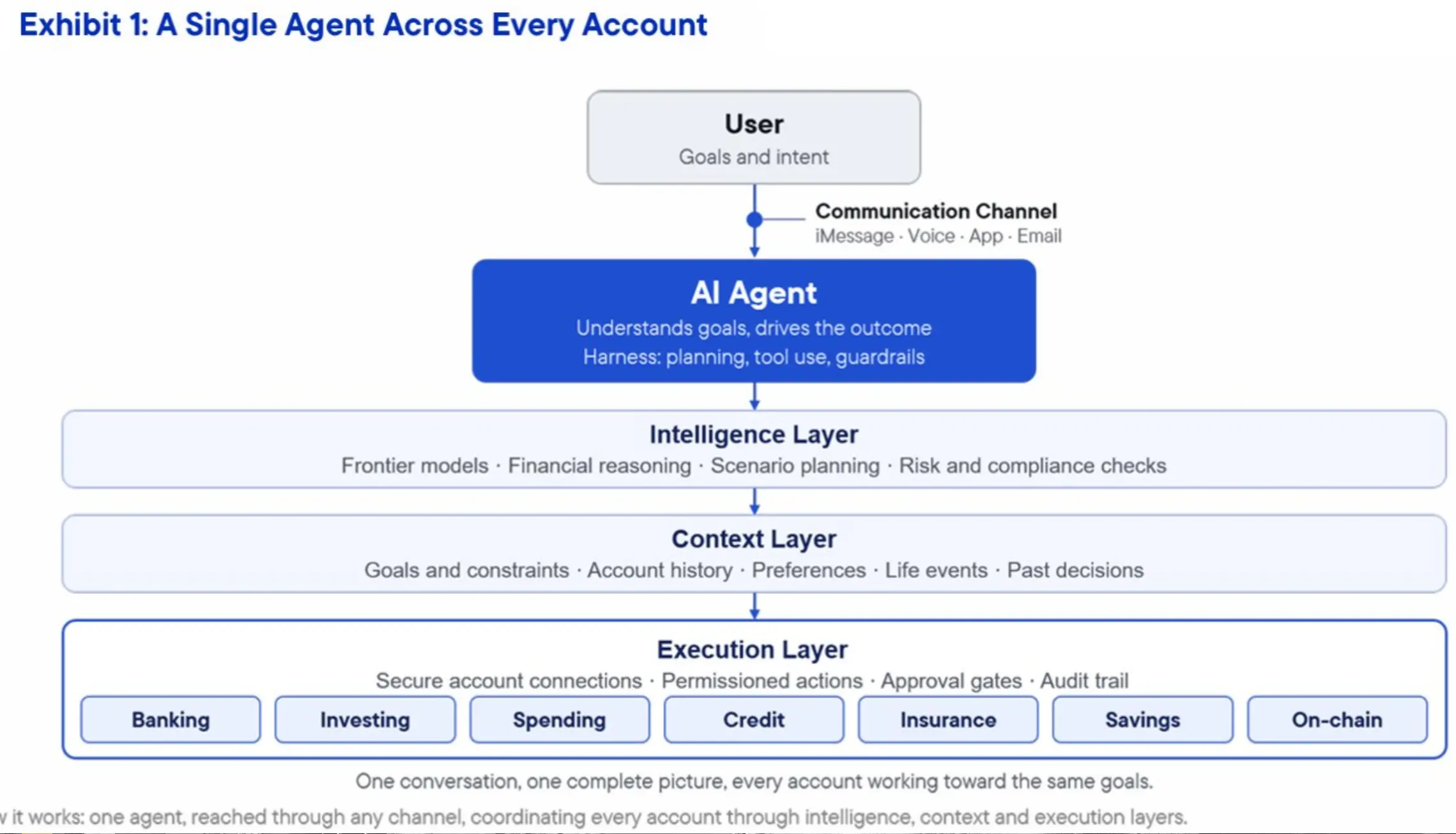
For most people, managing funds means managing a series of accounts. A person's financial life may involve a checking account from one bank, a 401(k) account provided by an employer's retirement plan service, a brokerage account, two or three credit cards, policies from different insurance companies, and high-yield savings accounts opened at other institutions for better interest rates.
Each account has its own login methods, applications, and alerts, and provides different advice to users. They do not communicate with each other. A family's complete financial situation exists only in the user's mind, and only when the user has time to compile this information.
This burden slows users down or causes them to miss certain matters, ultimately resulting in significant financial losses.
Two advancements are beginning to change this situation.
Personal Agents, or AI assistants, are now capable of understanding user intentions expressed in everyday language, weighing different options, and communicating with users through various channels.
On-chain agent finance is building foundational components that allow software to autonomously hold and transfer funds and generate returns on those funds.
The former provides understanding capabilities, while the latter provides execution capabilities. Relying solely on either side cannot solve this problem.
This article believes that the future of personal finance may be a unified entry point: users can contact the same agent through their preferred channels, whether it be text, voice, applications, or email, and the agent can also proactively reach out to users through these channels. It understands the user's complete financial situation, comprehends the user's goals, and takes actions across different accounts to help users achieve these goals.
This article also posits that the role may not be filled by today's leading universal Personal Agents, but rather by specialized financial Agents operating on cryptocurrency infrastructure, as the business models of universal Personal Agents often encourage spending.
Next, this article will introduce how people currently manage funds, what Personal Agents can and cannot do, why specialized financial Agents may be more suitable for this role, and why cryptocurrency infrastructure is suitable for agent finance.

How People Currently Manage Personal Finances
Despite the development of financial technology for nearly 20 years, many people still primarily manage their finances through manual operations: opening applications one by one to check balances, transferring funds between different institutions to pay bills, remembering due dates in their minds, and reconciling all information with spreadsheets when they have time.
Each product itself operates well. The real effort lies in connecting the work between these products.
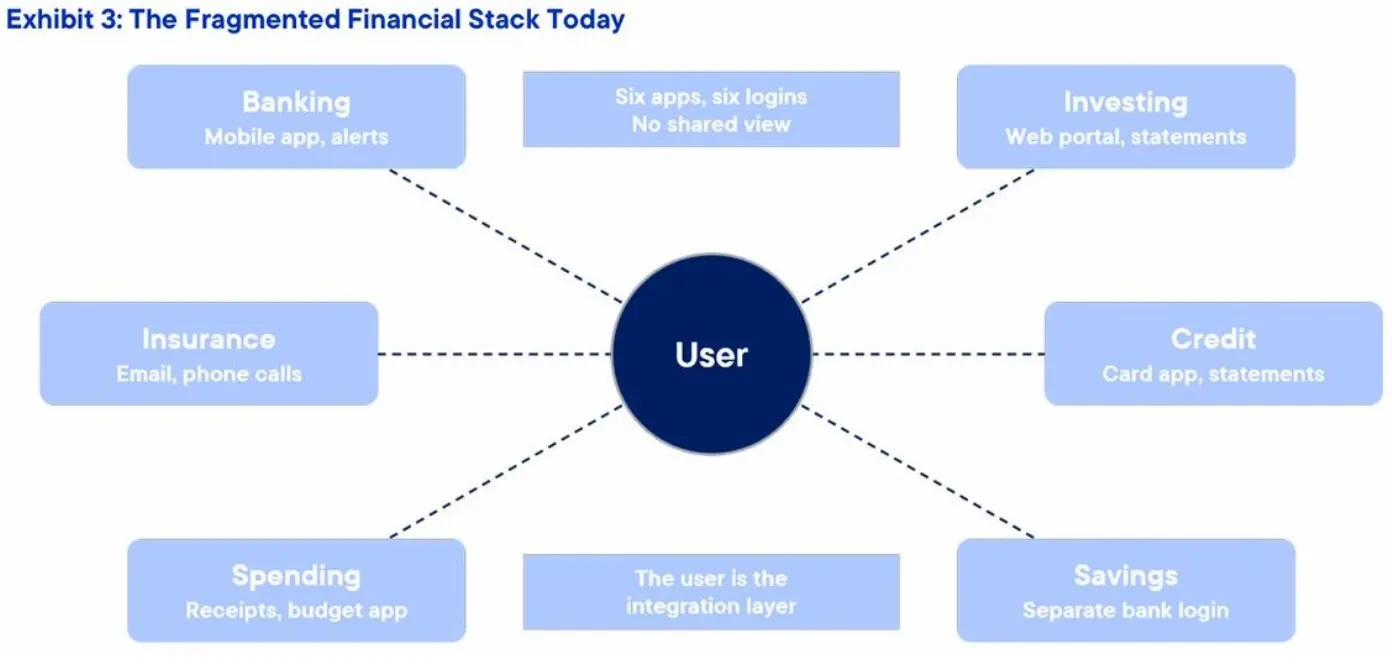
Where the problems lie:
Lack of a unified view. Net worth, cash flow, and goal completion progress are scattered across different institutions, and data is not shared between them.
Reactive management, lack of proactive management. People often discover a fee, a rate change, or a missed opportunity only after the cost has been incurred.
Advice is either expensive or too generic. The price of personalized financial planning is primarily aimed at the wealthy, while others receive only general advice.
Decision-making is constantly postponed. When every operation requires looking up information, logging into accounts, and transferring funds, people often choose to do nothing.
Ideas cannot turn into actions. "I should save more money" often remains just a thought, as there are no tools to turn it into a plan and execute it.
Personal Agent: Why Personal Finance May Need Specialized Agents
The first technology expected to change this situation is the Personal Agent.
Personal Agents are universal AI assistants that act on behalf of users. They can answer questions, conduct research, draft content, organize tasks, and increasingly take actions within users' applications.
Currently, if applied to personal finance, they excel at handling daily tasks related to funds but are not as suitable for directly managing funds.
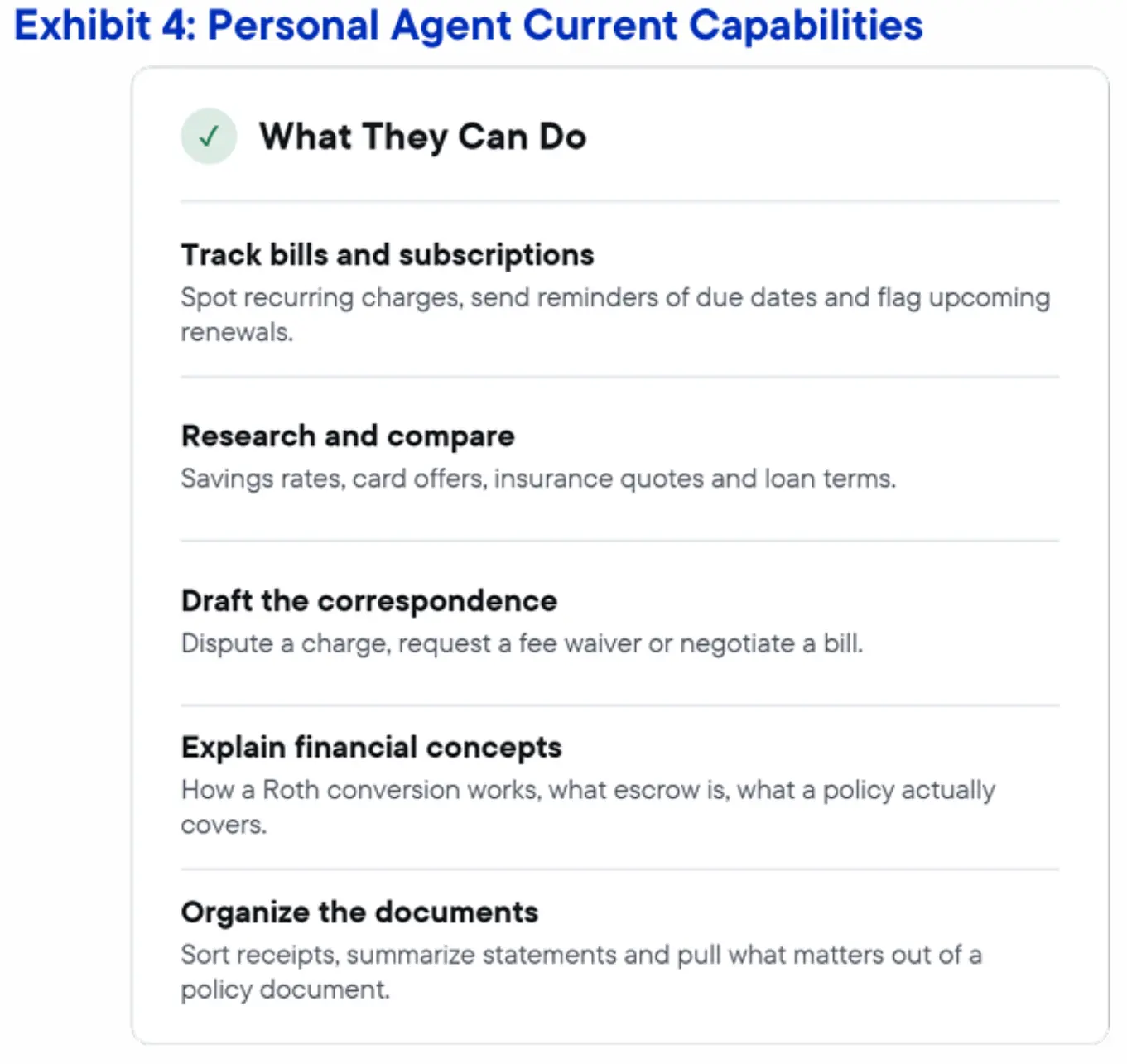
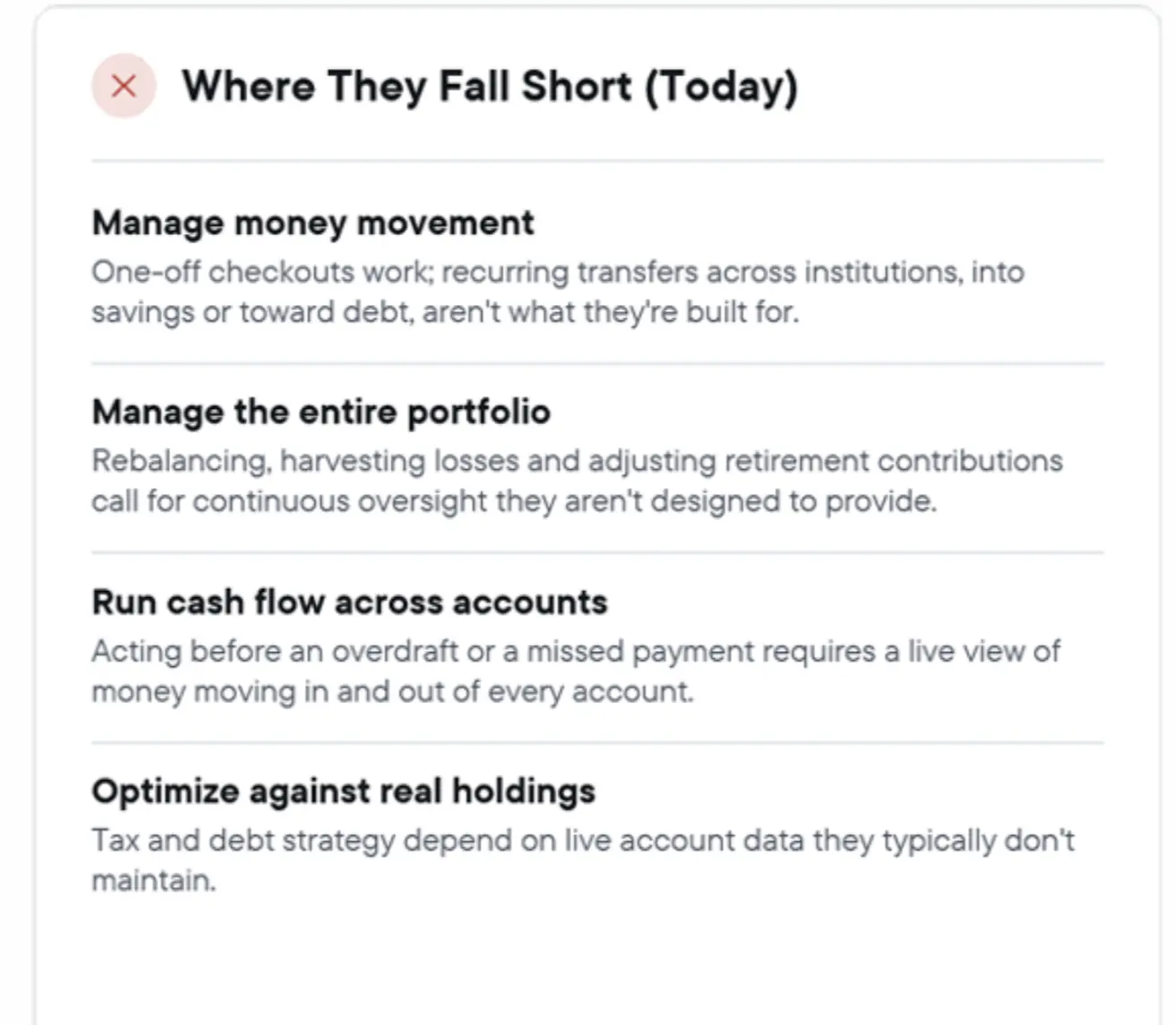
Leading Universal Agents
2026 is expected to be a breakthrough year for universal Personal Agents.
Users can contact Instinct via text or phone to make reservations, purchases, and cancel subscriptions on their behalf. Meta's Muse can send emails, book travel, fill out forms, and complete checkouts, usable both within its own applications and on WhatsApp. SpaceX AI's Grok Bot equips each agent with an independent cloud computer, allowing it to log into users' existing applications and operate like a human.
These agents have already engaged with money-related tasks: payments, canceling charges, negotiating bills. The competition for Personal Agents has just begun, with Meta, which has 3.6 billion daily active users, a startup valued at $10 billion, and SpaceXAI all vying to become the agents people trust with their daily lives.
To what extent these agents can participate in fund management remains an open question. Several factors suggest that a new class of specialized financial Agents may be more suitable for this role: they operate similarly to today's Personal Agents but are built around fund management from the start.
Incentive Mechanisms: Where the Money Flows
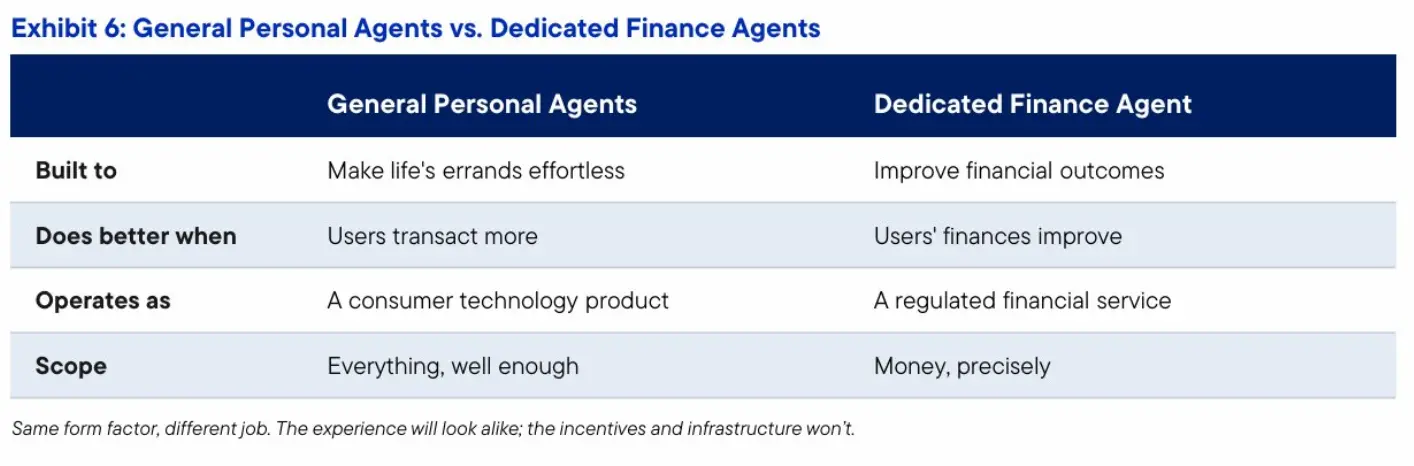
The most important factor is economic interest. Companies developing universal agents typically earn more when users spend more, with revenue potentially coming from advertising, transaction fees, or merchant commissions.
In contrast, personal finance Agents often need to succeed by doing the opposite.
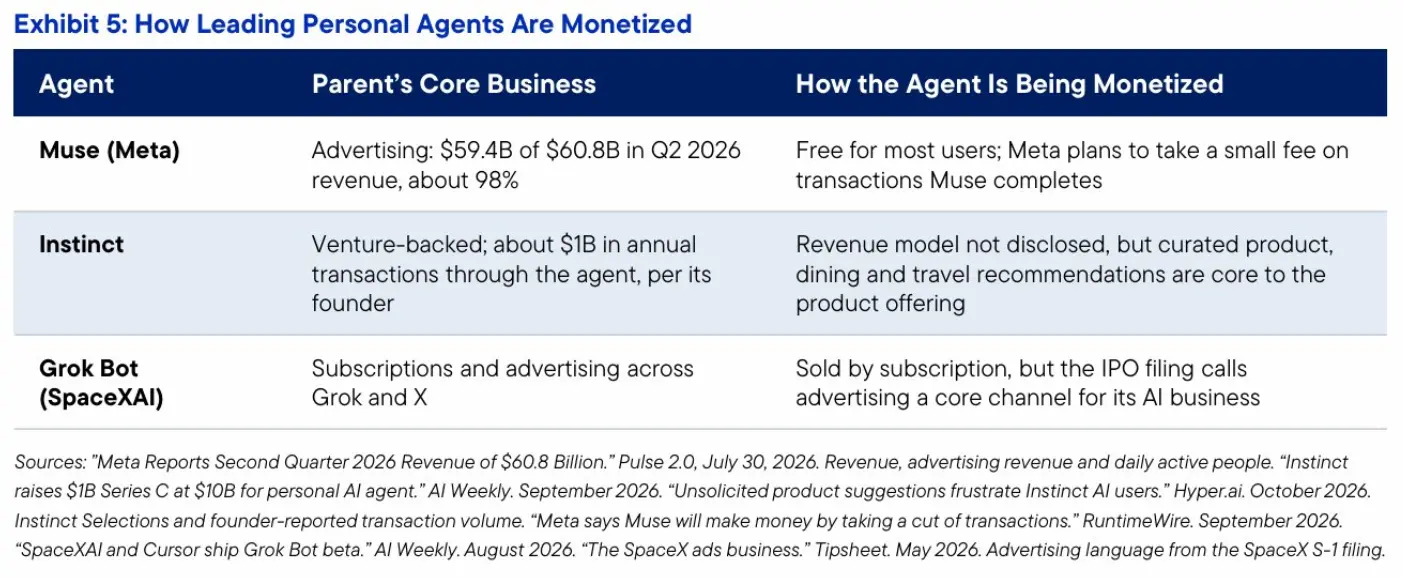
In the second quarter of 2026, approximately 98% of Meta's revenue came from advertising. At the Connect conference in September, Zuckerberg stated that Muse would remain free for most users, and Meta expects to profit in the future by charging small fees on shopping, bookings, and other transactions completed by Muse. Meanwhile, Meta also announced new partnerships with retailers such as Walmart, Best Buy, Gap, Sephora, and Wayfair.
The founder of Instinct stated that the product processes about $1 billion in transactions annually, with over half related to travel. At the end of September, Instinct began pushing curated product, dining, and travel recommendations to users through a feature called Instinct Selections. Some early users criticized that they did not actively request these recommendations.
Grok Bot sells subscriptions through SuperGrok and Cursor. However, its parent company's IPO application documents list advertising as the core monetization channel for the AI business and state that the company plans to integrate advertising into real-time conversations.
An agent whose income grows with transaction volume can become an excellent shopping steward but may also become a financial advisor with conflicts of interest. The job of a personal finance Agent is often to advise users against purchasing a certain item, and its business model must support this behavior.
In addition to incentive mechanisms, two other factors point to the same conclusion.
First, transferring funds, recommending investments, and managing debt involve licensing and suitability requirements, and in some cases, fiduciary responsibilities. Therefore, a universal agent company would need to establish a regulated financial business beyond its consumer technology operations to take on these tasks.
Second, personal finance places more emphasis on professional depth rather than breadth of coverage. Universal agents need to handle thousands of daily tasks well enough; financial agents must verify every account, calculate tax consequences based on users' actual holdings, arrange debt repayment order, and ensure every calculated number is accurate.
This requires a specially constructed system for information understanding, verification, and execution, which is the technical framework that will be introduced later in this article, rather than simply adding a financial skill to a universal agent.
Which Capabilities Can Be Inherited
Leading personal finance Agents are likely to draw from the successes of today's Personal Agents: no need to learn a new interface, using text messages and voice as the main communication channels, proactively contacting users, and remembering user information.
The form of this product is gradually becoming clearer. What remains uncertain is who can win the trust of users when the topic involves funds, becoming the main provider of this service.
The most likely final form is collaborative division of labor: the user's general Personal Agent manages daily life, while the finance-oriented Agent manages funds, with coordination between the two.
Communication between agents has already begun to emerge, with Instinct being an example of a network that coordinates different user agents. Therefore, when a user asks their daily-use agent whether they can afford a trip, this question can be passed on to the finance-oriented Agent that truly understands the user's financial situation.
In this model, the general agent plays the role of a steward, while the specialized finance agent acts as the chief financial officer.
Key Point: Personal Agents excel at handling daily matters related to funds, but their business models, regulatory qualifications, and broad functional positioning make them not entirely suitable for directly managing funds. Agents designed specifically for finance, with similar user experiences, may be better suited to take on this role.
Agent Finance: Why Crypto Infrastructure is Suitable for AI Agents
The second advancement is agent finance, which refers to software capable of autonomously holding, transferring funds, and generating returns on those funds.
Traditional finance already has similar products, such as smart investment advisors, automatic cash aggregation, and recurring bill payments. However, these products are limited to a single institution and are designed for human account holders rather than software acting on behalf of users.
For structural reasons, more meaningful advancements are occurring on-chain.
Crypto infrastructure is inherently open. Agents can have their own wallets and interact directly with any protocol via code, without needing to simulate user logins or wait for different systems to complete integration.
These infrastructures can set rules through code. Therefore, the limitations set by users are not just rules that agents must follow, but can also be enforced by the wallet. If an agent makes a mistake or is manipulated, the transaction cannot go through.
These infrastructures operate around the clock, with stablecoins settling in seconds and tokenized assets generating returns 24/7.
They also have verifiability, as every operation is recorded on a public ledger, allowing users to verify independently.
However, these infrastructures also carry real risks, including smart contract vulnerabilities and stablecoin de-pegging. Managing these risks on behalf of users is also part of the agent's work.
Nevertheless, it is precisely these characteristics that have led to the foundational components of agent finance first appearing on-chain. Currently, these applications mostly serve traders and crypto-native users.
Overall, they constitute the foundation needed for personal finance Agents to execute operations.
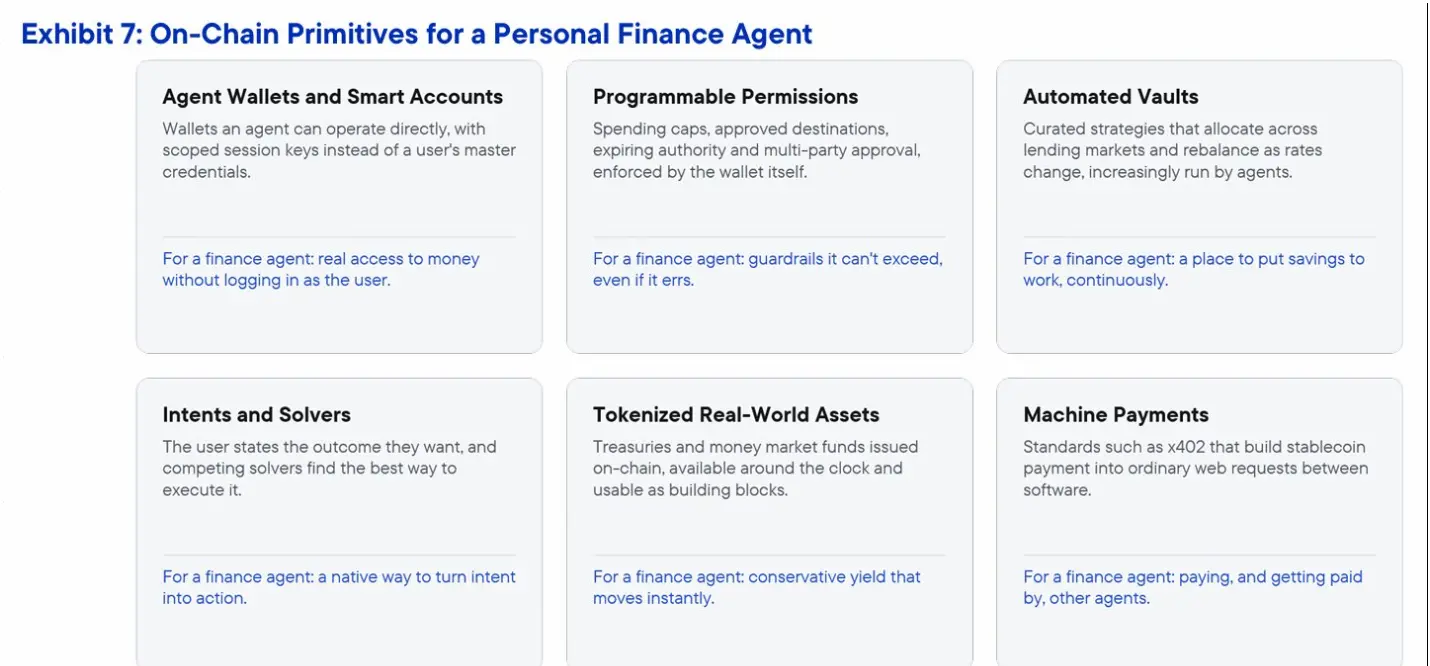
Key Point: Crypto infrastructure has enabled agents to conduct extensive operations under user-verifiable rules, and on-chain agent finance is building the tools necessary for execution. What is currently lacking is an agent capable of utilizing these capabilities to manage an individual's overall financial life.
The Future: A Unified Entry Point
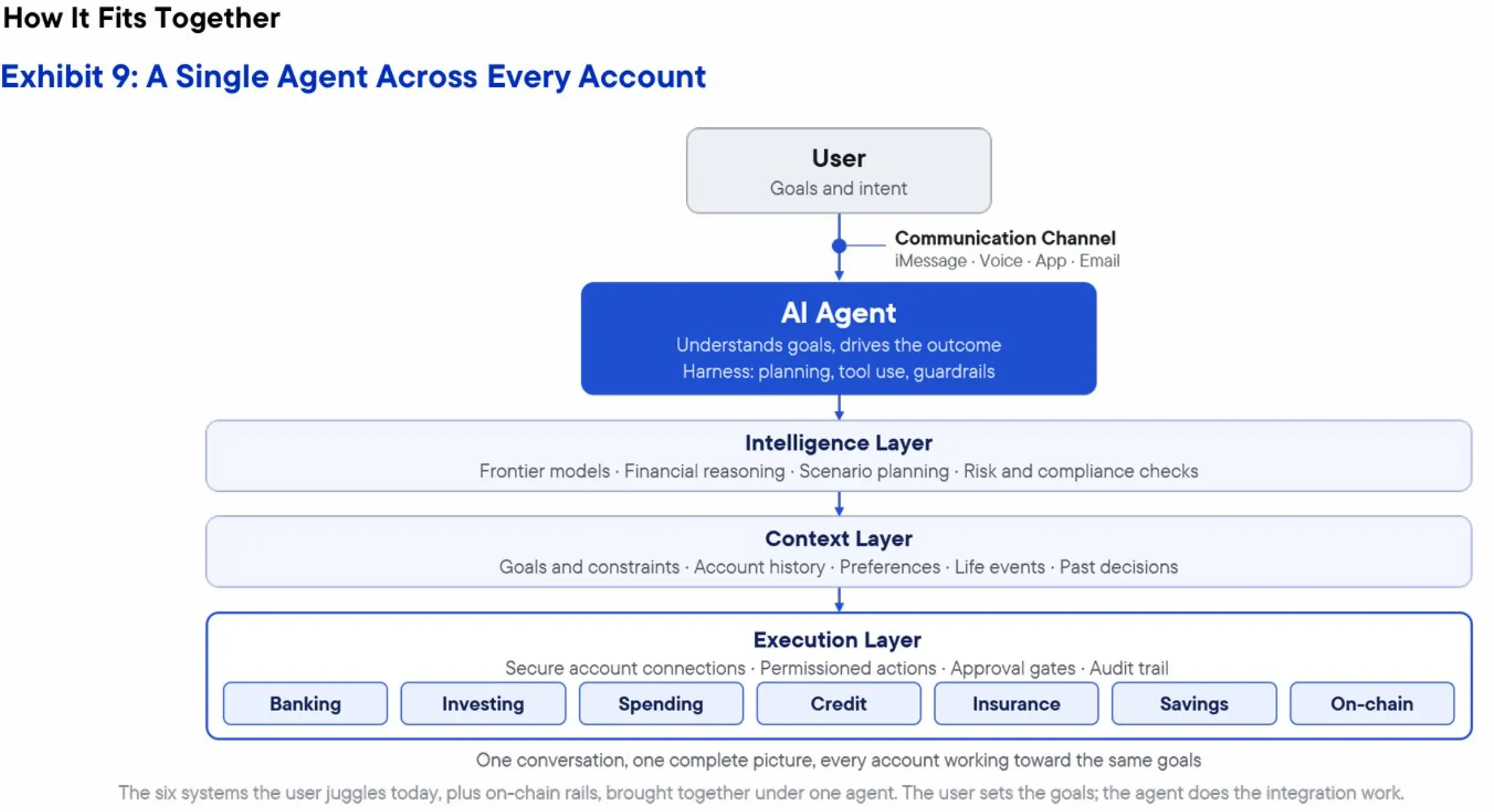
If we combine the usage of Personal Agents with the capabilities being built in on-chain agent finance, and apply it to a product specifically designed for fund management, the outline of the solution emerges: an agent that understands the user, can contact them through various channels, and can operate all of the user's accounts.
In this model, users no longer need to personally consolidate various accounts. They can communicate with the same agent through the most convenient channels: sending a text while waiting in line at the grocery store, sending a voice message while driving home, opening an app for a deeper look, or sending an email when there are documents to process.
When there are matters that need attention, the agent will also proactively contact the user, whether it's about an upcoming bill, a change in interest rates, or a deviation from a goal's progress.
From Intent to Outcome
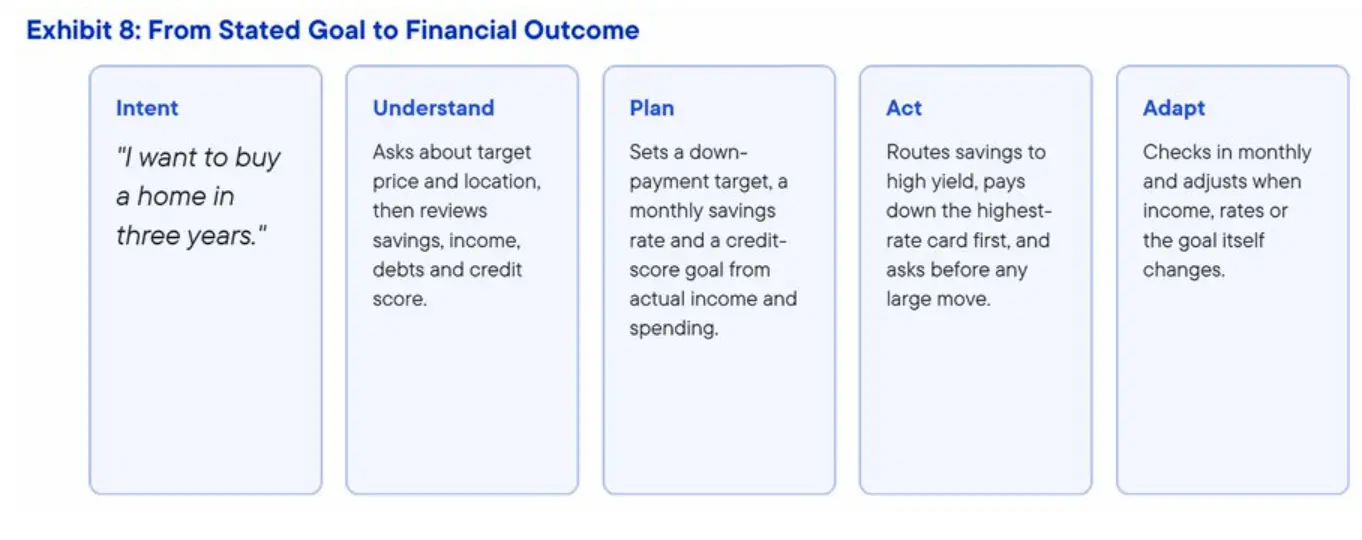
The standard for measuring this product is simple: can it transform a goal expressed in everyday language into a final outcome?
Below is a common goal used to illustrate this process.
What Needs to Be Built
To provide such an experience, it is not enough to simply layer a chatbot on top of a bank account. The product must excel in the following three aspects simultaneously, with none missing.
Professional and Proactive
Deeply understand financial products, strategies, and opportunities, rather than just possessing general knowledge.
Anticipate needs before users notice issues, such as falling interest rates, upcoming bill deadlines, or the availability of lower-priced insurance products.
Translate user intentions and goals into specific financial outcomes.
Continuously drive the realization of these outcomes rather than waiting for user requests.
Continuous and Interconnected
Share the same memory across all channels, allowing users to continue a conversation started via text through voice without needing to re-explain.
Automatically keep relevant information up to date as transactions are credited and account balances change, without requiring manual updates from users.
Establish secure, authorized connections with every institution the user interacts with.
Run continuously in the background and proactively contact users when there are matters that need attention.
Trust as the Design Foundation
Explain every recommendation in plain language, including the factors that need to be weighed.
Significant operations require user approval; routine operations are automatically executed within user-defined limits.
Maintain a complete record of what the agent did and why, allowing users to review it.
Ensure users always retain control: permissions can be changed or revoked at any time.
Why Now
This type of product is gaining acceptance among more and more people.
This year, early users began contacting agents via text and watched them complete tasks. The relevant infrastructure has also emerged: models capable of financial reasoning, an expanding open banking connection between financial institutions, and payment infrastructure already in use by agents.
At the same time, the companies best positioned to directly engage and serve consumers, namely today's general Personal Agent providers, face structural conflicts of interest when it comes to fund management.
This leaves opportunities for specialized participants, but this opportunity may not last long.
Such participants may prioritize building products based on crypto technology. With the formal enactment of stablecoin legislation in the United States, on-chain infrastructure can support actual operations from the outset, while traditional accounts can gradually integrate over time through open banking.
The first personal finance Agent to win user trust, capable of contacting users through various channels and genuinely helping them allocate funds and achieve goals, is likely to define this product category.
Attention should be paid to teams that can combine the ease of use of Personal Agents, on-chain operational capabilities, and financial-grade trust mechanisms.