








A letter from the founder of IOSG to Crypto OG: Don't let the casino swallow the cathedral
Jan 24, 2026 09:53:45


Original Title: “Don't Let the Casino Devour the Cathedral - A Letter to Chinese Crypto OGs”
Original Author: @jocyiosg, Founder of IOSG
Part 1: Who Stays? More Importantly, Why Stay
Last year, I wrote a tweet about the talent flow between AI and Crypto, and someone commented that it's great for talented people to go into AI, participating in building a future that is bound to happen.
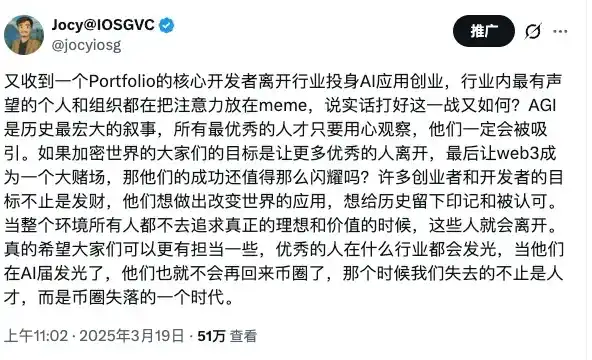
But a recent podcast conversation made me realize that this judgment is not deep enough. The question is not just "who stays," but more fundamentally "why stay" and "whether the ecosystem can support the revolution after staying." Those who remain in the industry to continue building after experiencing bull and bear markets, failures, and the friction between reality and ideals are the ones who are likely to lead the revolution in the crypto space.
In the past few months, I have talked to many crypto entrepreneurs from 2023 to 2025. Many Chinese teams raised only five to seven million dollars around 2023, and in the current environment, it is very difficult to raise the next round. Such a runway barely lasts for over two years until now, and they are stumbling to launch trading platforms. Countless airdrops and tokens given away have flooded the market, causing token prices to plummet, and the entrepreneurs' responses are tokens on the verge of zero, losing reputation in the crypto industry, and then turning to leave.
Looking back at Asia, there are fewer and fewer investors willing to support early-stage entrepreneurs. Without investor support, there are no determined entrepreneurs willing to step back into the crypto industry, and the entire industry ecosystem cannot progress—how can the crypto war between China and the US compete?
I wrote a tweet last April mentioning that a core team from a portfolio started working on AI applications, and the most prestigious talents in the industry are leaving. Until today, more and more people are making this choice, which is not a coincidence; it reflects a more systemic issue: after making money, Chinese and American Crypto OGs have chosen completely different paths.
Part 2: How American OGs "Support the Cathedral"
What do American Crypto OGs think about after making money?
Brian Armstrong: After bringing Coinbase public as the first mainstream crypto trading platform in the US, he founded Research Hub, attempting to fundamentally change the incentive mechanisms of scientific research. This is not just simple donations; it is about reconstructing the entire knowledge production system.
Naval Ravikant: As an early Bitcoin philosopher, he not only promoted ICOs through AngelList and used Bitcoin as a global crowdfunding tool but also incubated CoinList to provide a compliant framework for token issuance and funded the Zcash team. His thoughts on currency, crypto economics, and decentralization have profoundly influenced the entire industry.
Chris Dixon: He led the Series B round for Coinbase in 2013, becoming the first mainstream VC to fully bet on crypto. He grew a16z Crypto from $300 million in 2018 to over $7 billion, not only investing in projects but also establishing a Crypto school to systematically cultivate industry talent.
Dan Robinson: At Paradigm, he is not only an investor but also a builder. He participated in the early development of Uniswap, co-authored Uniswap V3, promoted the development of modern MEV auction models in the early stages of Flashbots, participated in Plasma research (the predecessor of modern Rollups), and led the seed round for Optimism. This deep technical involvement and intellectual output are what true ecosystem building is about.
Michael Saylor: He transformed MicroStrategy into a strategy firm, holding $67 billion worth of Bitcoin (over 3% of the total circulating supply), and continuously accumulated on a large scale through innovative financing methods like issuing stocks and low-interest bonds, becoming a symbolic figure of Bitcoin institutionalization.
Barry Silbert: He founded DCG and launched the GBTC Grayscale Bitcoin Trust, becoming the main channel for traditional investors to gain exposure to Bitcoin, with Genesis Trading and CoinDesk becoming industry infrastructure.
Chainlink: Founder Sergey Nazarov worked as a software engineer at Google and invented a decentralized oracle network in 2017, which has supported over $7 trillion in transaction volume. Having achieved financial freedom through multiple bull and bear cycles, he still actively promotes the Chainlink standard in places like Hong Kong, aiming to unify DeFi and traditional finance through CRE and build a global "internet of contracts" ecosystem.
Rune Christensen: After coming into contact with Bitcoin in 2011, he sold his English teacher recruitment business in China to fully invest in crypto. In 2015, he founded MakerDAO and launched the decentralized stablecoin DAI, becoming one of the first and largest DeFi protocols on Ethereum. For over a decade, he has been at the forefront of DeFi governance, recently rebranding the MKR brand to Sky and launching the Spark protocol to integrate DAI with US Treasury bonds, becoming a pioneer in the fusion of crypto and traditional finance.
Arthur Hayes: He founded BitMEX and launched perpetual contracts, bringing traditional financial derivatives into the crypto market, with the funding rate mechanism becoming an industry standard. After being fined for violating the Bank Secrecy Act in 2022 and receiving a pardon from Trump, he co-founded the Ethena stablecoin protocol with Guy. Over the past few years, Arthur has continuously shared his crypto insights with the industry without pause.
What do these people have in common? After making money, they think not about how to exit but about how to attract the best talent, how to create world-changing applications, and how to build a systematic ecosystem to support it. They are not just investors; they are builders, thought leaders, and contributors to public goods.
Part 3: Systemic Dilemma of Chinese Crypto OGs
In contrast, the fundamental differences in the policy environment in the Chinese crypto circle limit the long-term investment space, and most OGs choose to exit rather than give back after early successes and some wealth accumulation.
The lack of historical narrative. From the very beginning, American crypto has had a grand narrative of "changing the world," and the tradition of public goods construction that dates back to the Carnegie and Rockefeller eras continues in the crypto field. China's cultural accumulation in this regard is relatively weak.
We lack a systematic talent cultivation mechanism (compared to the US's Crypto school), lack long-term investment in crypto talent and infrastructure (compared to projects like YC/AllianceDao and Research Hub), and lack continuous intellectual output and industry discourse power (compared to Paradigm's research-driven approach and Naval's philosophical influence).
This is not a personal moral issue but a systemic problem caused by the lack of historical narrative, policy uncertainty, cultural genetic differences, and other factors.
What Does This Difference Lead To?
Many entrepreneurs and developers aim not just to get rich; they want to create applications that change the world and leave a mark in history that is recognized. All the best talents, if they observe carefully, will not return.
When Web3 is simplified to a big casino, and the mainstream narrative of the industry degenerates from "changing the world" to a purely wealth game, the best talents will vote with their feet. It is not that they do not want to make money; rather, they want to "make meaningful money"—to gain returns through the process of creating value, not by harvesting others in a zero-sum game.
When everyone in the environment stops pursuing true ideals and values, these people will leave. Narrative is not empty; it directly affects the talent structure. When an industry cannot provide a compelling vision and value recognition, no amount of monetary incentives can retain those value-driven talents.
The Vicious Cycle We See Now:
Lack of new value creation → The market can only compete within existing resources → Competing within existing resources reinforces a speculative mindset → Drives away those who want to innovate incrementally → Less value creation → The market becomes more reliant on existing resource competition
This is a snapshot of the speculative era in the Chinese crypto circle.
Part 4: Even Under Constraints, A Spark Can Ignite a Prairie Fire
Some may say: the environment is different, and comparisons cannot be simplistic. This is true. I am not asking Chinese OGs to do exactly what American OGs do.
Others may say: even if they want to do something, they can't do much, so why bother. But I believe that even in a constrained environment, supporting open-source developers, organizing technical community events, and investing in early-stage tech teams are still meaningful small actions. Systematic efforts will produce a compound effect.
Some may also say: overemphasizing idealism is hypocritical; crypto is just financial innovation. But this is not an either-or choice. A healthy ecosystem needs a sufficient proportion of value-driven individuals. If it is entirely dominated by purely financial-driven people, it will fall into a zero-sum game in the long run, ultimately harming everyone's interests. This is not moral preaching but enlightened self-interest.
IOSG's past investors include trading platforms, miners, early crypto OGs, and traditional funds. I believe many Chinese OGs are idealistic and heroic and are willing to push this industry forward. It is precisely under such difficult circumstances in the crypto industry, especially in China, that they are still willing to continue supporting and helping this industry.
A spark can ignite a prairie fire. We can also build a robust positive feedback ecosystem in crypto, as strong as that in the US.
Part 5: The Cathedral and the Casino: Buffett's Warning
Warren Buffett used this metaphor to describe American capitalism: In the next hundred years, make sure that the cathedral is not overtaken by the casino. This metaphor also applies to the crypto market:
Cryptocurrencies and blockchain have achieved unprecedented success. They are a magnificent cathedral that has created an economic system unlike any seen before in the world. At the same time, there is a huge casino right next to it.
The temptation is enormous, especially now, as the temptation is to walk into that casino. Inside the casino, everyone is having a great time, with money flowing frequently, but you must also ensure that the cathedral is supported.
In the next 100 years, Crypto must ensure that this cathedral is not devoured by the casino.
The cathedral of Bitcoin and Ethereum remains grand and magnificent, while some trading platforms' casinos are bustling every night. But if the prosperity of the casino does not feed back to the cathedral, that building, which creates real value, will gradually fall into disrepair, and ultimately the entire ecosystem will lose its foundation.
What Brian Armstrong, Vitalik, Chris Dixon, and others are doing is essentially supporting the cathedral. They are ensuring that the prosperity of the casino does not consume that cathedral.
Part 6: The Only Path of Long-Termism
Returning to my judgment from a few months ago, it now needs to be supplemented with a deeper understanding:
Those who remain after experiencing bull and bear markets may indeed lead the revolution, but simply "staying" is not enough. More importantly, it is "why stay" and "whether the ecosystem can support the revolution." The revolution needs the entire ecosystem to support it. The continuous development of American Crypto is not because people can endure more, but because a systematic feedback mechanism has been established, allowing the ecosystem to self-renew and self-evolve.
As an institutional investor, IOSG will continue to actively take on the responsibility of change:
Systematically invest in more early-stage startup teams, even if short-term returns are not obvious.
IOSG EIR will support and fund more entrepreneurs currently facing financing difficulties, establishing a stronger talent cultivation mechanism.
Continuously output and share frontline industry research and insights.
Focus on long-term value creation rather than short-term speculation in project investment choices.
We need to redefine success. The transfer of wealth in a zero-sum game vs. the creation of wealth in the process of creating real value may yield the same numbers but have completely different meanings.
If Chinese crypto institutions and capable participants can make breakthroughs in feedback mechanisms, they may become key forces in changing the ecosystem. This is not only a moral responsibility but also a rational choice for long-term interests—only a healthy ecosystem can incubate great projects, attract outstanding talent, and create sustainable value.
This is true long-termism and the only path to ensure that the cathedral is not devoured by the casino.
Latest News
ChainCatcher
Mar 11, 2026 22:50:47
ChainCatcher
Mar 11, 2026 22:48:04
ChainCatcher
Mar 11, 2026 22:35:42
ChainCatcher
Mar 11, 2026 22:31:03
ChainCatcher
Mar 11, 2026 22:30:25