
Binance theft case recovery enters judicial process: U.S. Department of Justice seeks to confiscate over 1.1 billion USD Coin (USDC)
Author: Zhou, ChainCatcher
On November 23, Eastern Time, the U.S. Department of Justice filed a civil forfeiture lawsuit in the U.S. District Court for the District of Columbia, seeking to forfeit approximately $1.17 billion USDC related to the theft incident at Binance on October 29.
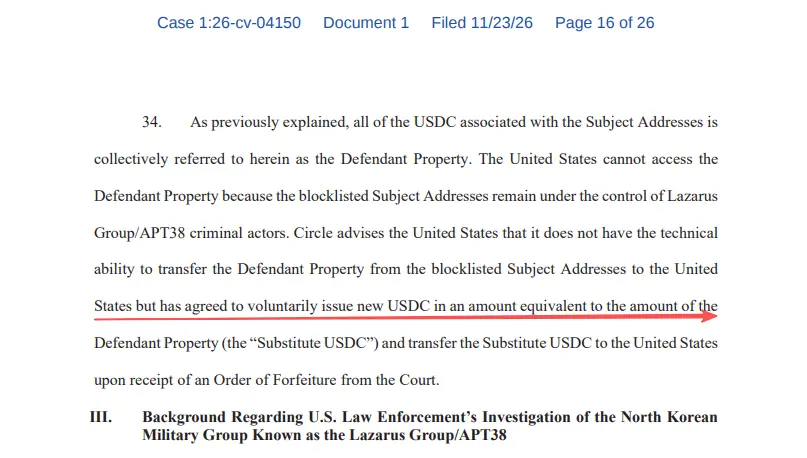
This batch of USDC has been frozen by Circle before and after the incident. The complaint reveals that Circle was unable to transfer them out of the hacker-controlled addresses, and therefore agreed to issue an equivalent amount of new USDC to the U.S. government after the court's forfeiture ruling.
$6.3 Billion Stolen, Almost All in Stablecoins
On the evening of October 29, multiple hot wallets across Binance's chains were emptied within about 20 minutes. According to TRM Labs, the total amount stolen is approximately $6.36 billion, which is about four times the amount stolen in the Bybit incident in 2025.
According to the complaint, the attackers gained access to Binance's internal system by disguising malware as a job interview, and then transferred assets from the hot wallets by altering wallet authorizations.
U.S. investigators attribute the attack to North Korean military hackers. The FBI refers to them as TraderTraitor, while the complaint uses the names Lazarus Group and APT38, both of which are part of the North Korean hacking system. The complaint also includes the 2025 Bybit theft of approximately $1.5 billion as part of this organization's past cases.
The complaint further mentions that some wallets receiving the stolen funds from Binance had previously also received funds from the September Bitget theft, which resulted in a loss of approximately $387 million.
As the funds were being transferred, stablecoin issuers also took action. Tether CEO Paolo Ardoino stated that over 1.567 billion USDT had been frozen that evening, and Circle CEO Jeremy Allaire also stated that approximately $823 million USDC had been frozen in coordination with law enforcement.
Binance subsequently announced that it would use its SAFU fund and company funds to cover all losses. According to its statistics, the affected assets amount to approximately $6.34 billion, which has now been fully replenished.
On the law enforcement front, on November 12, the U.S. Department of Justice announced that it had obtained court authorization to seize or restrict over $1.2 billion in stolen assets. The Department of Justice also disclosed that the total assets frozen by the U.S. government and private entities have exceeded $2.7 billion, nearly half of the total amount stolen.
Binance is also pursuing asset recovery outside the U.S. On November 18, Binance announced that the Abu Dhabi Global Market Court had issued a global freeze order for $6.5 billion, requiring 18 institutions, including Circle and World Liberty Financial, to continue freezing the relevant tokens.
Circle Can Only Issue New Coins to Hand Over Frozen Funds
The lawsuit filed on November 23 specifically targets the portion of USDC frozen by Circle. According to the Department of Justice press release, the amount involved exceeds $1.1 billion, distributed across 36 addresses on 18 blockchains, higher than the initial $823 million disclosed by Circle on the night of the incident. The complaint shows that the freezing was completed in batches.
Circle initially blocked four addresses that directly received the stolen funds around October 29, and subsequently blocked another 32 compromised Binance platform addresses. The basis for the prosecution's forfeiture includes computer fraud, telecommunications fraud, and money laundering.
The key point is that Circle can blacklist the addresses to prevent the funds from moving but cannot transfer these USDC out of the addresses still controlled by the hacker.
To this end, Circle agreed to voluntarily issue an equivalent amount of new USDC and transfer it to the U.S. government upon receiving the court's forfeiture order, while the tokens on the original addresses remain frozen.
For Circle, this is not an additional expenditure. The frozen old coins can no longer circulate, and the newly issued coins effectively transfer this portion of value to the rights holder recognized by the court.
This arrangement ties the issuer's technical capabilities to the court's procedures; the freezing was completed by the issuer on the night of the incident, while the transfer of asset ownership must wait for the judge's ruling.
To avoid any gaps in restrictions during the litigation, the prosecution simultaneously requested the court to continue restricting this batch of assets, arguing that the expiration of the temporary restraining order issued on November 12 is unclear.
The Department of Justice stated that the government is assisting Binance in recovering assets, but the complaint does not specify the final recipient of the funds, nor does it provide a distribution plan or timeline. Since Binance has already covered user losses out of its own pocket, some analysts believe that if these funds ultimately enter the refund process, the main claimant is likely to be Binance itself.
In contrast, recovering the other half of the stolen assets is much more difficult. The Department of Justice stated on Monday that since the incident, U.S. authorities have assisted in freezing, seizing, or returning over $2.9 billion in cryptocurrency assets, still less than half of the total amount stolen.
The remaining funds are continuously being transferred. According to tracking data from Elliptic, approximately $2.22 billion in assets remain in the relevant addresses, mainly in ETH and BTC. Since November 1, the attackers have sent at least 3,930 BTC into coinjoin, amounting to about $247 million, with these bitcoins coming from the attackers' exchanges of other stolen funds. The 18,270 bitcoins stolen directly from Binance were dispersed to 19 addresses on the night of the incident and have not been moved since.
These native assets cannot be frozen by any issuer; stablecoins can be locked on the night of the incident and then returned through court procedures, but once ETH and BTC enter mixing and cross-chain channels, the window for recovery will quickly narrow.