
OKX and the parent company of the New York Stock Exchange jointly launched a new exchange: on the first day, 6 stocks were listed, with a total transaction volume of 2.15 million USD
Author: Zhou, ChainCatcher
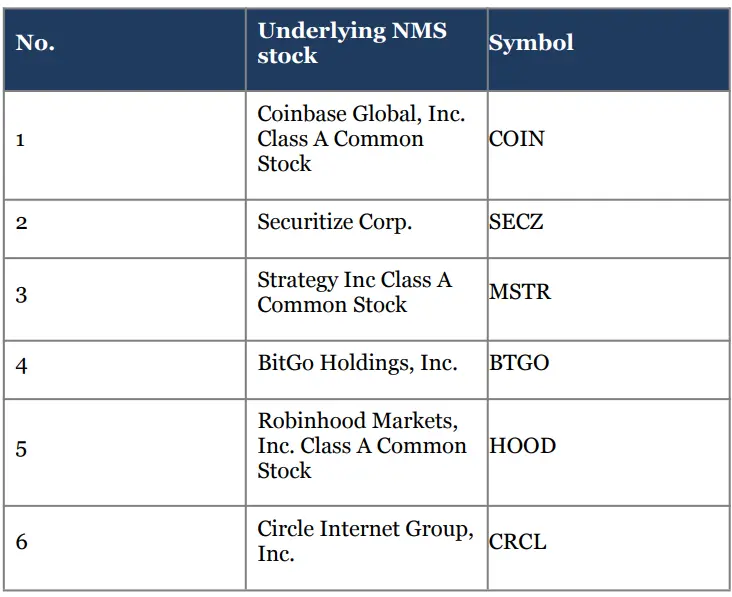
On November 23, Eastern Time, the joint venture platform OKXICE TSV launched, with the first batch of 6 stocks being Coinbase, Securitize, Strategy, BitGo, Robinhood, and Circle. The platform had previously confirmed 113 assets, including stocks and ETFs, which will be launched in batches.
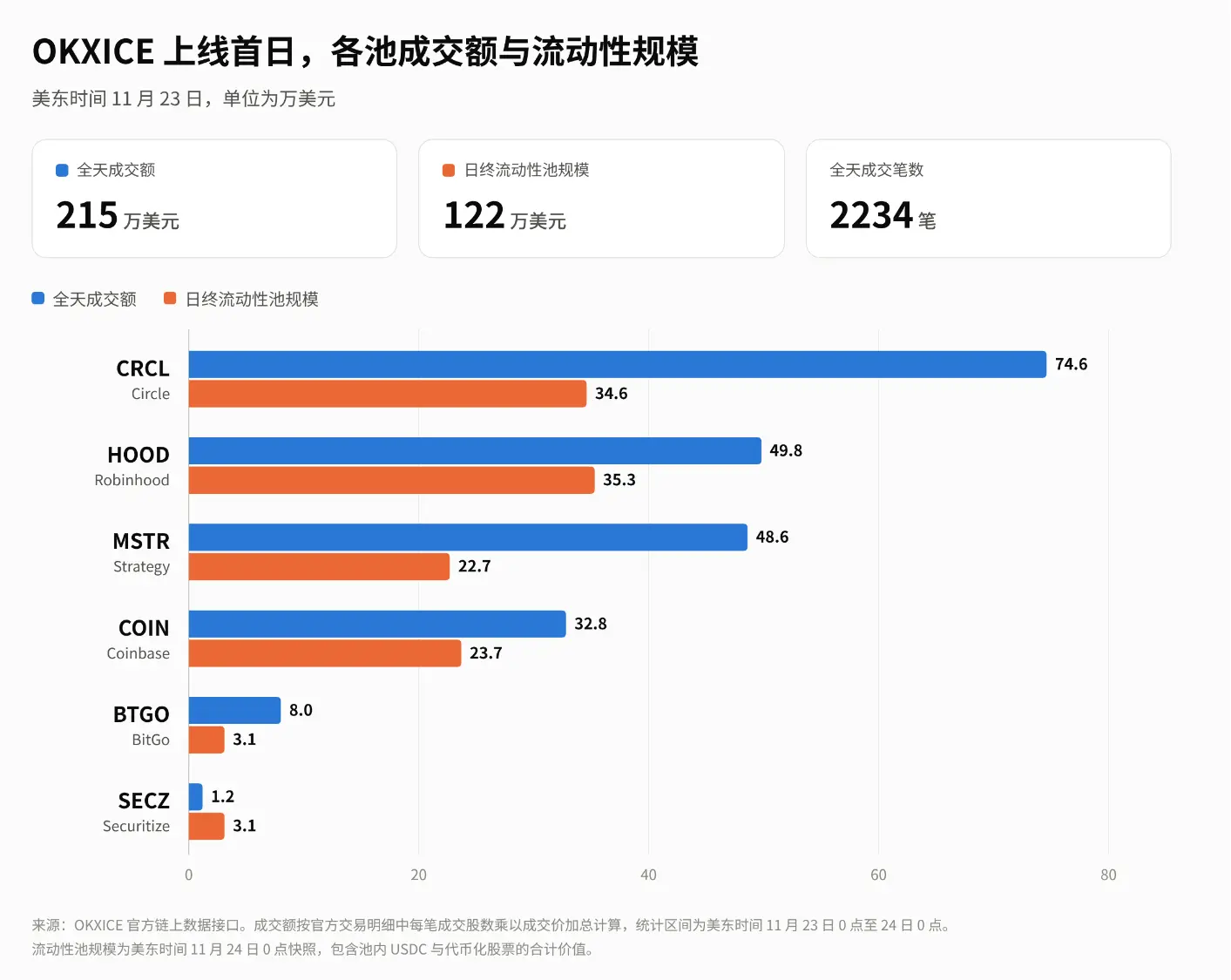
According to official statistics from OKXICE, on November 23, Eastern Time, the 6 pools had a total of 2,234 transactions, with a transaction volume of approximately $2.15 million. Among them, CRCL led with about $746,000, followed by HOOD and MSTR with about $490,000 each, COIN with about $328,000, BTGO with about $80,000, and SECZ with about $12,000.
In terms of liquidity scale, as of midnight on November 24, Eastern Time, the 6 liquidity pools totaled approximately $1.22 million, with HOOD and CRCL pools each around $350,000, COIN and MSTR each around $230,000, and BTGO and SECZ each around $30,000.
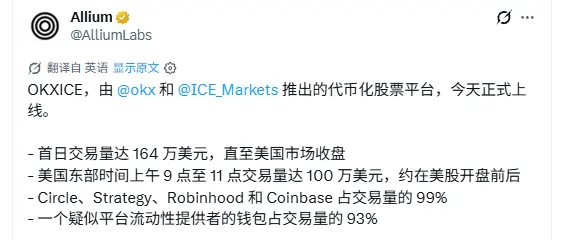
From the trading structure, the on-chain data platform Allium pointed out that as of the close of the U.S. stock market that day, a wallet suspected to be from a platform liquidity provider contributed 93% of the trading volume.
This platform took over half a year from preparation to launch. In March of this year, ICE invested in OKX at a valuation of $25 billion, obtaining a board seat. By June, both parties announced the establishment of the joint venture OKXICE, each holding 50% of the shares, with former New York Governor Andrew Cuomo and ICE Futures Exchange Senior Vice President Trabue Bland serving as co-chairs.
Although ICE is a shareholder, OKX stated that the New York Stock Exchange neither operates nor regulates this platform.
On September 17, the SEC issued an innovation exemption, allowing eligible tokenized securities trading platforms to trade on-chain versions of U.S. stocks without registering with the SEC as exchanges or alternative trading systems.
OKXICE issued a public notice on October 4 and officially launched after a notification period of over a month. Prior to it, TSV LLC on the Canton network had already completed its first batch of transactions, making OKXICE the second platform to start trading under this exemption.
Official information shows that OKXICE TSV operates on the Ethereum Layer 2 network X Layer under OKX, with trading completed through a permissioned AMM liquidity pool built on Uniswap v4. Users must complete identity verification and hold a non-transferable soul-bound token to enter the trading pool.
Compared to traditional exchanges, this platform does not have an order book and does not custody assets; tokens are kept in the users' own wallets. All transactions require full payment, with no margin or lending. Third-party contracts must be whitelisted to connect, and aggregators and other DeFi protocols currently cannot access these pools.
All listed stocks are tokenized by Securitize Markets, with each token corresponding to the securities rights of one share of the underlying stock, trading paired with USDC. Holders enjoy the same dividends and voting rights as the underlying stock, which are conveyed by Securitize.
The premise of this arrangement is that Securitize and its brokers operate normally. The official notice also indicates that once the other party makes a mistake or goes bankrupt, dividends and voting may not be conveyed, and it is uncertain whether self-custodied tokens will be protected under SIPA.
In terms of liquidity, OKXICE stated that neither the platform nor its affiliates will act as liquidity providers, and the funds in the pools come from third parties, which do not need to be registered brokers and can withdraw at any time.
There is also a limit on trading volume. According to the LULD tiering rules, COIN, HOOD, MSTR, and CRCL belong to Tier 1, with a daily trading volume limit of 0.25% of the average daily trading volume of the underlying stock from the previous month. BTGO and SECZ belong to Tier 2, with a limit of 2.5%. If a stock exceeds the limit for the second time, it will be suspended for three months.
In terms of fees, the official website currently shows a total fee rate of 0.3%, of which 0.2% goes to liquidity providers and 0.1% is the platform service fee.
67 Companies Oppose, Tokenization Route Controversy Emerges
The first batch includes only 6 stocks, directly related to a design in the innovation exemption. According to the regulations, before third-party tokenized stocks go live, the platform must notify the issuer, and if the issuer raises a written objection within 30 days, that stock cannot be traded on the platform; if there is no response, it is considered consent.
Jamie Selway, head of the SEC's Trading and Markets Division, also mentioned that after the 30-day period, the platform does not actually have to accept new objections, and OKXICE's choice to allow issuers to withdraw afterward is to make the platform more attractive.
In the month leading up to the launch, the number of companies raising objections gradually increased. By the notice on October 15, there were 9, exceeding 50 by the end of October, and increasing to 67 by November 5, including companies like Apple, Microsoft, NVIDIA, and Tesla. Excluding duplicate codes, among the 62 companies initially selected by OKXICE, 56 raised objections, with the remaining 6 being the stocks launched this time. Additionally, 11 companies not on the original list also proactively raised objections, including Meta, Arm, and Wells Fargo.
Most companies did not publicly state their reasons for opposition. According to Fortune, a few that did, such as Applied Optoelectronics, indicated that the framework is too new, and the impact on stock prices, liquidity, and volatility is still unclear; the company currently sees no benefits that offset these uncertainties. Previous reports have also suggested that some companies have concerns about OKX's offshore background.
However, opposition does not necessarily mean rejection. CNBC believes that the high rate of opposition is more likely to reflect that companies are not yet ready. Seth Ginns, Chief Investment Officer of Franklin Templeton's crypto division, stated that the 30-day window coincides with earnings season and midterm elections, and many issuers are willing to understand tokenization but do not want to make hasty decisions.
MassPay CEO Ran Grushkowsky also mentioned that executives from client companies are very interested, but the resistance mainly comes from investor relations departments, who are concerned that around-the-clock trading will disrupt the timing of announcements. Securitize CEO Carlos Domingo found that among some of the companies that raised objections, executives responsible for digital assets were even unaware of who had made the objection. OKXICE co-chair Andrew Cuomo stated that most companies are not familiar with tokenization, and the more they understand, the higher the acceptance will be.
Some also view this wave of opposition from a vested interest perspective. Crypto KOL Crypto Fearless believes that the essence of the resistance lies in old money's unwillingness to hand over pricing power to the blockchain, and exchanges also want to maintain their price discovery rights. Although OKX's compliance route is more stable, gaining regulatory acceptance is just the beginning, and in the future, it may have to cede more interests to traditional capital in a series of negotiations.
Opinions within the industry regarding the OKXICE model itself are also divided. OKX founder Star believes that while TSV has many restrictions, it is the first to allow tokenized stocks held on-chain to have the same legal rights as custodial stocks, enabling retail investors to directly provide liquidity in the AMM pool using their held stocks. Figure CEO Mike Cagney, on the other hand, believes that the transaction prices of AMMs are inherently inferior to those of order books, and the platform lacks margin and borrowing markets; after a large number of companies exit, the experimental significance of this sandbox has been diminished.
Beyond OKXICE, the offshore market has long had tokenized U.S. stock products. OKX itself has launched over 260 tokenized U.S. stocks provided by Ondo on CeDeFi, including Apple, NVIDIA, and Tesla, but the official statement clearly indicates that these tokens only provide price exposure, and holders are not shareholders of the companies.
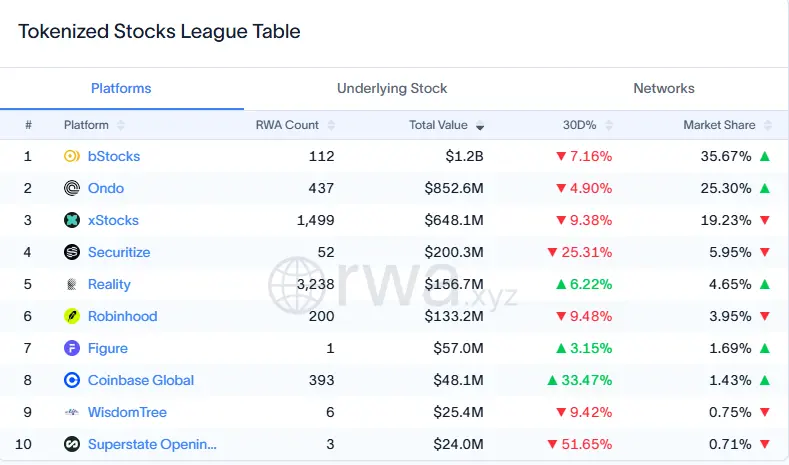
Data from RWA.xyz shows that as of November 22, the distributed value of tokenized stocks is approximately $3.37 billion, with bStocks leading at about $1.2 billion, followed by Ondo and xStocks at approximately $852 million and $648 million, respectively.
Nasdaq is promoting another tokenization route. In September of this year, Nasdaq announced a $100 million investment in Kraken's parent company Payward, with both parties jointly promoting Nasdaq equity tokens led by issuers, planning to launch in the second quarter of 2027. Nasdaq had previously announced that its own stocks would exit the innovation exemption framework and stated that TSV is not the best path for tokenization.
Clear Street analyst Owen Lau believes that tokenization may not bring enough new revenue to exchanges in the short term, but the trend of stocks going on-chain and around-the-clock trading is already established.
Under this trend, the choices of listed companies remain one of the biggest variables. Is this wave of opposition targeting the third-party model like OKXICE, or tokenization itself? Perhaps the answer will become clear when Nasdaq's plan is launched.